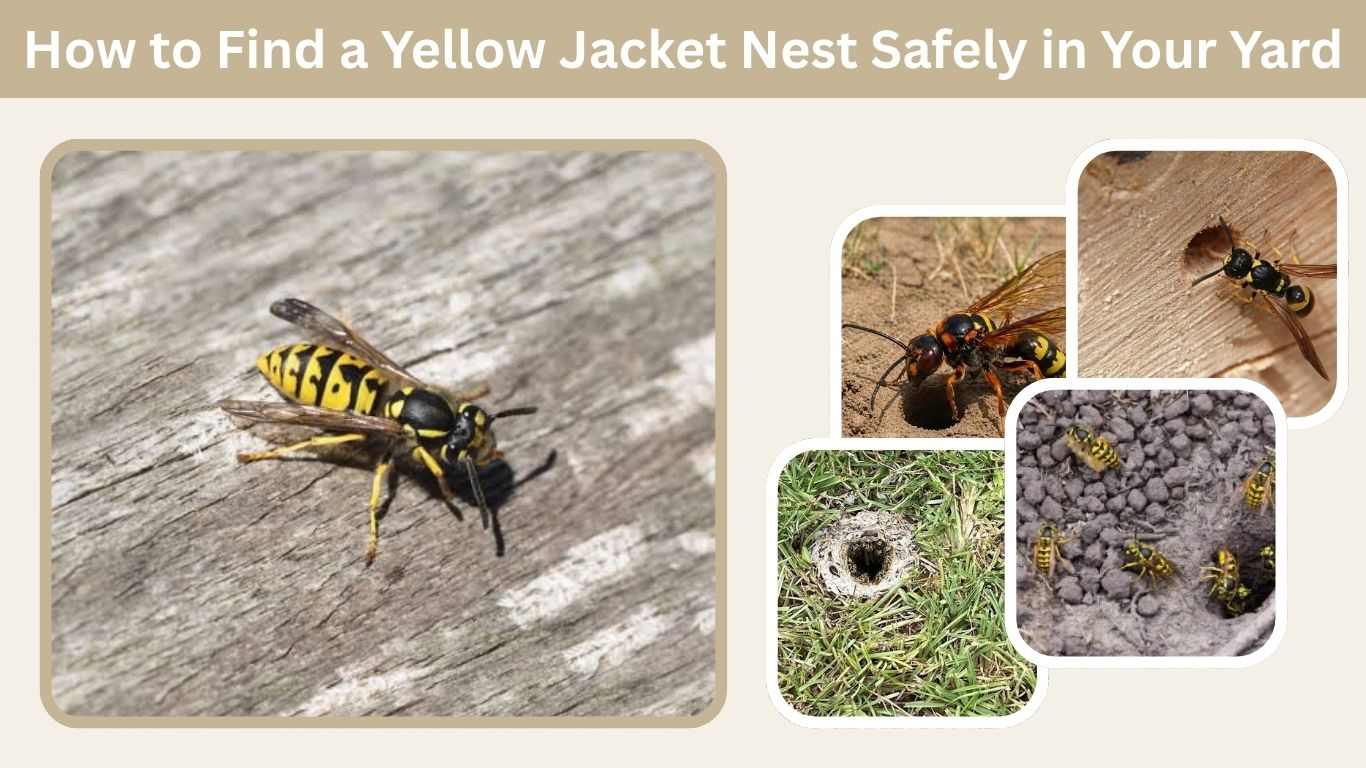
Finding a yellow jacket nest requires patience and careful observation—not digging, poking holes, or approaching active wasps. These defensive social wasps commonly establish colonies underground, inside wall cavities, beneath structures, or in other protected spaces. The visible hole may be small even when a large paper nest lies beyond it. This guide explains how to follow yellow jacket activity from a safe distance, locate nests in yards and houses, identify common warning signs, and decide when professional help is necessary.
First, Confirm That They Are Yellow Jackets
Before searching for a nest, make sure the insects are likely yellow jackets rather than honey bees, paper wasps, or harmless solitary wasps. Yellow jackets are compact, bee-sized wasps with sharply defined yellow-and-black markings and relatively smooth bodies. Unlike honey bees, they are not densely hairy and do not carry visible pollen on their hind legs.
Yellow jackets commonly fly quickly in and out of a single opening. They may also move from side to side shortly before landing. Paper wasps generally have longer legs and build visible, open-comb nests under eaves, while many yellow jacket nests remain concealed underground or inside enclosed cavities.
How to Find a Yellow Jacket Nest Safely
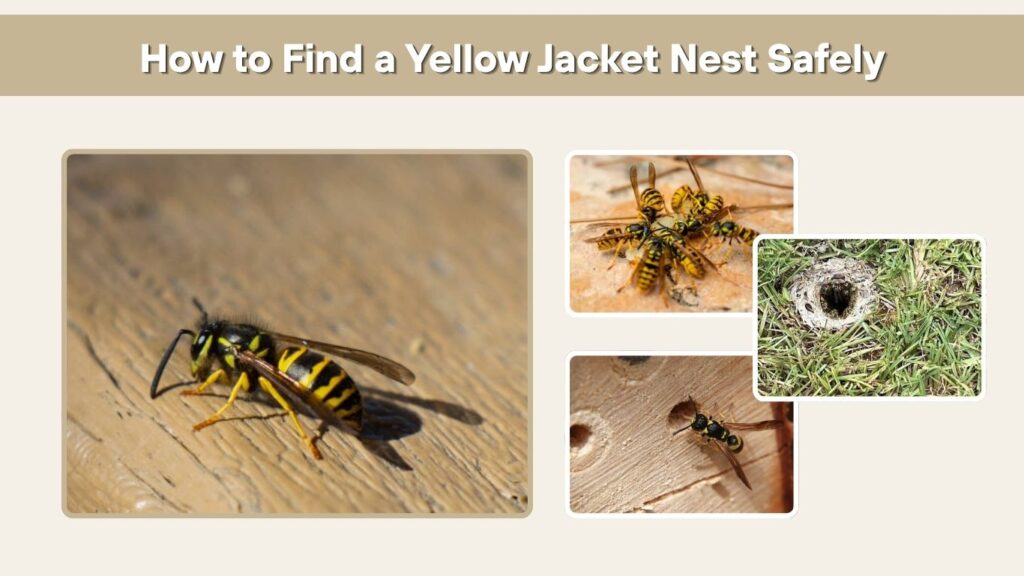
The safest method is to observe the wasps’ repeated flight pattern during daylight while remaining well away from their suspected entrance. University of Minnesota Extension recommends locating the exact entrance from a safe distance during the day.
Follow Their Flight Direction
Stand in an open location where you can see yellow jackets without blocking their route. Watch individual workers after they collect food or fly away from a feeding area. A single wasp may disappear quickly, but repeated observations can reveal a general direction.
Move only a small distance at a time and continue watching. Do not follow them through shrubs, tall grass, or cluttered areas where you could accidentally step near the colony.
Look for:
- Several yellow jackets flying along the same route
- Wasps repeatedly entering and leaving one small opening
- Traffic concentrated near the base of a tree or structure
- Wasps disappearing beneath grass, leaves, siding, or pavement
- Guarding activity around a hole or crack
Seeing yellow jackets around garbage, fruit, pet food, or outdoor meals does not necessarily mean the nest is beside that food source. Some species travel away from the colony to collect insects, meat, and sugary materials.
Mark the Area From a Distance
Once you identify the probable entrance, do not approach it to confirm the nest. Instead, note a nearby landmark such as a tree, fence post, paving stone, or building feature. Keep children, pets, lawn equipment, and foot traffic away from the area.
Never place an object directly beside the opening. Vibrations and movement near a colony can trigger defensive behavior.
How to Find a Yellow Jacket Nest in the Ground
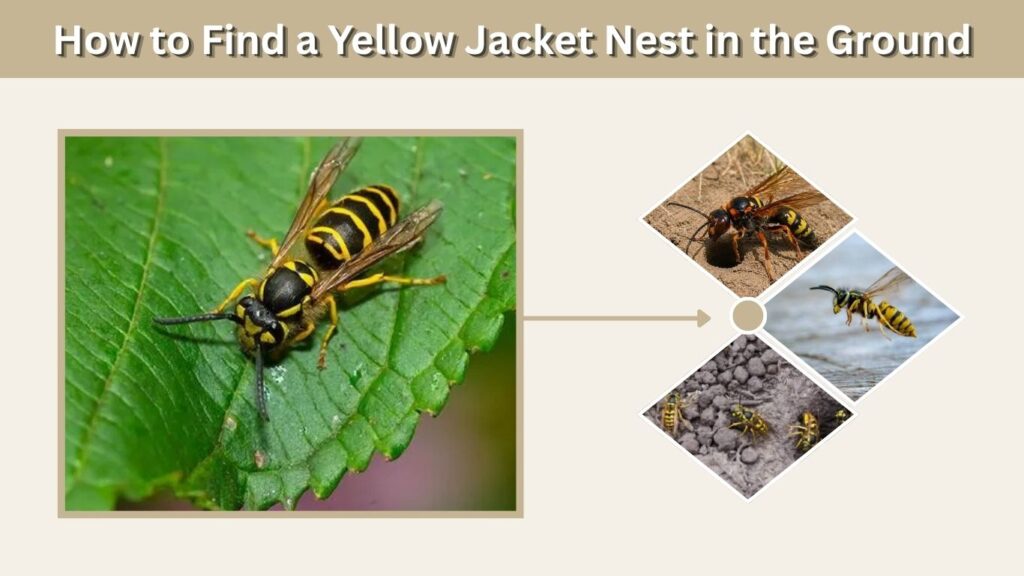
Most people do not see the actual underground paper nest. They see only an entrance leading into a cavity, often an abandoned mammal burrow. Ground-nesting yellow jackets may also use spaces beneath roots, landscaping materials, pavement edges, and other protected locations.
Signs of an Underground Nest
A ground nest may be present when you observe:
- Regular wasp traffic entering one hole
- A small opening surrounded by thin or disturbed vegetation
- Yellow jackets hovering briefly before entering
- Several workers guarding the same location
- Increased activity when the ground is disturbed
- More than one entrance serving the same general area
The entrance may be partly hidden by grass, pine needles, leaves, or ground cover. Do not move vegetation with your hands, feet, sticks, rakes, or power equipment.
Areas to Observe in Your Yard
| Yard location | What to watch for |
| Lawn or pasture | Wasps disappearing into a small soil opening |
| Tree roots or stumps | Repeated traffic into a hollow or root cavity |
| Rock or timber borders | Activity entering gaps beneath materials |
| Sheds and decks | Wasps flying beneath the floor or foundation |
| Compost and wood piles | Traffic into protected internal spaces |
| Pavement edges | Wasps entering cracks beside concrete |
| Dense ivy or shrubs | Workers vanishing into one concealed point |
Avoid mowing, trimming, digging, or using a leaf blower near suspected activity. Ground vibration can disturb a concealed colony.
How to Find a Yellow Jacket Nest in a House
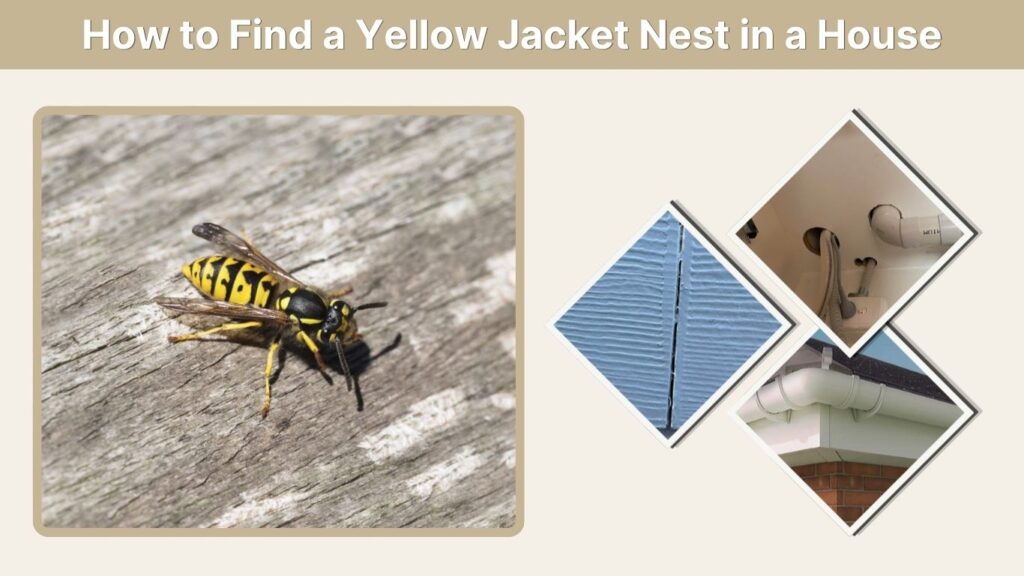
Some yellow jacket species establish colonies in wall voids, attics, crawlspaces, ceilings, and other enclosed sections of buildings. The insects usually reach the colony through an exterior gap, while the nest itself may be several feet away from the visible entrance.
Inspect the Exterior From a Safe Position
Observe the outside of the building and look for repeated traffic around:
- Gaps beneath siding
- Openings around pipes and cables
- Soffits and roof edges
- Cracks beside window or door frames
- Foundation vents
- Damaged fascia boards
- Gaps beneath decks or porches
- Holes where building materials meet
Watch one area for several minutes. A true nest entrance normally shows repeated incoming and outgoing traffic rather than one occasional wasp.
Do not climb a ladder or stand directly beneath suspected activity. Viewing from the ground with binoculars or a camera zoom is safer.
Signs the Nest May Be Inside a Wall
A concealed colony may produce repeated buzzing or scratching sounds from one part of a wall or ceiling. You may also notice yellow jackets repeatedly appearing inside the same room, particularly near windows or light sources.
Indoor yellow jackets do not always prove that an active nest is inside the house. Queens may occasionally enter buildings while seeking protected overwintering sites. However, multiple workers appearing repeatedly during the active season can indicate a nest within the structure.
Do not seal the outside entrance of an active wall nest. Trapped yellow jackets may search for another exit and potentially move farther into the building. Oregon State University Extension recommends having nests in structural cavities handled by a pest-control professional.
What Not to Do While Searching
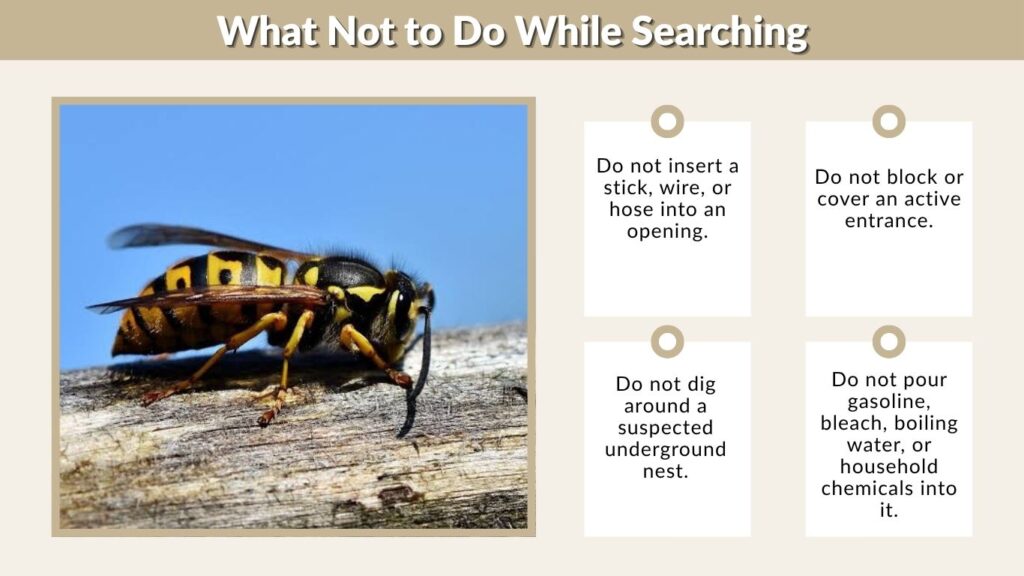
Searching carelessly can expose you and other people to multiple stings. Yellow jackets defend the colony rather than simply flying away when the nest is disturbed.
Avoid these actions:
- Do not insert a stick, wire, or hose into an opening.
- Do not dig around a suspected underground nest.
- Do not block or cover an active entrance.
- Do not pour gasoline, bleach, boiling water, or household chemicals into it.
- Do not burn or flood the nest.
- Do not stand directly in the wasps’ flight path.
- Do not operate mowers or trimmers near the entrance.
- Do not attempt removal when you cannot clearly identify every entrance.
Household chemicals and unapproved pesticide methods can injure people, pets, wildlife, and plants. Any pesticide use must follow its label, and treatment around buildings requires particular care to avoid indoor exposure.
When to Call a Pest-Control Professional
Professional help is the safest choice when the colony is inside a wall, attic, ceiling, crawlspace, or other structural cavity. It is also appropriate when the nest is near a doorway, children’s play area, pet enclosure, public walkway, or frequently used section of the yard.
Do not attempt close inspection when:
- Anyone nearby has a known insect-sting allergy.
- The colony has more than one entrance.
- Yellow jackets are entering occupied rooms.
- The entrance requires climbing to reach.
- The nest is beneath concrete or inside a structure.
- You have already been attacked near the location.
- You cannot create a safe exclusion zone.
People with serious venom allergies can experience life-threatening reactions following a sting, making nest avoidance especially important.
FAQs
What does a yellow jacket nest entrance look like?
A ground entrance usually looks like a small hole in soil, grass, or plant debris. The strongest identifying sign is repeated yellow jacket traffic rather than the hole’s shape. Workers may fly directly inside, briefly hover nearby, or guard the opening.
How far underground is a yellow jacket nest?
Depth varies because many colonies occupy existing animal burrows and natural cavities. The visible entrance may lead through a tunnel before reaching the paper nest. You cannot safely estimate its size or depth by inserting tools or digging around the opening.
What time is best for finding a yellow jacket nest?
Observe suspected flight paths during daylight, when workers are actively traveling between the colony and food sources. Remain at a safe distance and avoid standing in their route. Do not approach the entrance simply because activity appears lower later in the day.
Why are yellow jackets entering my house?
They may be reaching an active colony through an exterior gap, accidentally entering through an open door, or moving toward indoor light after emerging from a wall cavity. Repeated appearances in one room may justify a professional structural inspection.
Should I cover a yellow jacket nest entrance after finding it?
No. Blocking an active ground or wall entrance may not eliminate the colony and can cause the wasps to search for another exit. This is especially dangerous in buildings because they may enter occupied rooms through walls or ceilings.