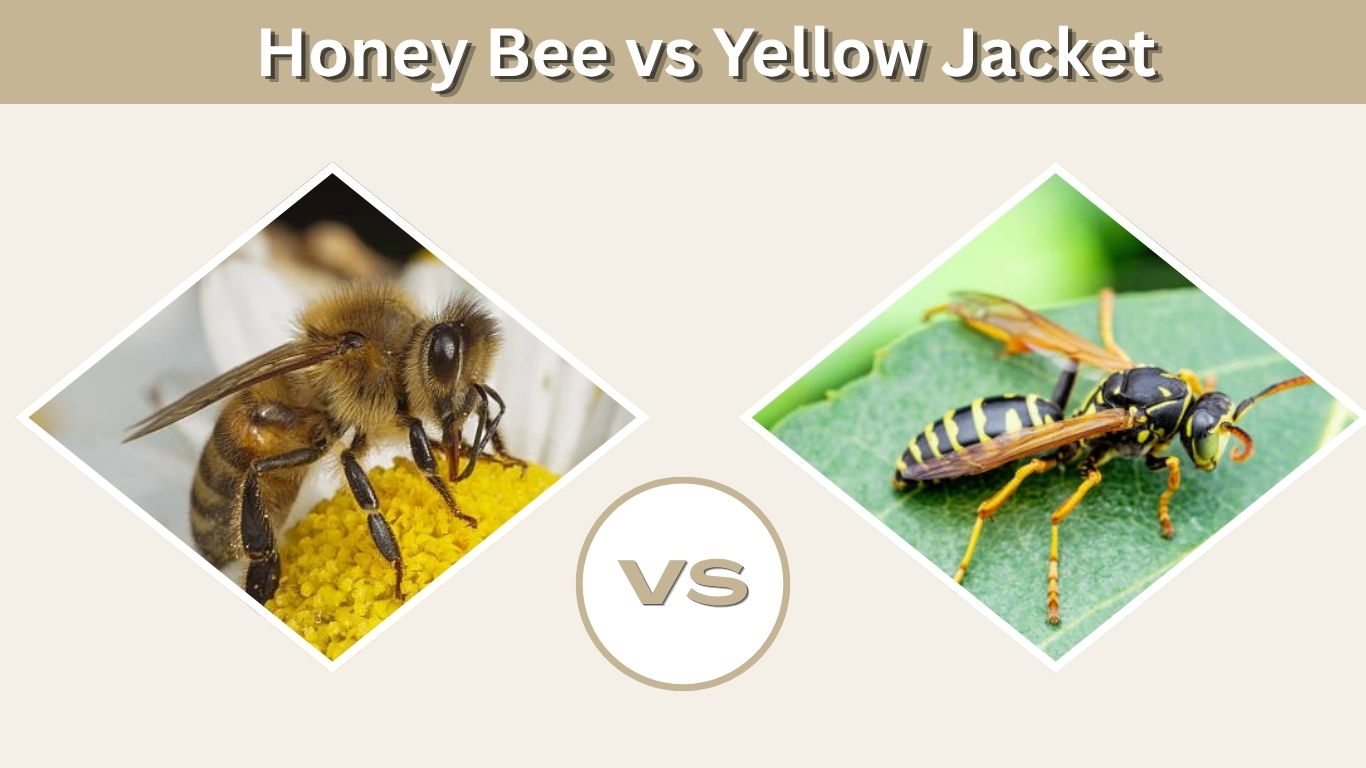
Honey bees and yellow jackets are similar in size, but they are different insects with distinct appearances, diets, nests, and stinging behaviors. A honey bee is usually fuzzy and golden-brown, while a yellow jacket has a smooth, brightly marked black-and-yellow body. Honey bees primarily collect pollen and nectar; yellow jackets hunt insects and scavenge around human food. Learning these differences can help you protect pollinators while responding safely to potentially defensive wasps.
Honey Bee vs Yellow Jacket: Quick Comparison
Honey bees are true bees, while yellow jackets are social wasps. Both live in colonies and can sting to defend themselves or their nests, but their body structures and daily behavior make them fairly easy to separate once you know what to observe.
| Feature | Honey bee | Yellow jacket |
| Insect type | Bee | Social wasp |
| Body texture | Fuzzy and hairy | Smooth and shiny |
| Main colors | Golden-brown, amber and black | Bright yellow and black |
| Body shape | Rounded and relatively thick | Compact with a defined waist |
| Food | Nectar and pollen | Insects, meat, sweets and other foods |
| Pollen baskets | Present on worker hind legs | Absent |
| Stinging ability | Worker usually stings a mammal once | Can sting repeatedly |
| Nest material | Wax comb | Paper-like comb |
| Common nest location | Hive, tree cavity or wall void | Ground burrow, wall void or aerial cavity |
How to Identify a Honey Bee and Yellow Jacket
The easiest identification method is to examine body texture, color, shape, legs, and feeding behavior. Avoid capturing or handling an unidentified insect merely to inspect it.
Honey Bee Identification
A worker honey bee has a rounded, hairy body covered with fine branched hairs that help collect pollen. Its colors are generally muted shades of brown, amber, gold and black rather than vivid lemon yellow. The abdomen may appear striped, but the bands usually have softer edges than those of a yellow jacket.
Look for these characteristics:
- A fuzzy thorax and hairy abdomen
- Golden-brown or amber coloring
- A relatively rounded body
- Thick hind legs
- Yellow or orange pollen pellets on the hind legs
- Frequent visits to flowers
Worker honey bees have specialized pollen baskets on their hind legs. A bee returning to its colony may carry a clearly visible clump of pollen, something a yellow jacket cannot do.
Yellow Jacket Identification
Yellow jackets typically measure around 3/8 to 5/8 inch long, making them similar in size to honey bees. Their bodies are hard, smooth and sparsely haired, with sharply defined yellow-and-black lines, spots, triangles or other markings. The exact abdominal pattern varies among species.
Common identification features include:
- A smooth, shiny body
- Bright black-and-yellow markings
- A defined waist between the thorax and abdomen
- No pollen baskets
- Fast, direct flight
- Interest in meat, fruit, garbage and sweet drinks
- Wings that fold narrowly over the abdomen while resting
Honey Bee vs Yellow Jacket Size
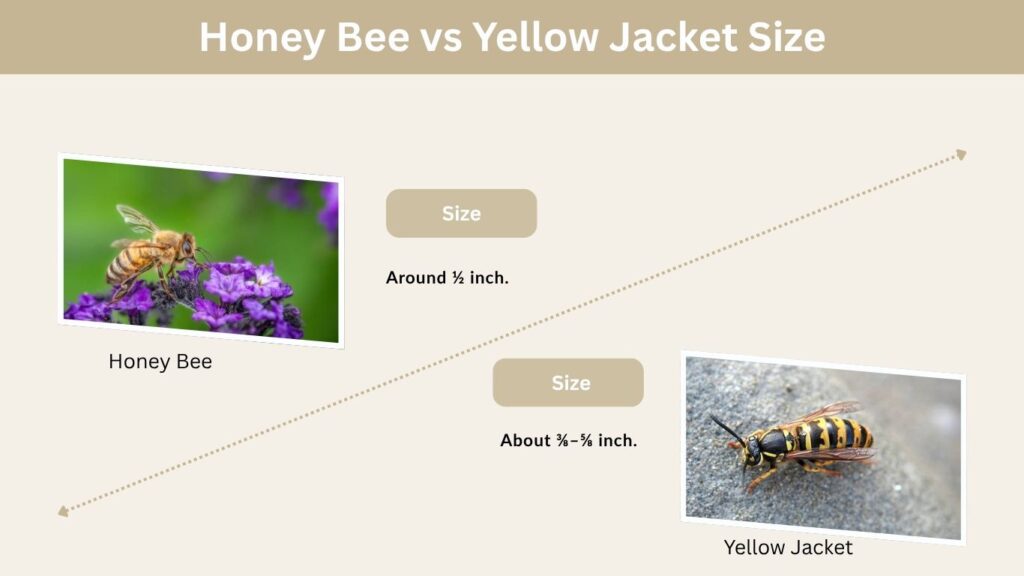
Size alone is not a reliable identification feature because the two insects overlap considerably. Many workers of both groups are close to half an inch long, although individual size varies according to species, caste, nutrition and colony conditions.
| Measurement or shape | Honey bee | Yellow jacket |
| Typical worker length | Around ½ inch | About ⅜–⅝ inch |
| Overall build | Stocky and rounded | Compact and tapered |
| Waist | Less visually obvious because of hair | Smooth and clearly defined |
| Legs | Hairy; hind legs adapted for pollen | Smooth, without pollen baskets |
| Visual impression | Soft and muted | Sharp and brightly patterned |
When viewing an insect from a safe distance, body texture is more helpful than exact length. A fuzzy individual carrying pollen is probably a honey bee; a smooth individual investigating a soda can or food container is more likely a yellow jacket.
Differences in Diet and Behavior
Honey bees gather nectar and pollen from flowers. Nectar supplies carbohydrates, while pollen provides nutrients used to raise developing bees. This flower-focused feeding behavior makes honey bees important pollinators.
Yellow jackets are predators and scavengers. Adults consume sugary liquids, while workers capture insects and other animal material to feed developing larvae. They may also gather around outdoor meals, fallen fruit, garbage cans and sugary drinks.
Which One Is More Aggressive?
Neither insect normally flies around looking for people to sting. However, social bees and wasps strongly defend their colonies when they detect danger. Yellow jackets are particularly sensitive to nest disturbance and may respond when someone steps near an underground entrance, operates a mower overhead or disturbs a wall cavity.
European honey bees encountered on flowers are generally focused on collecting food. They may sting when stepped on, trapped in clothing or handled. A honey bee colony can also become highly defensive when its nest is threatened. Africanized honey bees cannot be reliably distinguished from European honey bees by appearance alone and may defend colonies over a greater distance.
Honey Bee Nest vs Yellow Jacket Nest
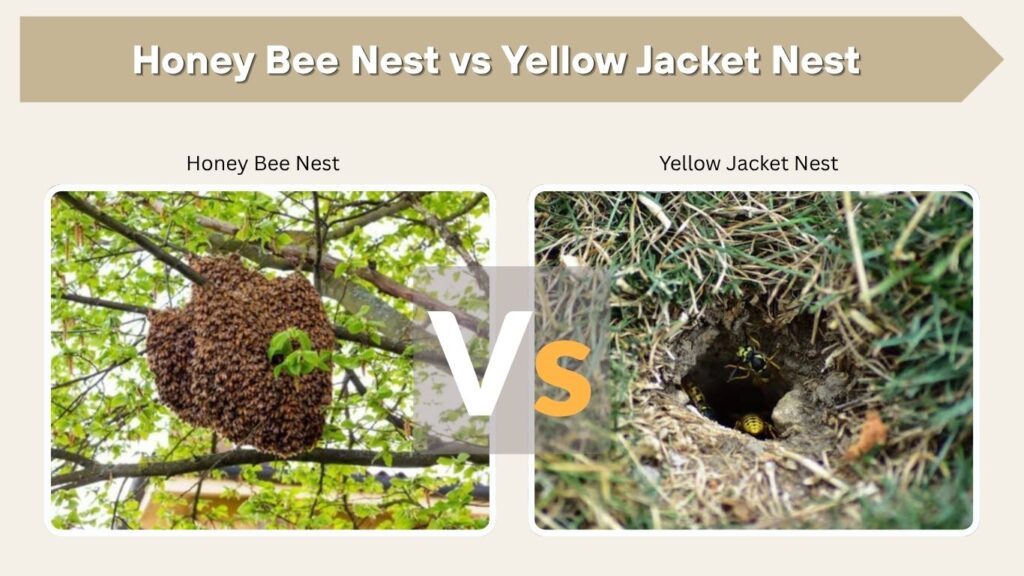
Honey bees construct vertical wax combs containing uniform hexagonal cells. These cells hold developing young, pollen and honey. Wild colonies commonly occupy protected cavities, including hollow trees and spaces inside buildings. Managed colonies live in beekeeper-provided hives.
Yellow jackets build enclosed nests from chewed plant fibers that form a paper-like material. Depending on the species, a nest may be underground, inside a wall or structure, in a tree cavity, or above ground. Only a small entrance may be visible when the nest is hidden underground.
| Nest feature | Honey bee | Yellow jacket |
| Building material | Wax | Paper-like plant fibers |
| Comb appearance | Exposed rows of hexagonal wax cells | Layered paper comb enclosed by an outer covering |
| Stored food | Honey and pollen | Usually no large stored honey reserve |
| Common location | Hive, hollow tree or structural cavity | Ground burrow, wall void, tree cavity or aerial site |
| Reuse | Wax comb may be used repeatedly | Old nests generally are not reused |
| Removal | Contact a beekeeper or bee-removal specialist | Contact a pest-control professional when hazardous |
Never seal an active entrance in a wall. Trapped insects may move farther into the building or find another way out. A colony in a difficult location should be identified before any removal is attempted.
Honey Bee Sting vs Yellow Jacket Sting
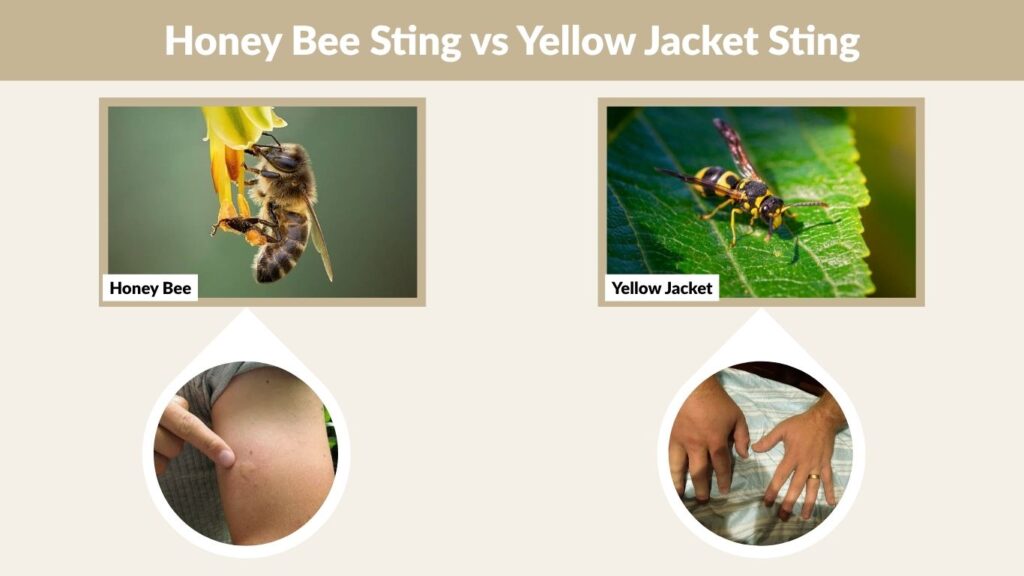
A worker honey bee has a barbed stinger. When it stings the elastic skin of a person or another mammal, the stinger and attached venom apparatus usually remain in the skin, fatally injuring the bee. Removing the stinger promptly limits the time it continues delivering venom.
Yellow jackets have smoother stingers that can be withdrawn and used repeatedly. A disturbed colony can therefore inflict multiple stings from the same wasp as well as stings from numerous workers.
Which Sting Hurts More?
Pain varies according to sting location, number of stings, individual sensitivity and the amount of venom delivered. Either insect can cause immediate burning pain, redness, itching and swelling. The greater practical danger with yellow jackets is their ability to sting repeatedly, particularly when a nest is disturbed.
Seek emergency medical assistance for difficulty breathing, swelling of the lips or throat, widespread hives, faintness or other signs of a severe allergic reaction.
What to Do When You See Them
Do not spray a honey bee merely because it is visiting flowers. Honey bees provide valuable pollination, and a temporary swarm can often be relocated by an experienced beekeeper.
Cover food and drinks during outdoor meals, close garbage containers and check cans or bottles before drinking. Walk away calmly from yellow jackets rather than swatting them. Keep people and pets away from any repeated flight activity leading into the ground or a building.
A nest beside a doorway, playground or frequently used path requires professional evaluation. Correct identification matters because honey bee colonies may be relocated, while hazardous yellow jacket nests usually require a different management approach.
FAQs
Are Yellow Jackets Bees?
No. Yellow jackets are social wasps belonging mainly to the genera Vespula and Dolichovespula. They are related to bees but are not honey bees. Their smooth bodies, predatory diet and paper nests distinguish them from fuzzy, pollen-collecting honey bees.
Can Yellow Jackets Make Honey?
Yellow jackets consume sugary foods and plant nectar, but they do not produce and store substantial honey reserves like honey bees. Honey bees convert nectar into honey and store it inside wax cells as food for the colony.
Do Honey Bees and Yellow Jackets Fight?
Yellow jackets may attempt to enter weakened honey bee colonies to take honey, developing brood or dead insects. Healthy colonies can defend their entrances, but sustained wasp pressure may create problems for colonies already weakened by disease, parasites or food shortages.
Can Honey Bees Sting More Than Once?
A worker honey bee generally leaves its barbed stinger in human skin and dies afterward. However, this one-sting rule does not apply to every target or every bee caste. Honey bee queens have different stingers, and male honey bees cannot sting.
How Can I Quickly Tell Them Apart?
Look at texture and behavior. A fuzzy, brownish insect gathering pollen from flowers is likely a honey bee. A smooth, vividly yellow-and-black insect scavenging around meat, garbage, fruit or sweet drinks is more likely a yellow jacket.