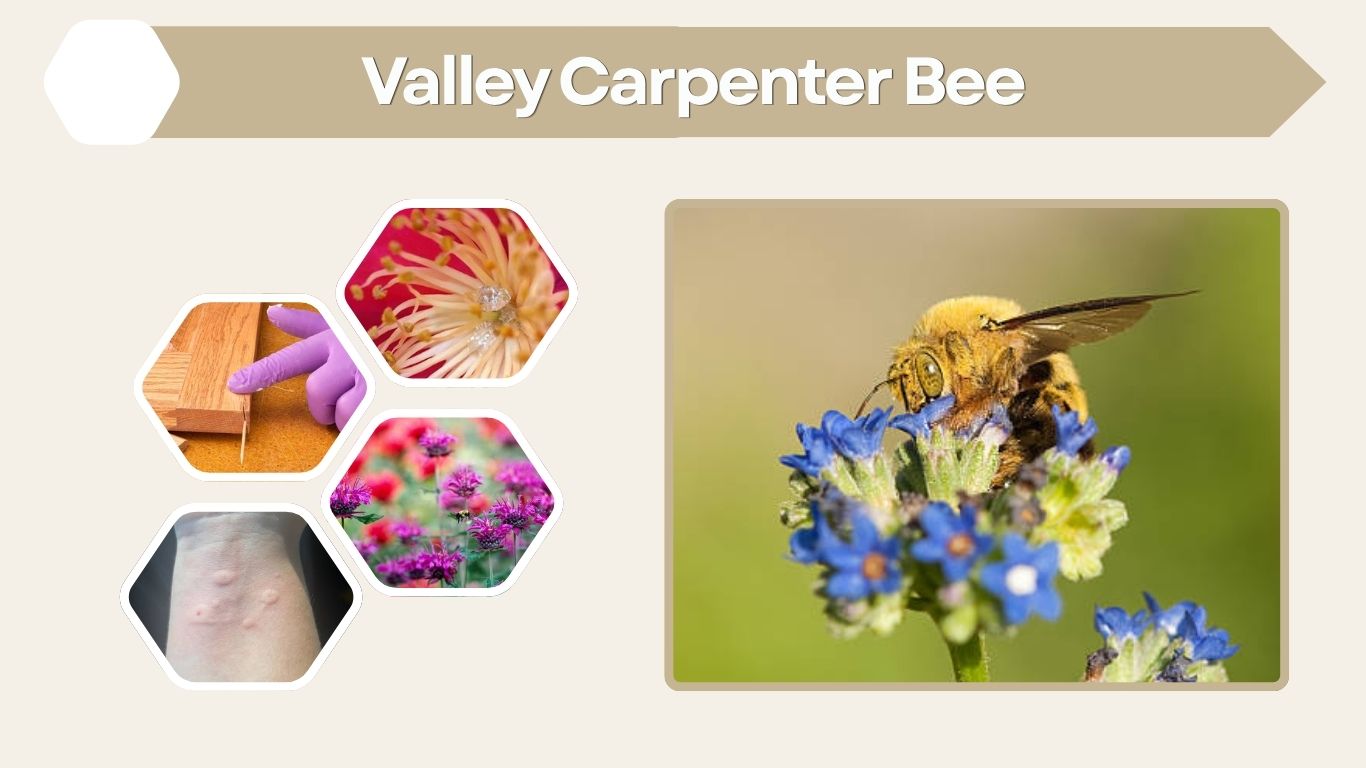
The valley carpenter bee is one of the largest and most distinctive bees found in the southwestern United States. Females are large and glossy black, while males look dramatically different with fuzzy golden bodies and striking green eyes. These native bees are important pollinators, although females may occasionally tunnel into wooden structures to build nests. From their unusual male-vs-female appearance to their sting risk, size, range, nesting habits, and life cycle, valley carpenter bees are fascinating insects worth understanding.
Valley Carpenter Bee Identification
The valley carpenter bee is a very large, heavy-bodied bee that may initially be mistaken for a bumblebee. However, its appearance—especially the smooth abdomen of females and extraordinary golden coloration of males—usually makes identification easier. California sources describe it as the largest of the state’s carpenter bees, reaching roughly an inch in length.
Scientific Name and Classification
The species is currently referred to as Xylocopa sonorina by recent University of California sources, with Xylocopa varipuncta being the older scientific name still widely used in field guides and online references.
Basic classification includes:
- Common name: Valley carpenter bee
- Scientific name: Xylocopa sonorina
- Former name: Xylocopa varipuncta
- Family: Apidae
- Order: Hymenoptera
- Genus: Xylocopa
- Type: Large carpenter bee
Valley Carpenter Bee Size
Adults are approximately 0.7–1 inch (18–26 mm) long. Their broad bodies and loud, powerful flight can make them appear even larger.
Because of their size, black females are sometimes described as giant black bumblebees. However, their relatively smooth, shiny abdomens distinguish them from the more densely hairy bodies of true bumblebees.
Black Valley Carpenter Bee
A large, completely black carpenter bee in California or other parts of the Southwest may be a female valley carpenter bee. Females have glossy black bodies, dark hairs, and wings that may show metallic or iridescent reflections in sunlight.
Male vs Female Valley Carpenter Bee
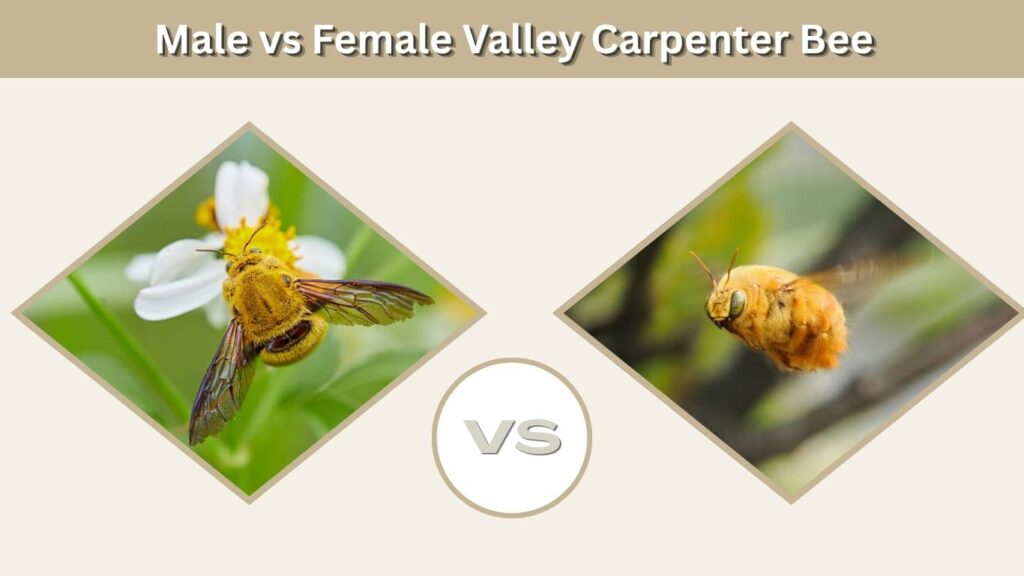
Few North American bees show such a dramatic difference between the sexes. A person unfamiliar with the species could easily assume the golden male and black female belong to completely different species. This strong sexual dimorphism is one of the valley carpenter bee’s most recognizable characteristics.
Male Valley Carpenter Bee
Male valley carpenter bees are sometimes nicknamed “teddy bear bees” because their bodies are covered with thick golden or yellowish-brown hairs.
Their most recognizable characteristics are their unusually large green eyes and fuzzy golden appearance. Male carpenter bees may hover around flowers, shrubs, people, or territories while searching for females.
Despite their intimidating size and hovering behavior, males cannot sting because they do not possess functional stingers.
Female Valley Carpenter Bee
Females are almost the opposite in appearance. Instead of golden coloration, they are large, glossy black bees with dark hairs and metallic-looking wings.
Females perform the wood excavation required for nesting. Using strong mandibles, they create tunnels in suitable wood and construct individual chambers for their offspring.
Unlike males, females possess stingers.
Quick Male vs Female Identification
- Male: Golden or yellow-brown and very fuzzy
- Male eyes: Large and green
- Male sting: Cannot sting
- Female: Glossy black
- Female wings: Dark with metallic reflections
- Female sting: Can sting
- Female behavior: Excavates nesting tunnels
Do Valley Carpenter Bees Sting?
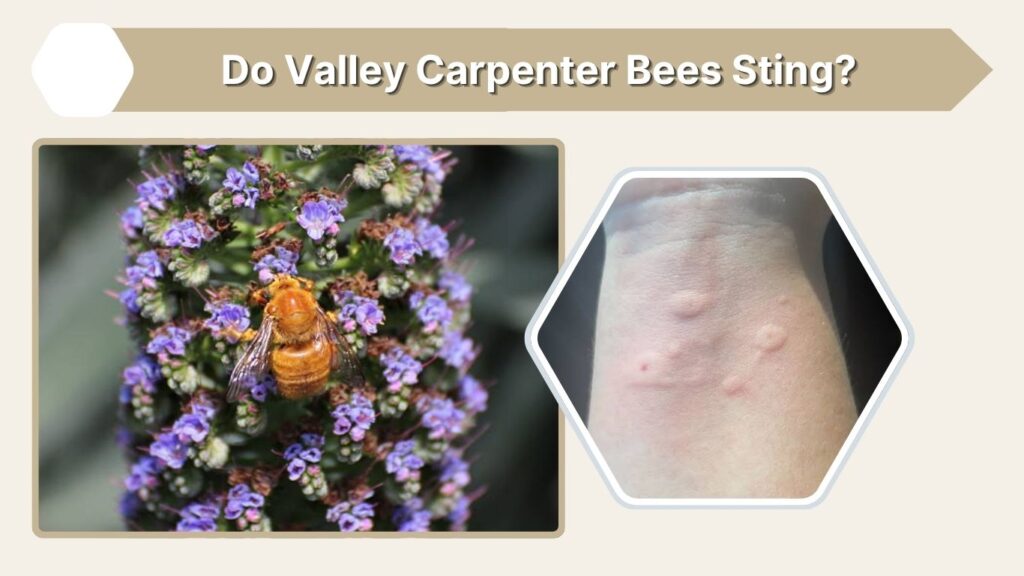
The large size of valley carpenter bees often makes people nervous, particularly when males hover nearby. In reality, these bees are generally much less dangerous than their appearance suggests. Carpenter bees normally focus on flowers, mating, and nesting rather than attacking humans.
Valley Carpenter Bee Sting
Female valley carpenter bees can sting, but they generally do so only if handled, trapped, stepped on, or seriously threatened. University of California guidance notes that male carpenter bees cannot sting and females typically sting only when provoked or roughly handled.
Are Valley Carpenter Bees Dangerous?
For most people, valley carpenter bees are not considered particularly dangerous.
A male may fly toward someone who enters his territory, but he cannot sting. A female can defend herself, yet she normally prefers escaping rather than attacking.
Their greater practical concern around homes is their ability to excavate wood.
Valley Carpenter Bee Habitat and Range
Valley carpenter bees favor warm regions where flowering plants and suitable nesting wood are available. They occur naturally in parts of the southwestern United States and Mexico and are particularly well known in California. Records also occur in states including Arizona, Nevada, New Mexico, Texas, and Utah.
Valley Carpenter Bee in California
The species is especially familiar in California, including the Central Valley and southern parts of the state. It can occur in gardens, farms, parks, suburban neighborhoods, woodland edges, and other places containing flowers and suitable wood.
California supports multiple carpenter bee species, but the valley carpenter bee is especially recognizable because females are black while males are golden and green-eyed.
Valley Carpenter Bee in Arizona
The species also occurs in Arizona. Adults may visit flowering desert and ornamental plants while using suitable dead wood or exposed structural wood for nesting.
Valley Carpenter Bee Diet and Pollination
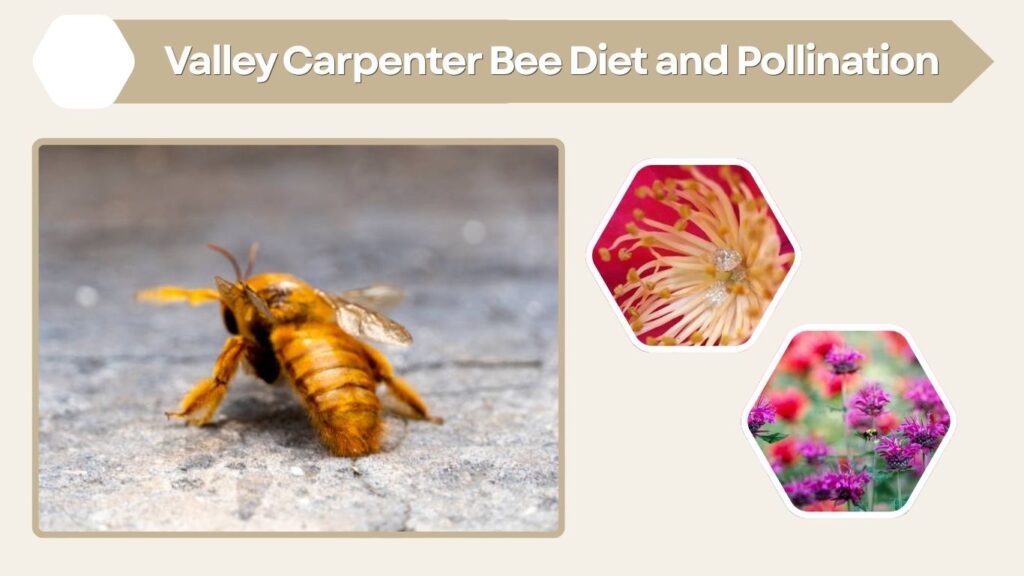
Valley carpenter bees do not eat wood. Their tunneling behavior is purely related to nest construction. Adults depend primarily on flowers for nutrition, making them useful native pollinators in gardens, natural ecosystems, and agricultural landscapes.
What Do Valley Carpenter Bees Eat?
Adults mainly feed on nectar, while females collect both nectar and pollen for their developing offspring.
Females combine pollen and nectar into a concentrated food supply inside each brood chamber. An egg is placed with this provision so the developing larva has sufficient food.
Nectar Robbing
Carpenter bees sometimes obtain nectar by cutting or piercing the base of a tubular flower rather than entering through the normal opening. This behavior is known as nectar robbing.
However, they also legitimately visit and pollinate many flowers.
Why Valley Carpenter Bees Are Beneficial
Their benefits include:
- Pollinating native wildflowers
- Visiting garden plants
- Transporting pollen between flowers
- Supporting plant reproduction
- Providing food for other wildlife
- Contributing to healthy native pollinator communities
Because of these benefits, removing carpenter bees is unnecessary when their nests are located in dead wood or other places where tunneling causes no structural problem.
Valley Carpenter Bee Nest and Life Cycle
The name “carpenter bee” comes from the female’s ability to excavate wood. Rather than constructing a hive like honey bees, females create tunnels containing several individual brood cells. Carpenter bees frequently prefer unpainted, weathered, or otherwise suitable wood.
Valley Carpenter Bee Nest
A female uses powerful mandibles to bore an entrance into wood. Once inside, she extends the tunnel and divides part of it into brood chambers.
Suitable nesting sites may include:
- Dead tree limbs
- Logs and stumps
- Fence posts
- Wooden beams
- Decks
- Eaves
- Outdoor furniture
- Unpainted structural wood
Each brood chamber receives pollen and nectar before an egg is laid.
Valley Carpenter Bee Life Cycle
The life cycle has four major stages:
Egg → Larva → Pupa → Adult
Females establish or reuse tunnels and provide each brood cell with pollen and nectar. The larvae develop inside their protected chambers before pupating and eventually becoming adults.
New generations can reuse existing galleries, which is why the same wooden area may attract carpenter bees year after year.
Valley Carpenter Bee Lifespan
There is no single reliable number that describes every individual’s lifespan under natural conditions. Adults can use nest tunnels for shelter, and carpenter bees may overwinter in galleries before becoming active again as conditions warm. Their complete lifespan therefore depends on sex, emergence timing, climate, predators, and other environmental factors.
Valley Carpenter Bee Damage and Control
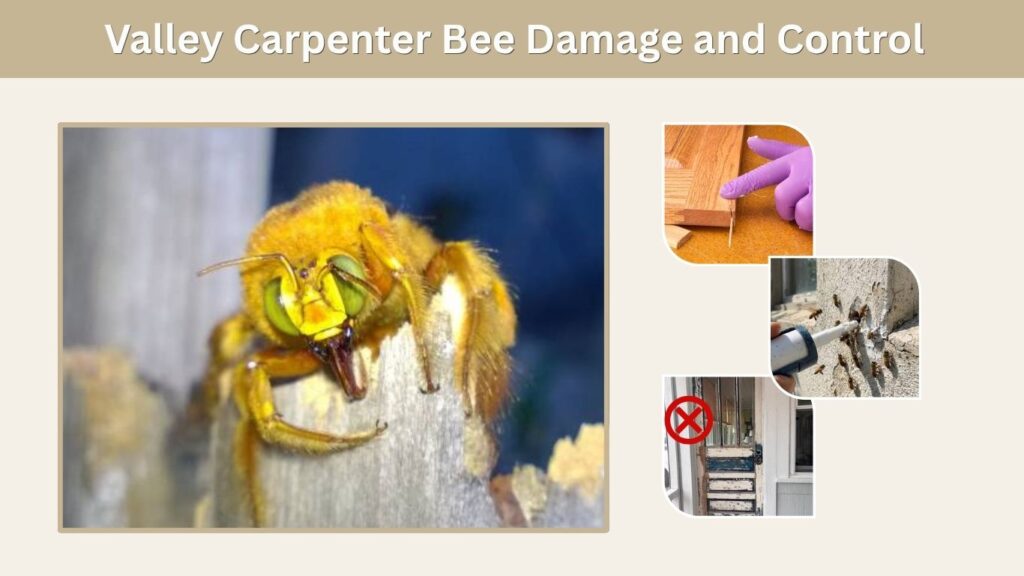
Carpenter bees are beneficial insects, so control should usually focus on protecting valuable wooden structures rather than eliminating bees throughout a property. Problems occur when females repeatedly excavate structural lumber or reuse old galleries for multiple generations.
Signs of Valley Carpenter Bee Damage
Look for:
- Nearly round holes in wooden surfaces
- Fresh wood particles beneath entrances
- Bees repeatedly entering the same hole
- Dark or yellowish staining around nest entrances
- Multiple tunnels in exposed wood
- Woodpecker damage around established galleries
How to Prevent Valley Carpenter Bees
The best long-term approach is making structural wood less attractive.
- Paint or varnish exposed wood.
- Repair cracks and damaged wooden surfaces.
- Replace severely weakened boards.
- Maintain exterior finishes.
- Seal inactive nesting holes after bees have left.
- Reduce exposed weathered wood around buildings.
UC Integrated Pest Management emphasizes prevention, regular painting or varnishing, and sealing abandoned holes to reduce future nesting.
FAQs
1. Is a valley carpenter bee black or golden?
Both colors are correct. Females are glossy black, while males are fuzzy golden or yellow-brown with green eyes.
2. Can a male valley carpenter bee sting?
No. Male valley carpenter bees do not have functional stingers, even though they may hover close to people.
3. How big is a valley carpenter bee?
Adults generally measure around 18–26 mm, or approximately 0.7–1 inch long, making them among the largest bees in California.
4. What is the scientific name of the valley carpenter bee?
Recent University of California sources use Xylocopa sonorina. The species was formerly—and is still commonly—listed as Xylocopa varipuncta.
5. Should I kill valley carpenter bees?
Usually not. They are valuable native pollinators. Management is most appropriate when repeated tunneling threatens structural wood; otherwise, allowing them to nest in natural dead wood can benefit local ecosystems.