
The African honey bee is a highly adaptable honey bee best known for strong colony defense, frequent swarming, and success in warm climates. The East African lowland honey bee, Apis mellifera scutellata, is native to sub-Saharan Africa and contributed to the Africanized honey bee populations now found across much of tropical America and parts of the southern United States. Although often called “killer bees,” their venom is not unusually powerful. The main danger comes from large numbers of bees responding together when a nest is disturbed.
What Is an African Honey Bee?
African honey bees are members of the same honey bee species, Apis mellifera, that includes many European honey bee subspecies. The term can be confusing because Africa contains several native honey bee forms. In discussions about “killer bees,” African honey bee usually refers to A. m. scutellata or to African-derived bees that developed after these bees were introduced into the Americas.
Scientific Name and Origin
The East African lowland or savanna honey bee is scientifically known as Apis mellifera scutellata. It naturally occurs in parts of sub-Saharan Africa and is adapted to warm environments where rainfall, flowering plants, predators, and food availability can change considerably.
African bees were taken to Brazil during the 1950s as researchers attempted to improve honey production in tropical conditions. Some escaped in 1957 and interbred with European-derived honey bees already present in the Americas. Their descendants became widely known as Africanized honey bees.
African Honey Bee Identification
African-derived and European honey bees are extremely similar visually. Reliable identification often requires measurements or genetic testing rather than simply looking at an individual bee.
Common honey bee features include:
- Brown, golden-brown, or dark coloration
- Alternating bands across the abdomen
- Hair-covered thorax
- Two pairs of transparent wings
- Large compound eyes
- Pollen baskets on the hind legs of workers
- Workers measuring roughly around half an inch long
African-derived workers may average slightly smaller than some European honey bees, but size alone is not a dependable identification method.
Where Do African Honey Bees Live?

True African honey bee populations originated in Africa, while Africanized descendants have spread far beyond their ancestral range. Their ability to reproduce rapidly, occupy small nesting spaces, and function well in tropical and subtropical climates allowed them to expand through South America, Central America, Mexico, and parts of the southern United States. Cold climates generally limit their establishment farther north.
African Honey Bee Habitat
African honey bees are adaptable and may use many types of habitats, especially where flowers and suitable nest sites are available.
They may occur in:
- Savannas and grasslands
- Tropical and subtropical regions
- Forest edges
- Agricultural landscapes
- Urban and suburban areas
- Tree cavities
- Rock openings
- Abandoned structures
- Wall voids and utility boxes
- Underground or exposed nesting locations
African-derived bees are generally less selective about nest cavities than European-derived colonies and can occupy smaller spaces.
African Honey Bees in the United States and Texas
Africanized honey bees reached the United States naturally through southern Texas in 1990. They subsequently became established across much of the Southwest and have also been documented in southern states including Florida. Texas A&M notes that Africanized bees spread widely through Texas and interbred with feral European-derived honey bees.
They are particularly successful in warmer regions. Temperature appears to be one factor limiting their expansion into colder areas.
African Honey Bee vs. European Honey Bee
African-derived and European-derived honey bees share the same basic colony organization, produce honey, collect pollen, pollinate plants, and possess similar-looking workers. The major differences are behavioral rather than visual. African-derived colonies generally react more quickly to disturbances, mobilize more defenders, swarm more frequently, and accept a wider variety of nesting locations.
Key Differences Between African and European Honey Bees
- Appearance: Extremely similar and difficult to separate visually
- Colony defense: African-derived colonies usually respond more strongly
- Guard bees: More workers may participate in defensive attacks
- Pursuit: Africanized bees may follow a perceived threat farther
- Swarming: African bees can swarm much more frequently
- Absconding: Colonies are more likely to abandon unsuitable nests
- Nesting: African-derived bees often accept smaller cavities
- Venom: Their venom is not substantially more potent
- Honey: Both types can produce and store honey
- Pollination: Both are effective flower visitors and pollinators
UF/IFAS reports that a disturbed Africanized colony may mobilize hundreds of workers compared with far fewer defenders from a typical managed European-derived colony.
Can You Tell Them Apart by Size?
Usually not in the field. African-derived bees may be slightly smaller on average, but there is considerable overlap. Looking at one bee and deciding whether it is Africanized based on color or size is unreliable.
Even experienced observers may require laboratory measurements or genetic analysis to confirm Africanization.
Behavior, Nests, and Swarming
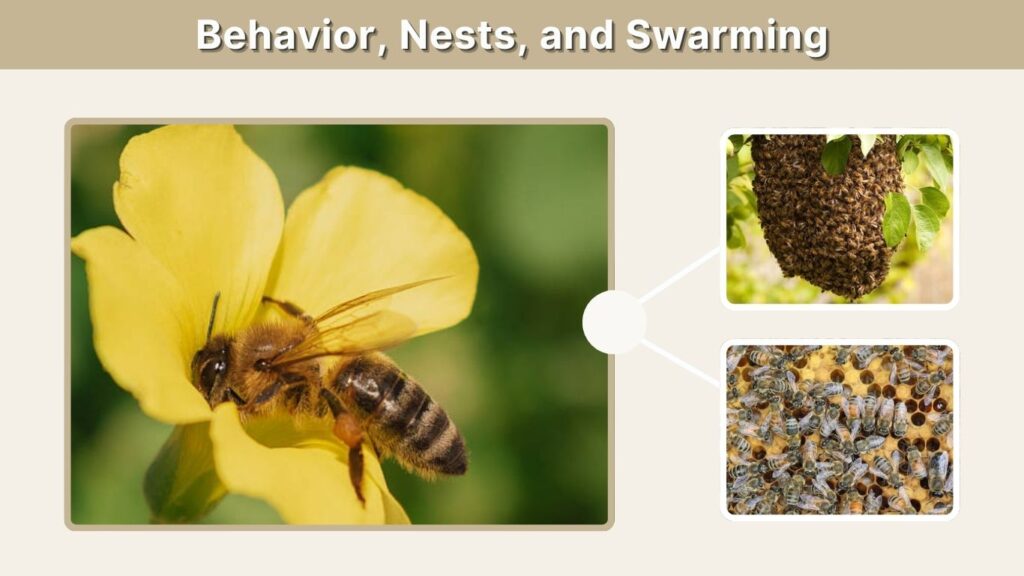
African honey bees are social insects living in organized colonies consisting of a queen, female workers, and male drones. Much of their reputation comes from colony-level behavior rather than anything unusual about a single bee. Their rapid reproduction, frequent swarming, flexible nest-site selection, and strong nest defense helped African-derived populations spread quickly through tropical and subtropical regions of the Americas.
African Honey Bee Nests and Swarms
African-derived colonies can establish nests in places that European honey bees might reject. Small cavities, utility structures, abandoned containers, trees, and even exposed locations may be used.
Swarming is different from an attack. A swarm occurs when part of a colony leaves with a queen to establish a new nest. Bees in a temporary swarm are generally much less defensive because they do not yet have brood and stored food to protect. Once they establish comb and resources, defensive behavior can increase.
African Honey Bee Queen and Colony
A functioning colony normally contains one reproductive queen, thousands of female workers, and drones during appropriate seasons.
The queen lays eggs, while workers clean cells, feed larvae, produce wax, defend the nest, regulate temperature, and eventually forage for food. Drones mainly exist to mate with queens.
African-derived colonies reproduce at the colony level frequently, which helps explain their rapid spread into new areas.
What Do African Honey Bees Eat?

Like other honey bees, African honey bees depend strongly on flowering plants. Workers collect nectar for carbohydrates and pollen for protein and other nutrients. Water and plant resins may also be gathered. This foraging behavior makes African-derived bees ecologically important pollinators even in regions where highly defensive colonies can present challenges for people and livestock.
Nectar and Pollen
Worker bees visit flowers and carry nectar back in a honey stomach. Pollen is transported on structures on their hind legs commonly called pollen baskets.
Back at the nest, nectar is processed and concentrated to create honey. Pollen supports brood development and provides important nutrients to the colony.
Do African Honey Bees Make Honey?
Yes. African honey bees and Africanized honey bees make honey.
Their colonies collect nectar, convert it into honey, and store it in wax comb just as European-derived honey bees do. African-derived bees are also effective pollinators. Their defensive behavior affects how colonies must be managed, but it does not mean they are incapable of producing usable honey.
African Honey Bee Stings and Danger
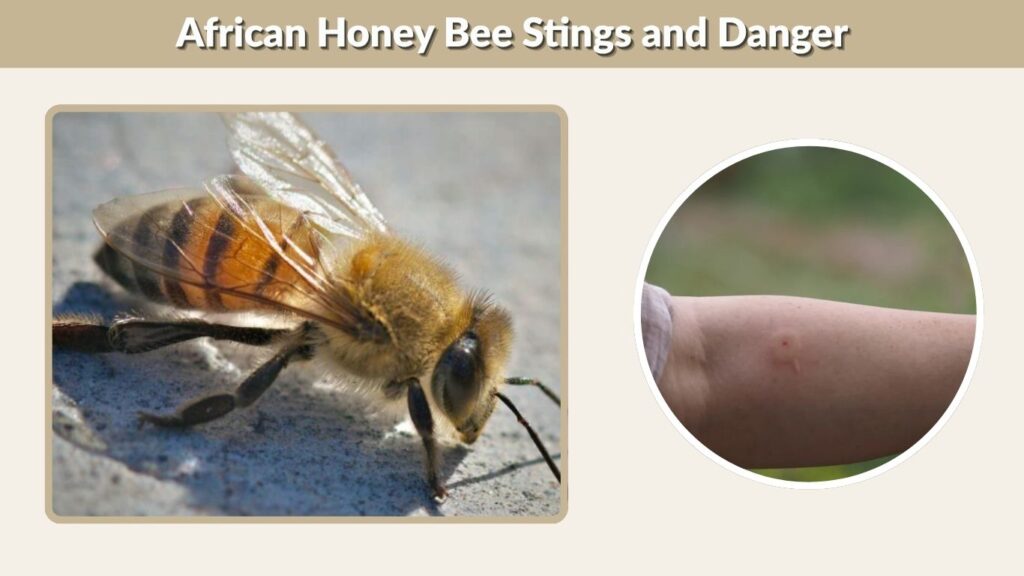
An individual African honey bee sting is not exceptionally venomous compared with a European honey bee sting. The greater danger occurs when a colony is disturbed and many workers respond simultaneously. African-derived colonies have a lower threshold for defensive responses and may continue pursuing a threat after it has moved away from the immediate nest area.
Why Are They Called Killer Bees?
The nickname “killer bee” developed because some defensive encounters have resulted in hundreds of stings and, in rare cases, human or animal deaths.
The name can be misleading. These bees do not hunt humans. They defend their nest intensely when they perceive nearby activity as a threat. Their venom is not substantially stronger; receiving many stings is what creates much of the additional danger.
What Should You Do If Africanized Bees Attack?
If a defensive colony begins attacking:
- Run away from the area immediately.
- Cover your nose, mouth, eyes, and face while moving.
- Enter an enclosed building or vehicle as quickly as possible.
- Do not stop to swat at the bees.
- Do not jump into water.
- Do not hide in bushes.
- Remove embedded stingers promptly once you are safe.
- Call emergency services if someone is being heavily attacked.
- Seek urgent medical care for breathing difficulty or signs of a severe allergic reaction.
Do African Honey Bees Die After They Sting?
Yes. A female worker honey bee normally leaves its barbed stinger in human skin and dies afterward. This applies to both African-derived and European-derived worker honey bees.
The difference is that a defensive Africanized colony may send many more workers to sting at the same time.
FAQs
African honey bees are often misunderstood because terms such as African bee, Africanized bee, honey bee, and killer bee are sometimes used interchangeably. The following answers address several of the most common questions about their biology, honey production, behavior, and relationship with European honey bees while keeping the distinctions between these terms clear.
Are African Honey Bees Aggressive?
It is more accurate to describe them as highly defensive. They are usually not attacking people while simply foraging on flowers. Strong reactions are most likely when a colony or nest is disturbed.
Do African Honey Bees Die After Stinging?
Yes. Female workers normally die after leaving their barbed stinger in human skin, just as European honey bee workers do.
What Is the Scientific Name of the African Honey Bee?
The East African lowland or savanna honey bee commonly associated with Africanization is Apis mellifera scutellata.
Are African Honey Bees an Invasive Species?
African-derived honey bees are nonnative in the Americas. After their introduction to Brazil, they spread rapidly and hybridized with European honey bees across much of Latin America and parts of the southern United States.
What Is the Difference Between Cape and African Honey Bees?
The Cape honey bee (Apis mellifera capensis) and the East African lowland honey bee (A. m. scutellata) are different African honey bee subspecies. Cape honey bees originate primarily from southern South Africa, while A. m. scutellata occupies a much broader savanna-associated range in eastern and southern Africa.