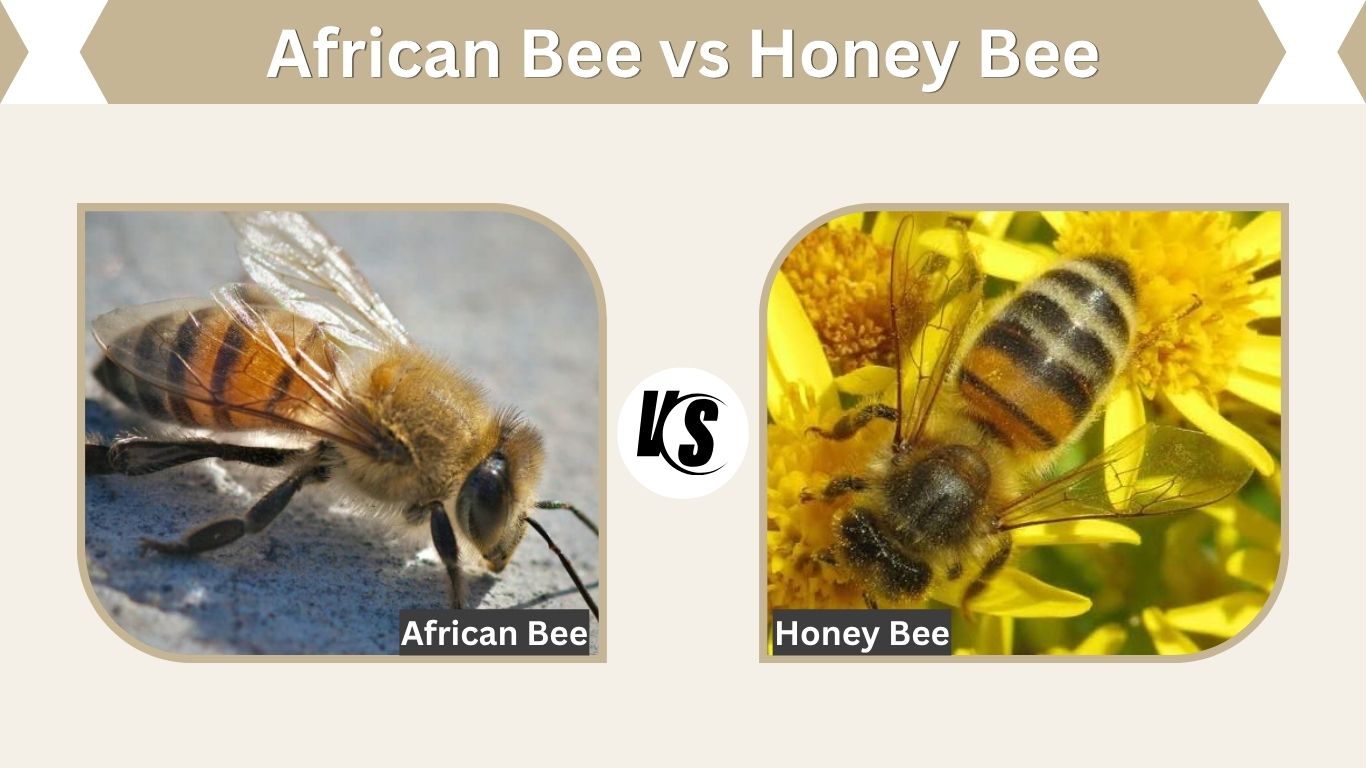
The African bee vs honey bee comparison can be confusing because African bees are themselves honey bees. In most comparisons, “regular honey bee” means the European honey bee commonly managed by beekeepers, while “African bee” usually refers to the African or Africanized honey bee. They look extremely similar but differ considerably in colony defense, swarming frequency, nesting habits, and response to disturbance. This guide explains the main differences between Africanized and European honey bees, including their size, sting, habitat, nests, honey production, and identification.
African Bee vs Honey Bee: Quick Comparison
Africanized and European honey bees belong to the same species, Apis mellifera. The African-derived bees found in the Americas originated largely from Apis mellifera scutellata, which was introduced into Brazil and subsequently hybridized with European honey bee populations. Their biggest differences are behavioral rather than visual, especially when a colony perceives a threat.
Main Differences at a Glance
| Feature | African/Africanized Bee | European Honey Bee |
| Species | Apis mellifera | Apis mellifera |
| Relative size | Slightly smaller | Slightly larger |
| Appearance | Very similar | Very similar |
| Colony defense | Highly defensive | Usually less defensive |
| Swarming | Very frequent | Less frequent |
| Absconding | More common | Uncommon |
| Nest cavities | Can use very small spaces | Usually prefers larger cavities |
| Honey storage | Generally smaller reserves | Typically larger reserves |
| Sting venom | Similar potency | Similar potency |
| Identification | Often requires testing | Often requires testing |
Africanized workers may average about 10% smaller, but this difference is too subtle for reliable visual identification.
Appearance and Size Differences
At first glance, an Africanized honey bee and a European honey bee can look almost identical. Both typically have brownish or golden bodies, darker abdominal bands, transparent wings, branched body hairs, and pollen-carrying structures on worker hind legs. Their similarities are strong enough that professionals generally do not identify Africanization from appearance alone.
Can You Identify an African Bee by Looking at It?
Usually, no. Although Africanized honey bees tend to be slightly smaller than European bees, individual variation creates considerable overlap.
Reliable identification may involve:
- Measuring specific body structures
- Examining wing venation patterns
- Comparing morphological measurements
- Laboratory analysis
- Genetic testing when necessary
Therefore, a small or dark honey bee should not automatically be labeled an Africanized bee.
Behavior and Aggression
Behavior is where the difference becomes much more obvious. European honey bees defend their nests, but many domestic European lines have been selectively managed for comparatively gentle behavior. African-derived colonies tend to respond faster and with many more defenders when the nest is disturbed.
African Bee vs Regular Honey Bee Behavior
Africanized colonies can:
- Mobilize hundreds of defensive workers
- React to disturbances farther from the nest
- Pursue perceived threats for greater distances
- Remain defensive much longer after disturbance
- Respond more intensely to vibrations or activity near a nest
UF/IFAS reports that a disturbed European colony may send roughly 10–20 defenders, whereas an Africanized colony can send several hundred.
It is therefore more accurate to call Africanized bees highly defensive rather than saying they constantly seek out people to attack.
Sting and Danger

The nickname “killer bee” can give the impression that Africanized honey bee venom is much stronger. That is incorrect. The venom of an Africanized honey bee is not considered more potent than that of a European honey bee. The increased risk comes primarily from the number of bees that may participate in colony defense.
African Killer Bee vs Honey Bee Sting
Both types share important sting characteristics:
- Female workers possess stingers.
- A worker usually dies after stinging human skin.
- Individual venom potency is broadly comparable.
- Multiple stings increase the medical risk.
The major difference is that an Africanized colony may produce far more stings during a defensive event because many more workers can respond simultaneously.
Anyone experiencing breathing difficulty, facial or throat swelling, dizziness, or other signs of a severe allergic reaction after a bee sting needs emergency medical assistance.
Nesting Habits
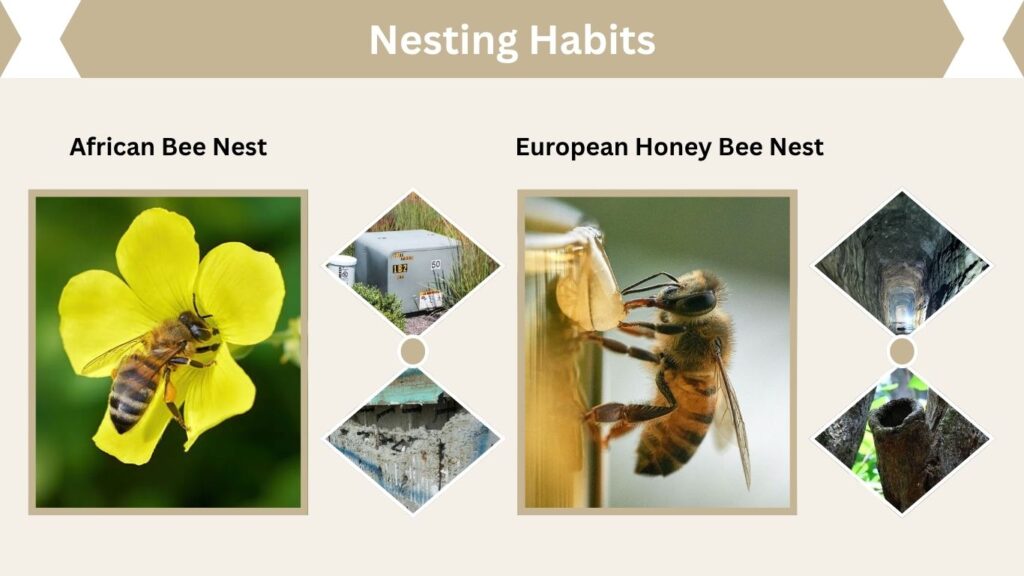
Both European and African-derived honey bees establish colonies containing comb, brood, pollen, and stored honey. However, African-derived colonies are willing to occupy much smaller and more varied nesting spaces, which can bring them into closer contact with people.
African Bee Nest vs European Honey Bee Nest
Africanized colonies may establish themselves in:
- Utility boxes
- Small tree cavities
- Wall voids
- Containers
- Underground spaces
- Abandoned structures
- Exposed protected locations
European honey bees generally favor larger, dry, protected cavities such as hollow trees and structural voids with more interior space.
UF/IFAS describes European colonies as commonly using cavities around 10 gallons in volume, while African-derived colonies may use cavities of roughly 1–5 gallons.
Swarming and Colony Movement
Swarming is the natural process by which a honey bee colony reproduces. Part of the colony leaves with a queen to establish another nest. Both European and African honey bees swarm, but African-derived colonies typically do it much more often.
Which Bee Swarms More Often?
African honey bees may:
- Swarm numerous times in one year
- Establish smaller daughter colonies
- Occupy small nesting cavities
- Expand into new areas quickly
- Abandon unsuitable nests more readily
UF/IFAS reports that European colonies commonly swarm once or twice annually, while African-derived colonies may swarm ten or more times under suitable conditions.
African bees also show stronger absconding behavior, meaning an entire colony may abandon a nest when resources decline or environmental conditions become unfavorable.
Habitat and Distribution

European honey bees have been transported around much of the world and are extensively maintained for crop pollination and honey production. African-derived honey bees are especially successful in warm tropical and subtropical regions.
Where Do Africanized Bees Live?
Africanized populations expanded from Brazil through South America, Central America, Mexico, and into portions of the United States, particularly warmer southern and southwestern areas. Climate limits their ability to establish as successfully in colder northern regions.
European honey bees, by comparison, can be managed across a much broader range of temperate climates and have historically been selected for storing enough food to survive long periods without nectar flow.
Honey Production and Pollination
Both African and European honey bees collect nectar and pollen, produce wax comb, make honey, and pollinate flowering plants. Africanized bees are therefore genuine honey bees rather than a completely different type of bee.
Do African Killer Bees Make Honey?
Yes. Africanized bees make and store honey.
However, European honey bee lines have historically been selected by beekeepers for substantial honey storage, manageable colonies, and reduced swarming. African-derived colonies tend to reproduce and relocate more frequently and may maintain smaller honey reserves under some conditions.
Both types can be effective pollinators because workers regularly travel between flowers to collect nectar and pollen.
African Honey Bee vs Africanized Honey Bee
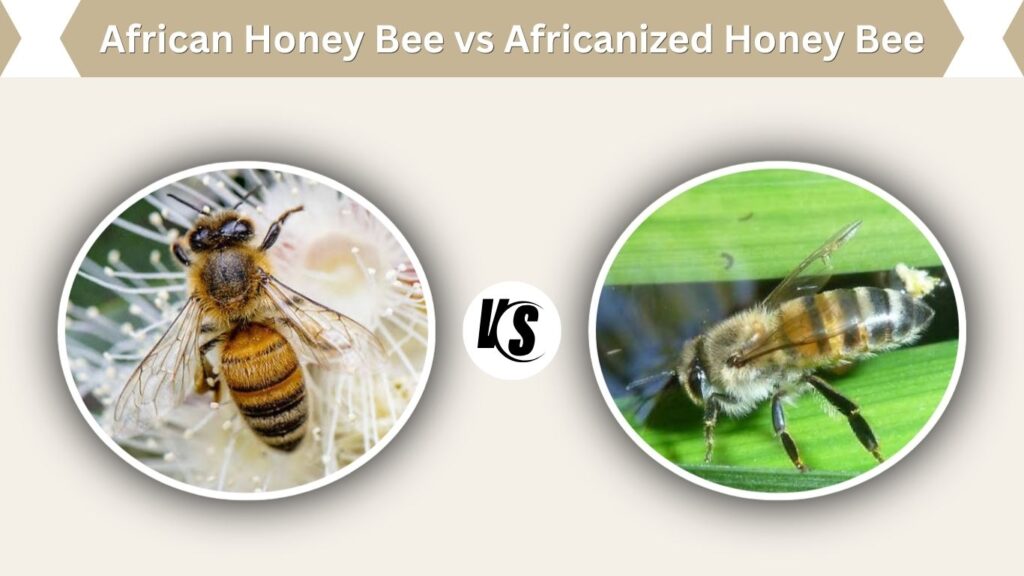
These terms are related but technically different. An African honey bee, particularly Apis mellifera scutellata, refers to an African subspecies naturally associated with sub-Saharan Africa.
An Africanized honey bee traditionally refers to populations in the Americas descended from African honey bees that interbred to varying degrees with European honey bees.
Why Are Africanized Bees Called Killer Bees?
“Killer bee” is a popular nickname rather than a scientific name. It arose because highly defensive colonies can release large numbers of workers when disturbed, occasionally resulting in severe multiple-sting incidents.
Africanized bees do not routinely hunt humans. Their strongest defensive behavior is associated with protecting an established colony and its brood and food stores.
Which Honey Bee Is More Dangerous?
An undisturbed European or Africanized honey bee gathering nectar from flowers usually has little reason to sting. The important difference appears around an established nest.
An Africanized colony poses a greater potential hazard because its defensive response can involve substantially more bees and persist over a larger area.
What to Do Around a Defensive Bee Colony
- Move away quickly if multiple bees begin attacking.
- Go inside a building or enclosed vehicle.
- Protect your face and eyes while escaping.
- Do not remain near the colony trying to identify the bees.
- Do not disturb an unknown nest.
- Have established colonies near occupied areas evaluated by an experienced professional.
The safest strategy is distance rather than trying to determine visually whether a colony is Africanized.
FAQs
Is an African Bee a Honey Bee?
Yes. African honey bees belong to the species Apis mellifera, the same species that includes European honey bee subspecies.
Are African Killer Bees Bigger Than Honey Bees?
No. Africanized honey bees are actually slightly smaller on average than many European honey bees. The difference is so small that visual identification is unreliable.
Are African Bees More Venomous?
No. Their sting venom is not substantially more potent. Their greater danger comes from the stronger colony-defense response and the possibility of receiving many stings.
Can African Bees and European Honey Bees Mate?
Yes. They belong to the same species and can interbreed. Africanized populations in the Americas developed after African-derived bees encountered European honey bee populations.
What Is the Biggest Difference Between African and European Honey Bees?
The biggest practical difference is colony defensiveness. African-derived colonies typically react faster, involve many more guard bees, pursue disturbances farther, and may remain defensive longer than typical managed European honey bee colonies.