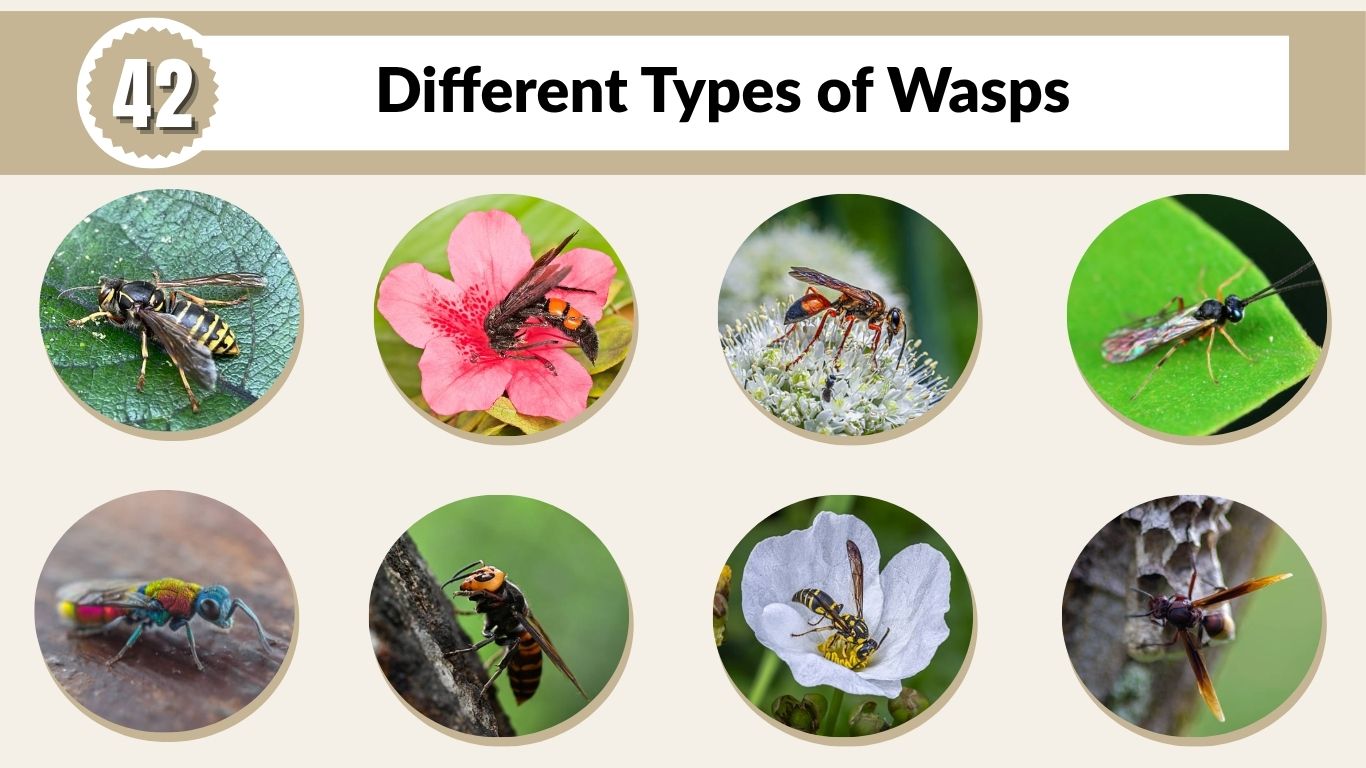
Wasps are a diverse group of insects known for their unique behaviors, nesting styles, and ecological importance. From social species like hornets and yellowjackets to solitary hunters such as mud daubers and digger wasps, each type plays a valuable role in nature. Many wasps help control pest populations, while others assist in pollination. In this guide, you will find 42 common types of wasps, each explained with identification features, habitat, behavior, and lifecycle to help you better understand these fascinating insects.
1. Paper Wasp
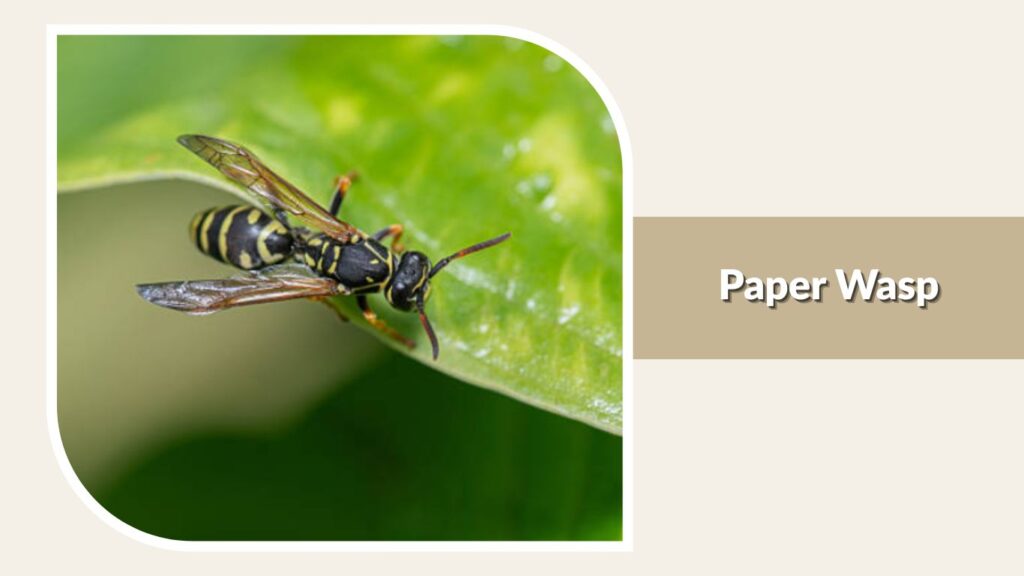
Paper wasps are one of the most commonly recognized types of wasps. They get their name from the paper-like material they use to build their nests, which are often seen hanging from eaves, branches, or ceilings. These wasps are generally less aggressive than other stinging wasps but will defend their nests if disturbed.
Identification
- Slender body with long legs that hang down during flight
- Usually brown with yellow or reddish markings
- Narrow waist and smooth, shiny body
- Wings folded lengthwise when at rest
Habitat and Distribution
Paper wasps are widely distributed across many parts of the world, especially in warm and temperate regions. They prefer open areas such as gardens, forests, and human structures where they can easily build their nests in sheltered locations.
Behavior and Diet
Paper wasps are social insects that live in small colonies. They feed on nectar and also hunt insects like caterpillars, making them beneficial for natural pest control. While they can sting, they usually do so only when threatened.
Lifecycle
The lifecycle of a paper wasp begins when a queen starts a new colony in spring. She lays eggs that develop into workers, which then help expand the nest and care for future larvae. By late summer, new queens and males are produced, and the cycle repeats the following year.
2. Yellowjacket
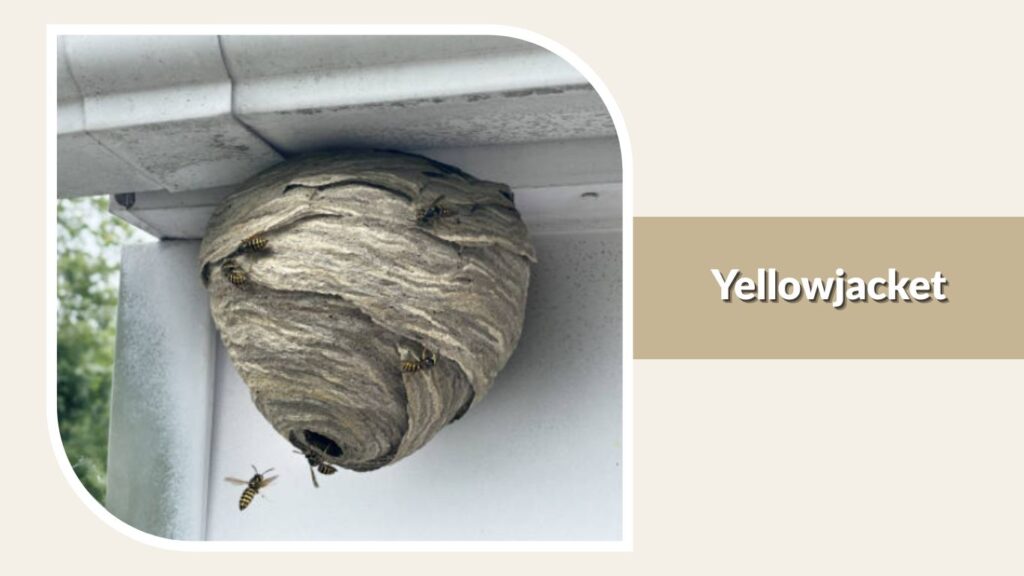
Yellowjackets are highly active and aggressive wasps known for their bright yellow and black markings. They are commonly seen around food sources, especially during late summer and early autumn. Unlike some other wasps, yellowjackets can sting multiple times, making them more dangerous when disturbed.
Identification
- Bright yellow and black striped body
- Compact and smooth body with a narrow waist
- Short legs compared to other wasps
- Fast and direct flight pattern
Habitat and Distribution
Yellowjackets are found in many regions around the world, particularly in temperate climates. They often build nests underground, in wall cavities, or in sheltered outdoor areas. Their nests can grow quite large and house thousands of individuals.
Behavior and Diet
Yellowjackets are social insects that live in large colonies. They are attracted to sugary foods, meats, and garbage, which often brings them into contact with humans. They are also predators, feeding on insects and helping control pest populations.
Lifecycle
The lifecycle begins with a fertilized queen emerging in spring to start a new colony. She builds the first nest and raises worker wasps. As the colony grows, workers take over food gathering and nest expansion. By the end of the season, new queens and males are produced before the colony dies off in winter.
3. Hornet
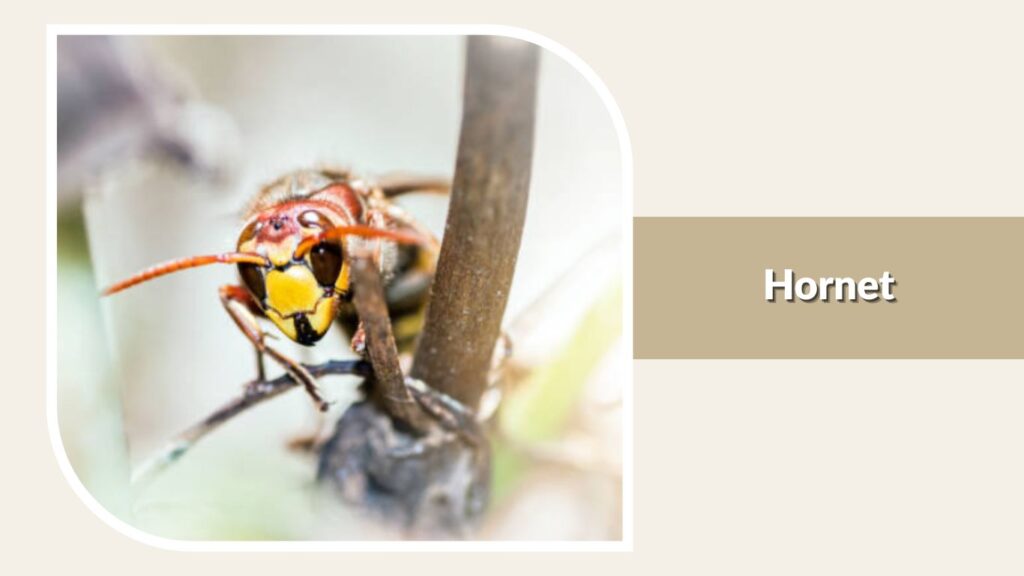
Hornets are large and powerful wasps known for their strong build and highly organized colonies. They are generally more aggressive than many other wasps, especially when their nest is threatened. Hornets are important in nature because they help control insect populations.
Identification
- Large, robust body compared to other wasps
- Yellow, black, or brown coloration depending on species
- Wide head with strong jaws
- Loud buzzing sound during flight
Habitat and Distribution
Hornets are found in various regions across the world, particularly in forests, woodlands, and suburban areas. They usually build large, enclosed nests made of paper-like material, often located in trees, shrubs, or sometimes on buildings.
Behavior and Diet
Hornets are social insects that live in well-structured colonies. They feed on tree sap, fruit, and nectar, but they also hunt insects such as flies and caterpillars. This makes them beneficial for controlling pests, although they can become aggressive when disturbed.
Lifecycle
The lifecycle begins when a fertilized queen emerges in spring and starts building a nest. She lays eggs that develop into worker hornets. As the colony grows, workers take over tasks like feeding larvae and expanding the nest. By late season, new queens and males are produced, and the colony eventually dies off.
4. Mud Dauber
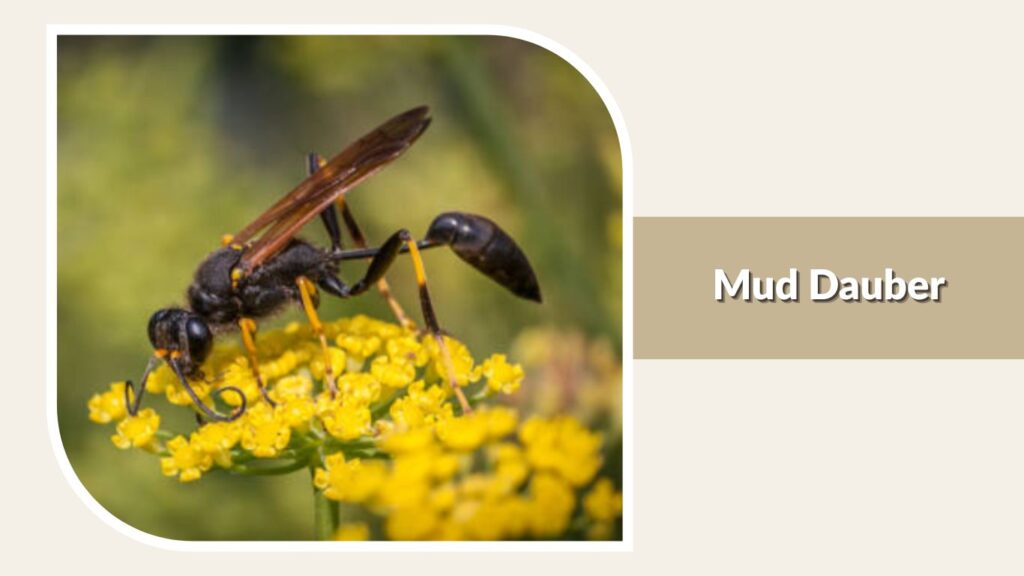
Mud daubers are solitary wasps known for building nests out of mud. Unlike social wasps, they do not live in colonies and are generally non-aggressive toward humans. They are often seen around buildings, where they create small tube-like nests on walls and ceilings.
Identification
- Slender body with a very narrow waist
- Usually black or metallic blue, sometimes with yellow markings
- Long legs and smooth body
- Distinct mud tube nests attached to surfaces
Habitat and Distribution
Mud daubers are widely found in warm and temperate regions around the world. They prefer sheltered areas such as under roofs, inside garages, or on walls where they can build their mud nests safely.
Behavior and Diet
Mud daubers are solitary and do not defend their nests aggressively. They primarily hunt spiders, which they paralyze and place inside their mud nests as food for their larvae. Adult mud daubers usually feed on nectar.
Lifecycle
The female builds a mud nest and fills it with paralyzed spiders before laying an egg inside. Once the egg hatches, the larva feeds on the stored prey. After completing development, the adult wasp emerges, and the cycle begins again.
5. Potter Wasp
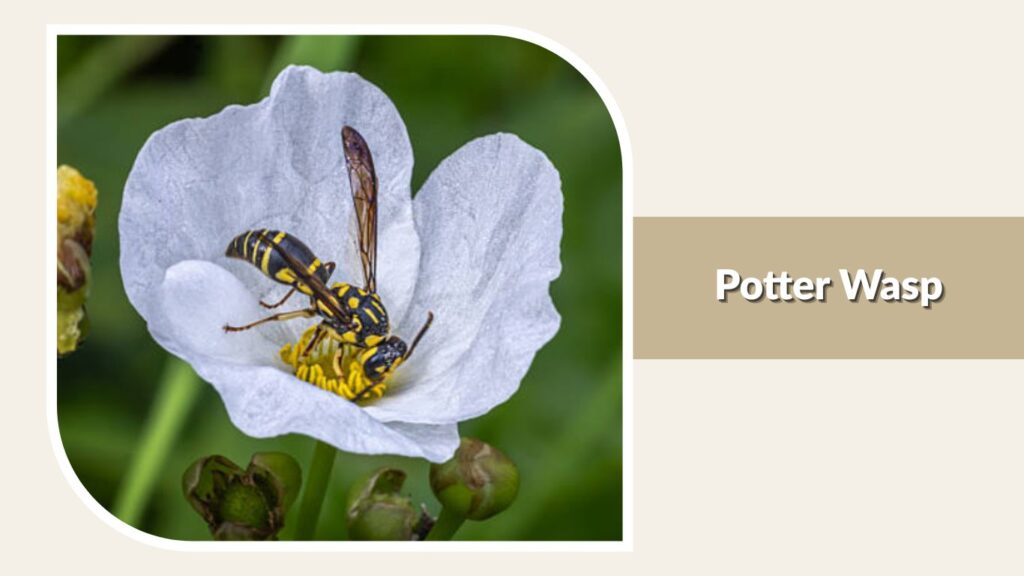
Potter wasps are solitary insects known for their unique nest-building behavior. They create small, pot-shaped nests made from mud, which gives them their name. These wasps are generally harmless to humans and are rarely aggressive unless directly handled.
Identification
- Small to medium-sized body with a narrow waist
- Usually black or brown with yellow or white markings
- Smooth and shiny appearance
- Distinctive pot-shaped mud nests
Habitat and Distribution
Potter wasps are found in many parts of the world, especially in warm and temperate regions. They prefer areas with access to mud and sheltered surfaces like walls, rocks, or plant stems where they can build their nests.
Behavior and Diet
Potter wasps are solitary and do not form colonies. They hunt caterpillars and other small insects, which they paralyze and store in their nests as food for their larvae. Adult wasps feed mainly on nectar from flowers.
Lifecycle
The female potter wasp builds a small mud pot and fills it with paralyzed prey before laying an egg inside. The larva hatches and feeds on the stored food. After completing its development, it pupates inside the nest and later emerges as an adult wasp.
6. Cuckoo Wasp
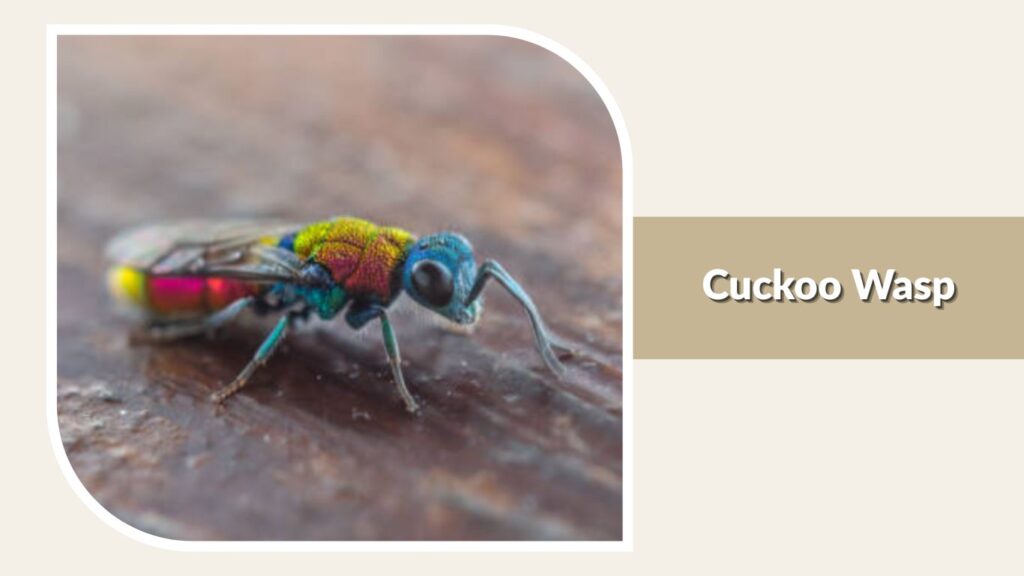
Cuckoo wasps are small, brightly colored wasps known for their metallic shine and unique parasitic behavior. Instead of building their own nests, they lay their eggs in the nests of other insects. These wasps are generally harmless to humans and are admired for their striking appearance.
Identification
- Small body with a metallic blue, green, or red color
- Hard, shiny exoskeleton
- Compact shape with a slightly rounded body
- Ability to curl into a ball when threatened
Habitat and Distribution
Cuckoo wasps are found in many regions worldwide, especially in warm and sunny environments. They are commonly seen in gardens, forests, and areas where other solitary wasps or bees build nests, since they rely on those nests for reproduction.
Behavior and Diet
Cuckoo wasps are parasitic, meaning they lay their eggs in the nests of other insects such as bees and wasps. The larvae then feed on the host’s food supply or young. Adult cuckoo wasps feed on nectar and are often seen visiting flowers.
Lifecycle
The female cuckoo wasp sneaks into a host nest and lays her egg inside. Once the egg hatches, the larva consumes the food stored in the nest or sometimes the host larva itself. It then pupates and eventually emerges as an adult, continuing the cycle.
7. Spider Wasp
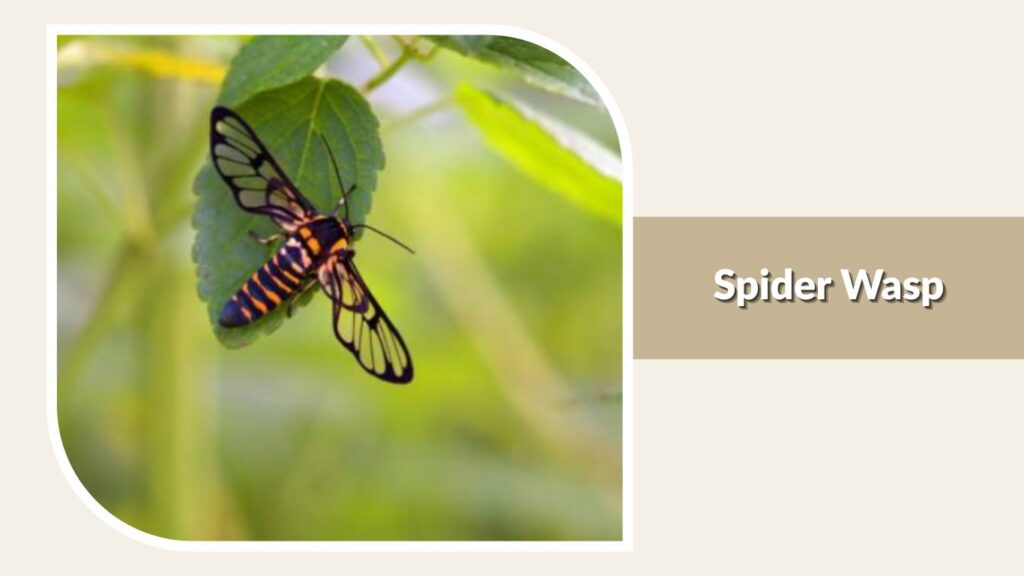
Spider wasps are a fascinating group of wasps known for their hunting skills and strong connection with spiders. They are solitary insects and are generally not aggressive unless disturbed. Spider wasps play an important role in controlling spider populations in their environment.
Identification
- Slender body with long legs
- Usually dark-colored, often black or blue with orange wings in some species
- Curved antennae
- Strong stinger used for paralyzing prey
Habitat and Distribution
Spider wasps are found worldwide, especially in warm and tropical regions. They prefer open habitats such as gardens, deserts, forests, and grasslands where spiders are abundant.
Behavior and Diet
Spider wasps are solitary hunters that specialize in capturing spiders. They sting and paralyze their prey, then carry it to a nest as food for their larvae. Adult spider wasps mainly feed on nectar from flowers.
Lifecycle
The female spider wasp captures a spider and places it in a nest, then lays an egg on it. When the egg hatches, the larva feeds on the paralyzed spider. After completing its development, it pupates and eventually emerges as an adult wasp.
8. Ichneumon Wasp
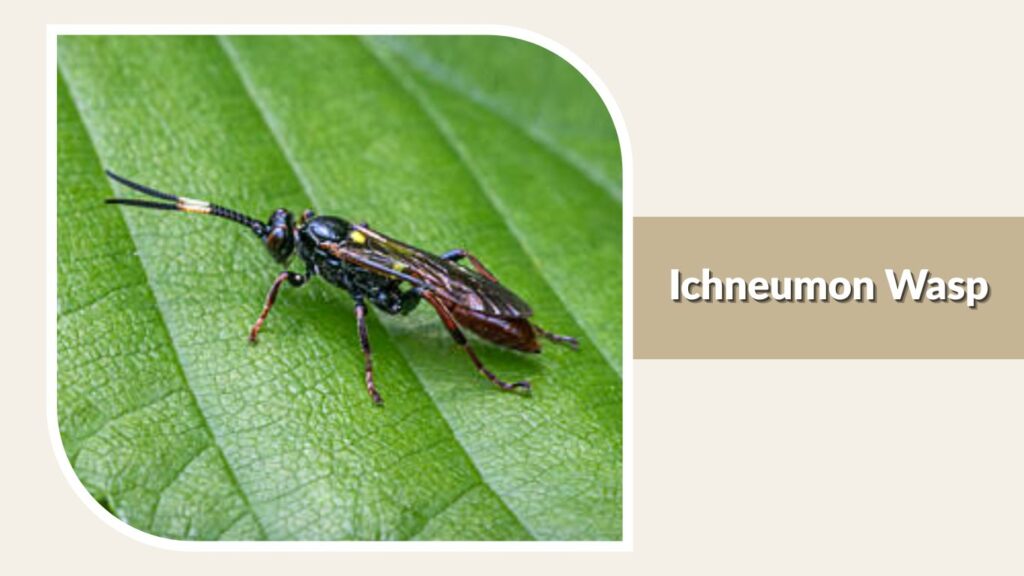
Ichneumon wasps are a large and diverse group of parasitic wasps known for their long bodies and specialized egg-laying behavior. They are generally harmless to humans and are highly beneficial because they help control pest insect populations in natural and agricultural environments.
Identification
- Slender body with long antennae
- Usually black, brown, or yellow with patterned markings
- Females often have a long, thread-like ovipositor (egg-laying organ)
- Narrow waist and delicate wings
Habitat and Distribution
Ichneumon wasps are found worldwide in a wide range of habitats, including forests, gardens, and farmland. They are especially common in areas where host insects, such as caterpillars and beetle larvae, are abundant.
Behavior and Diet
Ichneumon wasps are parasitic, meaning they lay their eggs inside or on other insects. The larvae develop by feeding on the host. Adult ichneumon wasps typically feed on nectar and are often seen visiting flowers.
Lifecycle
The female uses her ovipositor to place eggs inside or on a host insect. After hatching, the larva feeds on the host, eventually leading to its death. The larva then pupates and emerges as an adult wasp, continuing the cycle.
9. Braconid Wasp
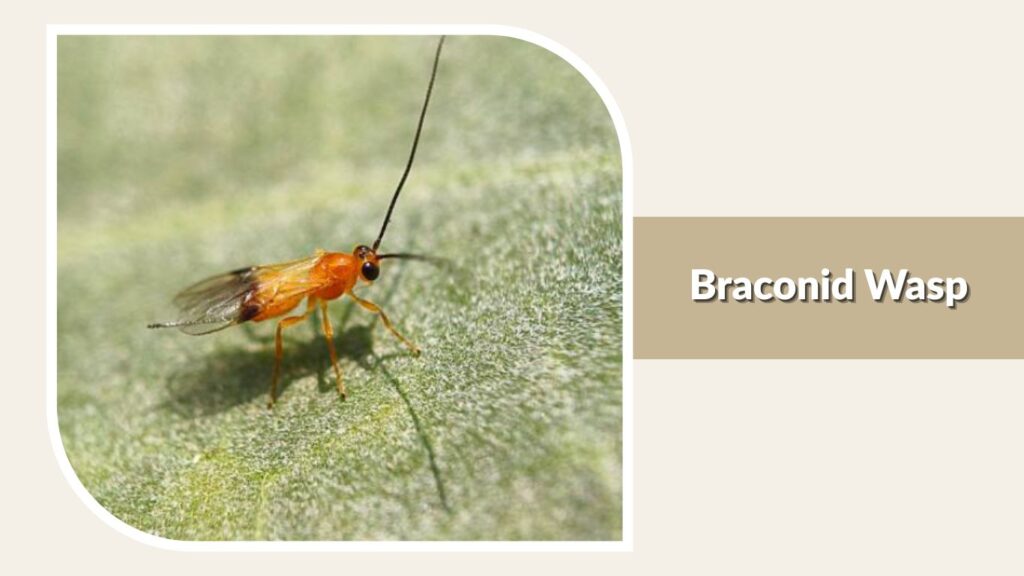
Braconid wasps are small parasitic wasps that play an important role in controlling harmful insect populations. They are widely used in agriculture as natural pest control agents. These wasps are harmless to humans and are often unnoticed due to their small size.
Identification
- Small and slender body
- Usually brown or black in color
- Long antennae relative to body size
- Females may have a visible ovipositor
Habitat and Distribution
Braconid wasps are found all over the world in a variety of habitats, including forests, gardens, and agricultural fields. They are especially common in areas where host insects like caterpillars and aphids are present.
Behavior and Diet
Braconid wasps are parasitic and lay their eggs inside or on other insects. Their larvae feed on the host, helping to reduce pest populations. Adult braconid wasps usually feed on nectar and plant juices.
Lifecycle
The female lays eggs inside a host insect. After hatching, the larvae feed on the host from within, eventually killing it. Once fully developed, they pupate and emerge as adult wasps, continuing the life cycle.
10. Fig Wasp
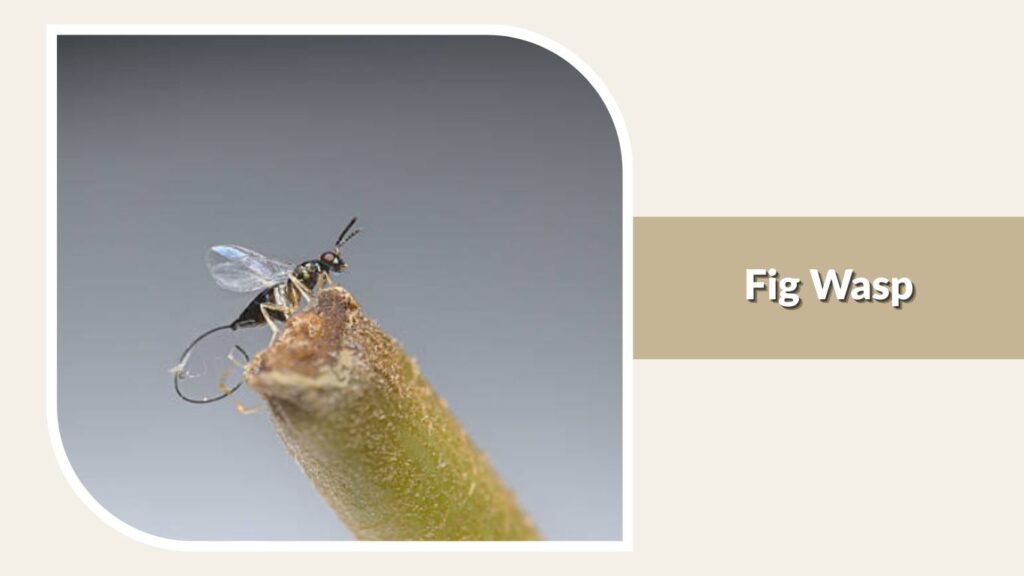
Fig wasps are tiny insects that have a unique and important relationship with fig trees. They are essential for pollinating figs, making them a key part of certain ecosystems. These wasps are highly specialized and spend most of their lives inside fig fruits.
Identification
- Very small body, often only a few millimeters long
- Usually dark brown or black in color
- Short wings and compact body shape
- Females often winged, while males may be wingless
Habitat and Distribution
Fig wasps are found in regions where fig trees grow, including tropical and subtropical areas. They live almost entirely within fig fruits, which serve as both their habitat and breeding site.
Behavior and Diet
Fig wasps have a mutual relationship with fig trees. The female enters a fig to lay her eggs and, in the process, pollinates the plant. Adult wasps feed on plant tissues inside the fig, while larvae develop within the fruit.
Lifecycle
The lifecycle of a fig wasp is closely tied to the fig fruit. The female enters a fig, lays eggs, and dies inside. The larvae develop within the fig, and males emerge first, mating with females before they leave. The females then carry pollen to a new fig, continuing the cycle.
11. Gall Wasp
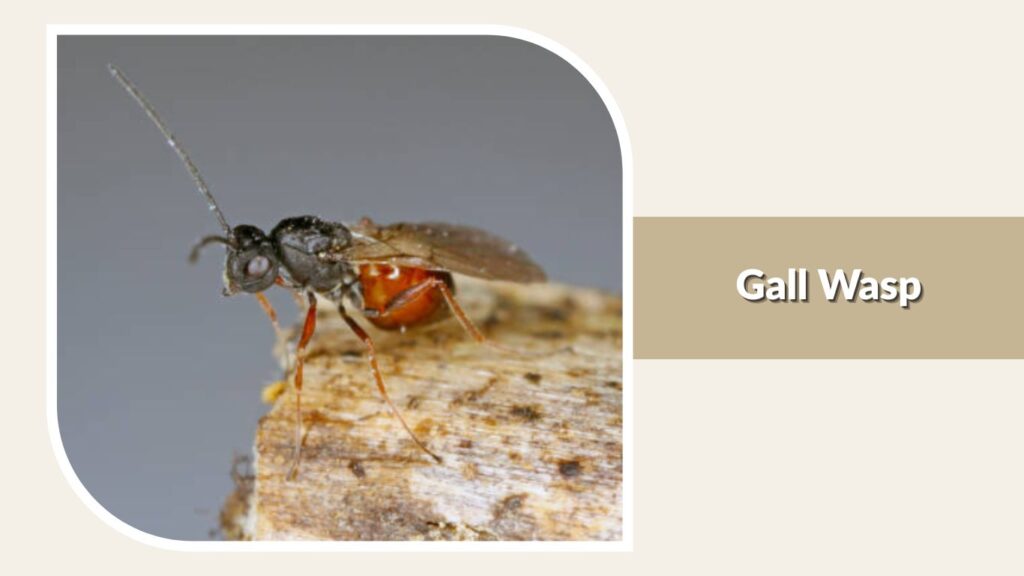
Gall wasps are small insects known for their ability to cause unusual growths on plants, called galls. These galls act as both a home and a food source for their larvae. Gall wasps are generally harmless to humans and are commonly found around trees and shrubs.
Identification
- Very small body, often hard to notice
- Usually black, brown, or yellowish in color
- Smooth and compact body shape
- Fine wings with simple structure
Habitat and Distribution
Gall wasps are found worldwide, especially in areas with plenty of trees such as oak, rose, and other plants they depend on. They are commonly seen in forests, gardens, and parks where host plants are available.
Behavior and Diet
Gall wasps are mostly plant-dependent insects. The female lays eggs in plant tissue, triggering the plant to form a gall. The larvae live inside these galls and feed on the plant material. Adult gall wasps may feed on nectar or not feed at all.
Lifecycle
The female lays eggs inside plant tissues, causing the plant to form a protective gall around the developing larvae. The larvae grow inside the gall, feeding on it. Once mature, they emerge as adult wasps and continue the reproductive cycle.
12. Velvet Ant
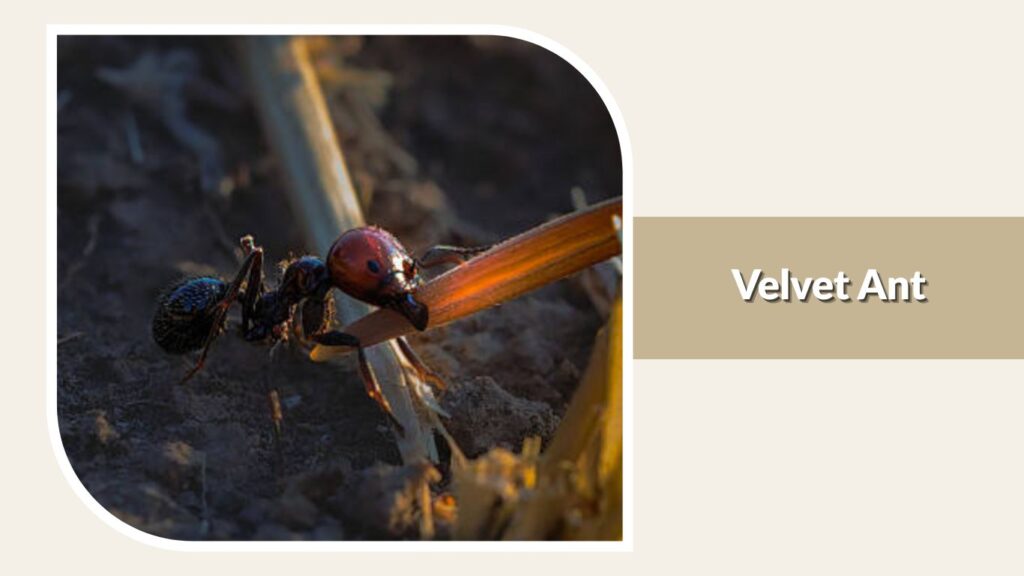
Velvet ants are actually a type of wasp, even though they look like ants. They are known for their bright colors and dense, velvety hair covering their bodies. Velvet ants are solitary insects and are famous for their extremely painful sting, which has earned them the nickname “cow killer.”
Identification
- Covered in thick, velvety hair
- Bright colors such as red, orange, or yellow with black
- Females are wingless and resemble ants
- Males have wings but do not sting
Habitat and Distribution
Velvet ants are found in dry and sandy regions around the world. They are commonly seen in deserts, grasslands, and open fields where they can move easily on the ground and find host nests.
Behavior and Diet
Velvet ants are parasitic and lay their eggs in the nests of other insects, especially bees and wasps. The larvae feed on the host’s larvae or stored food. Adult velvet ants feed mainly on nectar.
Lifecycle
The female velvet ant enters the nest of another insect and lays her egg inside. After hatching, the larva feeds on the host or its food supply. It then pupates and eventually emerges as an adult, continuing the cycle.
13. Thread-Waisted Wasp
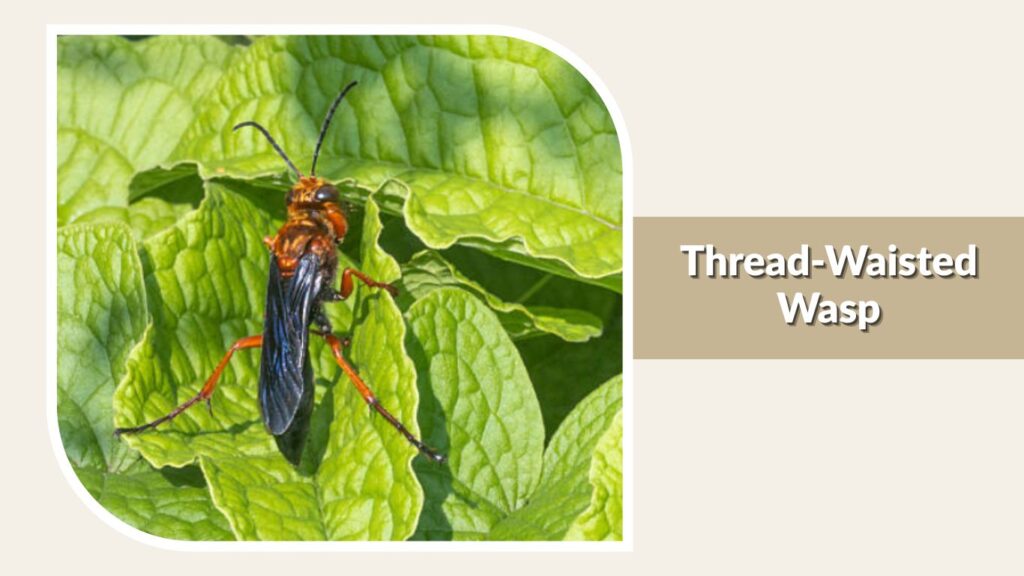
Thread-waisted wasps are slender, elegant insects known for their extremely narrow waist that connects the thorax and abdomen. They are solitary wasps and are generally non-aggressive toward humans. These wasps are important predators that help control insect populations.
Identification
- Very thin, thread-like waist
- Long, slender body
- Usually black, sometimes with yellow or metallic markings
- Long legs and narrow wings
Habitat and Distribution
Thread-waisted wasps are found in many parts of the world, especially in warm and temperate regions. They prefer open habitats such as gardens, grasslands, and sandy areas where they can dig or find suitable nesting spots.
Behavior and Diet
These wasps are solitary hunters that mainly prey on caterpillars and other soft-bodied insects. They paralyze their prey and place it in a nest as food for their larvae. Adult thread-waisted wasps typically feed on nectar.
Lifecycle
The female builds or prepares a nest, then hunts and paralyzes prey to store inside it. She lays an egg on the prey, and once the larva hatches, it feeds on the stored food. After growing and pupating, an adult wasp emerges and continues the life cycle.
14. Sand Wasp
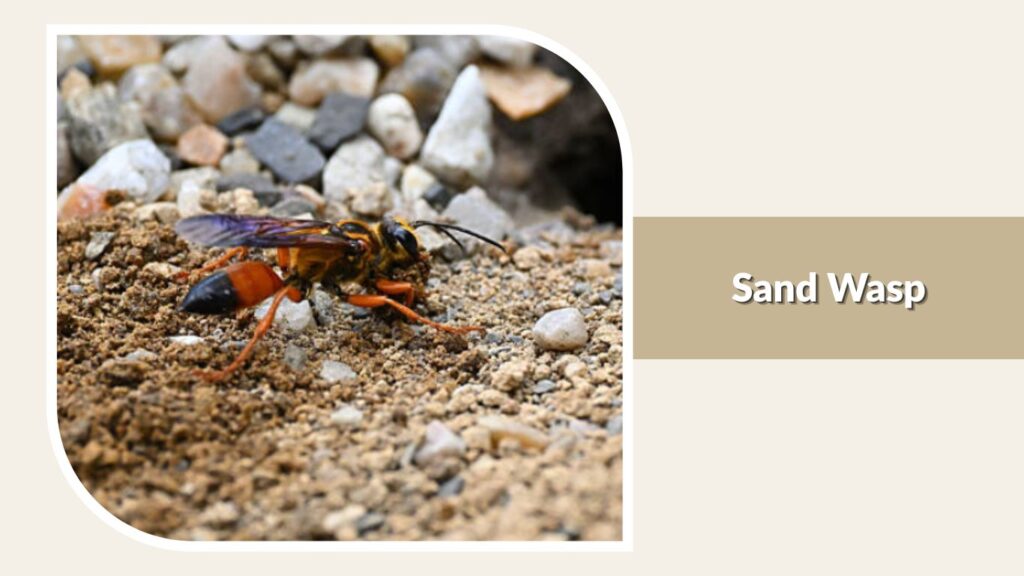
Sand wasps are solitary wasps that are well adapted to sandy environments. They are known for digging nests in the ground and hunting insects to feed their young. These wasps are generally non-aggressive and play a useful role in controlling pest insect populations.
Identification
- Slender body with a narrow waist
- Usually black or dark-colored, sometimes with pale markings
- Long legs adapted for digging
- Smooth body with clear wings
Habitat and Distribution
Sand wasps are commonly found in sandy areas such as deserts, beaches, and open fields. They prefer loose soil where they can easily dig burrows for nesting. They are widely distributed across warm and temperate regions.
Behavior and Diet
Sand wasps are solitary hunters that capture insects like flies and small bugs. They paralyze their prey and carry it back to their underground nests. Adult sand wasps feed mainly on nectar from flowers.
Lifecycle
The female digs a burrow in sandy soil and stocks it with paralyzed prey. She lays an egg on the prey, and when the larva hatches, it feeds on the stored food. After developing and pupating in the burrow, the adult wasp emerges to continue the cycle.
15. Digger Wasp
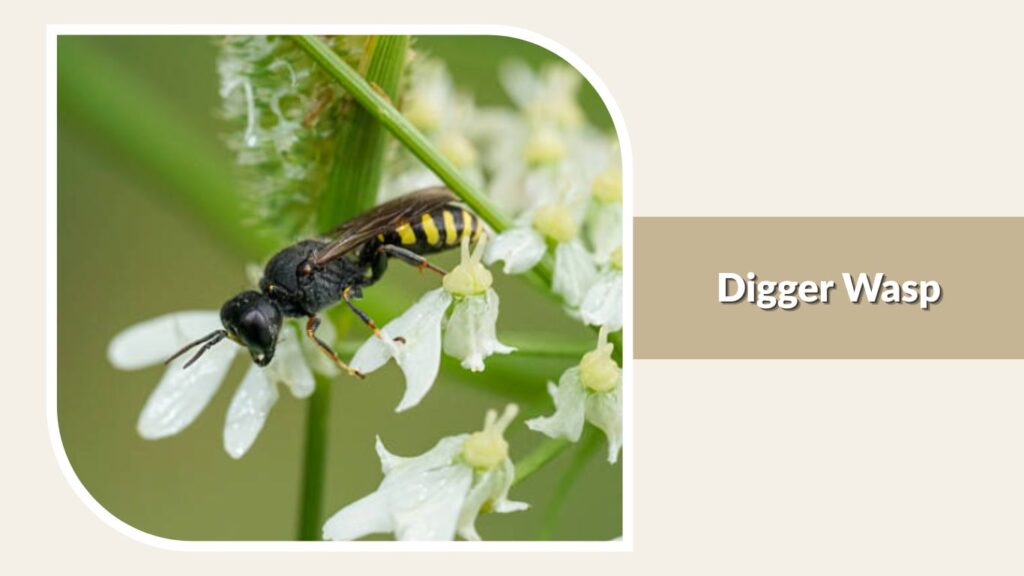
Digger wasps are solitary insects known for their burrowing behavior. They dig tunnels in the ground where they create nests for their young. These wasps are generally non-aggressive and are beneficial because they help control insect populations.
Identification
- Slender body with a narrow waist
- Usually black or dark-colored, sometimes with yellow markings
- Strong legs adapted for digging
- Smooth body with clear wings
Habitat and Distribution
Digger wasps are found worldwide, especially in sandy or loose soil environments. They prefer open areas such as gardens, fields, and deserts where they can easily dig their nests underground.
Behavior and Diet
Digger wasps are solitary hunters that capture insects or spiders. They paralyze their prey and place it in their burrow as food for their larvae. Adult digger wasps mainly feed on nectar from flowers.
Lifecycle
The female digs a tunnel and creates chambers where she places paralyzed prey. She lays an egg in each chamber, and when the larva hatches, it feeds on the stored food. After pupation, the adult emerges from the ground and continues the life cycle.
16. Mason Wasp
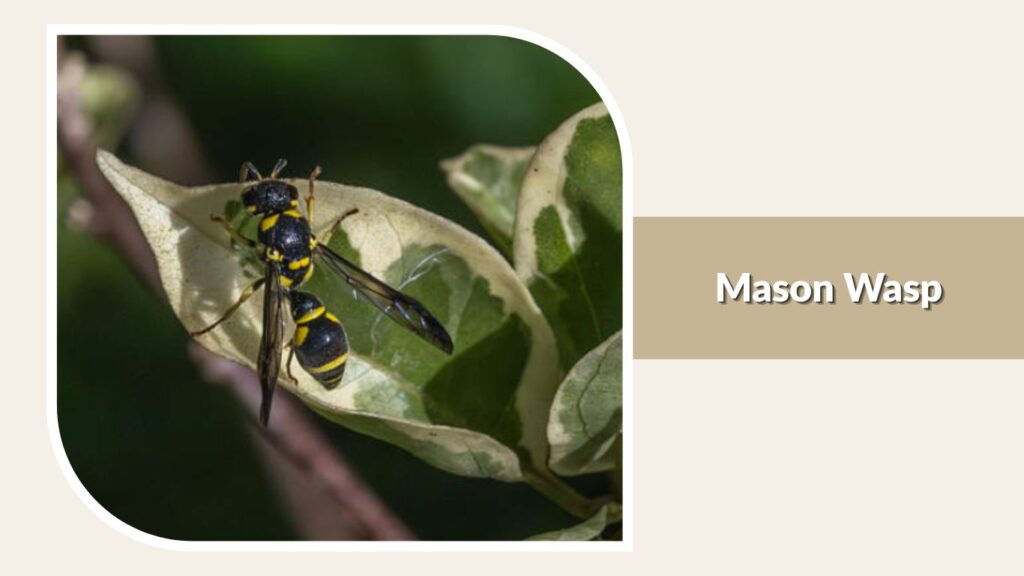
Mason wasps are solitary insects known for building their nests using mud, much like skilled builders. They are generally calm and non-aggressive toward humans. These wasps are beneficial in gardens because they help control pest insects.
Identification
- Medium-sized body with a narrow waist
- Usually black or dark brown, sometimes with yellow markings
- Smooth and slightly shiny body
- Strong jaws used for carrying mud
Habitat and Distribution
Mason wasps are found in many parts of the world, especially in warm and temperate regions. They prefer areas with access to mud and sheltered spaces such as walls, rocks, and plant stems for building nests.
Behavior and Diet
Mason wasps are solitary and do not form colonies. They hunt caterpillars and other small insects, which they paralyze and store in their nests. Adult mason wasps feed mainly on nectar from flowers.
Lifecycle
The female builds a mud nest divided into small chambers. She places paralyzed prey inside each chamber and lays an egg. The larva feeds on the stored food, then pupates inside the nest before emerging as an adult wasp.
17. Scelionid Wasp
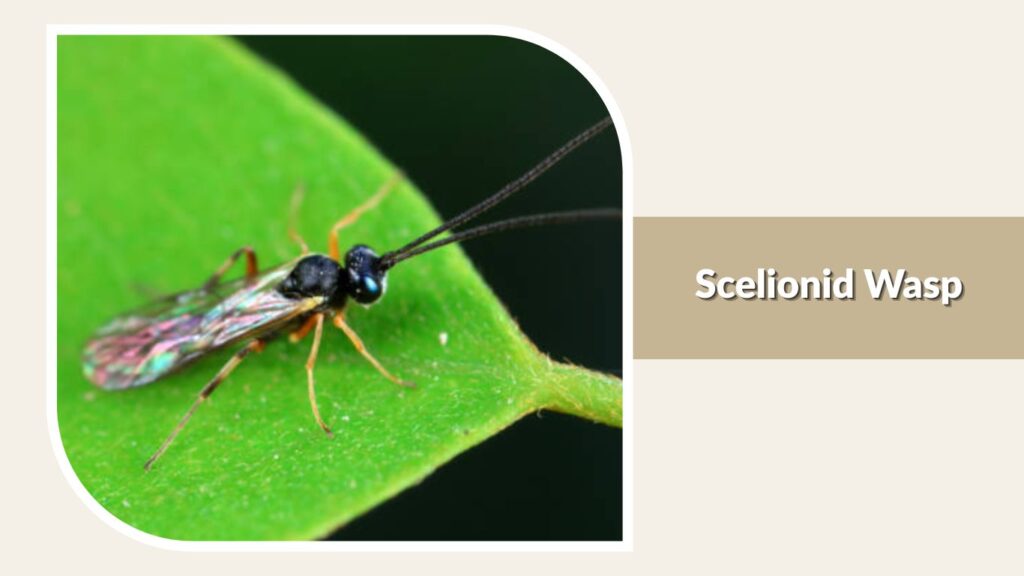
Scelionid wasps are tiny parasitic wasps that are highly important in controlling insect populations, especially agricultural pests. They are often unnoticed due to their small size but play a major role in natural pest management. These wasps are harmless to humans.
Identification
- Very small body, often less than a few millimeters long
- Usually black or dark brown in color
- Compact and slightly oval-shaped body
- Short wings and antennae compared to other wasps
Habitat and Distribution
Scelionid wasps are found worldwide in a variety of environments, including forests, grasslands, and agricultural fields. They are especially common in areas where host insects lay eggs, as they depend on these for reproduction.
Behavior and Diet
Scelionid wasps are egg parasitoids, meaning they lay their eggs inside the eggs of other insects, such as grasshoppers and bugs. The developing larvae consume the host egg. Adult scelionid wasps typically feed on nectar.
Lifecycle
The female lays her eggs inside the eggs of a host insect. After hatching, the larva feeds on the contents of the host egg. It then develops and pupates within the egg before emerging as an adult wasp, continuing the cycle.
18. Encyrtid Wasp
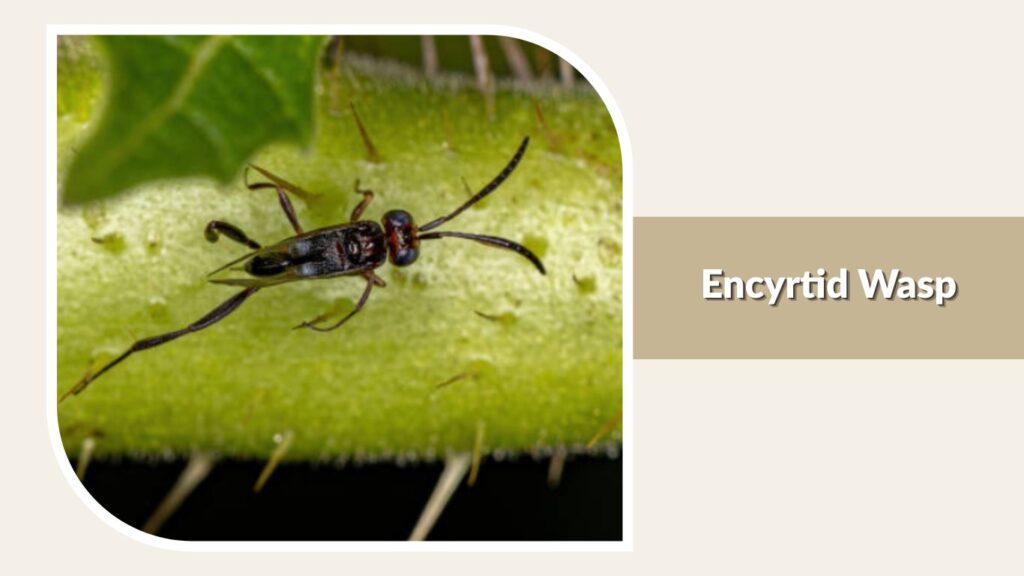
Encyrtid wasps are tiny parasitic wasps that are widely used in biological pest control. They are known for targeting harmful insects such as scale insects and mealybugs. Despite their small size, they play a very important role in maintaining ecological balance and supporting agriculture.
Identification
- Very small and delicate body
- Usually black, brown, or metallic in color
- Short antennae and transparent wings
- Compact body shape with a narrow waist
Habitat and Distribution
Encyrtid wasps are found around the world in gardens, forests, and agricultural areas. They are especially common where host insects like scale insects and aphids are present, as they rely on them for reproduction.
Behavior and Diet
Encyrtid wasps are parasitic and lay their eggs inside or on host insects. The larvae develop by feeding on the host, helping to reduce pest populations. Adult wasps typically feed on nectar and plant fluids.
Lifecycle
The female lays eggs inside a host insect. After hatching, the larva feeds on the host from within, eventually killing it. It then pupates and emerges as an adult wasp, ready to continue the reproductive cycle.
19. Eulophid Wasp
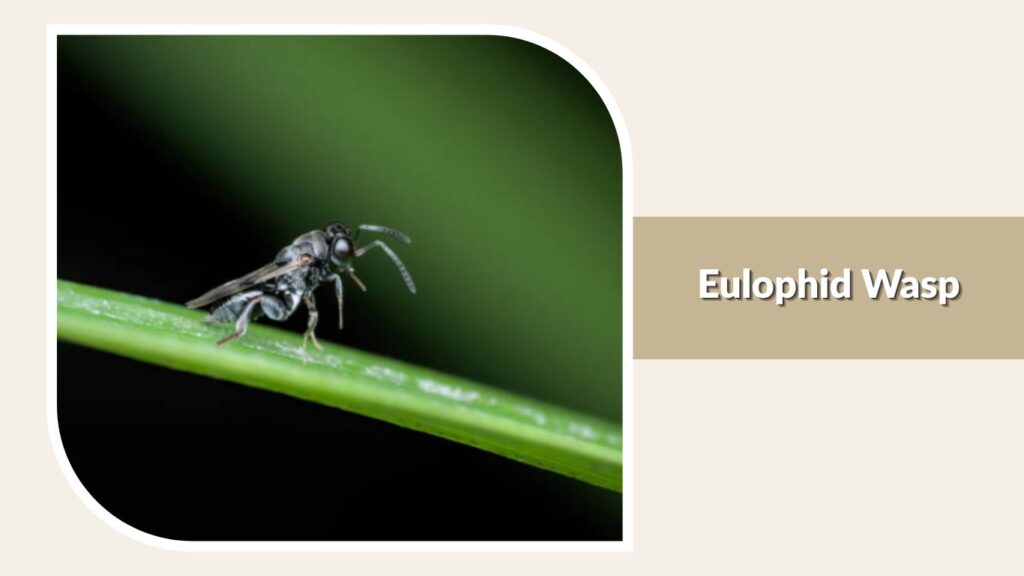
Eulophid wasps are small parasitic wasps that are highly beneficial for controlling insect pests. They are commonly found in agricultural and natural environments, where they help manage populations of harmful insects. Despite their tiny size, they have a significant impact on ecosystems.
Identification
- Very small body, often only a few millimeters long
- Usually metallic green, blue, or black in color
- Slender body with clear wings
- Short antennae and delicate appearance
Habitat and Distribution
Eulophid wasps are found worldwide in a wide range of habitats, including forests, gardens, and farmland. They are especially common in areas where host insects such as caterpillars, leaf miners, and beetle larvae are present.
Behavior and Diet
Eulophid wasps are parasitic and lay their eggs inside or on other insects. The larvae feed on the host, helping to reduce pest populations. Adult eulophid wasps usually feed on nectar and other plant-based substances.
Lifecycle
The female lays eggs in or on a host insect. Once the eggs hatch, the larvae feed on the host until they complete their development. They then pupate and emerge as adult wasps, continuing the cycle of parasitism.
20. Chalcid Wasp
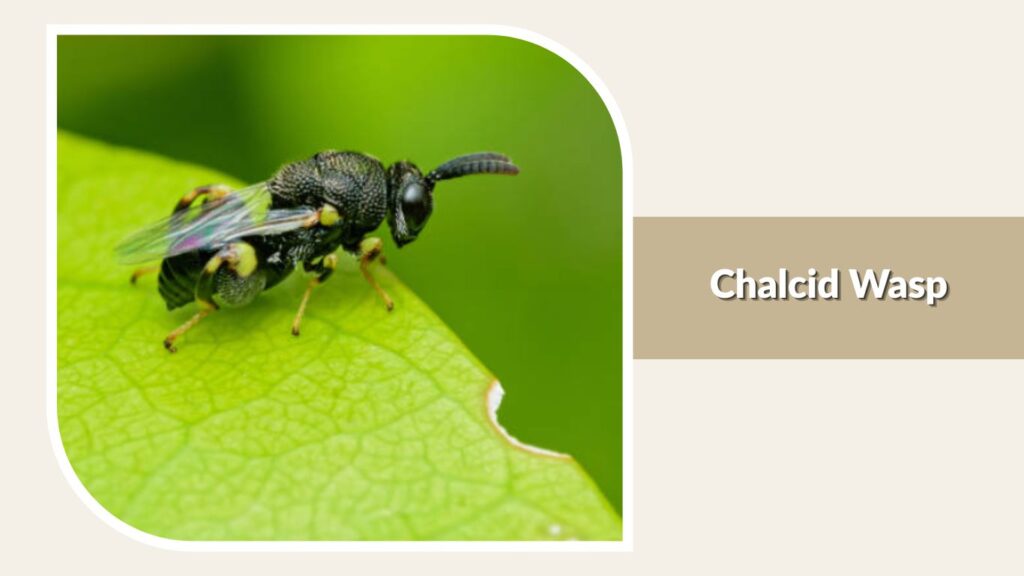
Chalcid wasps are a diverse group of tiny parasitic wasps known for their role in controlling pest insects. They are often used in agriculture as natural biological control agents. Although they are very small, they are extremely important for maintaining ecological balance.
Identification
- Very small body, often just a few millimeters long
- Metallic colors such as green, blue, or black
- Short and compact body shape
- Enlarged hind legs in some species
Habitat and Distribution
Chalcid wasps are found all over the world in many environments, including forests, gardens, and farmland. They are especially common in areas where host insects are abundant, as they rely on them for reproduction.
Behavior and Diet
Chalcid wasps are parasitic and lay their eggs inside or on other insects, such as beetles, flies, and caterpillars. Their larvae feed on the host, helping to reduce pest populations. Adult chalcid wasps usually feed on nectar.
Lifecycle
The female lays eggs in or on a host insect. After hatching, the larvae develop by feeding on the host. Once fully grown, they pupate and later emerge as adult wasps, continuing the lifecycle.
21. Trichogramma Wasp
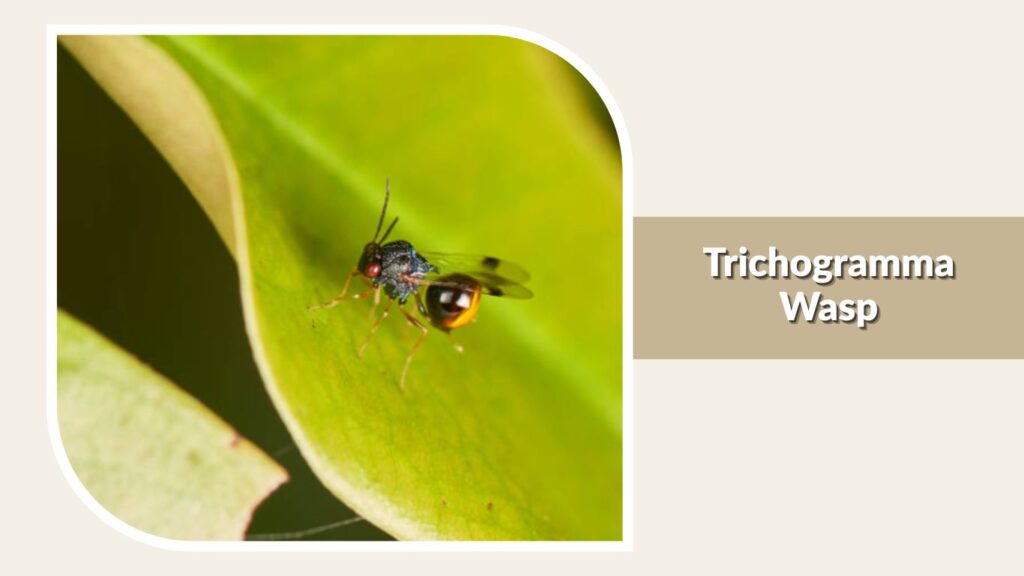
Trichogramma wasps are extremely tiny parasitic wasps widely used in agriculture for biological pest control. They are known for targeting the eggs of harmful insects, especially moths and butterflies. Despite their microscopic size, they are very effective in reducing pest populations.
Identification
- Extremely small, often less than 1 millimeter long
- Yellowish or light brown in color
- Delicate body with short antennae
- Transparent wings with fine fringes
Habitat and Distribution
Trichogramma wasps are found worldwide in agricultural fields, gardens, and natural habitats. They are especially common in areas where crop pests lay eggs, as they depend on these eggs for reproduction.
Behavior and Diet
Trichogramma wasps are egg parasitoids, meaning they lay their eggs inside the eggs of other insects. Their larvae develop by feeding on the host egg. Adult wasps feed on nectar and other plant-based substances.
Lifecycle
The female lays her eggs inside the eggs of a host insect. After hatching, the larvae consume the contents of the host egg. They develop and pupate inside the egg, eventually emerging as adult wasps ready to repeat the cycle.
22. Tarantula Hawk
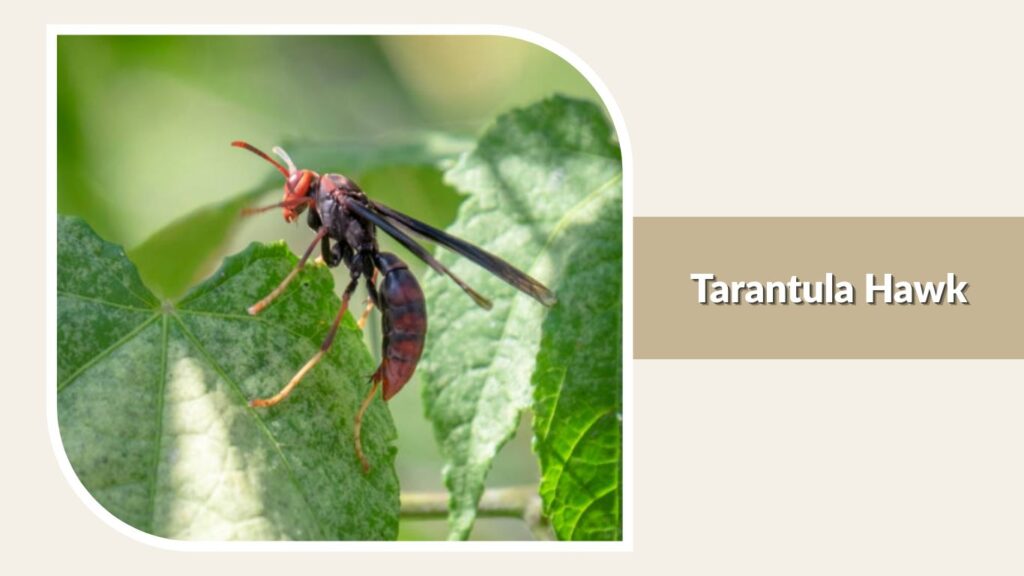
Tarantula hawks are large and striking wasps known for hunting tarantulas. They are famous for having one of the most painful stings among insects, although they are not aggressive unless provoked. These wasps play an important role in controlling spider populations.
Identification
- Large body with a slender waist
- Usually black or dark blue with bright orange wings
- Long legs and curved antennae
- Strong stinger used for paralyzing prey
Habitat and Distribution
Tarantula hawks are commonly found in warm regions, especially deserts and dry areas. They are widely distributed in the Americas and prefer habitats where tarantulas are present.
Behavior and Diet
Tarantula hawks are solitary hunters that specialize in capturing tarantulas. They sting and paralyze the spider, then drag it to a burrow. Adult wasps feed mainly on nectar, while the captured spider serves as food for their larvae.
Lifecycle
The female wasp hunts and paralyzes a tarantula, placing it inside a burrow. She lays a single egg on the spider. After hatching, the larva feeds on the still-living spider. It then pupates and eventually emerges as an adult wasp.
23. Blue Mud Dauber
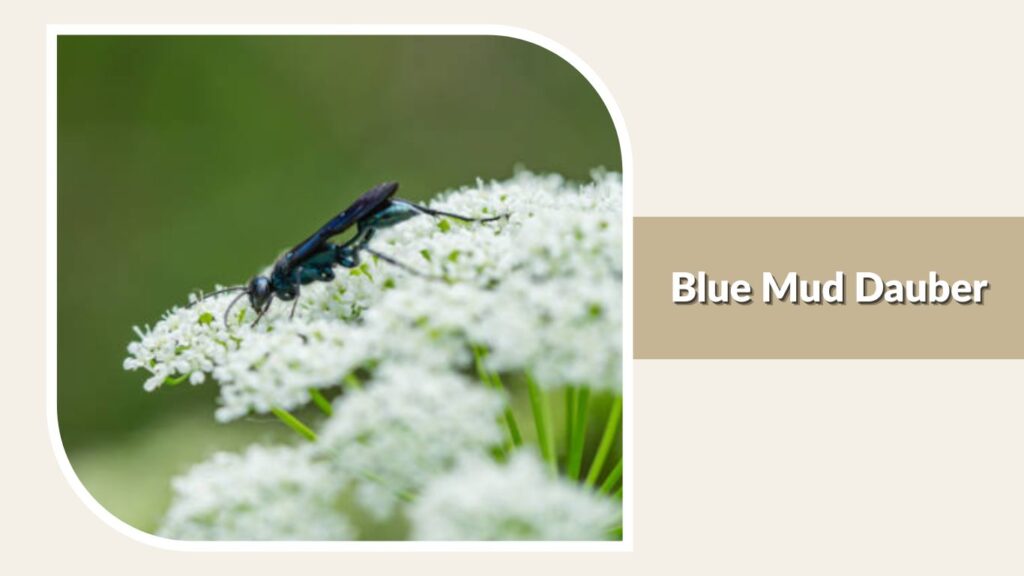
Blue mud daubers are solitary wasps known for their metallic blue or black appearance and their habit of building mud nests. They are generally non-aggressive and are often considered beneficial because they help control spider populations.
Identification
- Metallic blue or black shiny body
- Slender shape with a narrow waist
- Long legs and smooth body surface
- Builds tube-like mud nests on walls or structures
Habitat and Distribution
Blue mud daubers are found in many parts of the world, especially in warm and temperate regions. They prefer areas near water and human structures, such as houses, barns, and bridges, where they can easily find mud for nest building.
Behavior and Diet
These wasps are solitary and do not form colonies. They hunt spiders, especially black widows, which they paralyze and place in their nests as food for their larvae. Adult blue mud daubers mainly feed on nectar.
Lifecycle
The female builds a mud nest and fills it with paralyzed spiders before laying an egg inside. The larva hatches and feeds on the stored prey. After growing and pupating within the nest, the adult wasp emerges and continues the cycle.
24. Red Paper Wasp
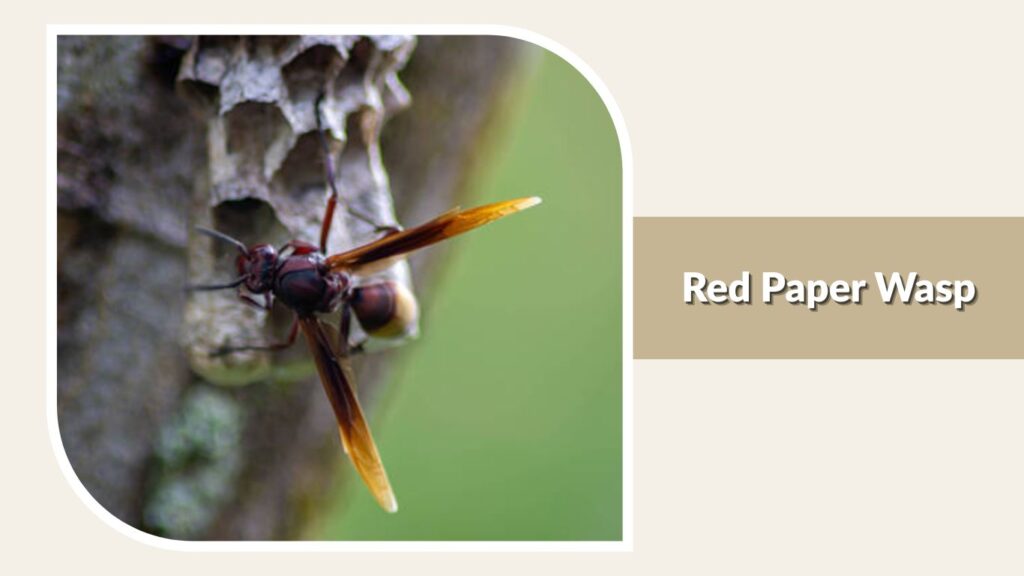
Red paper wasps are a type of paper wasp known for their reddish-brown coloration and long legs. They are commonly seen around homes and gardens, building open, umbrella-shaped nests. Although they can sting, they are usually not aggressive unless their nest is disturbed.
Identification
- Reddish-brown body color
- Slender body with long, dangling legs during flight
- Narrow waist and smooth, shiny appearance
- Wings folded lengthwise when at rest
Habitat and Distribution
Red paper wasps are commonly found in warm and temperate regions. They prefer to build nests in sheltered areas such as under roof eaves, tree branches, or inside sheds and garages.
Behavior and Diet
These wasps are social and live in small colonies. They feed on nectar and also hunt insects like caterpillars, making them helpful for natural pest control. They usually avoid humans but will defend their nests if threatened.
Lifecycle
A fertilized queen starts a new nest in spring and lays eggs. The first generation becomes workers that help expand the nest and care for the larvae. By late season, new queens and males are produced, and the colony eventually declines.
25. European Hornet
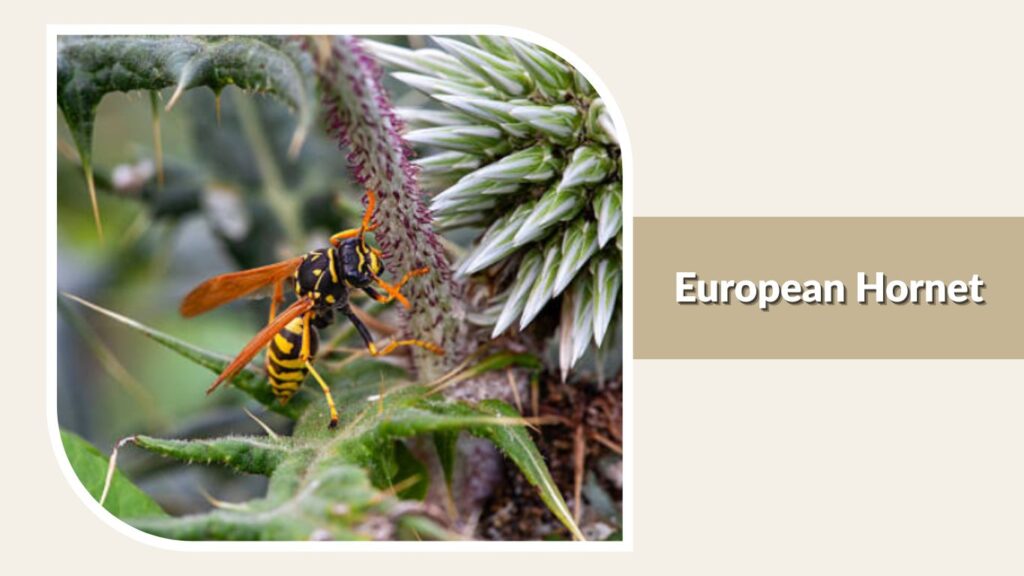
The European hornet is one of the largest true hornets and is known for its strong build and loud buzzing flight. Despite its intimidating size, it is generally less aggressive than some other hornet species unless its nest is threatened. It plays an important role in controlling insect populations.
Identification
- Large body with yellow and brown markings
- Robust shape with a broad head
- Reddish-brown thorax and yellow abdomen with black stripes
- Loud and noticeable flight
Habitat and Distribution
European hornets are found in forests, woodlands, and suburban areas. They are native to Europe but have also spread to other regions. They usually build large paper nests in tree hollows, wall cavities, or other sheltered spaces.
Behavior and Diet
These hornets are social insects that live in organized colonies. They feed on tree sap, fruit, and nectar, and they also hunt insects such as flies and beetles. This makes them beneficial for controlling pest populations.
Lifecycle
The lifecycle begins when a queen emerges in spring and starts a new nest. She lays eggs that develop into worker hornets, which take over feeding and nest building. Later in the season, new queens and males are produced before the colony declines in colder months.
26. Asian Giant Hornet
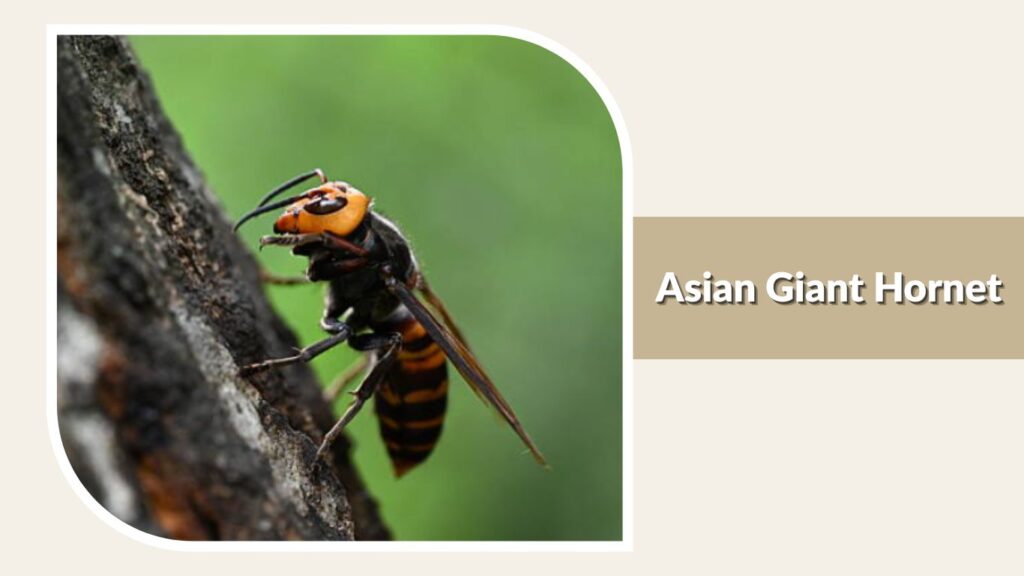
The Asian giant hornet is the largest hornet species in the world, known for its powerful build and strong mandibles. It has gained attention due to its ability to hunt other insects, especially bees. While it can be dangerous if provoked, it usually avoids humans unless its nest is threatened.
Identification
- Very large body size compared to other wasps
- Orange-yellow head with prominent eyes
- Brown and yellow striped abdomen
- Strong jaws and loud buzzing flight
Habitat and Distribution
Asian giant hornets are mainly found in forested and mountainous regions of Asia. They prefer areas with plenty of trees where they can build underground nests or use existing cavities.
Behavior and Diet
These hornets are social and live in colonies. They are powerful predators that hunt insects, including bees, to feed their larvae. Adult hornets feed on tree sap and sugary substances, and they are highly efficient hunters.
Lifecycle
A fertilized queen begins a new colony in spring by laying eggs. The first generation becomes workers that take over hunting and nest expansion. As the colony grows, it produces new queens and males, and the cycle continues with the next season.
27. Bald-Faced Hornet
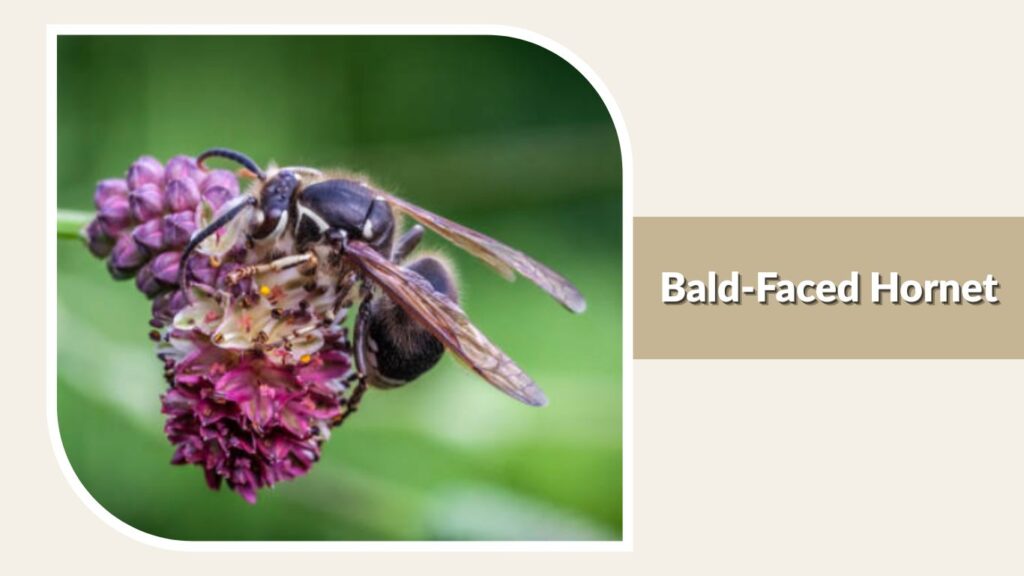
The bald-faced hornet is a large, black-and-white wasp known for its striking appearance and aggressive defense of its nest. Despite its name, it is actually a type of yellowjacket. These wasps are highly social and are often seen around trees, shrubs, and buildings.
Identification
- Black body with distinct white markings on the face and abdomen
- Large, robust body shape
- Smooth and shiny appearance
- Builds large, enclosed paper nests
Habitat and Distribution
Bald-faced hornets are commonly found in North America. They prefer forests, gardens, and suburban areas, where they build their nests in trees, bushes, or on buildings in elevated and protected locations.
Behavior and Diet
These hornets are social insects that live in large colonies. They feed on nectar and fruit, but they also hunt insects such as flies and caterpillars. They are very protective of their nests and can become aggressive if disturbed.
Lifecycle
The lifecycle begins when a fertilized queen starts a new nest in spring. She raises the first group of workers, which then take over tasks like feeding and nest expansion. Later in the season, new queens and males are produced before the colony dies off in colder weather.
28. Great Golden Digger Wasp
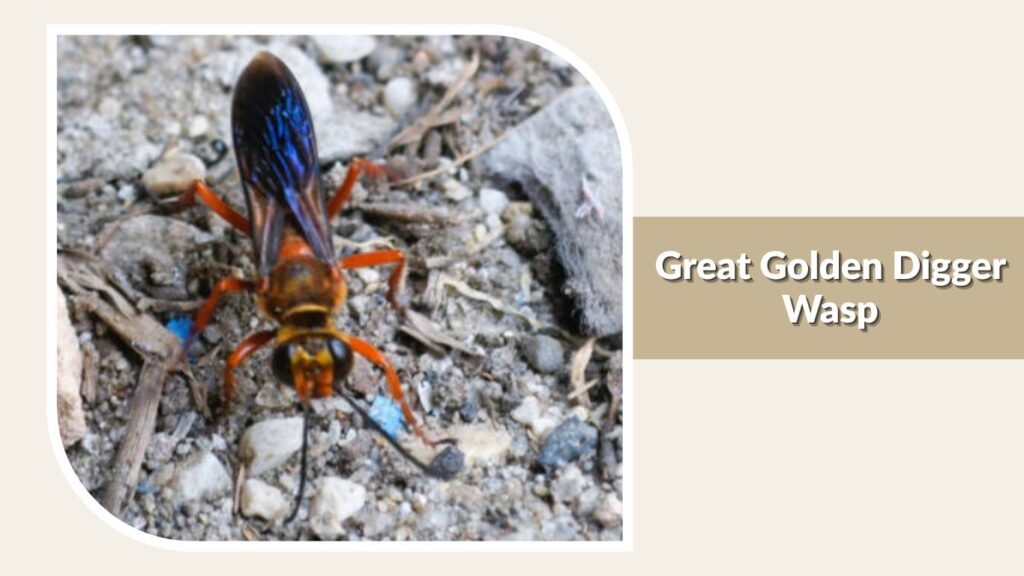
The great golden digger wasp is a large, eye-catching wasp known for its golden-orange coloration and burrowing behavior. It is a solitary insect and is generally not aggressive toward humans. This wasp is beneficial because it helps control populations of pest insects.
Identification
- Large body with bright golden-orange and black coloring
- Slender shape with a narrow waist
- Long legs adapted for digging
- Clear wings with a slightly smoky appearance
Habitat and Distribution
Great golden digger wasps are commonly found in North America. They prefer open, sandy areas such as gardens, fields, and forest edges where they can dig burrows for nesting.
Behavior and Diet
These wasps are solitary and hunt insects like grasshoppers and crickets. They paralyze their prey and place it in underground nests as food for their larvae. Adult wasps feed mainly on nectar from flowers.
Lifecycle
The female digs a burrow in the soil and creates chambers where she stores paralyzed prey. She lays an egg in each chamber. The larva hatches and feeds on the stored food, then pupates and later emerges as an adult wasp.
29. Ammophila Wasp
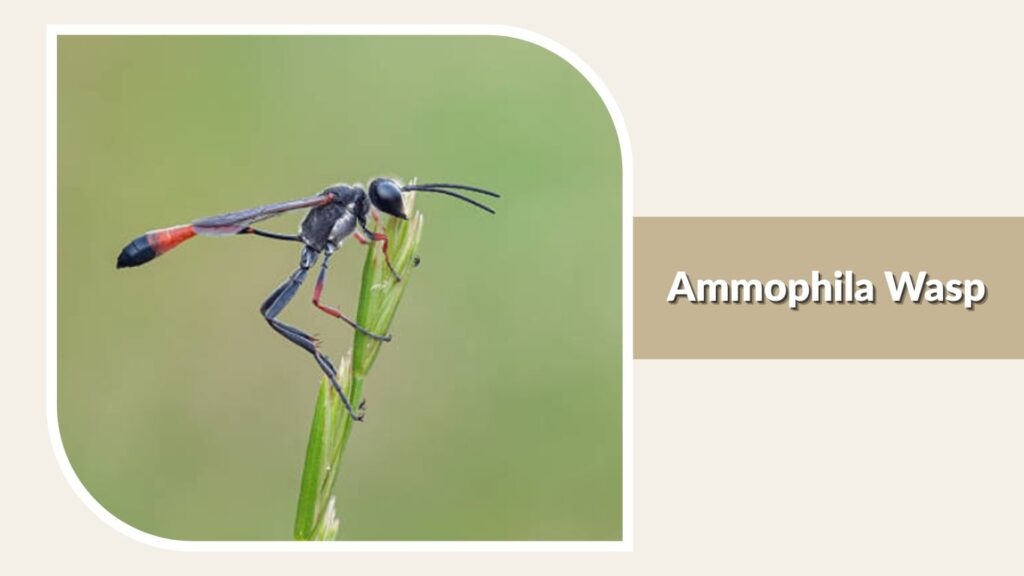
Ammophila wasps are slender, solitary wasps known for their long, thread-like waists and graceful movements. They are skilled hunters and are often seen flying low over the ground in search of prey. These wasps are beneficial because they help control caterpillar populations.
Identification
- Very slender body with an extremely thin, thread-like waist
- Usually black with a reddish or orange abdomen
- Long legs and narrow wings
- Smooth and shiny body surface
Habitat and Distribution
Ammophila wasps are found in many parts of the world, especially in warm and temperate regions. They prefer sandy or loose soil areas such as fields, gardens, and open landscapes where they can dig nests.
Behavior and Diet
These wasps are solitary hunters that mainly prey on caterpillars. They sting and paralyze their prey, then carry it to a burrow as food for their larvae. Adult Ammophila wasps feed on nectar from flowers.
Lifecycle
The female digs a burrow in the ground and places a paralyzed caterpillar inside. She lays an egg on the prey, and once the larva hatches, it feeds on the stored food. After growing and pupating, the adult wasp emerges and continues the life cycle.
30. Sphex Wasp
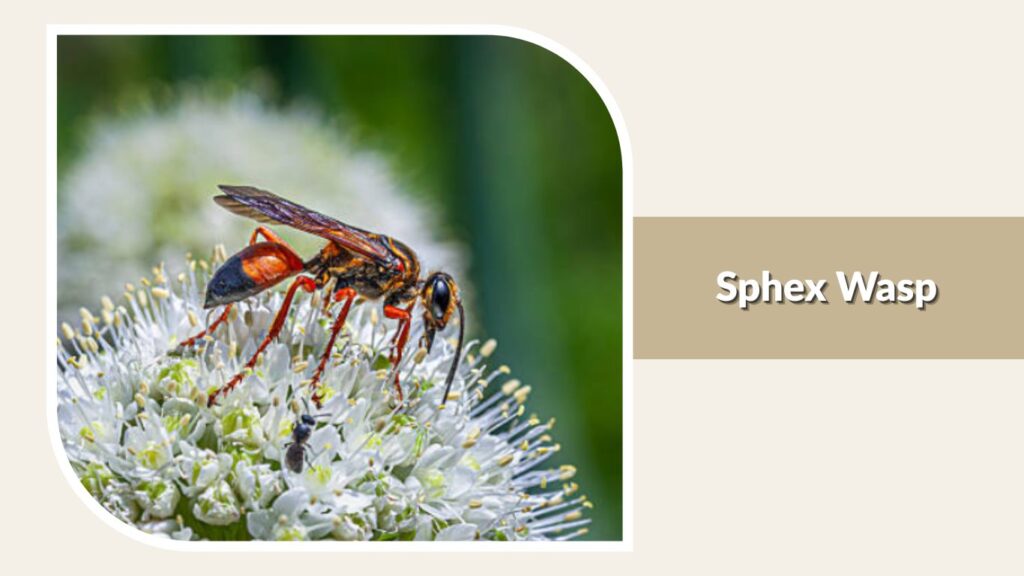
Sphex wasps are solitary hunting wasps known for their strong bodies and methodical behavior. They are often seen carrying paralyzed prey to their nests. These wasps are generally non-aggressive and are beneficial for controlling insect populations.
Identification
- Medium to large body with a narrow waist
- Usually black or dark-colored, sometimes with reddish markings
- Long legs and strong mandibles
- Smooth body with clear wings
Habitat and Distribution
Sphex wasps are found in many parts of the world, especially in warm and temperate regions. They prefer sandy or loose soil areas such as gardens, fields, and open ground where they can dig burrows.
Behavior and Diet
Sphex wasps are solitary hunters that capture insects such as grasshoppers and crickets. They paralyze their prey and place it in underground nests as food for their larvae. Adult wasps mainly feed on nectar.
Lifecycle
The female digs a burrow and prepares chambers where she stores paralyzed prey. She lays an egg on the prey, and the larva feeds on it after hatching. Once fully developed, it pupates and later emerges as an adult wasp.
31. Scoliidae Wasp
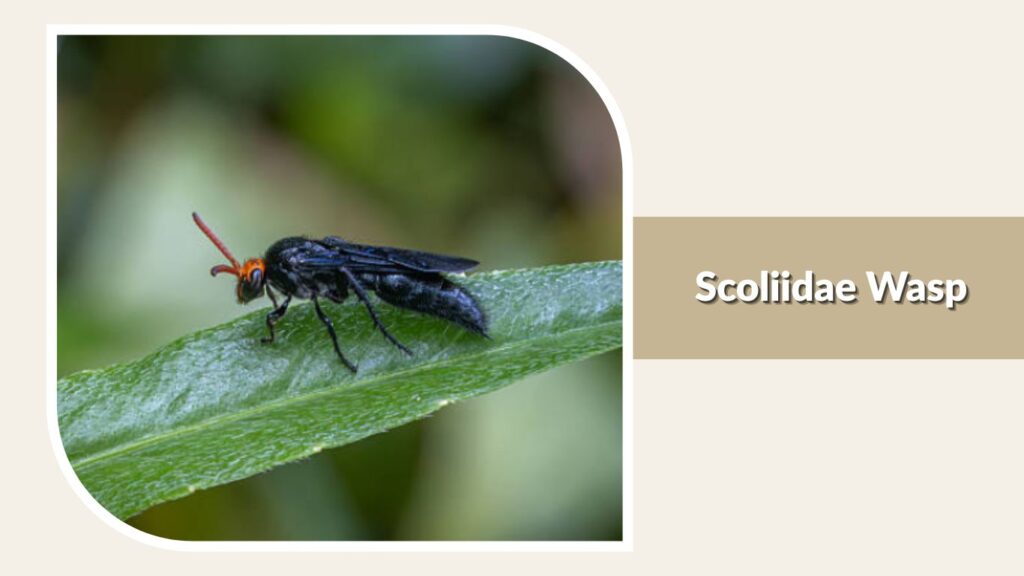
Scoliidae wasps, commonly known as scoliid wasps, are large, solitary wasps that are important natural controllers of soil-dwelling pests. They are often seen flying low over the ground in search of hosts. Despite their size, they are generally harmless to humans.
Identification
- Large, robust body with a hairy appearance
- Usually black with yellow or orange markings
- Broad wings and strong legs
- Slow and heavy flight
Habitat and Distribution
Scoliidae wasps are found in warm and temperate regions around the world. They prefer open areas such as gardens, fields, and sandy soils where their host insects, like beetle larvae, are commonly found.
Behavior and Diet
These wasps are parasitic and target beetle larvae living in the soil. The female digs into the ground, finds a host larva, and paralyzes it. Adult scoliid wasps feed mainly on nectar and are often seen visiting flowers.
Lifecycle
The female locates a beetle larva underground, paralyzes it, and lays an egg on it. When the egg hatches, the larva feeds on the host. After completing development, it pupates in the soil and later emerges as an adult wasp.
32. Tiphiid Wasp
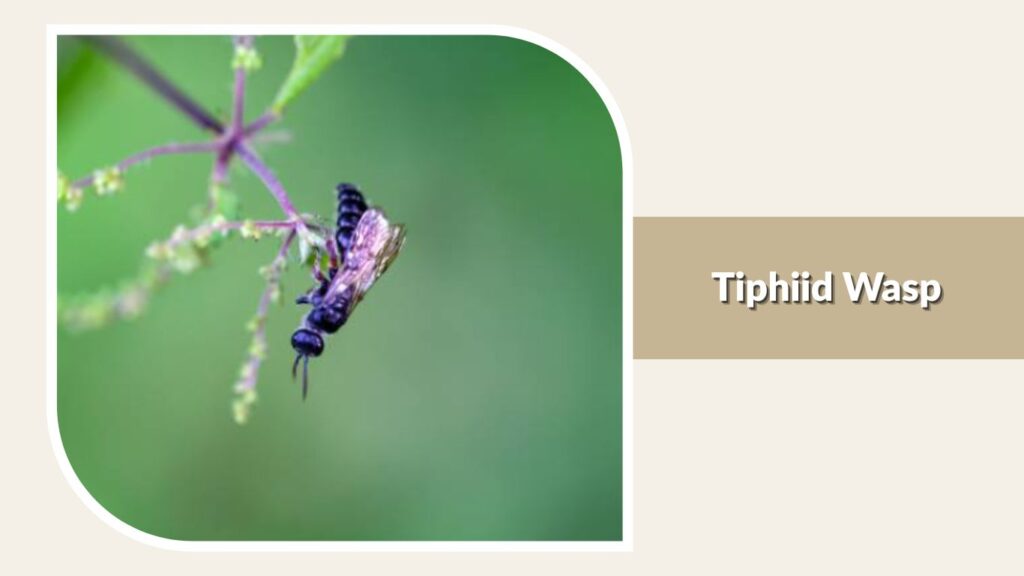
Tiphiid wasps are solitary parasitic wasps that are often found near the ground, searching for hosts. They are not aggressive toward humans and are beneficial because they help control populations of soil-dwelling insects, especially beetle larvae.
Identification
- Slender to medium-sized body
- Usually black or dark brown in color
- Females are often wingless, while males have wings
- Narrow waist and smooth body
Habitat and Distribution
Tiphiid wasps are widely distributed across warm and temperate regions. They are commonly found in sandy soils, gardens, and open fields where their host insects, such as beetle larvae, live underground.
Behavior and Diet
These wasps are parasitic and target beetle larvae. The female searches the soil, locates a host, and paralyzes it before laying an egg. Adult tiphiid wasps feed mainly on nectar and are often seen visiting flowers.
Lifecycle
The female finds a beetle larva in the soil, paralyzes it, and lays an egg on its body. After hatching, the wasp larva feeds on the host. It then pupates in the ground and eventually emerges as an adult wasp, continuing the cycle.
33. Pompilid Wasp
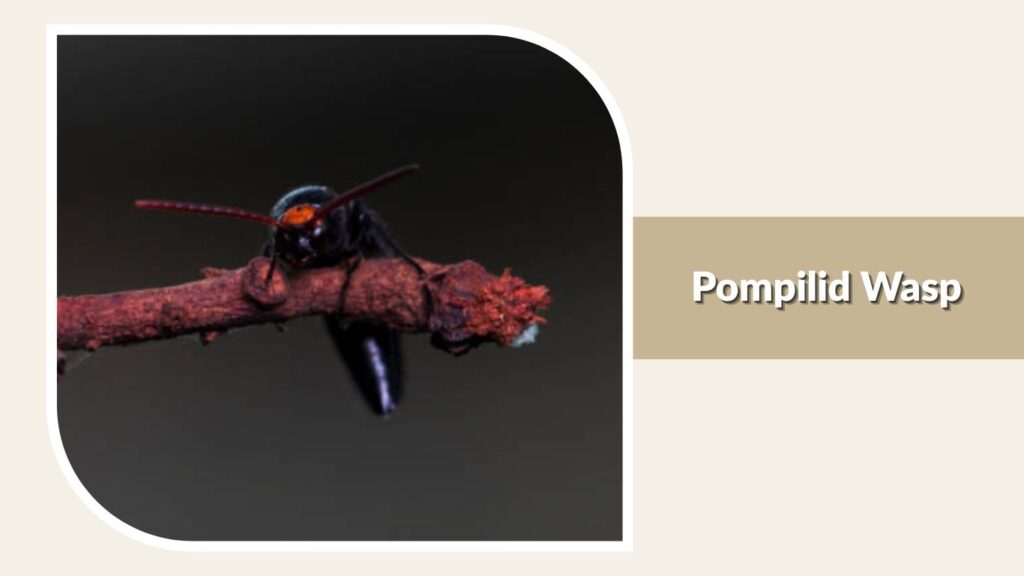
Pompilid wasps, commonly known as spider wasps, are skilled hunters that specialize in capturing spiders. They are solitary insects and are known for their quick movements and powerful stings used to subdue their prey. These wasps are generally not aggressive unless handled.
Identification
- Slender body with long legs
- Usually black or dark-colored, sometimes with orange or reddish wings
- Curved antennae
- Strong stinger used for paralyzing spiders
Habitat and Distribution
Pompilid wasps are found worldwide, especially in warm and tropical regions. They prefer open habitats such as gardens, grasslands, forests, and deserts where spiders are abundant.
Behavior and Diet
These wasps are solitary hunters that specialize in spiders. They sting and paralyze their prey, then drag it to a nest as food for their larvae. Adult pompilid wasps feed mainly on nectar from flowers.
Lifecycle
The female hunts a spider, paralyzes it, and places it in a nest or burrow. She lays an egg on the spider, and once the larva hatches, it feeds on the still-living prey. After pupation, an adult wasp emerges and continues the cycle.
34. Crabronid Wasp
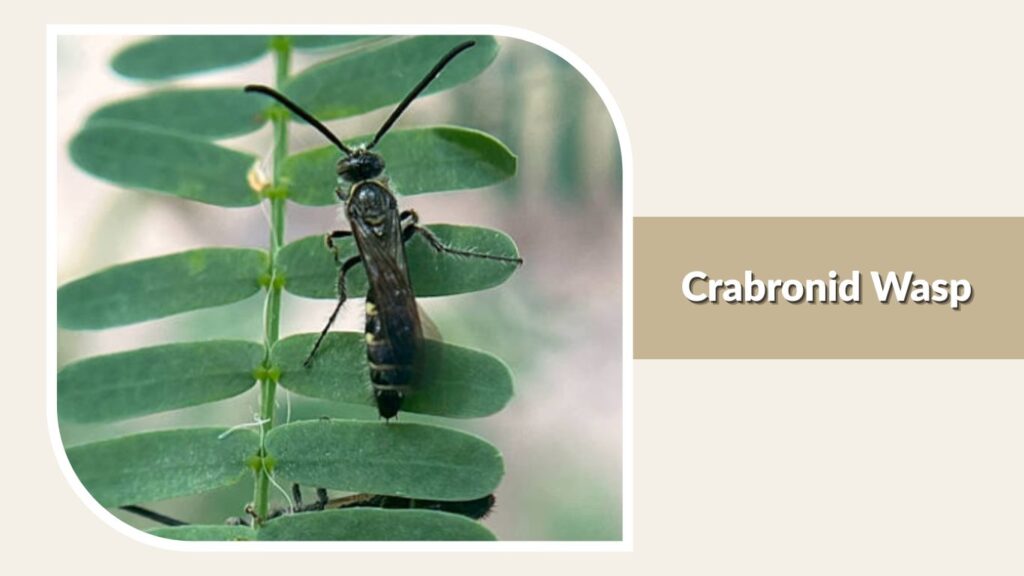
Crabronid wasps are a diverse group of solitary wasps that are known for their hunting skills. They are generally non-aggressive and play an important role in controlling insect populations. Many species within this group are skilled at capturing flies and other small insects.
Identification
- Small to medium-sized body
- Usually black or dark-colored, sometimes with yellow markings
- Slender shape with a narrow waist
- Clear wings and strong legs
Habitat and Distribution
Crabronid wasps are found worldwide in a variety of habitats, including forests, gardens, and sandy areas. They often build nests in soil, wood, or hollow plant stems depending on the species.
Behavior and Diet
These wasps are solitary hunters that capture insects such as flies and aphids. They paralyze their prey and store it in nests as food for their larvae. Adult crabronid wasps mainly feed on nectar.
Lifecycle
The female prepares a nest in soil or plant material and stocks it with paralyzed prey. She lays an egg on the food source, and the larva feeds on it after hatching. After developing and pupating, the adult wasp emerges to continue the lifecycle.
35. Vespid Wasp
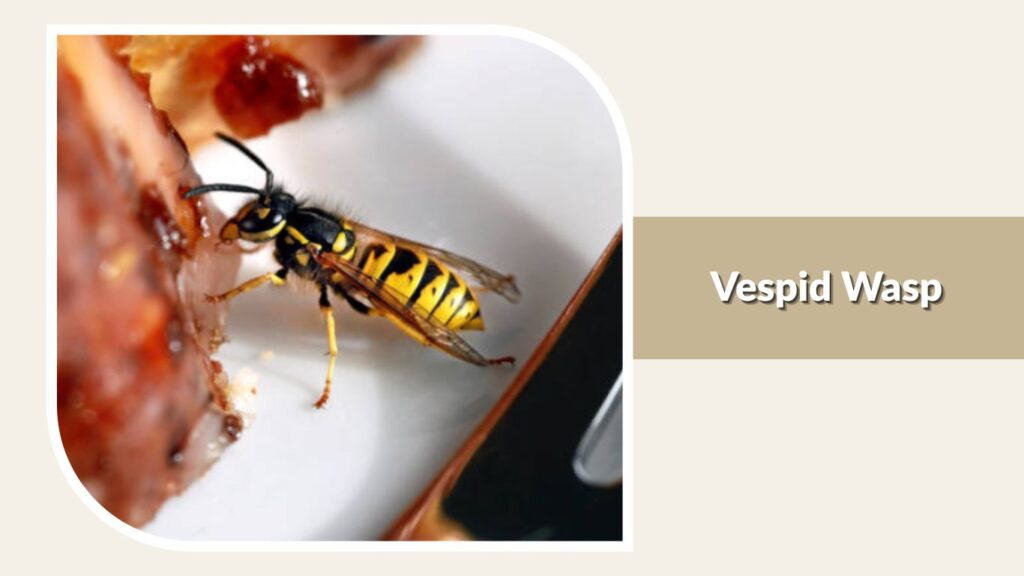
Vespid wasps belong to a large family that includes many well-known social wasps such as yellowjackets and hornets. They are known for their complex social behavior and ability to build paper-like nests. Vespid wasps can be both beneficial and defensive, depending on the situation.
Identification
- Medium-sized body with a narrow waist
- Usually black and yellow or black and white markings
- Smooth and shiny body surface
- Folded wings when at rest
Habitat and Distribution
Vespid wasps are found worldwide in a wide range of habitats, including forests, gardens, and urban areas. They typically build paper nests in trees, underground spaces, or on buildings, depending on the species.
Behavior and Diet
These wasps can be social or solitary, but many species live in organized colonies. They feed on nectar, fruits, and insects. Vespid wasps help control pest populations by hunting other insects, making them useful in ecosystems.
Lifecycle
A queen begins a new colony in spring by building a nest and laying eggs. The first generation becomes workers that take over tasks like feeding and nest expansion. Later, new queens and males are produced before the colony declines at the end of the season.
36. Eumenine Wasp
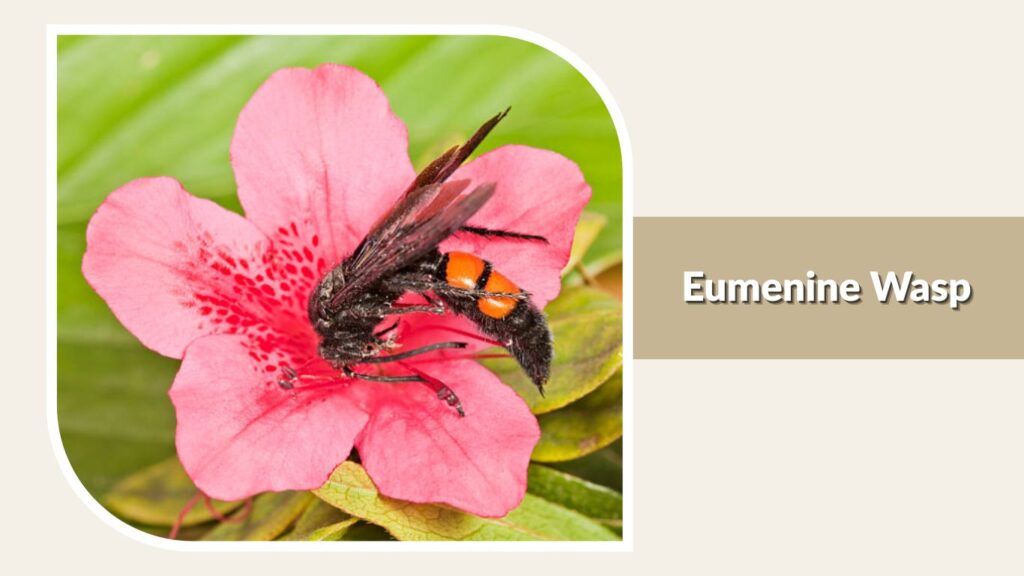
Eumenine wasps, also known as potter or mason wasps, are solitary insects famous for their skill in building small mud nests. They are generally calm and rarely sting humans. These wasps are beneficial because they help control caterpillar populations.
Identification
- Medium-sized body with a narrow waist
- Usually black or dark with yellow or white markings
- Smooth and slightly shiny appearance
- Often associated with small mud pot nests
Habitat and Distribution
Eumenine wasps are found worldwide, especially in warm and temperate regions. They prefer areas with access to mud and sheltered surfaces like walls, rocks, and plant stems where they can build their nests.
Behavior and Diet
These wasps are solitary and do not live in colonies. They hunt caterpillars and other soft-bodied insects, which they paralyze and store in their nests. Adult eumenine wasps feed mainly on nectar.
Lifecycle
The female builds a small mud nest divided into chambers. She places paralyzed prey inside each chamber and lays an egg. The larva feeds on the stored food, then pupates inside the nest before emerging as an adult wasp.
37. Polistes Wasp
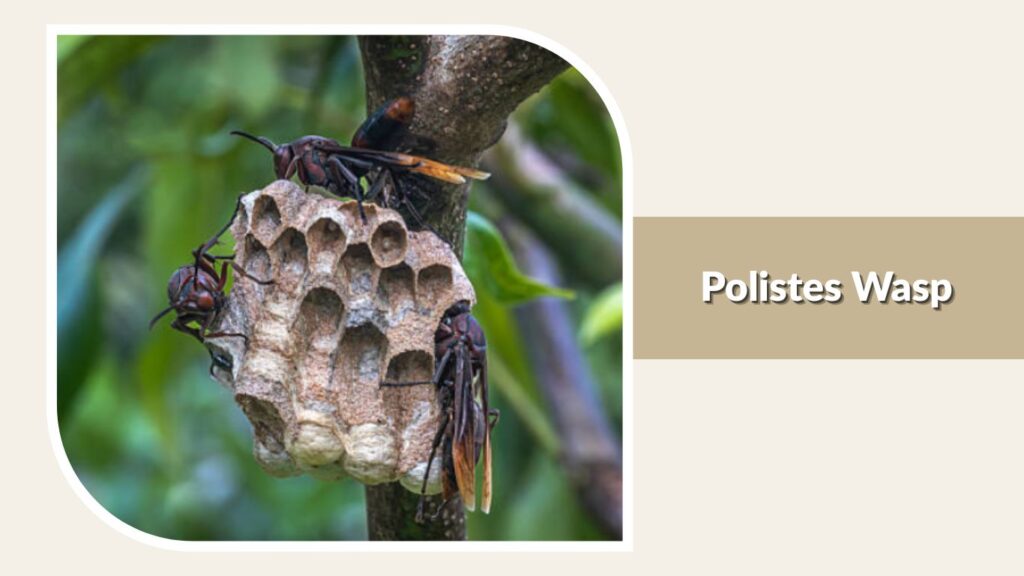
Polistes wasps are commonly known as paper wasps and are among the most familiar social wasps. They are recognized for their open, umbrella-shaped nests and relatively less aggressive behavior compared to other social wasps. These wasps are beneficial for controlling garden pests.
Identification
- Slender body with a narrow waist
- Long legs that hang down during flight
- Usually brown, yellow, or reddish in color
- Wings folded lengthwise when at rest
Habitat and Distribution
Polistes wasps are found worldwide, especially in warm and temperate regions. They often build their nests in sheltered places such as under roof eaves, tree branches, and inside sheds or garages.
Behavior and Diet
These wasps are social and live in small colonies. They feed on nectar and also hunt insects like caterpillars, making them helpful for natural pest control. They are generally non-aggressive but will defend their nest if disturbed.
Lifecycle
A queen starts a new colony in spring by building a nest and laying eggs. The first generation becomes workers that help expand the nest and care for the young. Later in the season, new queens and males are produced before the colony declines.
38. Vespa Wasp
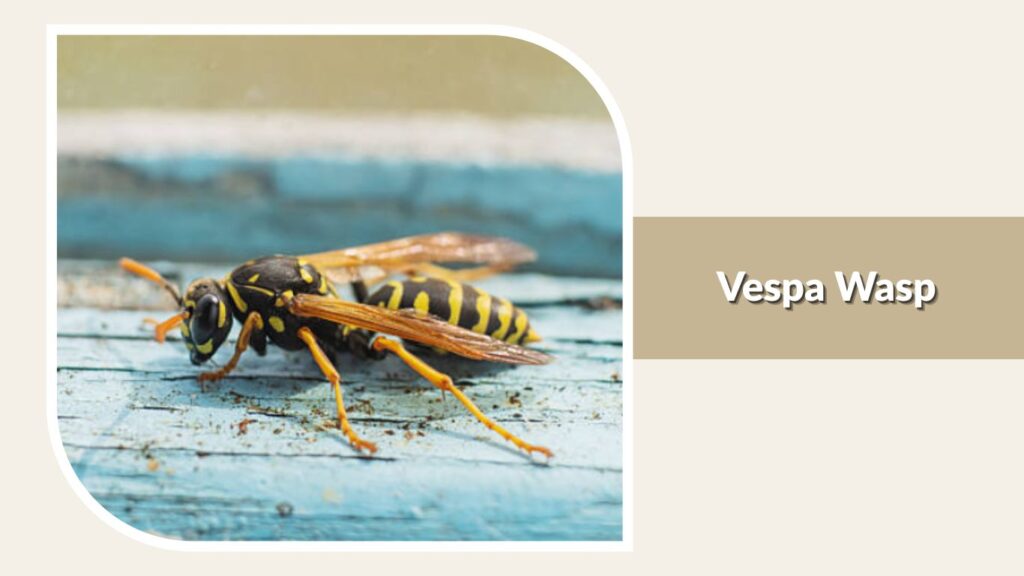
Vespa wasps are commonly known as true hornets and are among the largest social wasps. They are known for their strong build, organized colonies, and ability to defend their nests aggressively. Despite their intimidating appearance, they also play a useful role in controlling insect populations.
Identification
- Large and robust body
- Usually yellow, black, or brown with bold markings
- Broad head with strong jaws
- Loud buzzing flight
Habitat and Distribution
Vespa wasps are mainly found in Asia and Europe, though some species have spread to other regions. They prefer forests, woodlands, and sometimes urban areas, where they build large paper nests in trees, underground, or inside structures.
Behavior and Diet
These wasps are highly social and live in well-organized colonies. They feed on nectar, tree sap, and fruits, but they also hunt insects such as bees and flies to feed their larvae. They can be aggressive when protecting their nest.
Lifecycle
The lifecycle begins when a fertilized queen emerges in spring and starts building a nest. She lays eggs that develop into workers, which take over feeding and nest expansion. Later, new queens and males are produced before the colony declines.
39. Dolichovespula Wasp
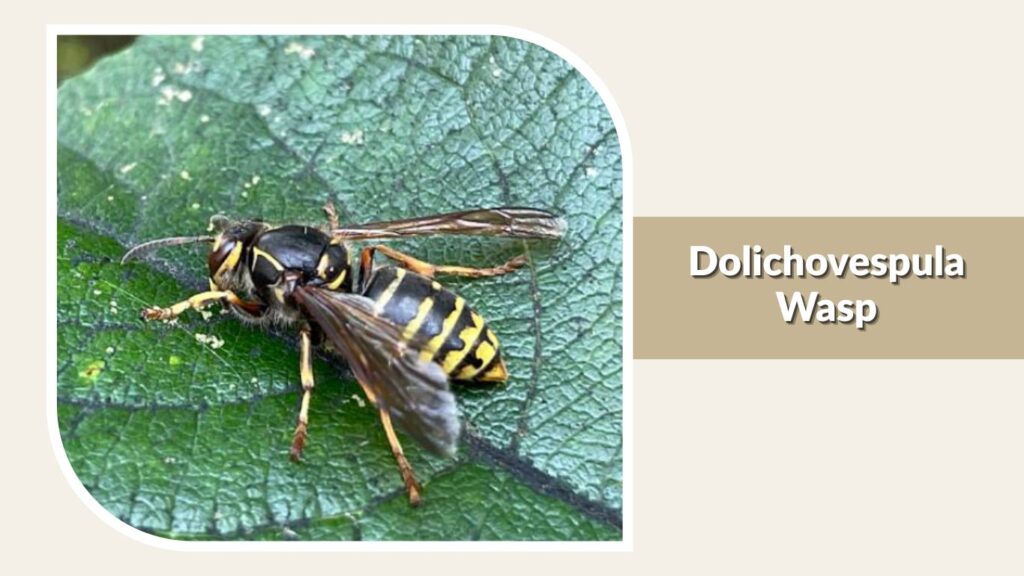
Dolichovespula wasps are a group of social wasps that include several species commonly known as aerial yellowjackets. They are known for building enclosed paper nests above ground and can be quite defensive when their nest is disturbed. These wasps are important for controlling insect populations.
Identification
- Medium-sized body with black and yellow or black and white markings
- Smooth and shiny appearance
- Slender shape with a narrow waist
- Builds enclosed, paper-like nests above ground
Habitat and Distribution
Dolichovespula wasps are found in temperate regions across the Northern Hemisphere. They prefer forests, gardens, and suburban areas, often building nests in trees, shrubs, or on buildings in sheltered locations.
Behavior and Diet
These wasps are social and live in organized colonies. They feed on nectar, fruits, and insects such as flies and caterpillars. While beneficial for pest control, they can become aggressive if their nest is threatened.
Lifecycle
A queen starts a new colony in spring by building a nest and laying eggs. The first generation becomes worker wasps that take over feeding and nest expansion. By late season, new queens and males are produced, and the colony declines as colder weather approaches.
40. Microgastrinae Wasp
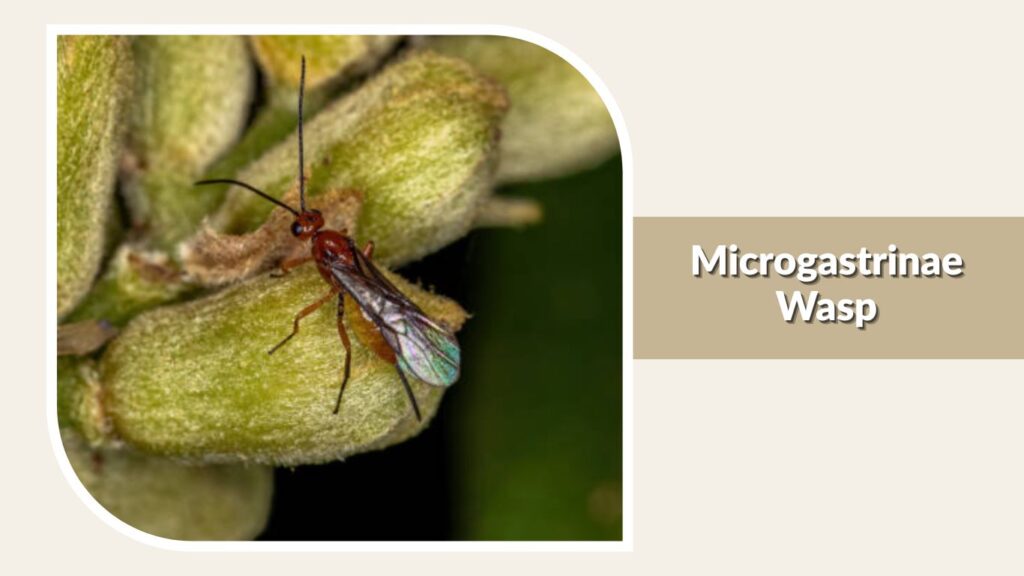
Microgastrinae wasps are a group of tiny parasitic wasps that are widely known for their role in controlling caterpillar populations. They are very important in agriculture and natural ecosystems because they help reduce the number of harmful insect pests.
Identification
- Very small body size
- Usually black or dark brown in color
- Slender body with short antennae
- Delicate wings and narrow waist
Habitat and Distribution
Microgastrinae wasps are found worldwide in forests, gardens, and agricultural areas. They are especially common in places where caterpillars are abundant, as they rely on them as hosts for their larvae.
Behavior and Diet
These wasps are parasitic and specifically target caterpillars. The female lays eggs inside the caterpillar, and the larvae develop by feeding on it. Adult Microgastrinae wasps feed mainly on nectar and plant fluids.
Lifecycle
The female injects eggs into a caterpillar host. After hatching, the larvae feed internally and eventually emerge from the caterpillar to pupate nearby. Once fully developed, adult wasps emerge and continue the reproductive cycle.
41. Aphidius Wasp
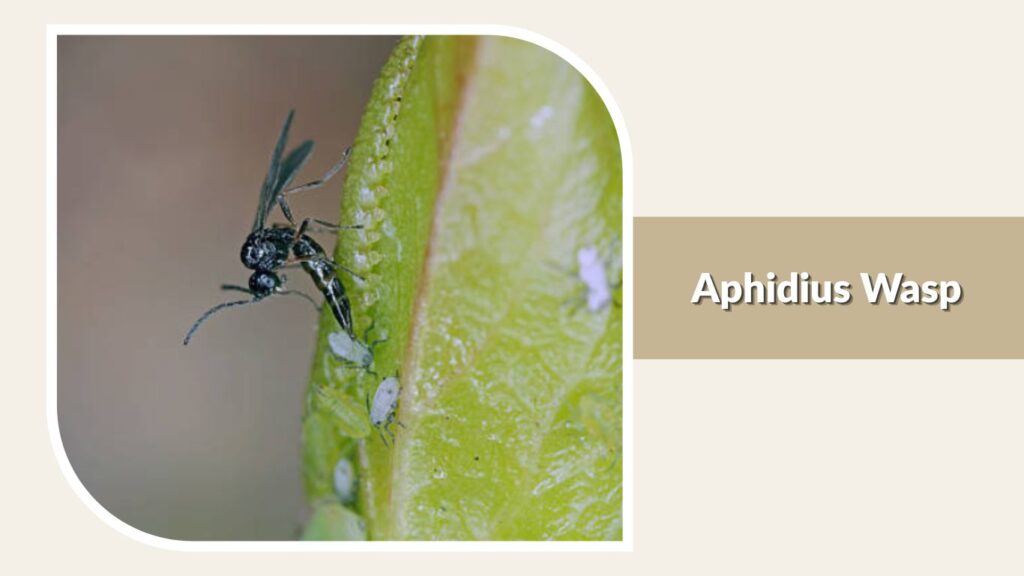
Aphidius wasps are small parasitic wasps that are highly effective in controlling aphid populations. They are widely used in agriculture and gardening as natural biological control agents. These wasps are harmless to humans and play an important role in maintaining plant health.
Identification
- Very small and slender body
- Usually black or dark brown in color
- Long antennae relative to body size
- Clear wings with a delicate structure
Habitat and Distribution
Aphidius wasps are found worldwide, especially in gardens, greenhouses, and agricultural fields. They are commonly present in areas where aphids are abundant, as they rely on them for reproduction.
Behavior and Diet
These wasps are parasitic and specifically target aphids. The female lays eggs inside an aphid, and the developing larva feeds on it. Adult Aphidius wasps feed mainly on nectar and plant fluids.
Lifecycle
The female injects an egg into an aphid. After hatching, the larva feeds on the aphid from the inside, eventually killing it and forming a hardened shell known as a “mummy.” The adult wasp later emerges and continues the cycle.
42. Leucospis Wasp
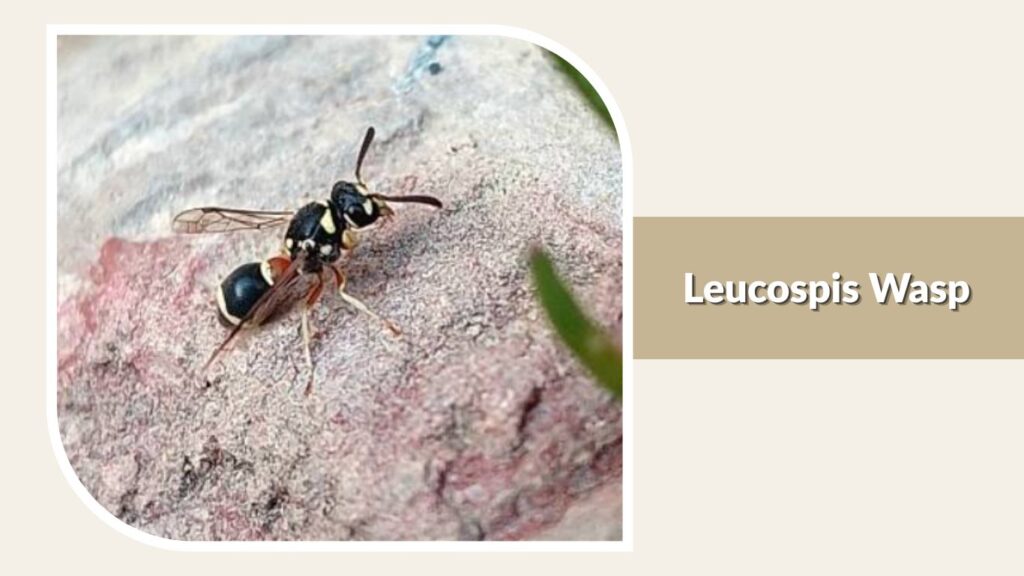
Leucospis wasps are distinctive parasitic wasps known for their strong bodies and unique egg-laying behavior. They are not harmful to humans and are mostly observed around areas where solitary bees are present. These wasps play a role in balancing insect populations.
Identification
- Medium-sized, robust body
- Usually black with yellow or white markings
- Thick hind legs and curved abdomen
- Females have a long, curved ovipositor that rests along the back
Habitat and Distribution
Leucospis wasps are found in warm and temperate regions around the world. They are commonly seen in gardens, forests, and areas where solitary bees build nests, as they depend on these nests for reproduction.
Behavior and Diet
These wasps are parasitic and target the nests of solitary bees. The female lays her eggs inside the host nest, and the larvae feed on the host’s larvae or stored food. Adult Leucospis wasps typically feed on nectar.
Lifecycle
The female uses her ovipositor to place an egg inside a host nest, usually that of a bee. After hatching, the larva consumes the host or its food supply. It then pupates within the nest and eventually emerges as an adult wasp, continuing the life cycle.
FAQs
Are all wasps aggressive?
Not all wasps are aggressive. Many species, especially solitary wasps, are calm and rarely sting humans. Social wasps like yellowjackets and hornets are more defensive and may sting if their nests are disturbed.
Do wasps have any benefits in nature?
Yes, wasps are very beneficial. They help control pest insect populations by hunting or parasitizing harmful species. Many wasps also contribute to pollination, making them important for maintaining healthy ecosystems.
What do wasps eat?
Wasps have varied diets depending on the species. Adult wasps often feed on nectar, fruits, or sugary substances, while many species hunt insects or spiders to feed their larvae.
How do wasps build their nests?
Different wasps use different materials. Some build paper-like nests from chewed wood fibers, while others use mud or dig burrows in the ground. Nesting behavior depends on whether the wasp is social or solitary.
What should you do if you see a wasp nest?
If you see a wasp nest, it is best to keep a safe distance and avoid disturbing it. Most wasps will not attack unless threatened. If the nest is in a risky location, consider contacting professionals to handle it safely.