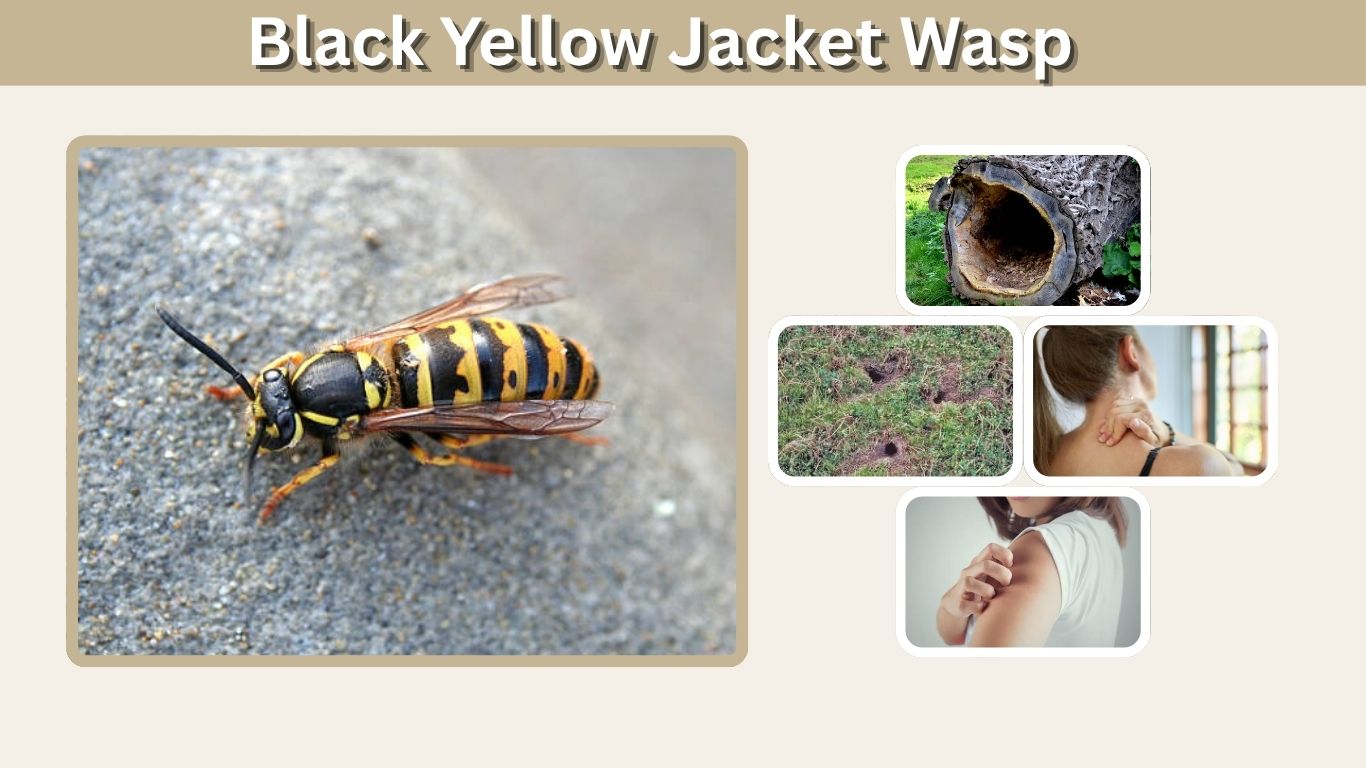
A black yellow jacket is a small social wasp recognized by its bold black-and-yellow markings, smooth body, rapid flight, and painful sting. Although people frequently call it a “black yellow jacket bee,” it is a wasp rather than a bee. These insects may build large colonies underground, inside wall cavities, or in protected aerial locations. Learning how to recognize their appearance, nesting behavior, food preferences, and common look-alikes can help you avoid dangerous encounters around your home or yard.
What Is a Black Yellow Jacket?
“Black yellow jacket” is not the official name of one species. It is a general description used for several yellowjacket wasps in the genera Vespula and Dolichovespula. Most familiar species have sharply contrasting yellow and black bands, although some related species have black-and-white markings.
Yellowjackets are social insects. A colony contains a queen, female workers, developing larvae, and, later in the season, males and new queens. The workers cooperate to collect food, expand the nest, feed the larvae, and defend the colony.
Black Yellow Jacket Identification
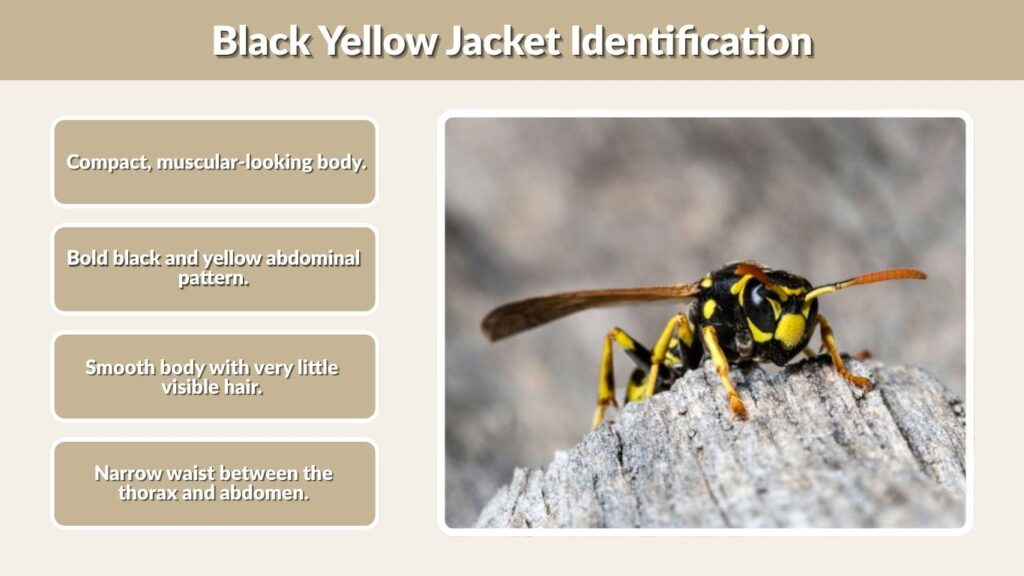
Yellowjackets are usually about ⅜ to ⅝ inch long, although queens can be noticeably larger. They have compact bodies with smooth surfaces and relatively little hair. Their bright markings vary among species, but the abdomen normally has black and yellow bands or patches.
Main Identification Features
Look for the following characteristics:
- Compact, muscular-looking body
- Bold black and yellow abdominal pattern
- Smooth body with very little visible hair
- Narrow waist between the thorax and abdomen
- Dark, relatively short antennae
- Six yellow, black, or partly yellow legs
- Clear wings folded over the back when resting
- Fast, direct, side-to-side flight
The exact black stripe pattern can help specialists distinguish species, but color alone is not always reliable.
Black Yellow Jacket Size
Most workers are approximately the size of a honey bee. A large queen may approach an inch long, particularly when seen in spring before she establishes a colony.
An unusually big black-and-yellow insect may not be a yellowjacket. Cicada killers, European hornets, paper wasps, and mud daubers can all be substantially larger.
| Insect | Typical Appearance | Key Difference |
| Yellowjacket | Compact, black and yellow | Smooth body and short legs |
| Honey bee | Golden-brown and black | Hairy body and pollen baskets |
| Paper wasp | Slender, brown or black and yellow | Long dangling legs |
| Mud dauber | Black and yellow | Extremely thin, threadlike waist |
| Hoverfly | Black and yellow | One pair of wings and no stinger |
| Cicada killer | Large, black and yellow | Much bigger and usually solitary |
Is a Black Yellow Jacket a Bee?
A black yellow jacket is a wasp, not a bee. The confusion occurs because yellowjackets and honey bees are similar in size and may share striped patterns.
Yellowjacket vs Honey Bee
Honey bees have fuzzy, golden-brown bodies that help collect pollen. Female workers also have pollen-carrying structures on their hind legs. Yellowjackets have smoother, brighter bodies and do not carry visible pollen.
Their feeding behavior is also different. Honey bees mainly visit flowers for nectar and pollen. Yellowjackets hunt insects and may gather meat, sugary drinks, ripe fruit, garbage, and other human foods.
| Feature | Yellowjacket | Honey Bee |
| Body covering | Smooth with sparse hair | Noticeably fuzzy |
| Color | Bright yellow and black | Golden-brown and black |
| Food | Insects, meat and sugary foods | Nectar and pollen |
| Stinger | Can sting repeatedly | Worker usually stings once |
| Nest | Paper nest in a cavity | Wax comb inside a hive |
What Is a Black and White Yellow Jacket?
Not every yellowjacket is yellow. The bald-faced hornet has a mostly black body with ivory-white markings. Despite its common name, it is not a true hornet. It is an aerial yellowjacket belonging to the genus Dolichovespula.
Bald-faced hornets are larger than many ground-nesting yellowjackets and construct enclosed, gray paper nests in trees, shrubs, under roof edges, or on buildings. They normally ignore people while foraging but strongly defend their nest when it is disturbed.
Where Do Black Yellow Jackets Build Nests?
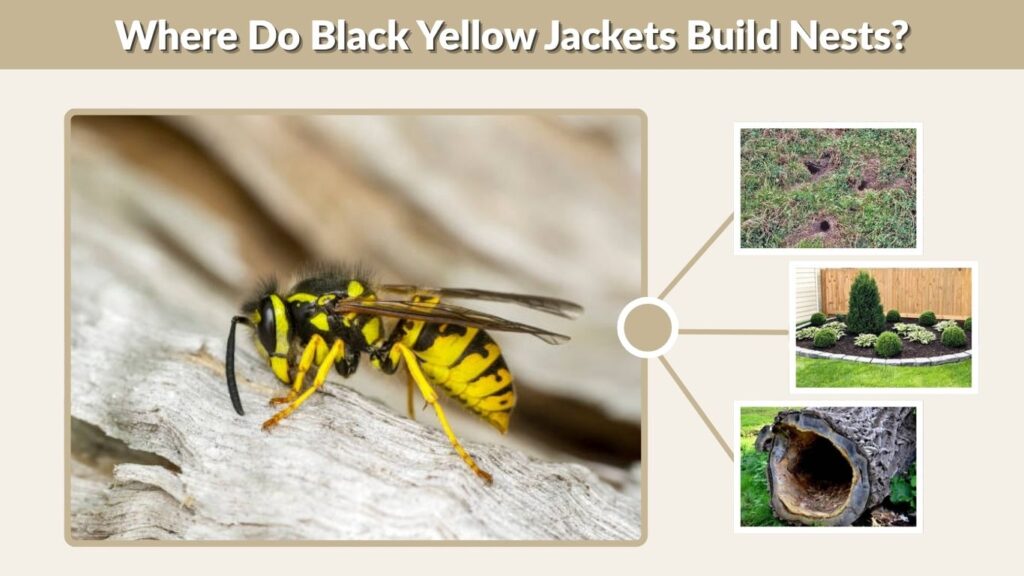
Different species choose different nesting locations. Many Vespula yellowjackets establish underground colonies, while several Dolichovespula species build aerial nests.
Common Nesting Sites
Black-and-yellow jacket nests may be found:
- Inside abandoned rodent burrows
- Beneath shrubs or landscaping materials
- In hollow logs and tree cavities
- Behind siding or inside wall voids
- Under porches, decks or sheds
- Inside attics and roof spaces
- Suspended from tree branches
A ground nest may be difficult to see. The clearest warning is a steady flow of workers entering and leaving one small opening. Unlike solitary ground wasps, numerous yellowjackets share the same colony entrance.
What Does the Nest Look Like?
Yellowjackets make paper by chewing weathered wood fibers and mixing them with saliva. Their nest contains stacked combs surrounded by a protective paper envelope.
Do not seal an active wall opening without treating the colony. Trapped workers may search for another exit and enter the occupied part of the building.
Black Yellow Jacket Behavior and Diet
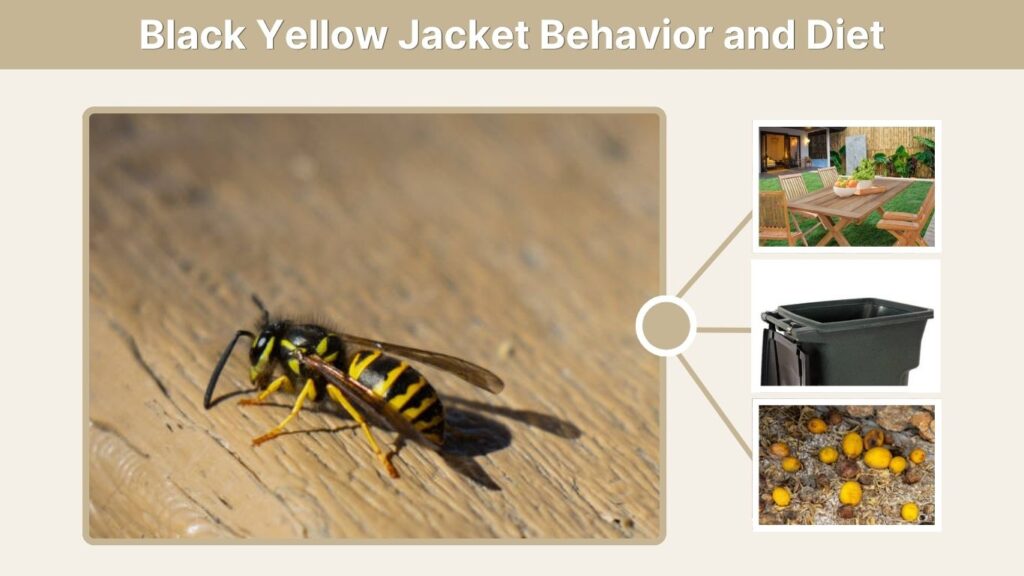
Yellowjackets are both predators and scavengers. Workers capture caterpillars, flies, and other insects, which provide protein for developing larvae. Adults consume sugary materials, including nectar, fruit juices, honeydew, soda, and food scraps.
This feeding behavior explains why yellowjackets frequently appear near:
- Outdoor dining tables
- Open garbage cans
- Barbecue areas
- Fallen or overripe fruit
- Soda and juice containers
- Pet food left outside
They can provide natural pest control by hunting caterpillars and other insects. However, their attraction to human food makes them a serious nuisance around picnics and outdoor events.
Are Yellow Jackets Attracted to Black?
Food odors, sweet drinks, garbage, ripe fruit, scented products, and nest disturbance are usually more important than the color black. Clothing-color guidance varies among educational sources, but light, smooth clothing is commonly recommended when working near stinging insects.
Black clothing does not automatically cause a yellowjacket to sting. The greater risks are approaching a nest, swatting at a worker, stepping near a ground entrance, or trapping an insect against the skin. Avoid floral prints, strong fragrances, rapid movements, and uncovered food when yellowjackets are active.
Do Black Yellow Jackets Sting?
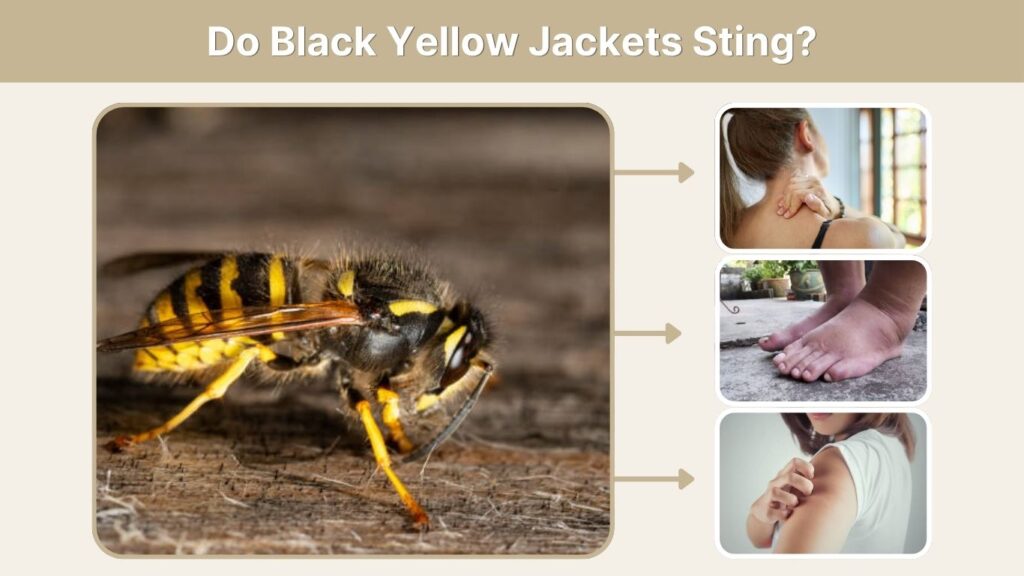
Female workers and queens can sting. Their smooth stingers are not normally left in the skin, allowing them to sting repeatedly.
A sting commonly causes:
- Immediate burning or sharp pain
- Redness around the puncture
- Localized swelling
- Itching or tenderness
- Warmth around the affected area
Yellowjackets become particularly dangerous when their nest is disturbed because numerous workers may attack together.
What to Do After a Sting
Move away from the area before treating the injury. Wash the site with soap and water, apply a wrapped cold pack, and avoid scratching it. Unlike a honey bee sting, a yellowjacket sting usually does not leave a stinger that needs removal.
Seek emergency medical help for difficulty breathing, throat or facial swelling, widespread hives, faintness, a weak rapid pulse, or severe vomiting. Multiple stings may also require urgent medical evaluation.
How to Prevent Yellowjacket Problems
Reducing access to food and nesting spaces can make a property less attractive.
- Keep outdoor garbage containers tightly closed.
- Clean food spills from tables and patios.
- Pick up fallen fruit regularly.
- Cover drinks and inspect cans before drinking.
- Do not leave pet food outside.
- Seal wall gaps before nesting season.
- Repair damaged siding and window screens.
- Watch for repeated flight into one ground or wall opening.
- Avoid striking, flooding or burning a nest.
A distant nest that does not threaten people may be left undisturbed because yellowjackets prey on other insects. Professional removal is safer when the colony is inside a wall, close to a doorway, beside a play area, or near someone with a serious sting allergy.
FAQs
Why is a yellowjacket black and yellow?
The contrasting pattern acts as warning coloration. It signals to potential predators that the insect can defend itself with a painful sting. Several harmless flies, beetles, and moths imitate this pattern, gaining protection through their resemblance to stinging wasps.
Is a black yellow jacket more dangerous than a bee?
It may present a greater immediate risk near its nest because a yellowjacket can sting repeatedly and colony members may attack together. Honey bees are generally less interested in human food, and an individual worker normally stings only once.
What is a big black-and-yellow wasp?
It could be a cicada killer, European hornet, paper wasp, mud dauber, or yellowjacket queen. Check its body shape, leg length, nesting behavior, and size. Ordinary yellowjacket workers are compact and usually no longer than about ⅝ inch.
Do black yellow jackets make underground nests?
Many species do. They frequently use abandoned animal burrows, cavities beneath roots, hollow logs, or gaps under landscaping materials. Other species build enclosed paper nests above ground or establish colonies inside wall and roof cavities.
What should I do when a yellowjacket flies near me?
Stay calm and move away slowly. Do not swat, crush, or make rapid movements. Cover food and drinks, then leave the area if the insect remains persistent. Several workers flying from one location may indicate a nearby nest.