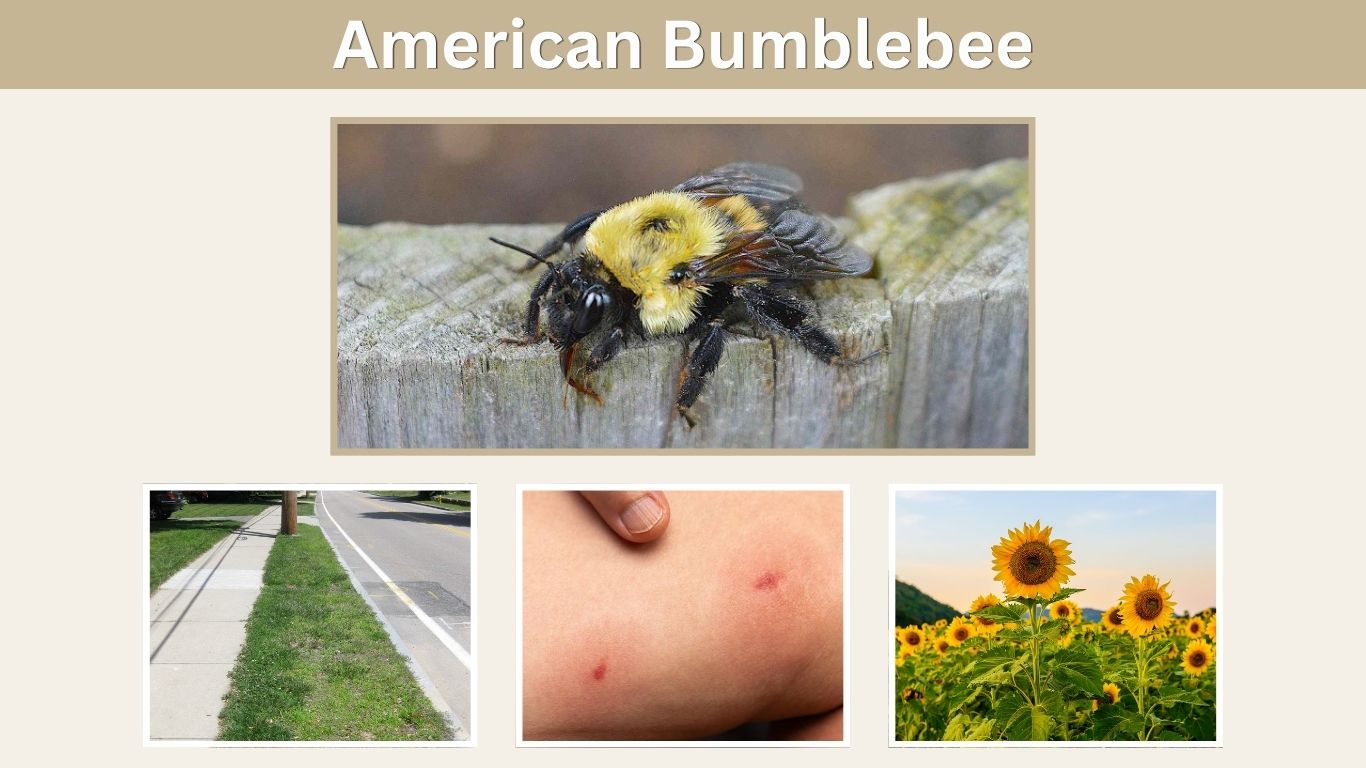
The American bumblebee is a large, fuzzy native pollinator recognized by its black head, yellow body bands, and dark rear end. Scientifically named Bombus pensylvanicus, it was once one of North America’s most widespread bumblebees. It remains an important pollinator of wildflowers and crops, but its abundance has declined substantially in parts of its historical range. It should not be confused with the South American bumblebee catfish, which is an unrelated aquarium fish.
What Is an American Bumblebee?
The American bumblebee belongs to the family Apidae, which also includes honeybees and carpenter bees. It is a social species that forms an annual colony containing one queen, female workers, and males. Unlike honeybee colonies, its nest does not continue for multiple years.
| Feature | American Bumblebee |
| Scientific name | Bombus pensylvanicus |
| Family | Apidae |
| Queen size | Approximately 21–25 mm |
| Worker size | Approximately 14–18 mm |
| Male size | Approximately 16–22 mm |
| Color | Black and yellow |
| Diet | Nectar and pollen |
| Nest | Usually at ground level or underground |
| Colony size | Commonly 60–120 individuals |
The American bumblebee is considered relatively large. Queens are the biggest members of the colony, while workers vary considerably in size depending partly on food availability during development.
American Bumblebee Identification
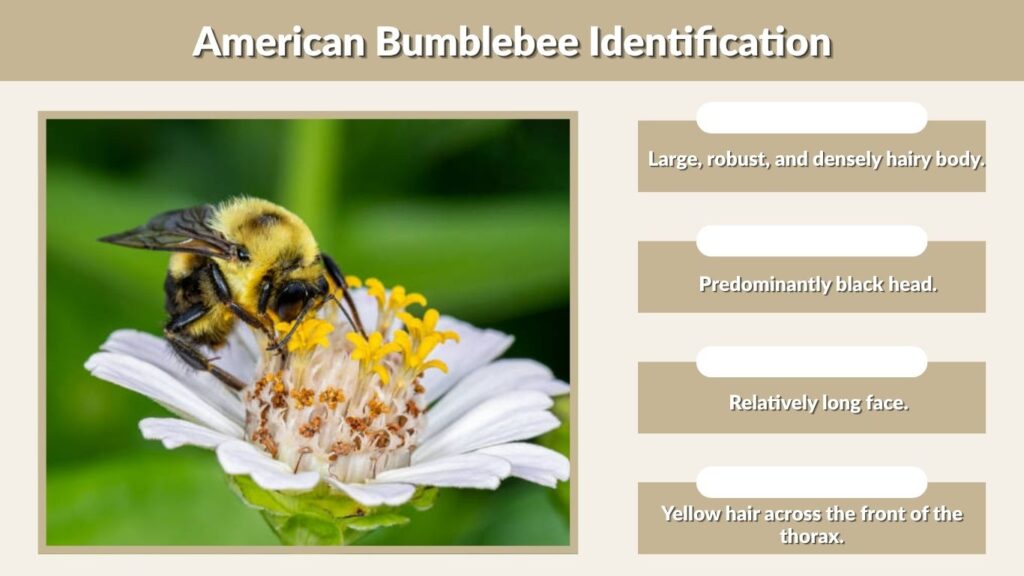
American bumblebees can resemble several other black-and-yellow species. Accurate identification should consider the color pattern, head shape, size, location, and photographs from more than one angle.
Key Identification Features
- Large, robust, and densely hairy body
- Predominantly black head
- Relatively long face
- Yellow hair across the front of the thorax
- Yellow coloring on the first abdominal segments
- Black posterior portion of the abdomen
- Long legs compared with many similar bumblebees
- Pollen-carrying structures on the hind legs of females
Typical females have yellow hair on the front of the thorax, black hair toward its rear, three yellow abdominal segments, and a black abdominal tip. Color patterns may vary, and distinguishing this species from the black-and-gold or yellow bumblebee sometimes requires close examination.
Queen, Worker, and Male
Queens are the largest individuals and are most noticeable when they emerge in late spring to search for flowers and nesting locations. Workers are smaller females responsible for collecting food, caring for developing young, and defending the nest.
Males often have more yellow hair and lack pollen baskets. They do not collect pollen for the colony and cannot sting because only female bees possess a functional stinger.
American Bumblebee Habitat and Range
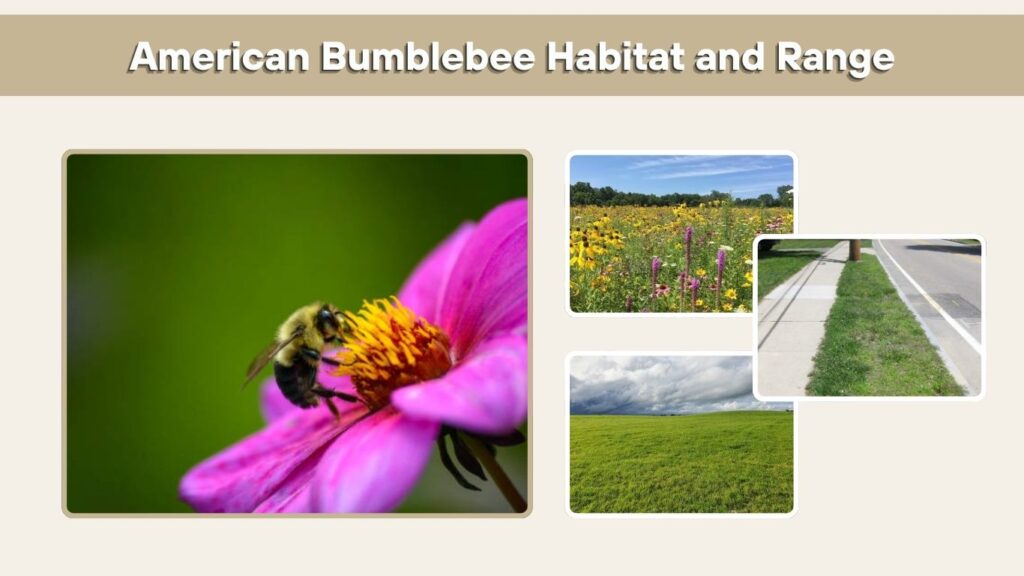
American bumblebees are strongly associated with open landscapes. Historically, they occurred widely through the eastern and central United States, the Great Plains, southern Canada, and portions of the western United States. Declines have been particularly severe near the northern edge of the range.
Preferred Habitat
Common habitats include:
- Native prairies
- Meadows and grasslands
- Farms and pastures
- Roadsides and field edges
- Wet meadows
- Open woodland edges
- Parks and pollinator gardens
Successful habitat must offer flowers throughout the active season, undisturbed nesting locations, and protected places where new queens can spend the winter. Summer habitat is especially valuable when it contains diverse patches of flowering plants and good vegetation cover.
American Bumblebee Nest
American bumblebees do not construct hanging paper nests or large wax hives. They usually establish relatively small colonies at ground level.
Where Do They Nest?
Nests are commonly located:
- Among clumps of long grass
- Beneath accumulated grass or leaf litter
- Inside abandoned rodent nests
- Under hay or plant debris
- In shallow underground cavities
- Along undisturbed grassy field edges
The species appears to nest mostly on or near the soil surface, although underground nests also occur. A nest may be difficult to notice until workers are repeatedly seen entering the same opening.
Do not mow, dig, flood, or spray an active nest. Bumblebees normally concentrate on collecting food, but female workers may defend the colony when its entrance is disturbed.
American Bumblebee Diet and Pollination
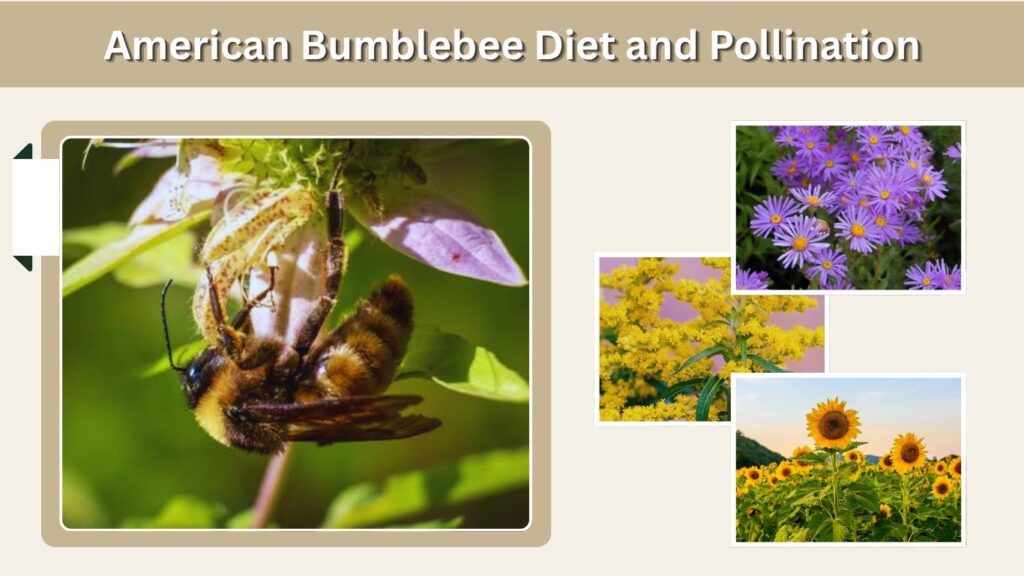
Adult American bumblebees feed on nectar for energy. Females also collect pollen, which provides protein and nutrients for developing larvae.
Flowers They Visit
They are generalist foragers and can use many flowering plants. Particularly useful plants include:
- Goldenrods
- Asters
- Sunflowers
- Bee balm
- Milkweeds
- Clovers
- Blazing stars
- Wild indigos
- Mountain mints
- Native thistles
The species needs a continuous supply of flowers from late spring through early autumn. Late-season flowers are particularly important because new queens must build sufficient body reserves before overwintering. Bumblebee nests store relatively little food compared with honeybee hives, making dependable nearby flowers essential.
American Bumblebee Life Cycle
The colony follows an annual life cycle. Only newly produced, fertilized queens normally survive the winter.
Spring and Summer
An overwintered queen emerges in late spring, feeds from flowers, and searches for a nest. She builds a small food supply and lays her first eggs. After the first workers develop, they take over foraging, brood care, and nest defense while the queen remains inside laying additional eggs. Development from egg to adult worker may take up to about 30 days.
Autumn and Winter
Later in the season, the colony produces males and new queens. They leave the nest and mate. The new queens feed heavily before locating protected overwintering sites, often associated with decaying wood or other undisturbed cover.
The original queen, workers, and males die by the end of the season. Each surviving young queen starts a new colony the following year rather than returning to the old nest.
Does the American Bumblebee Sting?
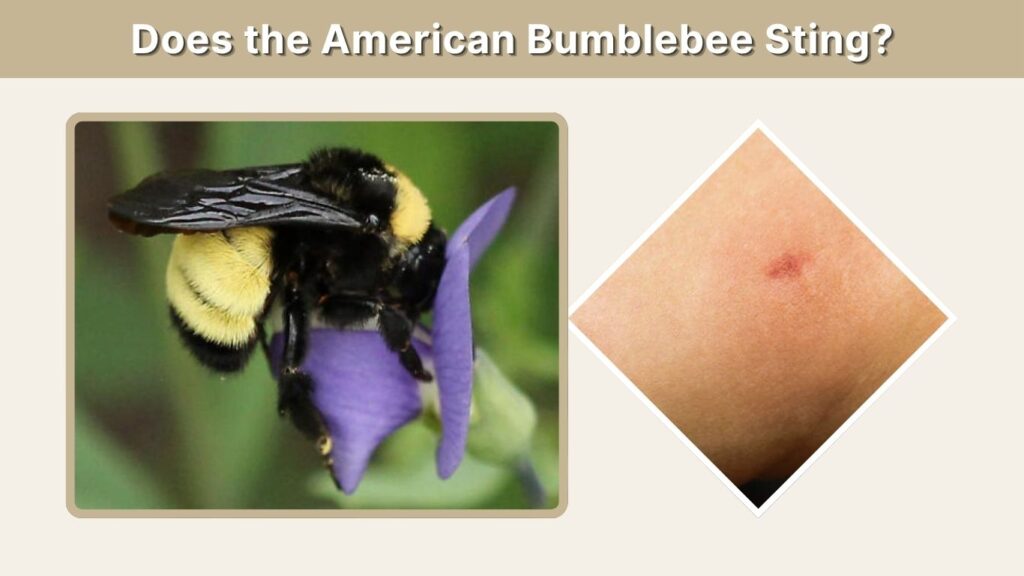
Queens and female workers can sting. Unlike a worker honeybee, a bumblebee does not normally leave its stinger behind and can therefore sting more than once. Males cannot sting.
American bumblebees generally sting in self-defense rather than actively pursuing people. Risk increases when someone handles a bee, steps on one, blocks a nest entrance, or disturbs the ground around a colony. Observing foraging bees on flowers is usually safe.
American Bumblebee vs Carpenter Bee
Both insects are large and may have yellow and black hair, but their bodies and nesting behavior differ.
| Feature | American Bumblebee | Carpenter Bee |
| Abdomen | Densely hairy | Usually smooth and shiny |
| Social behavior | Lives in an annual colony | Mostly solitary |
| Nest location | Grass, soil, or existing cavities | Tunnels excavated in wood |
| Body shape | Broad and fuzzy | Broad with a shiny rear |
| Wood damage | None | Females can tunnel into wood |
Carpenter bees commonly have a glossy, nearly hairless abdomen, while an American bumblebee’s abdomen is visibly fuzzy. Carpenter bees create tunnels in wood; American bumblebees do not eat or excavate structural timber.
American Bumblebee vs Honeybee
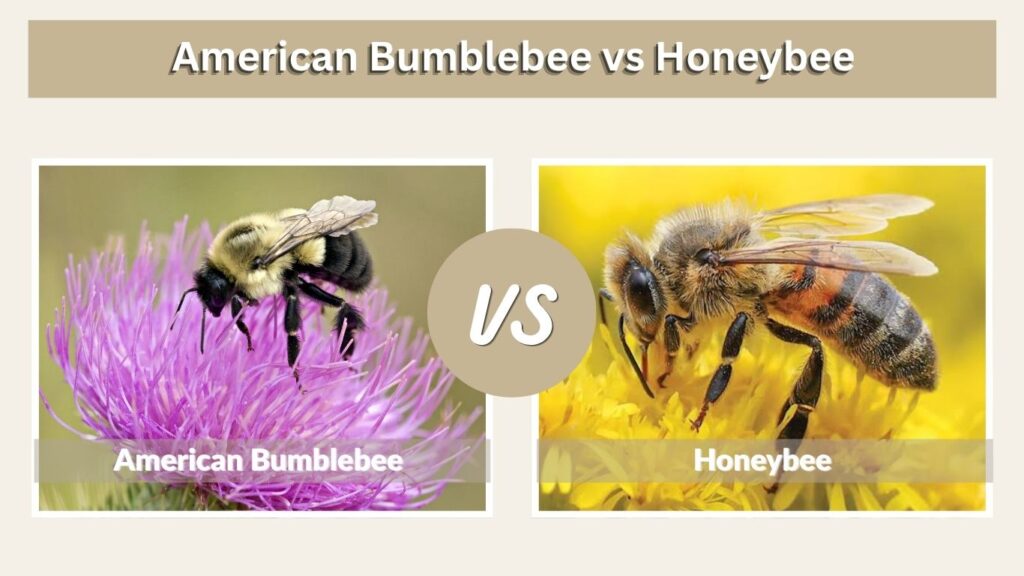
Honeybees are slimmer, less fuzzy, and usually golden-brown with narrower dark bands. Their colonies may contain tens of thousands of bees and continue for several years.
American bumblebee colonies are much smaller, last one season, and store only limited food. Bumblebees are native North American pollinators, whereas the familiar western honeybee was introduced from outside North America.
Is the American Bumblebee Endangered?
The species has experienced serious declines. The U.S. Fish and Wildlife Service reports an estimated 89% reduction in relative abundance compared with other bees sharing its habitat, based on an earlier conservation assessment. Major suspected threats include habitat loss, pesticides, development, climate-related pressures, low genetic diversity, and pathogens associated with managed bees.
As of August 2026, the American bumblebee is not federally listed as endangered or threatened in the United States. Its federal status is “under review,” and the U.S. Fish and Wildlife Service is preparing a species status assessment to determine whether protection under the Endangered Species Act is warranted. The IUCN assessment categorizes it as Vulnerable, while Canada lists it as a species of Special Concern.
FAQs
Are American bumblebees aggressive?
They are not normally aggressive while gathering food. Female bees may defend their nest when the entrance or surrounding ground is disturbed. Avoid handling them and keep mowing equipment away from active colonies.
How large is an American bumblebee queen?
Queens are approximately 21–25 millimeters long, making them noticeably larger than workers. They are generally seen alone in late spring while feeding and searching for a place to establish a colony.
Where do American bumblebees build nests?
They usually nest among long grass, hay, plant litter, or shallow ground cavities. They may also occupy abandoned animal nests. The best nesting sites remain undisturbed and are close to abundant flowers.
How can I help American bumblebees?
Grow diverse native flowers that bloom from spring through autumn, reduce pesticide use, leave some grass and leaf litter undisturbed, retain fallen or decaying wood, and avoid mowing an entire habitat at once.
Is the South American bumblebee catfish related to this bee?
No. The South American bumblebee catfish is a freshwater fish named for its black-and-yellow pattern. The American bumblebee is a flying pollinating insect in the genus Bombus.