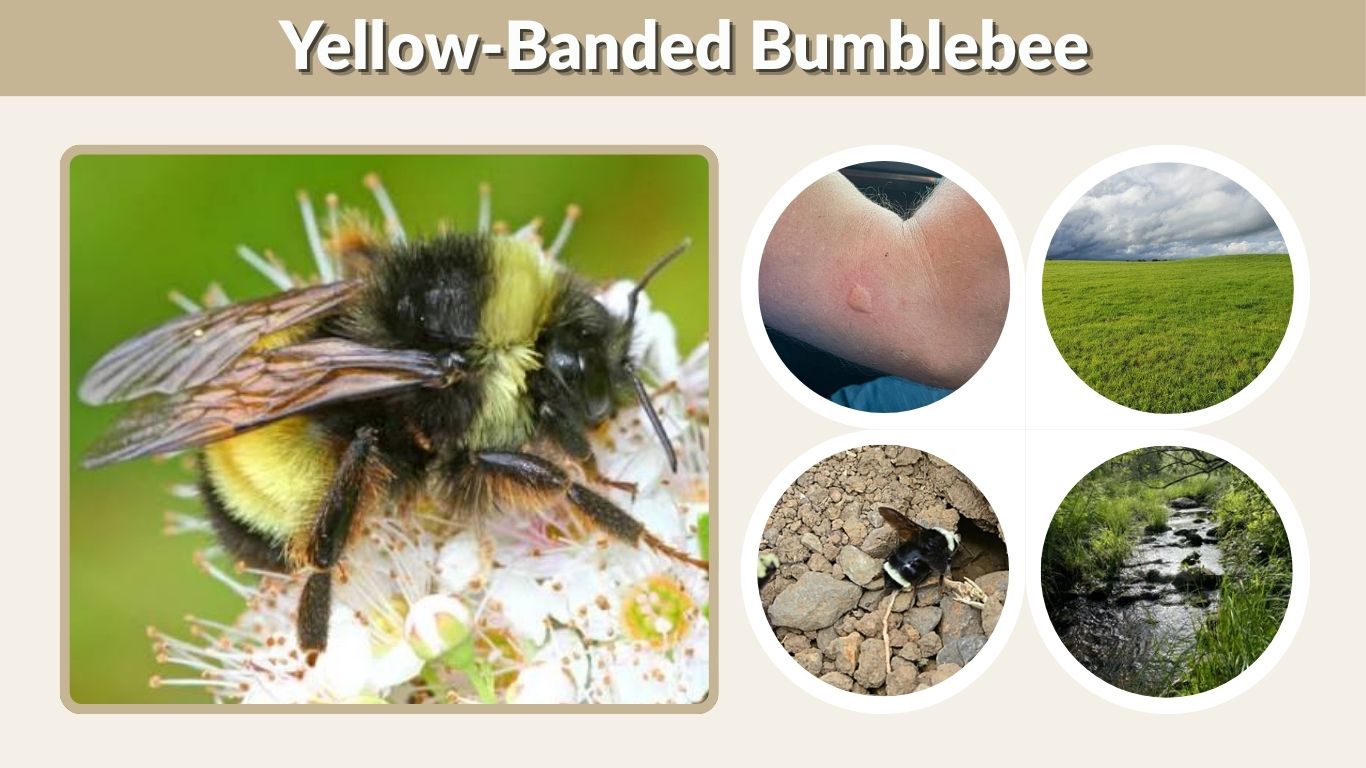
The yellow-banded bumblebee is a medium-sized North American pollinator recognized by the broad golden-yellow band crossing the middle of its abdomen. Scientifically named Bombus terricola, it once ranked among the most common bumblebees across parts of Canada and the northern United States. Although it remains widespread, populations have declined sharply in many southern parts of its historical range.
What Is a Yellow-Banded Bumblebee?
The yellow-banded bumblebee belongs to the bee family Apidae, which also includes honeybees, carpenter bees, and other bumblebees. It is a social species that lives in an annual colony containing a queen, female workers, and reproductive males.
Its scientific classification includes:
| Classification | Name |
| Scientific name | Bombus terricola |
| Family | Apidae |
| Order | Hymenoptera |
| Queen size | About 19–21 mm |
| Worker size | About 10–15 mm |
| Male size | About 13–15 mm |
| Diet | Nectar and pollen |
| Nest location | Usually underground |
| Native range | North America |
The species was once grouped with the western bumblebee, Bombus occidentalis. Genetic and physical evidence now supports treating them as separate species.
Yellow-Banded Bumblebee Identification
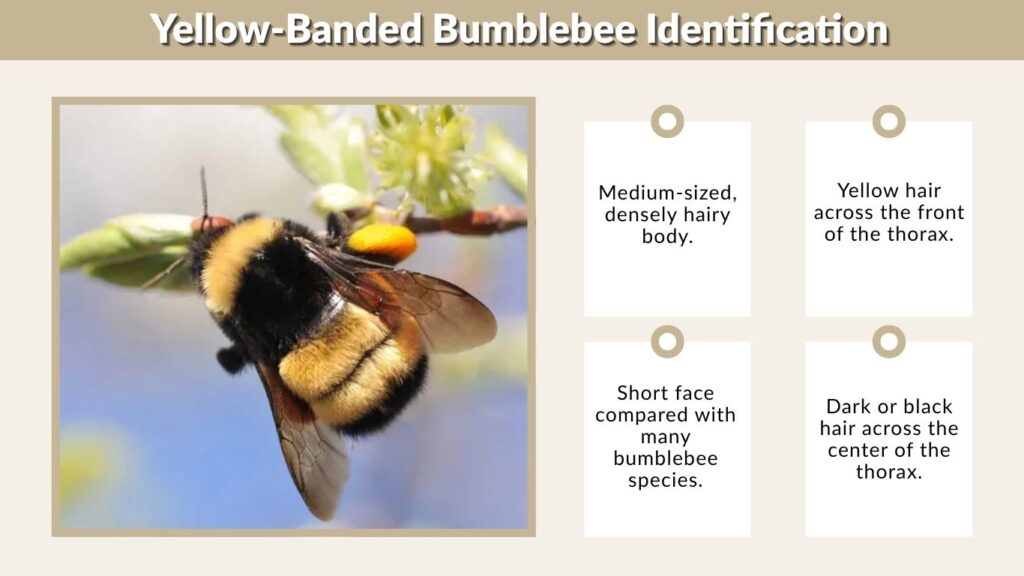
The species gets its name from the conspicuous yellow band across the middle of its dark abdomen. However, several North American bumblebees have similar black-and-yellow patterns, so identification should be based on a combination of markings, size, face shape, and location.
Key Identification Features
- Medium-sized, densely hairy body
- Short face compared with many bumblebee species
- Yellow hair across the front of the thorax
- Dark or black hair across the center of the thorax
- Broad golden-yellow band across abdominal segments two and three
- Mostly black rear portion of the abdomen
- Short, even body hair
- Dark wings with a slightly brownish appearance
The central yellow abdominal band is the most recognizable characteristic. The fifth abdominal segment may be black or covered with paler yellow-brown hair, creating some variation between individuals.
Yellow-Banded Bumblebee Queen
The queen is the largest member of the colony, typically measuring around 19–21 millimeters. She has the same general black-and-yellow pattern as workers but appears broader, heavier, and more robust.
Queens are most likely to be seen alone during spring. An overwintered queen must feed on early flowers, locate a suitable nest cavity, and raise the colony’s first group of workers. Once those workers become active, the queen spends most of her time inside the nest laying eggs.
Workers and Males
Workers are smaller females that collect pollen and nectar, care for larvae, maintain the nest, and defend the colony. Female workers have flattened pollen baskets on their hind legs.
Males are usually intermediate in size between queens and workers. They resemble females but commonly have more yellow hair on the face. Males lack pollen baskets and cannot sting.
Yellow-Banded Bumblebee Range
The yellow-banded bumblebee occurs only in North America. Its historical range extends from Georgia north through the Appalachian Mountains and northeastern United States to Labrador. Farther west, it occurs through the northern United States and much of Canada to Montana, British Columbia, the Northwest Territories, and southeastern Yukon.
Its northern limit roughly follows the treeline. It is present in every Canadian province and territory except Nunavut, although its distribution is now much more fragmented in parts of the southern and western range. Older reports from Alaska have been reassessed, and the species is no longer considered part of Alaska’s known bee fauna.
Where Is It Still Found?
Current populations are generally stronger in boreal and northern regions than in densely developed or intensively farmed southern landscapes. The species may still be encountered in parts of:
- New England
- The Appalachian region
- The Great Lakes
- The northern Great Plains
- The Canadian Prairies
- Eastern and central Canada
- Boreal forests
- British Columbia’s interior
- The Northwest Territories and southeastern Yukon
The U.S. Fish and Wildlife Service reports that it has disappeared or become much less common across substantial areas of the Pacific Northwest, southern Appalachians, and southeastern plains.
Yellow-Banded Bumblebee Habitat and Nesting Behavior
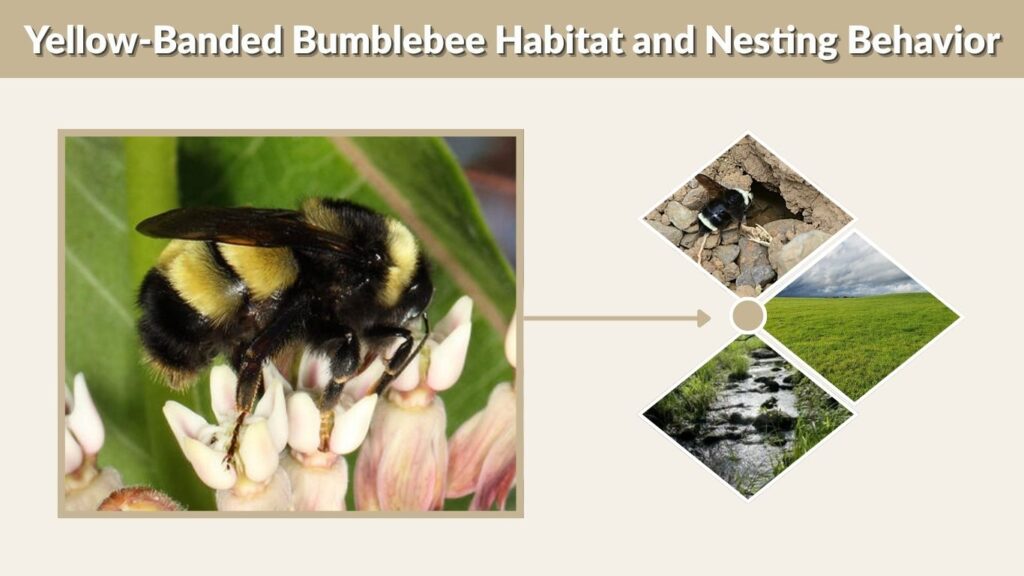
Yellow-banded bumblebees use a wide variety of open and partly wooded environments. They are habitat generalists, but successful colonies need nesting sites, season-long flowers, and protected places where new queens can overwinter.
Preferred Habitat
Suitable habitats include:
- Meadows and grasslands
- Forest openings
- Boreal and mixed forests
- Prairie habitats
- Stream and river edges
- Roadsides
- Farms and field margins
- Parks and gardens
- Mountain meadows
- Urban green spaces
The availability of pollen and nectar throughout the growing season is one of the species’ most important habitat requirements. A landscape with abundant flowers for only a few weeks may not support the colony through its complete active period.
Yellow-Banded Bumblebee Nest
This species normally nests underground, often using an abandoned rodent or rabbit burrow rather than excavating a completely new chamber.
The nest entrance may appear as a small hole surrounded by grass, leaves, roots, or loose soil. Because the entrance can be difficult to see, people sometimes discover a colony only after noticing workers repeatedly flying in and out of the same location.
The nest lasts for one season. It is not a permanent hive like a honeybee colony, and it is not normally reused by the same queen the following year.
Diet and Pollination
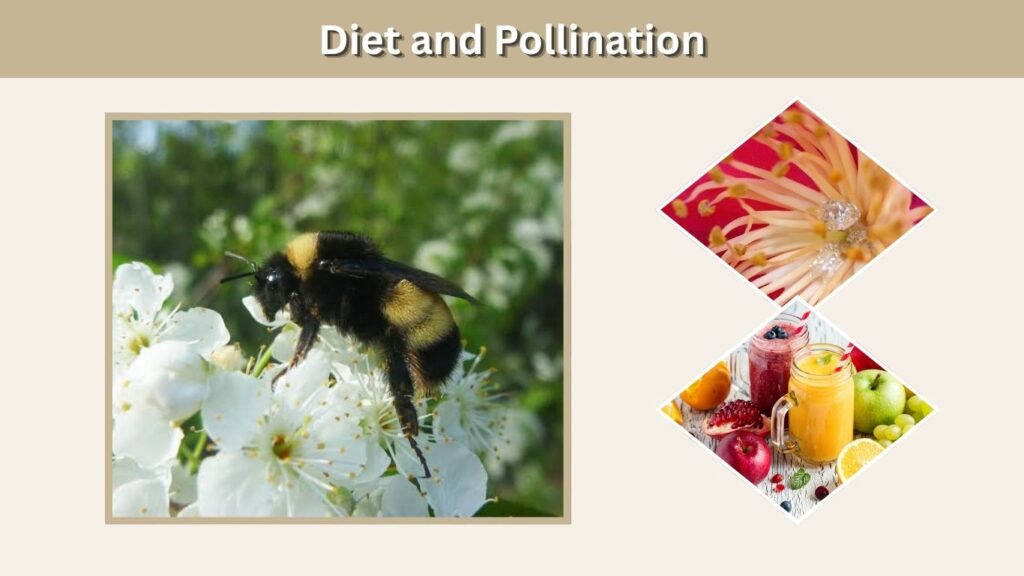
Adult yellow-banded bumblebees obtain energy from flower nectar. Queens and workers also collect protein-rich pollen to feed developing larvae.
They are generalist foragers that visit numerous wild and cultivated flowers, including willows, raspberries, clovers, blueberries, asters, goldenrods, and members of the pea family. Their relatively short tongues are best suited to shallow flowers, although they may reach nectar in deep blossoms by chewing a small opening near the flower’s base.
The species needs a sequence of flowering plants from spring through late summer. Early flowers support emerging queens, while late-season flowers help newly produced queens build energy reserves before winter.
Yellow-Banded Bumblebee Life Cycle
The colony follows an annual cycle in which only newly mated queens normally survive winter.
Spring Colony Formation
A queen emerges from her overwintering location during spring. After feeding, she searches for an underground nesting cavity, collects pollen, and lays her first eggs.
The queen initially cares for the larvae herself. Once the first workers emerge, they take over food collection and nest maintenance, allowing her to concentrate on egg production.
Summer Colony Growth
Worker numbers increase through spring and summer. They travel between the nest and nearby flowers, bringing nectar and pollen back to the developing colony.
The active season generally lasts from approximately April to September in southern regions and May to August farther north.
Autumn and Overwintering
Near the end of summer, the colony produces males and new queens. These reproductive bees leave the nest and mate.
Workers, males, and the old queen die when cold weather arrives. Each fertilized young queen searches for a protected overwintering site, often burrowing into loose soil or decaying wood. She emerges the following spring to begin another colony.
Does the Yellow-Banded Bumblebee Sting?
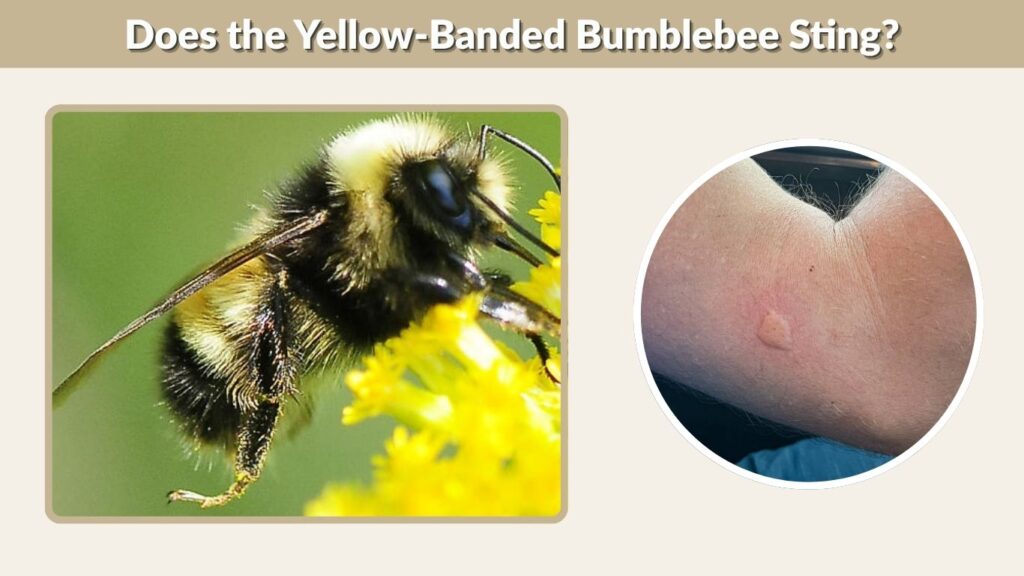
Queens and female workers can sting, while males cannot. They generally sting defensively when trapped, stepped on, handled, or when their underground nest is disturbed.
Foraging bees on flowers usually present little risk when left alone. Avoid blocking a nest entrance, mowing directly over an active colony, or attempting to dig it out. Unlike honeybee workers, bumblebees have smooth stingers and may sting more than once.
Is the Yellow-Banded Bumblebee Endangered?
The species has undergone serious regional declines but does not have the same legal status everywhere.
In Canada, it was assessed as Special Concern by COSEWIC in 2015 and added to Schedule 1 of the Species at Risk Act in 2018. The Canadian management plan reports a decline of at least 34% in surveyed southern areas while noting that the bee remains relatively common in parts of the north. The IUCN assessment categorizes it as Vulnerable.
In the United States, the U.S. Fish and Wildlife Service completed a review in 2019 and determined that federal Endangered Species Act listing was not warranted at that time. Its official species page nevertheless documents extensive range contraction and increasing fragmentation.
Major threats include pesticide exposure, loss of season-long floral resources, intensive agriculture, climate change, extreme heat, habitat alteration, and pathogens transmitted from commercially managed bees.
FAQs
How can you identify a yellow-banded bumblebee?
Look for a medium-sized bee with a yellow front thorax, dark central thorax, and a broad golden-yellow band across the second and third abdominal segments. Its remaining abdomen is mostly black, although the rear may contain pale yellow-brown hair.
Where does the yellow-banded bumblebee live?
It occurs across northern and eastern North America, from the Appalachian region and northeastern United States through much of Canada. It inhabits meadows, grasslands, forest openings, roadsides, parks, farms, and boreal landscapes.
How large is a yellow-banded bumblebee queen?
A queen generally measures about 19–21 millimeters. Workers are smaller at approximately 10–15 millimeters, while males usually measure around 13–15 millimeters. Queen size is easiest to notice in spring before workers appear.
What do yellow-banded bumblebees eat?
Adults drink nectar, while queens and workers collect pollen for the developing larvae. They visit numerous shallow or moderately deep flowers, including willows, clovers, raspberries, blueberries, asters, and goldenrods.
How can people help this bumblebee?
Grow pesticide-free flowers that bloom from early spring through autumn, preserve unmowed grassy areas, retain some loose soil and decaying wood, and avoid disturbing underground nests. Diverse flowers are more useful than a single plant species blooming briefly.