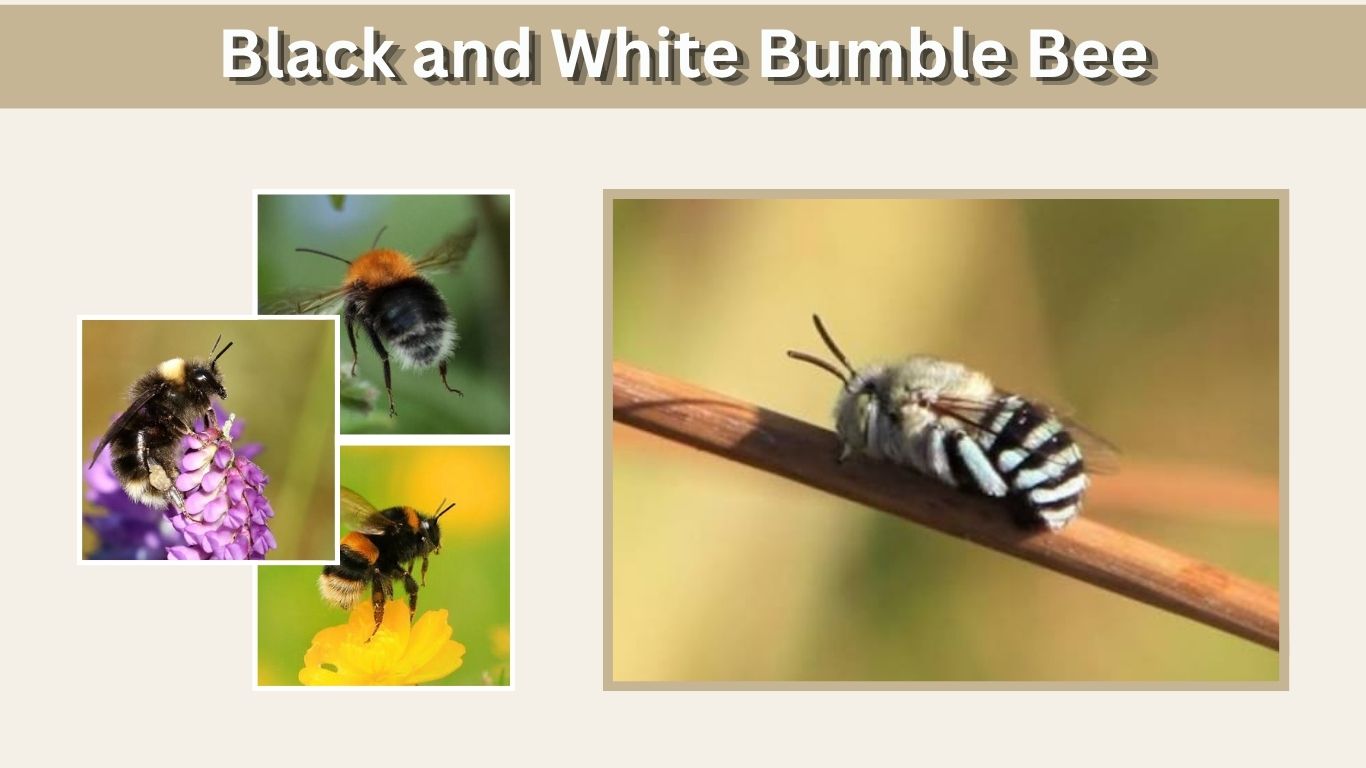
A black and white bumble bee may belong to several different species rather than one specific type. White-tailed bumblebees, western bumble bees, tree bumblebees, and Franklin’s bumble bees can all display black bodies with white abdominal tips. Other bumblebees feature yellow, gold, orange, brown, or red markings. Correct identification depends on the bee’s tail color, band arrangement, facial hair, legs, body shape, sex, and geographic location.
How to Identify a Black and White Bumble Bee
Bumblebees are stout insects covered with dense hair. Their visible colors come mainly from differently colored hairs rather than the underlying exoskeleton, which is generally black. Some individuals also develop unusually dark coloration known as melanism.
Main Identification Features
- Rounded, heavily built body
- Dense black body hair
- White, cream, yellow, orange, or red tail
- One or more pale bands on the thorax or abdomen
- Two pairs of wings
- Long, segmented antennae
- Six hairy legs
- Pollen baskets on the hind legs of queens and workers
- Slower, heavier flight than many wasps
- Body pattern that may vary between males and females
Tail color and band placement are usually the best starting points. The face, antennae, hind legs, season, and location provide additional clues.
Common Black and White Bumble Bee Species
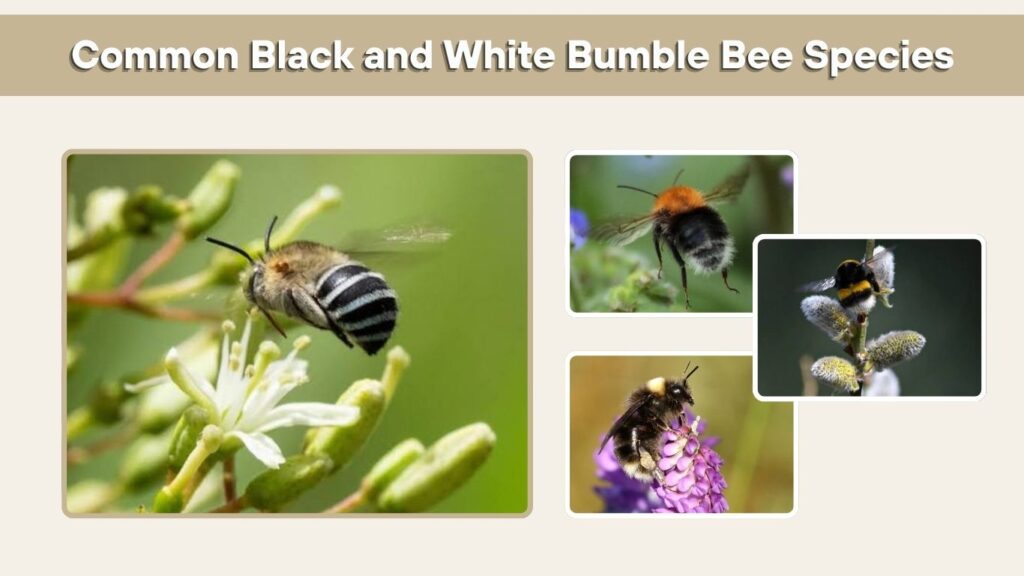
Several species match the description of a black bumblebee with a white tail or white “bum.”
| Species | Main color pattern | General region |
| White-tailed bumblebee | Black with two yellow bands and a white tail | Europe |
| Western bumble bee | Mostly black with yellow and white markings | Western North America |
| Tree bumblebee | Ginger thorax, black abdomen, white tail | Europe and parts of Asia |
| Franklin’s bumble bee | Black abdomen with a white tip | Restricted part of western North America |
| Heath bumblebee | Three yellow bands and a white tail | Europe |
| Garden bumblebee | Three yellow bands and a white tail | Europe |
White-Tailed Bumblebee
The white-tailed bumblebee, Bombus lucorum, has a black body, a lemon-yellow collar behind the head, another yellow band near the front of the abdomen, and a clean white tail. Males usually have additional yellow facial hair.
It may be confused with the buff-tailed bumblebee, but the white-tailed species generally has a purer white tail and brighter lemon-colored bands.
Western Bumble Bee
The western bumble bee, Bombus occidentalis, is a North American species with variable black, yellow, and white markings. Some forms are mainly black with a yellow thoracic band and a white abdominal tip.
The face is generally covered with black hair, helping distinguish it from several western species with prominent yellow facial hair. Color variation can make photograph-only identification difficult.
Tree Bumblebee
The tree bumblebee, Bombus hypnorum, has a ginger or reddish-brown thorax, black abdomen, and bright white tail. Dark individuals may have an almost black thorax, making them appear primarily black and white.
Unlike most ground-nesting bumblebees, tree bumblebees frequently use elevated cavities, including hollow trees, roof spaces, and bird boxes.
Franklin’s Bumble Bee
Franklin’s bumble bee, Bombus franklini, has an extensively yellow front thorax surrounding a central black patch, a largely black abdomen, and white hair at the abdominal tip. Its face is primarily black, with yellow near the top of the head.
The species has a highly restricted historical range and should not be assumed to be the identity of an ordinary black-and-white bee without expert confirmation.
Black Bee With a White Tail or White Butt
A white abdominal tip is commonly called a white tail, white bum, or white butt. It is made from pale hair covering the final abdominal segments.
Possible identifications include:
- White-tailed bumblebee
- Western bumble bee
- Tree bumblebee
- Garden bumblebee
- Heath bumblebee
- Ruderal bumblebee
- Franklin’s bumble bee
Several of these species have nearly identical colors. A clear photograph should show the top of the thorax, complete abdomen, face, and hind legs. Geographic location is also essential because European and North American species differ.
Black and Yellow Striped Bumble Bee
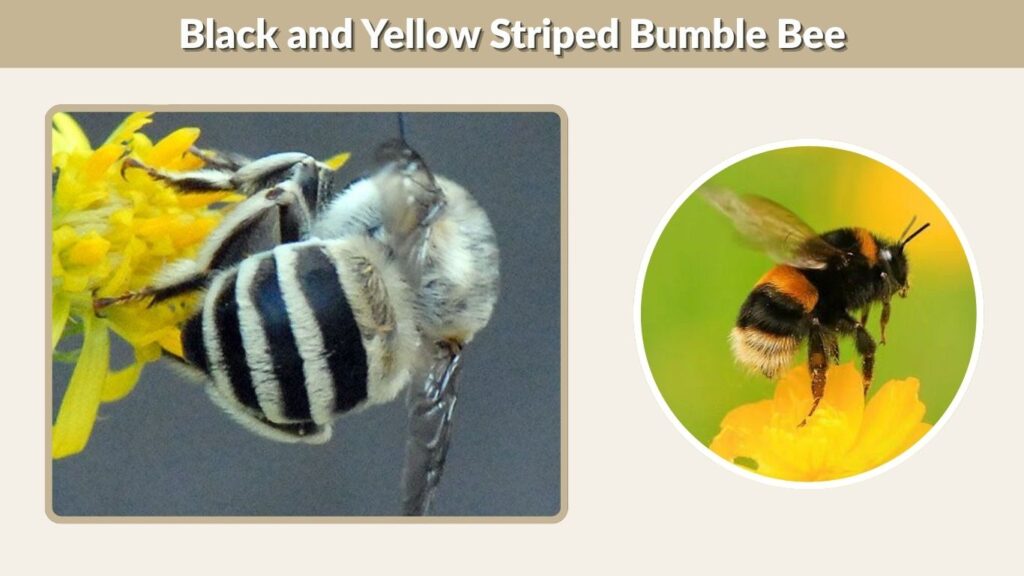
Black and yellow is the most familiar bumblebee pattern, but it occurs in many species. The number, width, and location of the yellow bands are more useful than color alone.
The common eastern bumble bee often has a yellow thorax and one yellow band at the abdomen’s front, followed by a predominantly black abdomen. The yellow-banded bumble bee has a broad yellow band across the middle abdominal segments. Male yellow-banded bumblebees also have pale yellow facial hair.
A smooth, narrow-waisted insect with sharp yellow markings may instead be a yellowjacket. Bumblebees are generally rounder and much hairier.
Black and Gold Bumble Bee
The black-and-gold bumble bee, Bombus auricomus, is a recognized North American species. It has a mostly black thorax and bold yellow or golden abdominal markings. Males may have an entirely yellow first abdominal segment and conspicuous yellow facial hair.
This species should not be confused with every bee that happens to look black and gold. Common eastern, American, yellow-banded, and other bumblebees may produce a similar appearance from a distance.
Black and Orange Bumble Bee
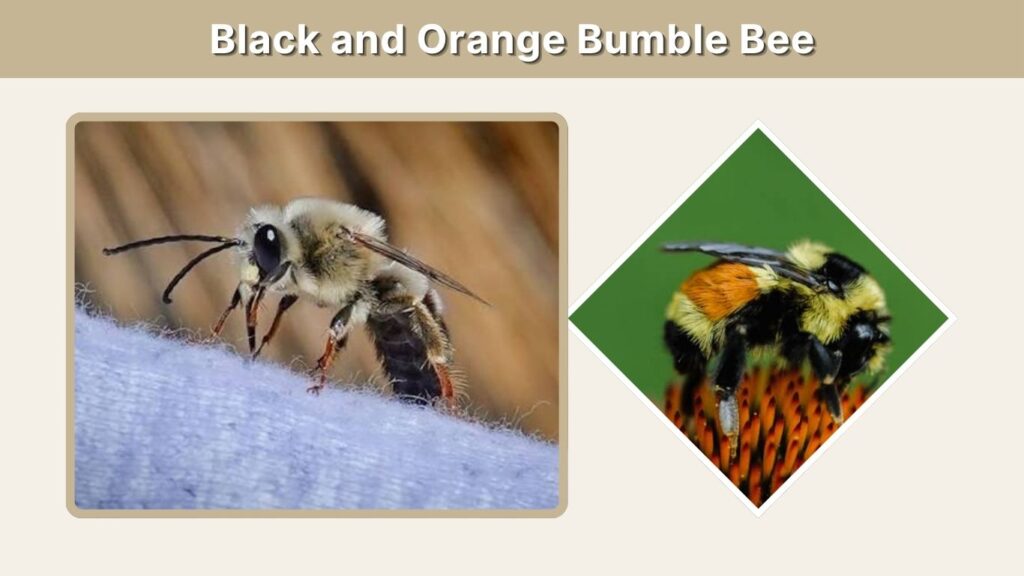
Orange or rust-colored hair occurs in numerous bumblebee species. The orange marking may form a tail, belt, abdominal patch, or thoracic covering.
Red-Tailed Bumblebee
Female red-tailed bumblebees, Bombus lapidarius, have velvety black bodies and broad red or orange-red tails. Males also display yellow facial hair and yellow bands near the front and back of the thorax.
Red-Belted Bumble Bee
The red-belted bumble bee, Bombus rufocinctus, can show highly variable combinations of black, yellow, reddish, or orange hair. The contrasting color usually forms a belt across part of the abdomen.
Tree Bumblebee
A tree bumblebee may appear orange and black because its ginger thorax contrasts sharply with its black abdomen. Its white tail separates it from most other orange-and-black bees.
Completely Black Bumblebees
An all-black bee may be a naturally dark bumblebee, a melanic color form, a carpenter bee, or a different solitary bee.
Melanism can reduce or hide the normal pale bands of a bumblebee. It occurs in multiple species and is especially noticeable in some tree and ruderal bumblebees. Faint original markings may remain visible under strong light.
A female hairy-footed flower bee can also appear entirely black and may be mistaken for a small bumblebee. Orange-red hair on the hind legs helps identify it.
Bumblebee vs Carpenter Bee
Large carpenter bees are frequent bumblebee lookalikes. Both may have black bodies, yellow thoracic hair, and dark wings.
The most useful difference is the abdomen:
| Bumblebee | Carpenter bee |
| Abdomen densely covered with hair | Upper abdomen smooth and shiny |
| Usually nests in existing cavities | Excavates tunnels in wood |
| Social colony in most species | Primarily solitary |
| Round, uniformly fuzzy appearance | Hairy thorax with exposed abdomen |
A large black bee repeatedly entering a neat round hole in wood is more likely to be a carpenter bee.
Do Black and White Bumblebees Sting?
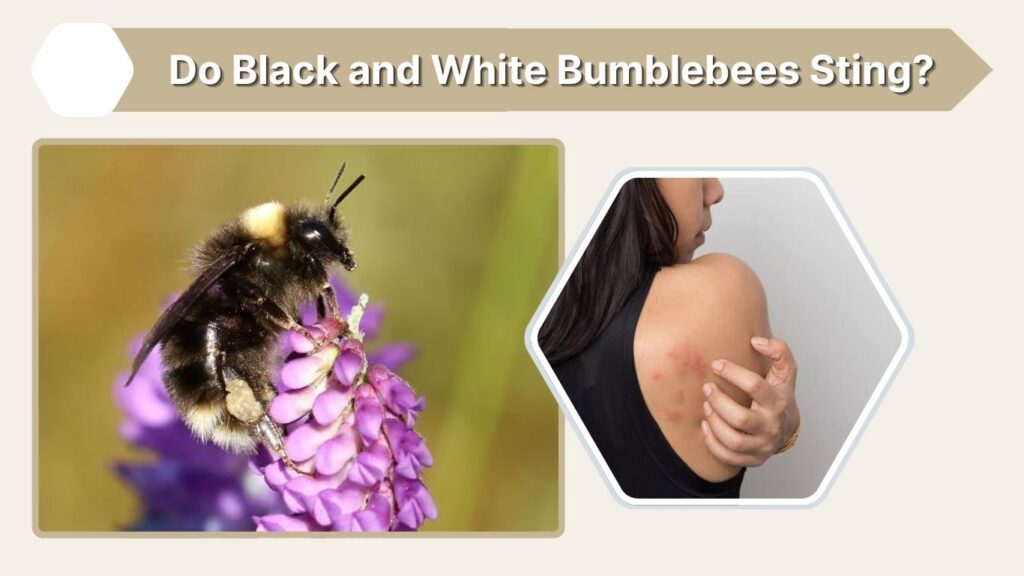
Queens and female workers can sting, but males cannot. Bumblebees usually avoid stinging while feeding and are most likely to defend themselves when squeezed, stepped on, or disturbed near their nest.
Their stingers are smooth enough to permit repeated stings, unlike the strongly barbed stinger of a honey bee worker.
Do not handle an unidentified bee. Observe it from a reasonable distance and avoid blocking an active nest entrance.
FAQs
What bumblebee is black with a white tail?
Possible species include the white-tailed bumblebee, western bumble bee, tree bumblebee, heath bumblebee, and Franklin’s bumble bee. The correct answer depends on location, yellow band placement, facial hair, and body shape.
What is a black bee with a white bum?
It is often a white-tailed type of bumblebee. However, several species share this marking, so a photograph of the complete body and geographic location are needed for reliable identification.
Are black and white bumblebees dangerous?
They are generally peaceful pollinators. Female queens and workers can sting when threatened, while males cannot. Avoid touching them or disturbing a nest, especially when someone nearby has a serious sting allergy.
Why does a bumblebee have black wings?
Bumblebee wings may appear dark because of natural pigmentation, age, lighting, or the dark body beneath them. Some cuckoo bumblebees have particularly dark wing membranes, but wing color alone cannot confirm the species.
What is the difference between an orange-and-black bee and a red-and-black bee?
The terms may describe the same species because red hairs can appear orange, rust, or ginger under different lighting. Tail position, band arrangement, facial hair, location, and sex provide better identification clues than the exact shade.