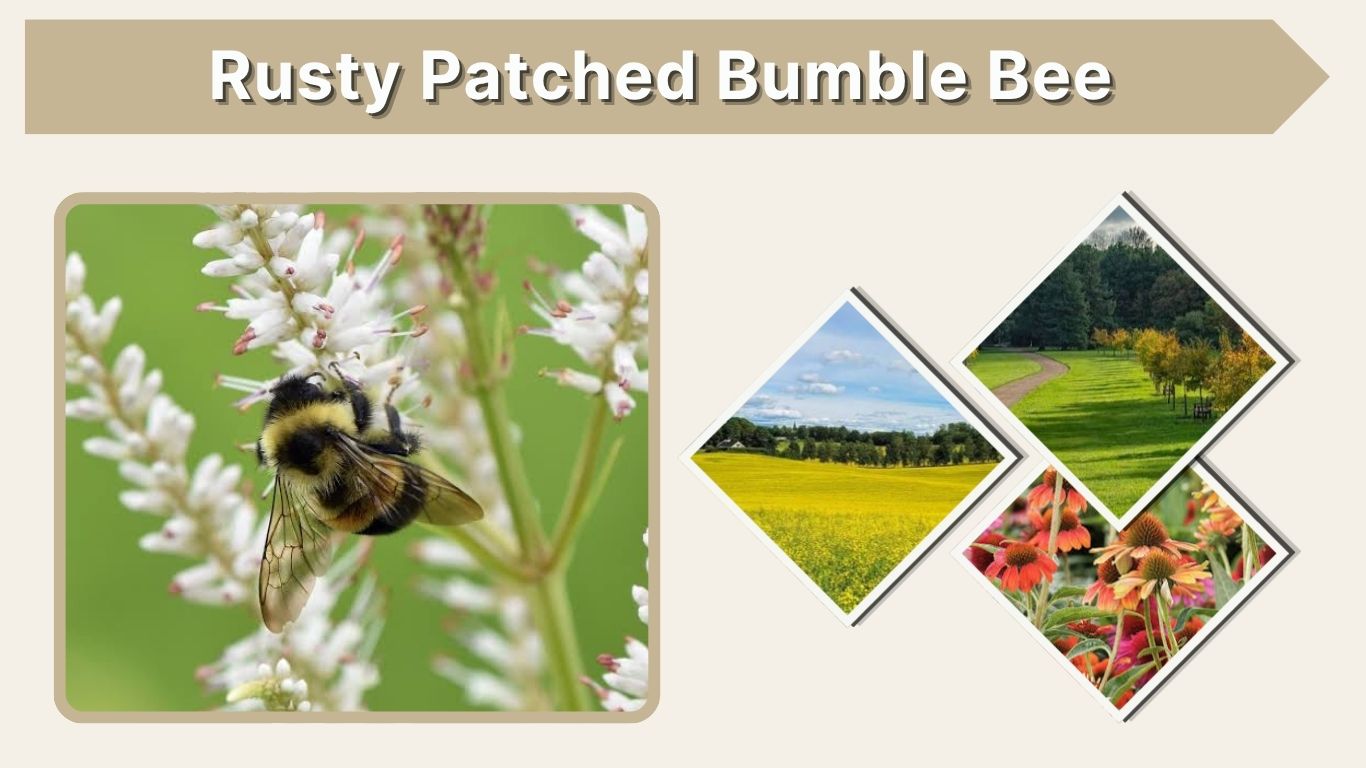
The rusty patched bumble bee is a rare North American pollinator recognized by the rust-colored marking on the abdomen of workers and males. Its scientific name is Bombus affinis. Once common across the eastern United States and parts of Canada, the species experienced a rapid population collapse and was federally listed as endangered in the United States in 2017. Today, protecting surviving colonies, flowering habitat, nesting sites, and overwintering queens is essential to its recovery.
Rusty Patched Bumble Bee Facts
| Feature | Information |
| Scientific name | Bombus affinis |
| Family | Apidae |
| Type | Social bumble bee |
| Worker size | 9–16 mm |
| Male size | 14–17 mm |
| Queen size | 19–23 mm |
| Diet | Nectar and pollen |
| Nesting site | Usually abandoned underground mammal burrows |
| U.S. status | Federally endangered |
| Canadian status | Endangered; possibly extirpated |
| Minnesota status | Official state bee |
Healthy colonies can contain more than 1,000 workers. Queens are the largest individuals, while workers vary considerably in size depending on colony conditions and food availability.
Rusty Patched Bumble Bee Identification
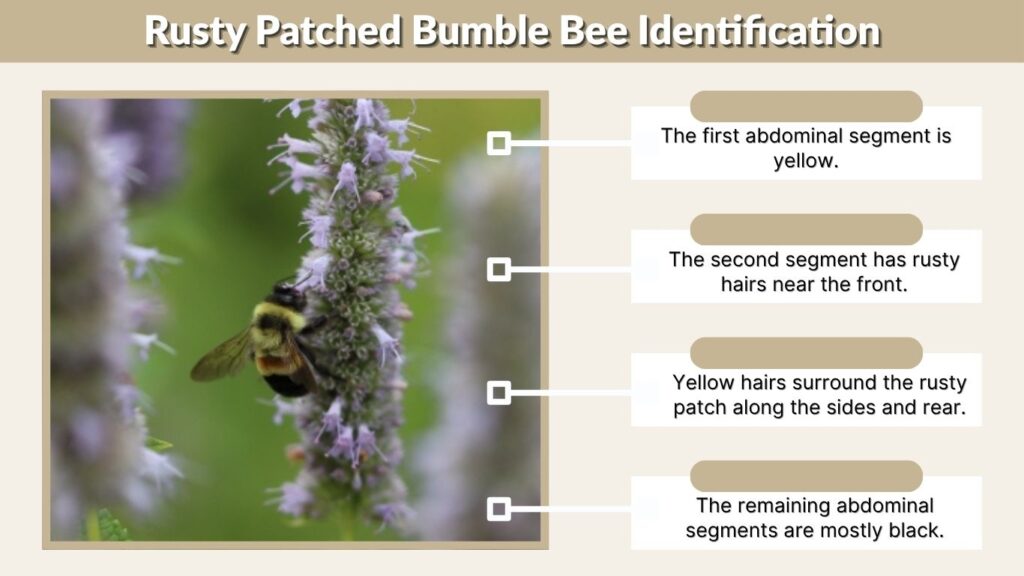
Workers and males have yellow hair covering much of the upper thorax. Between the wings is a black T-shaped or thumbtack-like marking that may extend toward the back of the thorax.
The abdomen provides the most important identification feature:
- The first abdominal segment is yellow.
- The second segment has rusty hairs near the front.
- Yellow hairs surround the rusty patch along the sides and rear.
- The remaining abdominal segments are mostly black.
- The face is relatively short and rounded.
The rusty patch may be difficult to see when the bee is moving or viewed from the side. Photographs from above, from the side, and directly toward the face provide the best chance of confirming an identification.
What Does the Queen Look Like?
Rusty patched bumble bee queens look different from workers and males. Despite the species’ name, queens do not have a rusty patch.
A queen has yellow hair covering the first two abdominal segments, followed by a mostly black abdomen. She also lacks the clear black thumbtack marking seen on the thorax of workers and males. Queens are generally larger and heavier-bodied, but size alone cannot confirm the species.
Rusty Patched Bumble Bee vs. Similar Bumble Bees
Several widespread species can be mistaken for the rusty patched bumble bee.
| Species | Main difference |
| Brown-belted bumble bee | Brown abdominal patch is bordered by black, not yellow |
| Tricolored bumble bee | Has bright orange across the second and third segments |
| Half-black bumble bee | Lacks a true rusty patch and has no thoracic thumbtack |
| Red-belted bumble bee | May have orange hairs but lacks the thumbtack marking |
The brown-belted bumble bee is especially confusing because it also has brown or rusty hair on its second abdominal segment. However, the rear and sides of that segment are black rather than yellow. Identification should be based on the abdominal pattern, thoracic marking, face shape, and multiple clear photographs.
“Rusty patched bumble bee,” “rusty-patched bumblebee,” and “rusty patch bumblebee” all refer to Bombus affinis. The U.S. Fish and Wildlife Service commonly uses the name rusty patched bumble bee.
Rusty Patched Bumble Bee Habitat and Nesting Sites
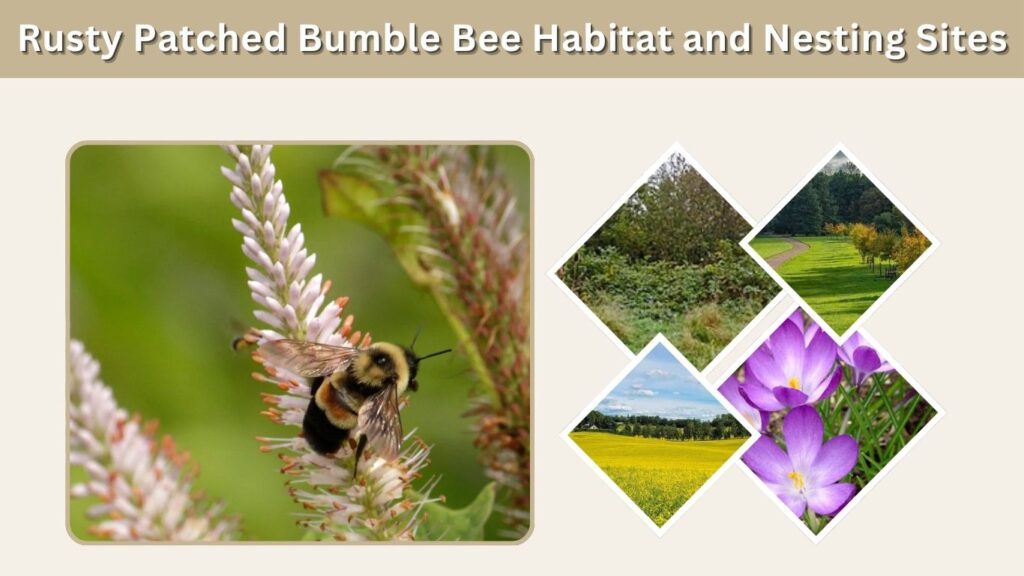
The rusty patched bumble bee has been recorded in prairies, woodland edges, marshes, agricultural areas, parks, gardens, and suburban landscapes. Suitable habitat must provide flowers from early spring through fall, protected nesting locations, and undisturbed places where new queens can spend the winter.
Most documented nests have been underground. Queens often establish colonies in abandoned rodent burrows or other existing cavities approximately one to four feet below the surface. Nests can occasionally occur at ground level or aboveground, but about 95% of documented historical nests were underground.
New queens probably overwinter in shallow chambers beneath loose soil, leaf litter, moss, or short vegetation, often near wooded areas. Heavy soil disturbance, fall raking, digging, mowing, and early-spring cleanup can damage these concealed sites.
Historical and Current Range
Historically, the rusty patched bumble bee occurred broadly across the eastern and upper midwestern United States, extending from Connecticut to South Dakota and south to northeastern Georgia. Its Canadian range included southern Ontario and Quebec, with older records from New Brunswick.
The species has declined by approximately 87% and is believed to occupy less than 1% of its former range. Current U.S. conservation efforts focus particularly on surviving populations in the Midwest, including Minnesota, Wisconsin, Iowa, and Illinois, although records have also occurred in several northeastern and Appalachian states.
Canada still classifies the species as endangered, but no confirmed individual has been found there since 2009 despite extensive surveys. Canadian authorities consequently consider it extremely rare or possibly extirpated.
Life Cycle and Behavior
The rusty patched bumble bee has an annual colony cycle. A fertilized queen survives winter alone and emerges during early spring. She feeds on early-blooming flowers, searches for a suitable cavity, builds a nest, and lays the first eggs.
The first generation develops into female workers that collect nectar and pollen, defend the nest, and care for later broods. Larvae pass through four growth stages before pupating, and development from larva to adult may take approximately five weeks.
During late summer and fall, the colony produces males and new queens. They leave the nest, mate, and disperse. Workers, males, and the original queen eventually die, while the newly mated queens find protected overwintering locations and restart the cycle the following spring.
Why Is the Rusty Patched Bumble Bee Endangered?
The species was listed as endangered under the U.S. Endangered Species Act in 2017, becoming the first bumble bee to receive federal protection. Its decline appears to result from several interacting pressures rather than one isolated cause.
Major threats include:
- Disease and pathogen transmission from managed bees
- Exposure to insecticides and fungicides
- Loss and fragmentation of flowering habitat
- Agricultural intensification
- Competition with managed bees
- Drought and extreme temperatures
- Climate change
- Problems associated with small, isolated populations
Evidence suggests that introduced pathogens, combined with pesticide exposure and nutritional stress, played an important role in the sudden decline. A weakened bee with inadequate pollen may be less capable of surviving disease or chemical exposure.
In May 2026, the U.S. Fish and Wildlife Service finalized approximately 1.5 million acres of critical habitat across 33 counties in Illinois, Iowa, Minnesota, Virginia, West Virginia, and Wisconsin. The designation guides federal agencies but does not change land ownership or automatically open private property to the public.
What Do Rusty Patched Bumble Bees Eat?
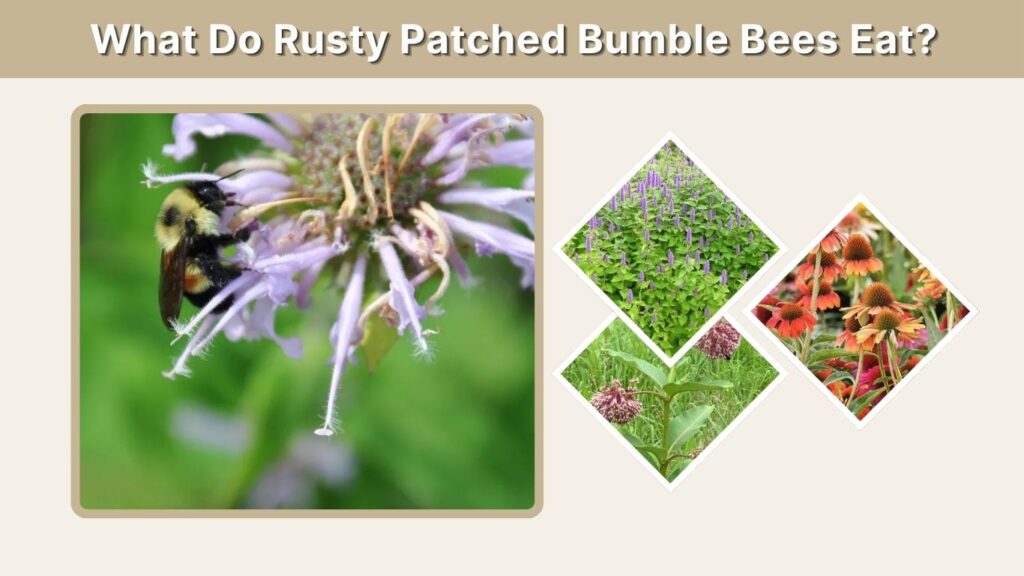
Adults drink nectar for carbohydrates and collect pollen as a protein-rich food for developing larvae. The species is a generalist pollinator that visits many kinds of flowering plants, but its relatively short tongue makes shallow or easily accessible flowers especially useful.
Helpful plants include:
- Native giant hyssop
- Milkweeds
- Wild geranium
- Wild bergamot
- Coneflowers
- Joe-Pye weed
- Mountain mint
- Native thistles
- Goldenrods
- New England aster
- Willows
- Serviceberries
- Native plums and cherries
A successful garden should not depend on only one flower. Queens need early-spring nectar, growing colonies require abundant summer pollen, and new queens need late-season flowers before winter.
How to Help the Rusty Patched Bumble Bee
Plant native flowers that bloom continuously from early spring through fall. Include flowering trees and shrubs as well as perennials, and select species native to your particular region.
Reduce pesticide use, especially while plants are flowering. Leave some lawn areas unmowed, preserve abandoned burrows, avoid disturbing possible nests, and leave portions of fallen leaves and garden stems in place through winter. These practices provide food, nesting cover, and overwintering shelter for many native bees.
How to Report a Sighting
Do not catch, handle, or disturb a suspected rusty patched bumble bee. Instead, photograph it while it visits flowers. Capture clear views of the back, side, face, thorax, and abdomen, and record the location, date, and flower species.
Photographs can be uploaded to community-science platforms such as Bumble Bee Watch, BeeSpotter, or iNaturalist, where knowledgeable reviewers may verify the identification. Formal researchers and permit holders should follow current U.S. Fish and Wildlife Service survey and reporting requirements.
FAQs
Is the rusty patched bumble bee endangered?
Yes. It has been federally listed as endangered in the United States since 2017 and is also listed as endangered in Canada. Its population and occupied range have declined dramatically since the late twentieth century.
Does every rusty patched bumble bee have a rusty patch?
No. Workers and males have the rusty abdominal patch, but queens do not. Queens have yellow hair across their first two abdominal segments and are generally visible mainly during spring colony establishment and fall dispersal.
Is the rusty patched bumble bee Minnesota’s state bee?
Yes. Minnesota designated the rusty patched bumble bee as its official state bee in 2019. The Minneapolis–St. Paul area remains one of the most important regions for surviving populations and conservation activity.
Can rusty patched bumble bees sting?
Female workers and queens are physically capable of stinging, but bumble bees normally sting only when trapped, handled, stepped on, or defending a nest. Observe and photograph suspected individuals without touching or disturbing them.
What should I do after finding a suspected rusty patched bumble bee?
Take several clear photographs, record the location and flower, and submit the observation to a recognized community-science platform. Do not capture the bee or attempt to locate and open its nest, because the species is federally protected.