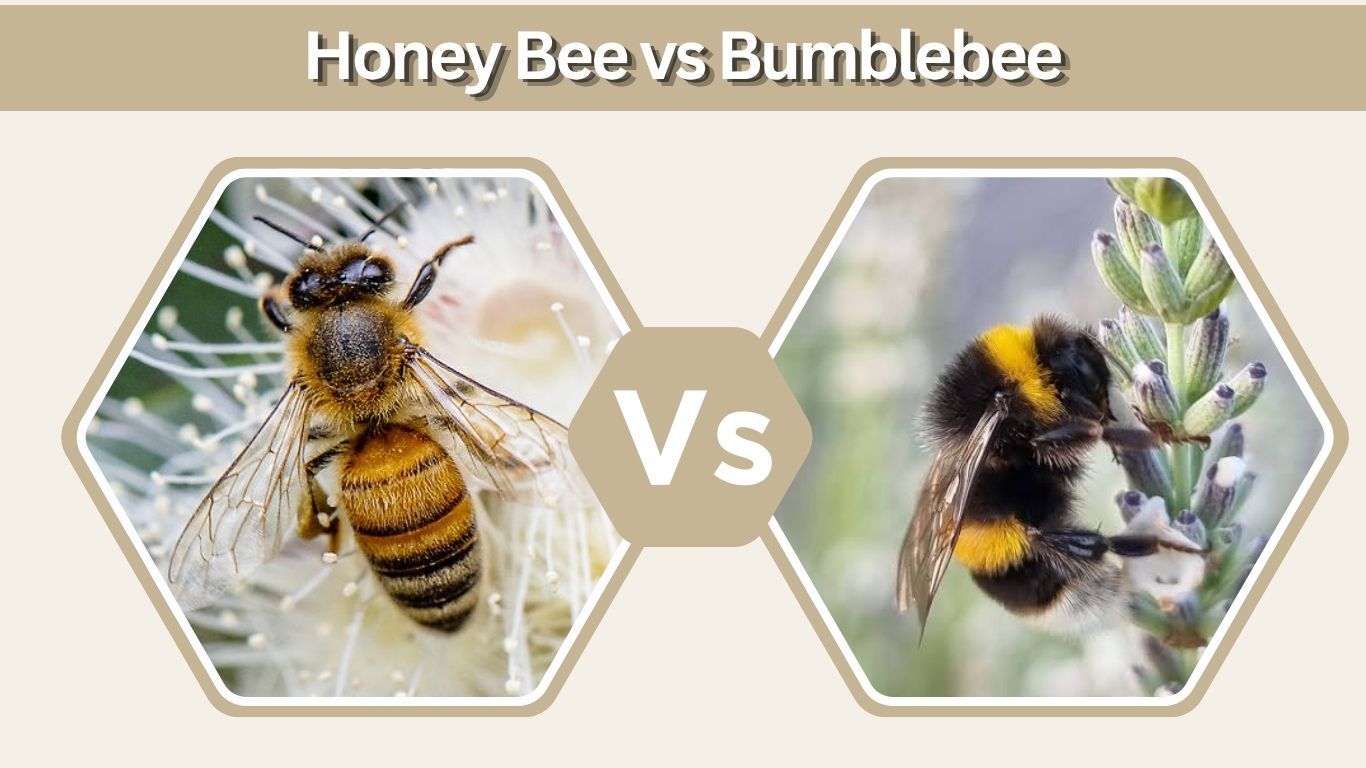
Honey bees and bumblebees are both important pollinators, but they differ greatly in appearance, colony size, nesting habits, honey production, and stinging behavior. Honey bees are slimmer, live in very large colonies, and store substantial amounts of honey, while bumblebees are larger, fuzzier, and usually live in much smaller seasonal colonies. Their pollination methods also differ, with bumblebees capable of buzz pollination. Understanding the differences between a honey bee vs bumblebee makes identification easier and helps you react appropriately when either species appears around your home or garden.
Honey Bee vs Bumblebee at a Glance
At first glance, both insects may appear similar because they often visit the same flowers. Looking more closely reveals clear differences. Bumblebees generally have rounder, hairier bodies, while honey bees are smaller and more streamlined. Their nests and social structures are also very different.
| Feature | Honey Bee | Bumblebee |
| Typical appearance | Slim, golden-brown | Large, round and fuzzy |
| Body size | Usually smaller | Usually larger |
| Colony size | Thousands of bees | Usually dozens to hundreds |
| Honey production | Large stores | Very small stores |
| Nest lifespan | Often multiple years | Usually one season |
| Sting ability | Worker usually stings once | Female can sting repeatedly |
| Pollination | Excellent | Excellent, including buzz pollination |
| Common nest | Hive/cavity | Underground or sheltered cavity |
Honey Bee vs Bumblebee Appearance
Appearance is usually the quickest way to tell the two insects apart. Honey bees typically have a narrower abdomen and relatively smooth-looking body, although they do have fine hairs. Bumblebees are noticeably bulkier and covered with dense hairs that give them their characteristic fuzzy appearance.
How to Identify a Honey Bee
Honey bees usually have a golden-brown or amber body marked with darker bands.
Common features include:
- Slender oval-shaped body
- Golden, tan, or brown coloration
- Dark abdominal bands
- Moderately hairy thorax
- Transparent wings
- Smaller overall appearance than most bumblebees
- Workers often seen traveling repeatedly between flowers and a nest
Honey bees can sometimes appear orange-brown rather than bright yellow, which helps distinguish them from many wasps and yellow jackets.
How to Identify a Bumblebee
Bumblebees are heavier-bodied and much more noticeably hairy.
They commonly have a combination of:
- Black coloration
- Yellow or orange bands
- Dense fuzzy hair
- Rounded abdomen
- Broad thorax
- Thick, robust body
- Relatively loud buzzing flight
Different bumblebee species have different banding patterns, so not every bumblebee is simply black and yellow.
Bumblebee vs Honey Bee Size
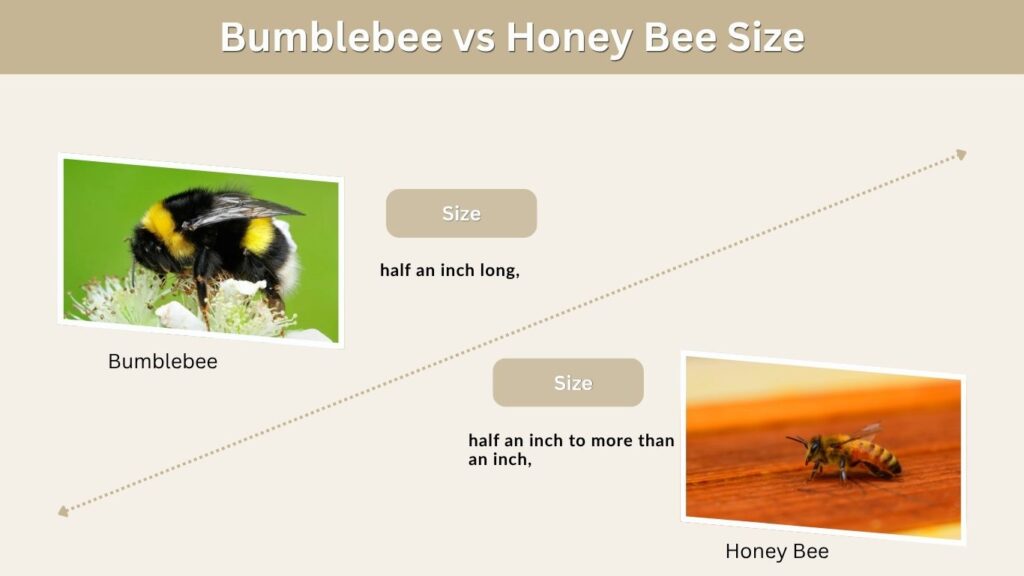
Bumblebees are usually larger and more robust than worker honey bees. However, exact measurements vary by species, sex, and caste. Bumblebee queens can be considerably larger than workers, while honey bee queens are longer than normal worker bees.
Which Bee Is Bigger?
A typical worker honey bee is around half an inch long, whereas many bumblebees range from roughly half an inch to more than an inch, depending on the species and caste.
The major visual difference is body bulk. Even when their lengths are similar, the bumblebee’s thick, hairy body usually makes it appear significantly larger.
| Characteristic | Honey Bee | Bumblebee |
| Body build | Slimmer | Thick and rounded |
| Hair | Moderate | Very dense |
| Typical worker size | Smaller | Larger |
| Queen | Longer abdomen | Often very large and robust |
Bumblebee Nest vs Honey Bee Nest
Their nesting behavior is one of the biggest differences between honey bees and bumblebees. Honey bees construct organized wax combs and may occupy the same nest for years. Bumblebee colonies are generally seasonal and establish much smaller nests.
Honey Bee Nest
Honey bees naturally nest in enclosed cavities.
Possible locations include:
- Hollow trees
- Wall cavities
- Chimneys
- Roof spaces
- Abandoned structures
- Managed beehives
Inside the nest, workers construct parallel sheets of hexagonal wax cells. These cells hold developing larvae, pollen, and honey.
A healthy honey bee colony may contain tens of thousands of bees during peak season.
Bumblebee Nest
Bumblebees commonly establish nests:
- Underground in abandoned rodent burrows
- Beneath sheds
- Under decks
- In compost piles
- Inside bird boxes
- Beneath dense vegetation
- In wall or roof cavities
Their nests are much less geometrically organized than honey bee combs. Bumblebees create clusters of wax cells and small storage pots.
Most bumblebee colonies die naturally at the end of the season, with newly produced queens surviving to start fresh colonies later.
Honey Bee vs Bumblebee Honey Production
Both bees can produce honey-like food reserves, but honey bees are the major honey producers.
Honey bee colonies must survive periods when flowers are unavailable. They therefore collect large quantities of nectar and convert it into stored honey.
Do Bumblebees Make Honey?
Bumblebees collect nectar and store small quantities inside their nests, but they do not produce large harvestable honey reserves like honey bees.
Most bumblebee colonies are temporary. Because almost the entire colony dies at the end of the season, they do not require enough stored food to sustain thousands of workers through winter.
This is why commercial honey production depends primarily on honey bees.
Bumblebee vs Honey Bee Pollination
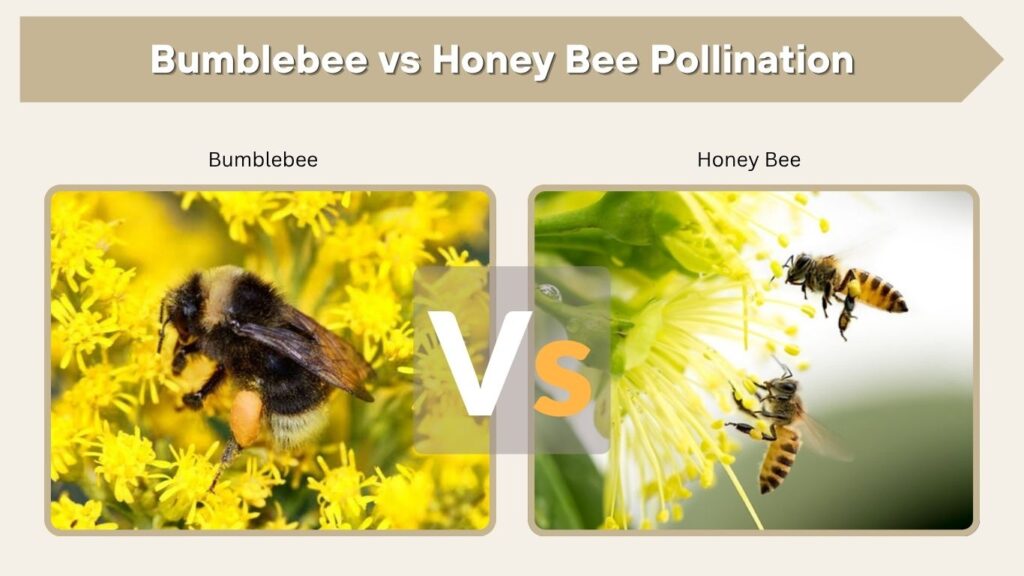
Both insects are extremely useful pollinators. Their different body structures and behaviors allow them to perform somewhat different roles.
Honey bees can recruit large numbers of workers to productive flower patches, while bumblebees can remain active under cooler or less favorable conditions.
Bumblebee Buzz Pollination
One important bumblebee advantage is buzz pollination.
A bumblebee grips a flower and rapidly vibrates its flight muscles. The vibration releases tightly held pollen from the flower.
Plants that benefit strongly from buzz pollination include:
- Tomatoes
- Blueberries
- Cranberries
- Peppers
- Eggplants
Honey bees generally cannot perform true buzz pollination.
Honey Bee Pollination
Honey bees are highly efficient because they form enormous colonies containing thousands of foraging workers.
A successful worker can also communicate the location of valuable food through movements known as the waggle dance.
This social system allows many bees from one colony to repeatedly visit productive flowering areas.
Honey Bee vs Bumblebee Sting
Both female honey bees and female bumblebees can sting. However, what happens after they sting is different.
| Sting Feature | Honey Bee | Bumblebee |
| Females can sting | Yes | Yes |
| Males can sting | No | No |
| Can usually sting repeatedly | No | Yes |
| Stinger commonly remains | Yes | Usually no |
| Bee usually survives sting | Usually no | Usually yes |
Honey Bee Sting
A worker honey bee has a strongly barbed stinger. When it stings human skin, the stinger may become embedded.
As the bee pulls away, the sting apparatus can be torn from its abdomen. The worker normally dies afterward.
This is why removing a visible honey bee stinger quickly is important.
Bumblebee Sting
A bumblebee’s stinger is smoother and can usually be withdrawn.
As a result, a female bumblebee may sting more than once during a defensive encounter.
Bumblebees are generally reluctant to sting when simply feeding on flowers. Most encounters happen when a bee is grabbed, trapped, stepped on, or defending a nest.
Which Sting Hurts More?
Both can cause immediate sharp pain, redness, swelling, and itching.
Pain varies greatly according to the person, sting location, bee species, and number of stings. It is therefore difficult to say that one always hurts more than the other.
For people with venom allergies, either sting can potentially trigger a serious allergic reaction.
Honey Bee vs Bumblebee Behavior
Honey bees and bumblebees are generally focused on collecting food rather than confronting humans.
However, bees protecting their nest may become defensive.
Honey Bee Behavior
Honey bees live in highly organized permanent societies containing a queen, workers, and seasonal males.
Workers perform specialized jobs, including:
- Feeding larvae
- Cleaning the hive
- Producing wax
- Guarding entrances
- Foraging
- Cooling the hive
- Collecting nectar and pollen
Because many thousands may live together, disturbance of an established hive can involve a large number of defensive workers.
Bumblebee Behavior
Bumblebee colonies are much smaller.
Workers forage, maintain the nest, and care for developing young. Bumblebees often appear slower and heavier in flight, although they are capable fliers.
They generally tolerate people nearby when visiting flowers but may defend the immediate area around their nest.
Honey Bee vs Bumblebee vs Wasp
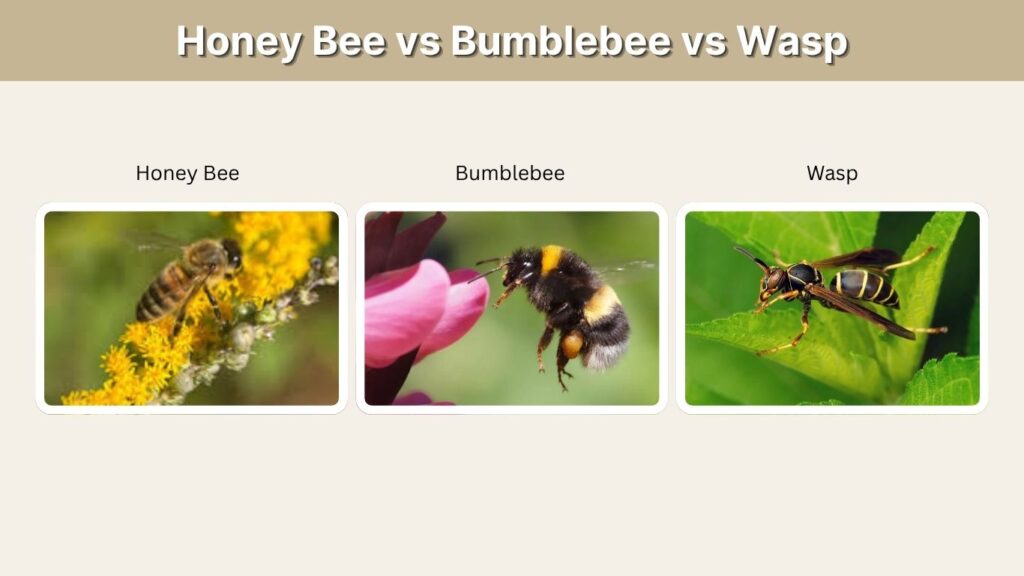
Bees are sometimes confused with wasps because all can have yellow and black markings.
The easiest difference is body texture.
Honey bees are moderately hairy, bumblebees are extremely fuzzy, and many wasps are comparatively smooth and shiny.
Wasps also tend to have narrower waists and more clearly defined body segments.
| Insect | Body | Main Food Behavior | Sting |
| Honey bee | Hairy, slender | Nectar and pollen | Worker generally once |
| Bumblebee | Very fuzzy, thick | Nectar and pollen | Multiple times |
| Wasp | Smooth, narrow waist | Predatory/omnivorous | Multiple times |
| Hornet | Large, smooth wasp | Predatory | Multiple times |
Honey Bee vs Bumblebee vs Carpenter Bee
Carpenter bees create another common identification problem because many species are similar in size to bumblebees.
The easiest clue is usually the abdomen.
A bumblebee has a densely hairy abdomen, while many carpenter bees have a relatively smooth, shiny abdomen.
Carpenter bees also excavate nesting tunnels in wood rather than building social colonies like honey bees.
Most carpenter bee nests consist of individual females or small groups rather than thousands of workers.
American Bumblebee vs Honey Bee
The American bumblebee is a North American bumblebee species with the general characteristics typical of its group: a large, hairy body and smaller colony structure than honey bees.
A honey bee encountered in the same area is usually slimmer, less densely furry, and golden-brown.
Both can be valuable pollinators, so identification should not automatically lead to removal. Bees visiting flowers away from a nest usually pose little reason for concern.
FAQs
How can you tell a honey bee from a bumblebee?
Look primarily at size and hair. Bumblebees usually have thick, rounded bodies covered with dense fuzzy hair. Honey bees are typically smaller, slimmer, and golden-brown with darker abdominal bands.
Can bumblebees make honey like honey bees?
Bumblebees store small amounts of nectar-derived food in their nests, but they do not maintain the large honey reserves produced by honey bee colonies. Honey bees store substantial quantities because their colonies can remain active for multiple years.
Which is better at pollination, honey bees or bumblebees?
Both are excellent pollinators. Honey bees have the advantage of enormous colonies containing many foragers, while bumblebees can perform buzz pollination and often work effectively during cooler conditions.
Can honey bees and bumblebees sting more than once?
Bumblebees can normally sting repeatedly. A worker honey bee usually cannot because its barbed stinger may lodge in human skin and tear away when the bee attempts to escape.
Are bumblebees more aggressive than honey bees?
Neither should normally be considered aggressive while simply feeding on flowers. Both may defend their nests when threatened. Bumblebee colonies are generally much smaller, while honey bee hives may contain thousands of workers capable of defensive behavior.