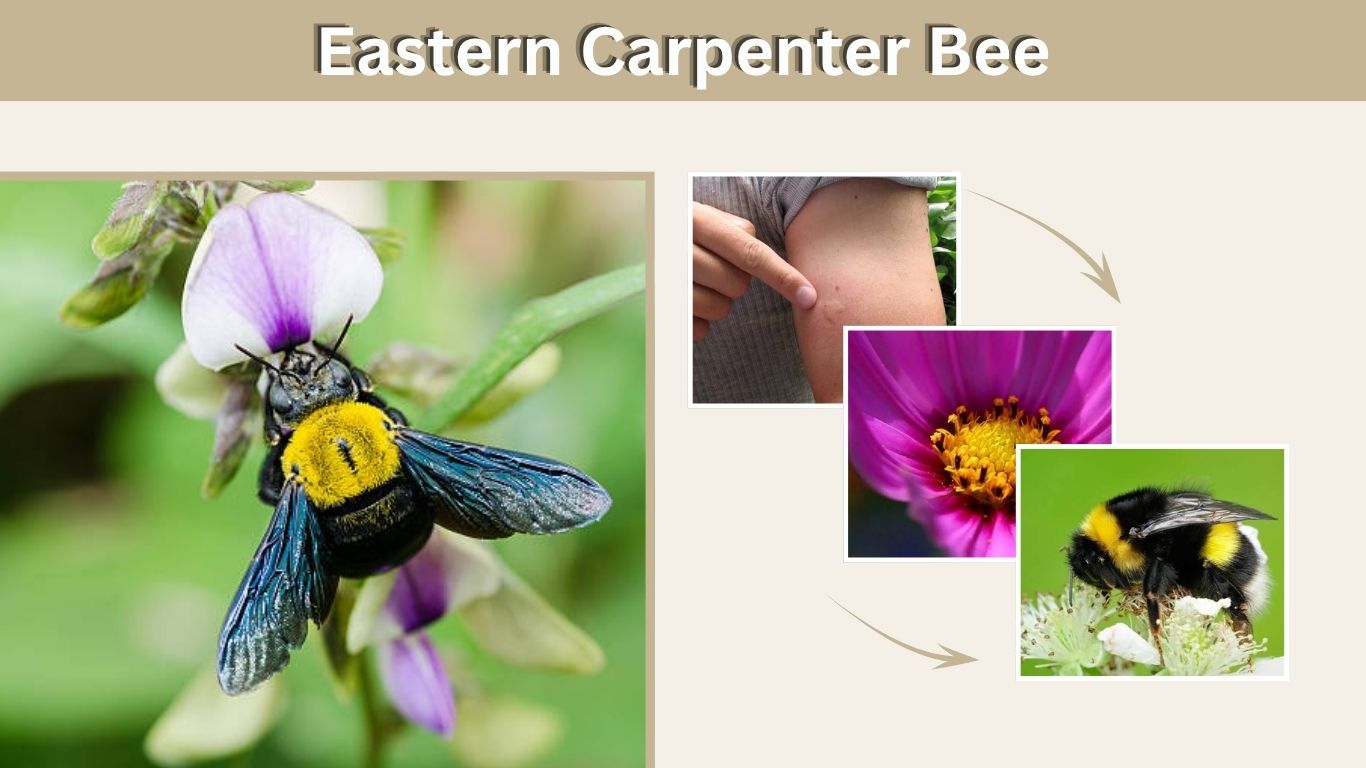
The eastern carpenter bee (Xylocopa virginica) is a large native bee commonly seen hovering around flowers, decks, fences, porches, and other wooden structures. Although its size and loud buzzing can seem intimidating, it is an important pollinator and is generally not aggressive. The species is easily confused with bumblebees, but its shiny abdomen provides an important identification clue. Understanding its appearance, male and female differences, sting risk, nesting behavior, diet, life cycle, and control can help homeowners manage these bees responsibly.
Eastern Carpenter Bee Identification
Eastern carpenter bees are among the largest commonly encountered bees in eastern North America. Their robust bodies, hairy thoraxes, dark wings, and shiny abdomens make them relatively easy to recognize once you know what to look for. The appearance of the face also helps distinguish males from females.
Appearance and Characteristics
Key identification features include:
- Scientific name: Xylocopa virginica
- Family: Apidae
- Order: Hymenoptera
- Body: Large, broad, and robust
- Thorax: Covered with yellowish, whitish, or orange-yellow hairs
- Abdomen: Mostly smooth, shiny, and black
- Wings: Dark or smoky and translucent
- Female face: Mostly black
- Male face: Usually has pale yellow or white markings
- Legs: Hairy, particularly the hind legs used for carrying pollen
Eastern Carpenter Bee Size
Adults are usually around 3/4 to 1 inch long, making them noticeably larger than honey bees. Their broad bodies and powerful flight can make them appear even bigger while hovering around nest sites.
Range and Habitat
Eastern carpenter bees occur widely across the eastern United States and use both natural and human-made environments. They nest in dry wood, including dead trees, logs, fence posts, decks, porch rails, roof eaves, siding, and outdoor furniture. Soft, weathered, or unfinished wood is particularly attractive.
Male vs Female Eastern Carpenter Bee
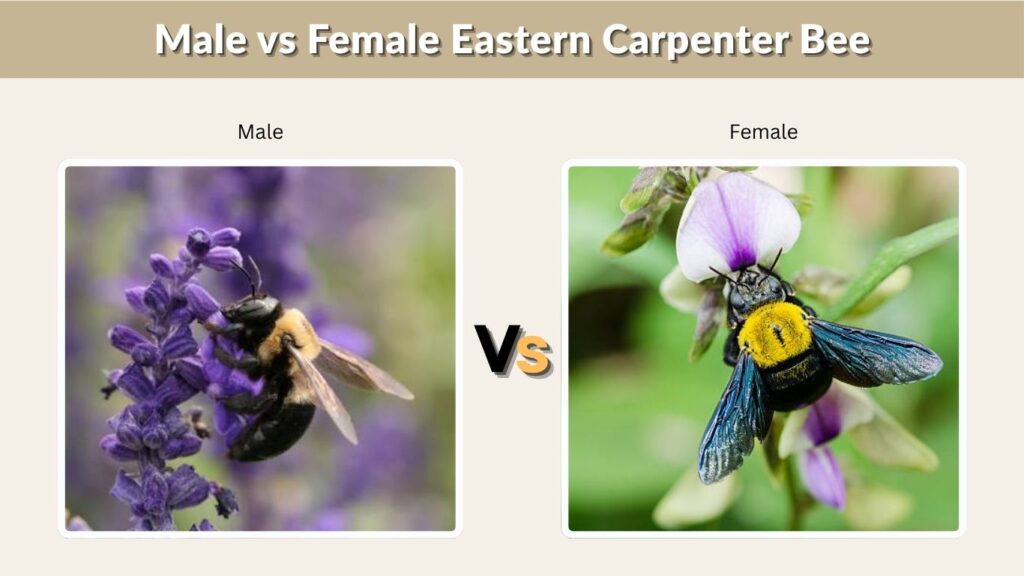
Male and female eastern carpenter bees look similar at first, but several characteristics distinguish them. The easiest difference is often facial coloration. Their behavior also differs significantly, particularly near nesting areas.
Male Eastern Carpenter Bee
Male carpenter bees commonly patrol territories around nest entrances. They may hover directly in front of people or rapidly approach anyone walking nearby.
Despite this intimidating behavior, male eastern carpenter bees cannot sting because they lack a stinger. Their faces commonly have noticeable white or pale-yellow markings.
Female Eastern Carpenter Bee
Females usually have an entirely dark or black face. They perform most of the work involved in excavating galleries, collecting pollen and nectar, provisioning brood cells, and laying eggs.
Females possess a functional stinger but are generally docile and unlikely to sting unless handled or strongly threatened.
Does an Eastern Carpenter Bee Have a Queen?
Eastern carpenter bees do not normally have a queen in the same sense as honey bees or bumblebees. They are primarily solitary or facultatively social bees rather than members of large colonies. Individual reproductive females commonly maintain and provision their own nest galleries.
Do Eastern Carpenter Bees Sting?
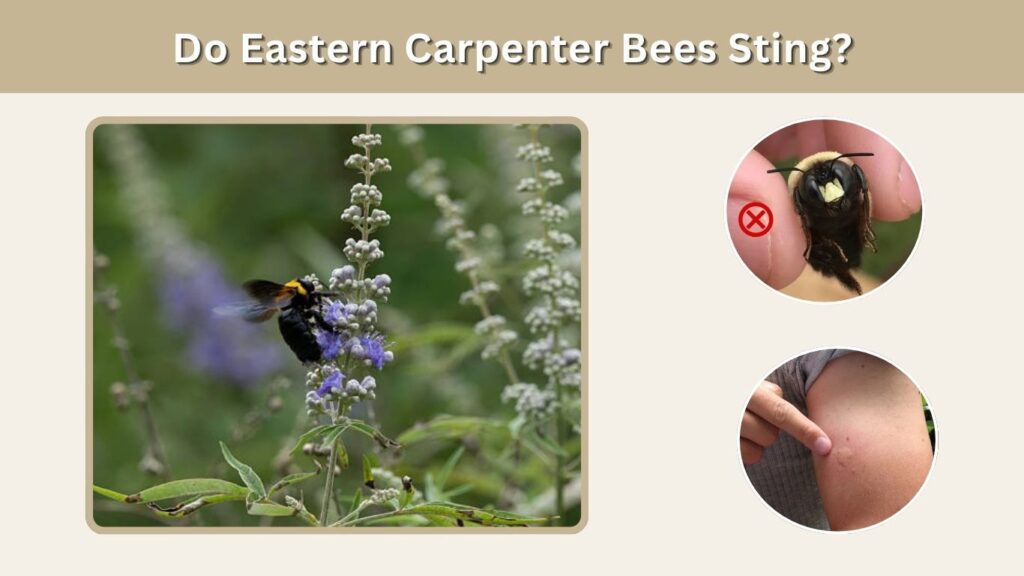
Their large size frequently causes concern, especially when males repeatedly hover around people. However, their defensive abilities are much less threatening than their behavior may suggest.
Eastern Carpenter Bee Sting
Only females can sting. A female eastern carpenter bee may sting if she is caught, squeezed, or directly threatened, but stinging incidents are uncommon.
Males often behave aggressively around territories, but their close approaches are essentially defensive bluffing because males have no stinger.
Do Eastern Carpenter Bees Bite?
Eastern carpenter bees have strong mandibles that females use to excavate wood, but they are not considered biting pests of humans. Their jaws are primarily tools for nest construction rather than defense against people.
Are Eastern Carpenter Bees Dangerous?
For most people, eastern carpenter bees present little danger when left alone. Their main concern around homes is usually wood damage rather than stinging.
Anyone who develops symptoms of a serious allergic reaction after a bee sting—such as trouble breathing, throat swelling, severe dizziness, or widespread hives—should seek urgent medical attention.
Eastern Carpenter Bee Diet and Benefits
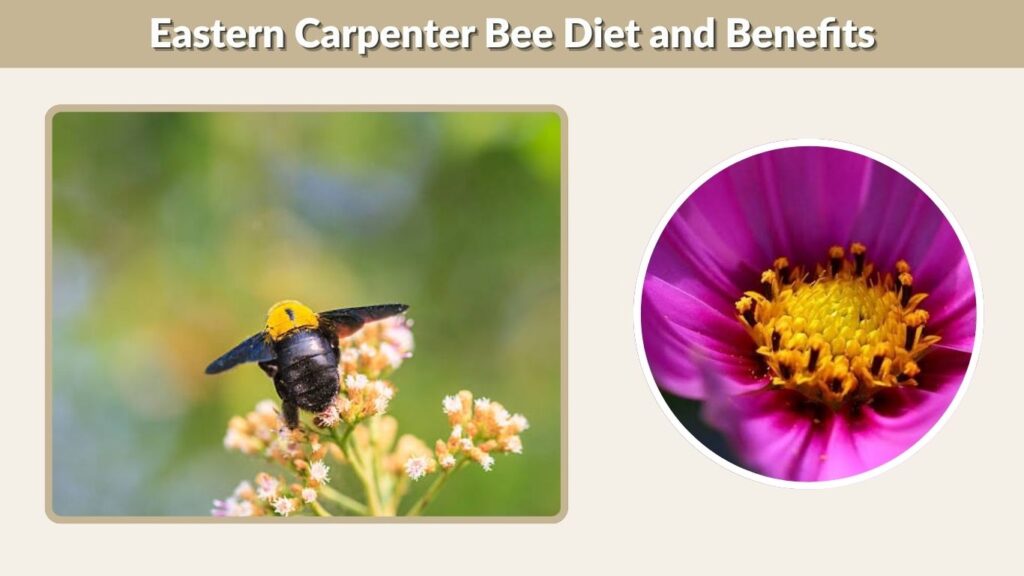
Eastern carpenter bees do not eat wood despite their ability to excavate impressive tunnels. Instead, their diet consists primarily of flower resources, which makes them valuable pollinators in gardens and natural habitats.
What Do Eastern Carpenter Bees Eat?
Adults mainly consume nectar and pollen from flowers. Females also collect these resources to prepare food for developing larvae.
Inside each brood cell, a female places a mixture of pollen and nectar before laying an egg. The larva consumes this stored food while developing.
Pollination Benefits
While visiting flowers, eastern carpenter bees transfer pollen between blooms. Their large bodies can carry considerable pollen, helping many flowering plants reproduce.
They are therefore beneficial insects when nesting in natural wood or locations where their tunneling does not threaten buildings.
Eastern Carpenter Bee Nest and Life Cycle
Carpenter bees receive their name from the females’ ability to excavate galleries in wood. They do not consume the wood; instead, they remove it while constructing protected chambers where their young develop.
Eastern Carpenter Bee Nest
A female creates an almost perfectly round entrance hole slightly less than half an inch wide. After entering the wood, she turns and tunnels along the grain.
Typical galleries may extend several inches, although old galleries reused and enlarged over multiple generations can become much longer. Inside, individual brood cells are separated with partitions made from chewed wood material.
Common nesting locations include:
- Deck railings
- Roof eaves
- Porch ceilings
- Fence posts
- Wooden siding
- Shutters
- Outdoor furniture
- Dead trees and logs
Eastern Carpenter Bee Life Cycle
Adults commonly emerge during spring, when mating and nest construction begin. Females provision individual chambers with pollen and nectar and lay an egg in each.
The young pass through egg, larva, pupa, and adult stages. Under suitable conditions, development from egg to adult takes roughly seven weeks. New adults later use galleries for shelter, and many overwinter inside old nests before emerging the following spring.
Social Behavior
Eastern carpenter bees are generally described as solitary, although several individuals may occupy galleries in the same piece of wood. Some populations can also show flexible social behavior. Seeing many bees around one board therefore does not necessarily mean there is a large hive similar to a honey-bee colony.
Eastern Carpenter Bee vs Bumblebee
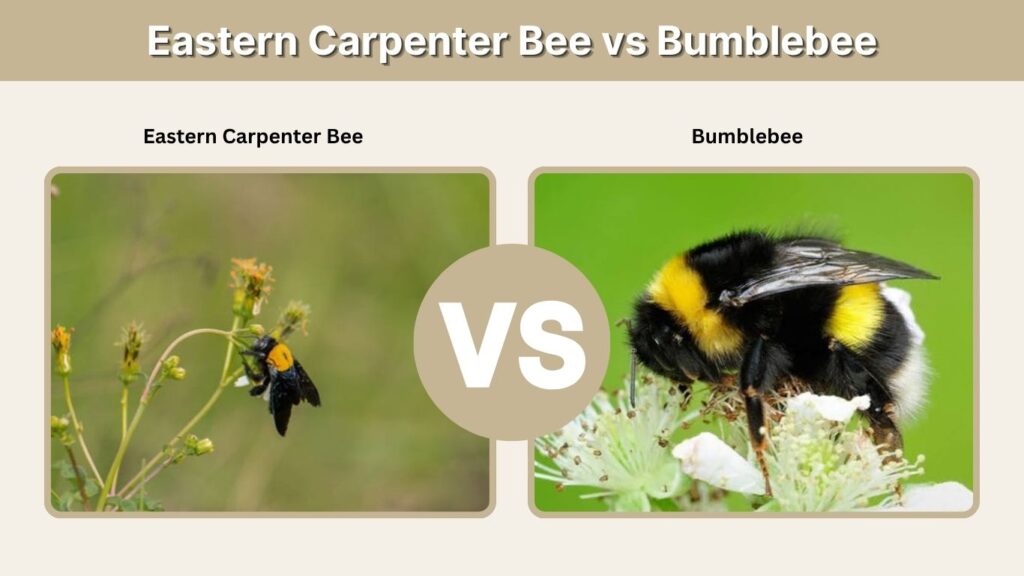
Eastern carpenter bees are frequently mistaken for bumblebees because both are large, yellow-and-black bees. The abdomen provides one of the quickest ways to separate them.
| Feature | Eastern Carpenter Bee | Bumblebee |
| Abdomen | Smooth and shiny | Fuzzy and hairy |
| Nest | Galleries in wood | Usually underground or in cavities |
| Social structure | Mostly solitary | Social colonies |
| Male sting | Cannot sting | Cannot sting |
| Female sting | Possible but uncommon | Can sting defensively |
| Wood damage | Can occur | Does not excavate wood |
The shiny black abdomen of an eastern carpenter bee is generally the easiest field identification feature, while bumblebees have much hairier abdomens.
Eastern Carpenter Bee Damage and Control
A single nest usually causes limited damage. Problems develop when carpenter bees repeatedly reuse the same wooden structures, extending old galleries and creating additional tunnels over many years.
Signs of Carpenter Bee Damage
Watch for:
- Round holes in exposed wood
- Coarse sawdust beneath holes
- Yellowish or brown staining below entrances
- Bees repeatedly entering the same hole
- Multiple galleries concentrated in one board
- Woodpecker damage around bee galleries
How to Prevent Eastern Carpenter Bees
Prevention usually focuses on making wood less attractive:
- Paint exposed wooden surfaces thoroughly.
- Maintain painted surfaces as they weather.
- Repair badly damaged boards.
- Seal suitable nest entrances after confirming bees are no longer actively using them.
- Reduce exposed, unfinished softwood around vulnerable structures.
- Inspect eaves, decks, railings, and fascia boards each spring.
Painting is generally more effective at discouraging nesting than simply staining wood. For substantial infestations or galleries in difficult-to-access structural areas, professional pest management may be appropriate.
Do Carpenter Bee Traps Work?
Carpenter bee traps may capture some individuals around heavily used nesting areas, but they should not replace wood maintenance. Long-term management is more effective when homeowners repair existing damage and protect exposed wood so females have fewer suitable places to excavate new galleries.
FAQs
1. What is the scientific name of the eastern carpenter bee?
The eastern carpenter bee’s scientific name is Xylocopa virginica. It belongs to the bee family Apidae.
2. Can a male eastern carpenter bee sting?
No. Male eastern carpenter bees lack stingers, although they frequently hover, chase intruders, and behave aggressively around nesting territories.
3. Do eastern carpenter bees make honey?
They collect nectar and pollen, but they do not produce harvestable honey or maintain large honey stores like honey bees. Females primarily use collected nectar and pollen to provision their developing young.
4. How long do eastern carpenter bees live?
Their development from egg to adult can take about seven weeks, while adults emerging later in the season may overwinter inside nest galleries and become active again the following spring.
5. Should I get rid of eastern carpenter bees?
Not necessarily. They are valuable pollinators and generally harmless when nesting away from structures. Control is most justified when repeated nesting is damaging decks, siding, eaves, railings, or other important wooden components.