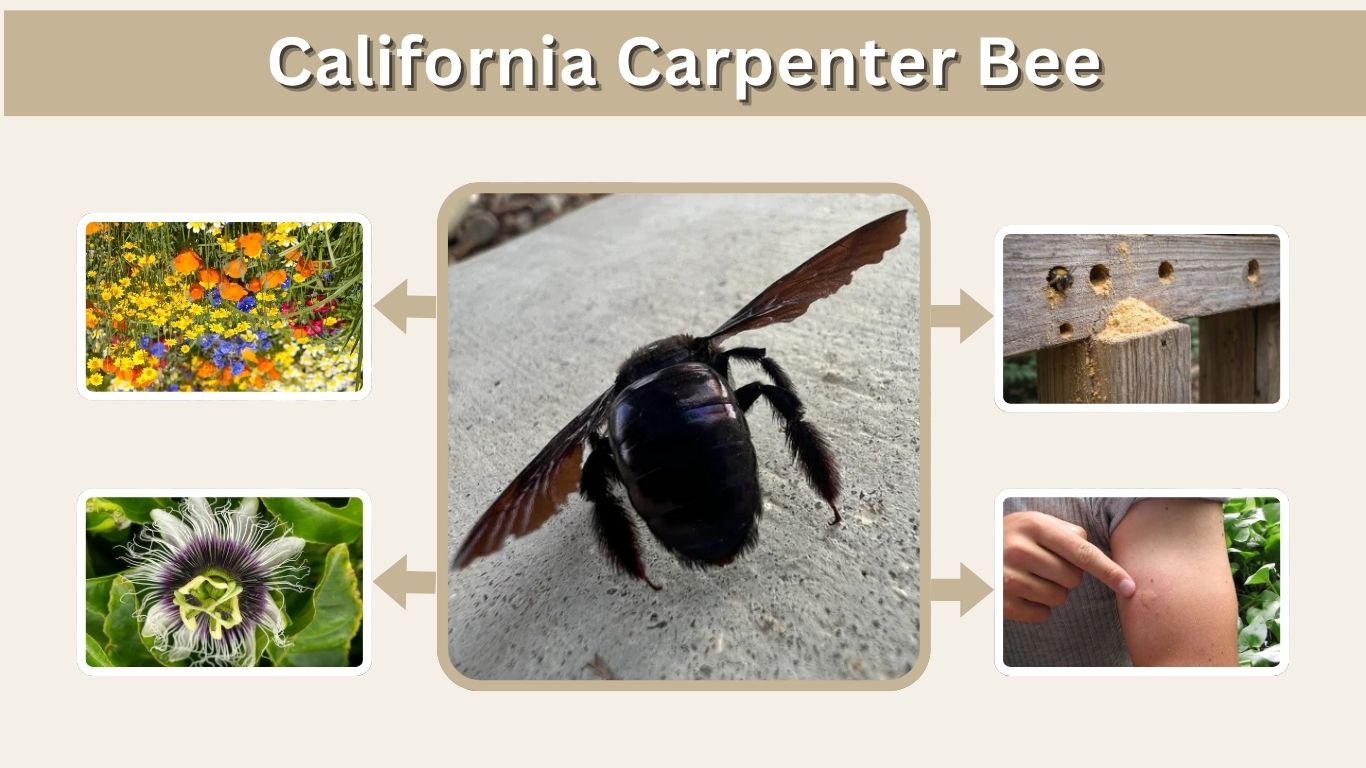
California carpenter bees are large, noticeable native bees often seen around gardens, flowering plants, fences, decks, and wooden structures. Several carpenter bee species occur throughout California, including the impressive valley carpenter bee. Although their large size and loud flight can seem intimidating, these bees are generally not aggressive and are important native pollinators. Understanding their appearance, nesting habits, sting risk, and behavior can help homeowners distinguish California carpenter bees from bumblebees and decide when nesting activity actually requires attention.
What Is a California Carpenter Bee?
California is home to several species of carpenter bees in the genus Xylocopa. They get their common name from the females’ habit of excavating tunnels in dead wood for nesting. Carpenter bees occur in both Northern and Southern California and are particularly noticeable during warm months when adults visit flowers or search for nesting sites.
California Carpenter Bee Species
Some carpenter bees commonly associated with California include:
- Valley carpenter bee (Xylocopa sonorina)
- Mountain carpenter bee (Xylocopa tabaniformis orpifex)
- California carpenter bee species within the genus Xylocopa
- Other regional carpenter bees adapted to deserts, valleys, foothills, and coastal areas
The valley carpenter bee is one of the most recognizable species because females can appear almost completely black while males are often golden or yellowish.
Are Carpenter Bees Native to California?
Yes. Several carpenter bee species are native to California and form an important part of the state’s pollinator community. They naturally nest in dead branches, logs, agave stalks, and other dry woody material.
Human structures such as fences, pergolas, roof trim, and untreated lumber can provide similar nesting conditions, which explains why carpenter bees sometimes appear around homes.
California Carpenter Bee Identification
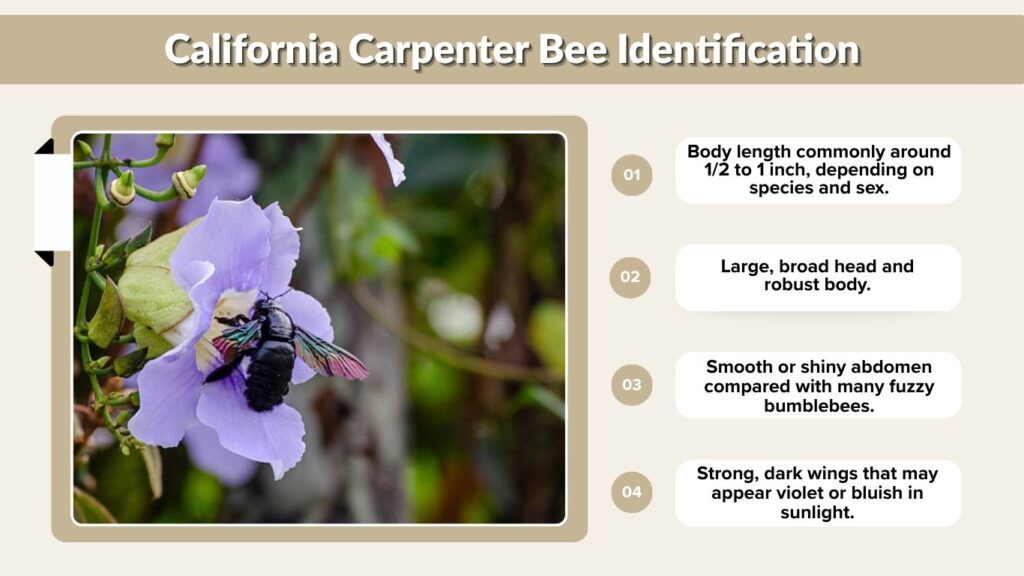
Large size is usually the first feature people notice. California carpenter bees have heavy bodies and powerful wings, and some individuals may look similar to bumblebees. A closer look at the abdomen, coloration, and behavior usually makes identification much easier.
Key Identification Features
Look for these characteristics:
- Body length commonly around 1/2 to 1 inch, depending on species and sex
- Large, broad head and robust body
- Smooth or shiny abdomen compared with many fuzzy bumblebees
- Strong, dark wings that may appear violet or bluish in sunlight
- Females of some species are mostly black
- Males of valley carpenter bees may appear golden, tan, or yellowish
- Frequent hovering around flowers, wooden structures, or nesting territories
California Carpenter Bee Size
Carpenter bees are among the larger native bees found in California. Valley carpenter bees can approach an inch in length, making them especially easy to notice.
Their heavy appearance often causes people to assume they are dangerous. However, body size does not indicate aggression. Most carpenter bees spend their time feeding, nesting, or defending small territories without attacking people.
Black Carpenter Bees in California
A large black carpenter bee seen in California is often a female valley carpenter bee or another dark-colored Xylocopa species. Females generally have black bodies, sometimes with metallic blue or violet reflections on their wings.
Their size and dark coloration can make them look intimidating, particularly when they fly close to people or wooden structures.
Male vs Female California Carpenter Bees
Male and female carpenter bees can look surprisingly different. This is particularly true of the valley carpenter bee, where the sexes are so different in color that they can easily be mistaken for separate species.
Female California Carpenter Bee
Female carpenter bees usually have:
- Dark brown or black bodies
- Dark wings with blue or violet reflections
- Strong jaws used to excavate wood
- A functional stinger
- Nest-building and pollen-collecting responsibilities
Females spend considerable time constructing tunnels, collecting pollen, preparing brood cells, and laying eggs.
Male California Carpenter Bee
Male valley carpenter bees are often golden-yellow or tan rather than black. They may hover near flowers, nesting areas, or passing animals and people.
Males can appear territorial because they sometimes approach objects entering their flight area. However, male carpenter bees do not possess stingers, so their hovering displays are harmless.
How to Tell Males and Females Apart
Color provides one clue, but behavior is also useful. Females frequently enter nest holes carrying pollen, while males spend more time hovering and patrolling.
For species where both sexes are dark, facial markings, body proportions, and nesting behavior may help distinguish them.
California Carpenter Bee Nest and Holes
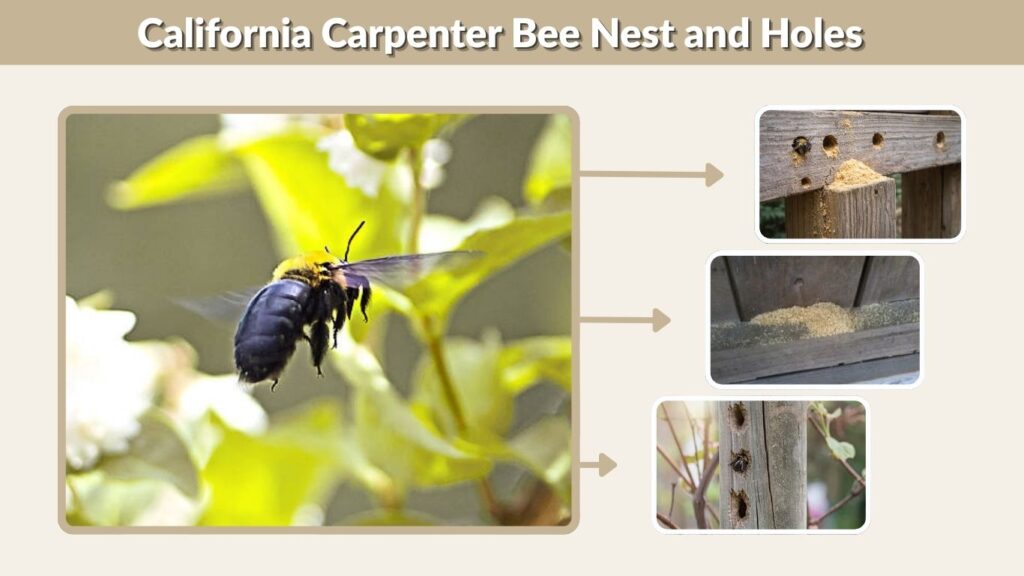
Carpenter bees do not eat wood. Instead, females use their powerful jaws to excavate tunnels where their offspring develop. Natural nesting sites include dead branches and dry plant stalks, but exposed structural lumber can also attract them.
What Does a Carpenter Bee Nest Look Like?
Typical signs of carpenter bee nesting include:
- A round entrance hole in wood
- Holes commonly close to 1/2 inch in diameter
- Fresh wood shavings beneath the entrance
- Yellowish pollen or waste stains near the hole
- Bees repeatedly entering and leaving the same opening
- Tunnels running several inches through the wood
How Carpenter Bees Build Their Nests
After creating an entrance, the female usually turns and excavates along the grain of the wood. She divides the tunnel into several brood cells.
Each cell receives a supply of pollen and nectar. The female lays an egg inside before sealing the chamber with chewed wood material. Larvae develop within these protected cells before emerging as adults.
Where They Commonly Nest
Around California properties, possible nesting locations include:
- Unpainted fences
- Pergolas
- Wooden decks
- Eaves
- Fascia boards
- Outdoor furniture
- Dead trees and branches
- Dry plant stems or old logs
Painted, sealed, or well-finished wood is generally less attractive than weathered, unfinished lumber.
Are California Carpenter Bees Dangerous?
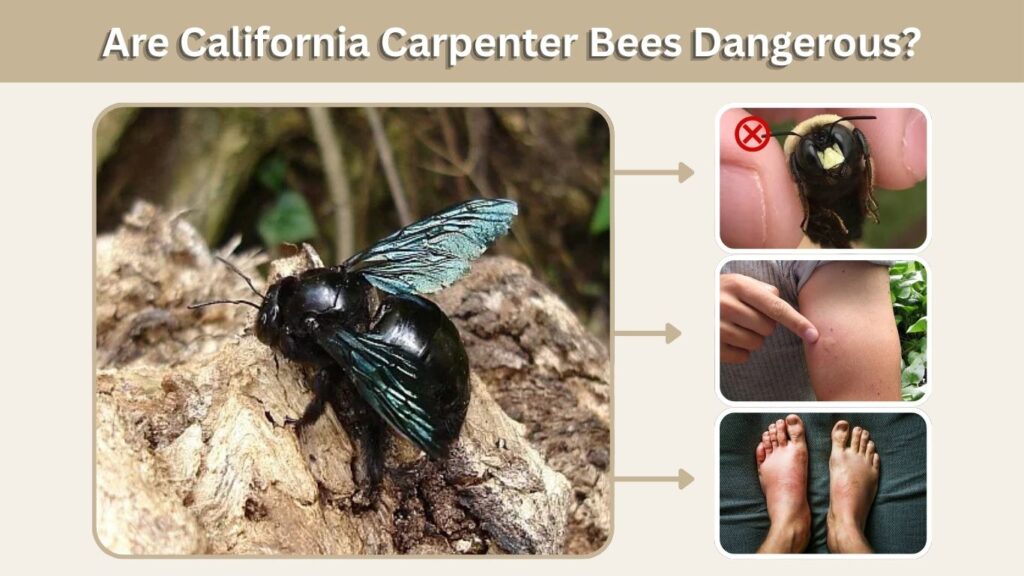
Despite their intimidating appearance, carpenter bees pose relatively little danger to people. They are not naturally aggressive and usually avoid unnecessary physical contact. Their greatest conflict with homeowners comes from repeated nesting in structural wood rather than from stinging behavior.
Do California Carpenter Bees Sting?
Female carpenter bees can sting because they possess functional stingers. However, they generally sting only when handled, trapped, stepped on, or strongly threatened.
A female flying near a nest is usually more interested in reaching her tunnel than attacking nearby people.
Male carpenter bees cannot sting at all. Their territorial hovering can look aggressive, but they lack a functional stinger.
Is Their Sting Toxic?
Carpenter bee venom is designed for defense, but the species is not considered unusually toxic to humans. For most people, a sting causes localized pain, redness, itching, or swelling similar to other bee stings.
Anyone experiencing difficulty breathing, widespread swelling, dizziness, or other signs of a severe allergic reaction should seek emergency medical care.
Carpenter Bees in Northern and Southern California
Carpenter bees occur across many parts of California, although the species present and their abundance vary by habitat and region. Warm temperatures, flowering plants, and suitable nesting wood can make some properties particularly attractive.
Carpenter Bees in Northern California
Northern California carpenter bees can be found around gardens, woodland edges, farms, parks, and residential areas. Activity usually increases during warmer periods when flowers provide abundant nectar and pollen.
Natural dead wood and untreated structures may both provide suitable nest sites.
Carpenter Bees in Southern California
Southern California provides excellent habitat for several carpenter bee species because of its long warm season and variety of flowering plants.
Valley carpenter bees can be particularly noticeable around gardens and desert landscapes. They visit many ornamental and native flowers and may remain active for extended periods when temperatures are favorable.
Why California Carpenter Bees Are Important Pollinators
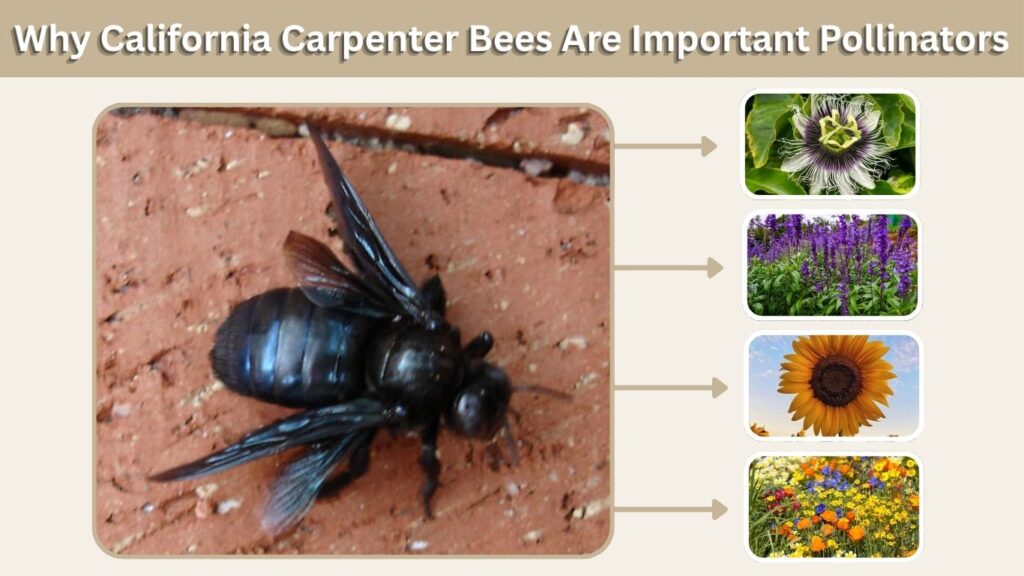
California carpenter bees provide valuable pollination services to native plants, garden flowers, and some crops. Their large bodies allow them to carry considerable amounts of pollen between flowers. They can also perform specialized pollination behaviors that make them particularly effective visitors to certain plants.
Flowers Carpenter Bees Visit
They commonly visit plants producing abundant pollen or nectar, including:
- Passionflowers
- Salvias
- Sunflowers
- California native wildflowers
- Lavender
- Tomatoes and related plants
- Various flowering shrubs and garden ornamentals
Should You Provide a Home for Carpenter Bees?
Where structural damage is not a concern, retaining dead branches, logs, or suitable natural nesting material can support native carpenter bees.
Gardeners can also help by growing pesticide-free flowering plants throughout the season. Providing natural nesting habitat away from houses may reduce the chance that bees choose decks, fences, or roof structures.
Carpenter Bees Around the House
Seeing one carpenter bee around a home does not necessarily indicate a serious infestation. The best response depends on where the bee is nesting and whether the wood is experiencing repeated damage.
If bees are using natural wood away from buildings, they can usually be left alone. When tunnels occur in important structural components, homeowners may need to protect the wood while still minimizing harm to beneficial pollinators.
How to Reduce Carpenter Bee Nesting
Maintaining wooden surfaces is one of the simplest approaches. Painting or sealing exposed wood makes many locations less attractive for excavation.
Existing holes should only be sealed after confirming that active bees or developing young are not trapped inside. Replacing badly damaged boards may sometimes be necessary where the same nesting area has been reused for many years.
FAQs
Are there carpenter bees in California?
Yes. California supports several native carpenter bee species, including the well-known valley carpenter bee. They occur in gardens, deserts, valleys, woodland edges, farms, and residential areas.
Are California carpenter bees dangerous?
They are generally not dangerous. Females can sting but rarely do so unless physically threatened. Males sometimes hover aggressively but cannot sting.
How large do California carpenter bees get?
Depending on the species, adults may range from roughly half an inch to nearly an inch long. Valley carpenter bees are among the largest and most noticeable species.
Do male California carpenter bees have stingers?
No. Male carpenter bees do not have functional stingers. Their territorial hovering can appear threatening, but they cannot sting people.
What is the difference between a carpenter bee and a bumblebee?
Carpenter bees typically have a smoother, shinier abdomen, while bumblebees are generally covered with dense hair across much of the abdomen. Carpenter bees also excavate individual nests in wood, whereas most bumblebees live in social colonies.