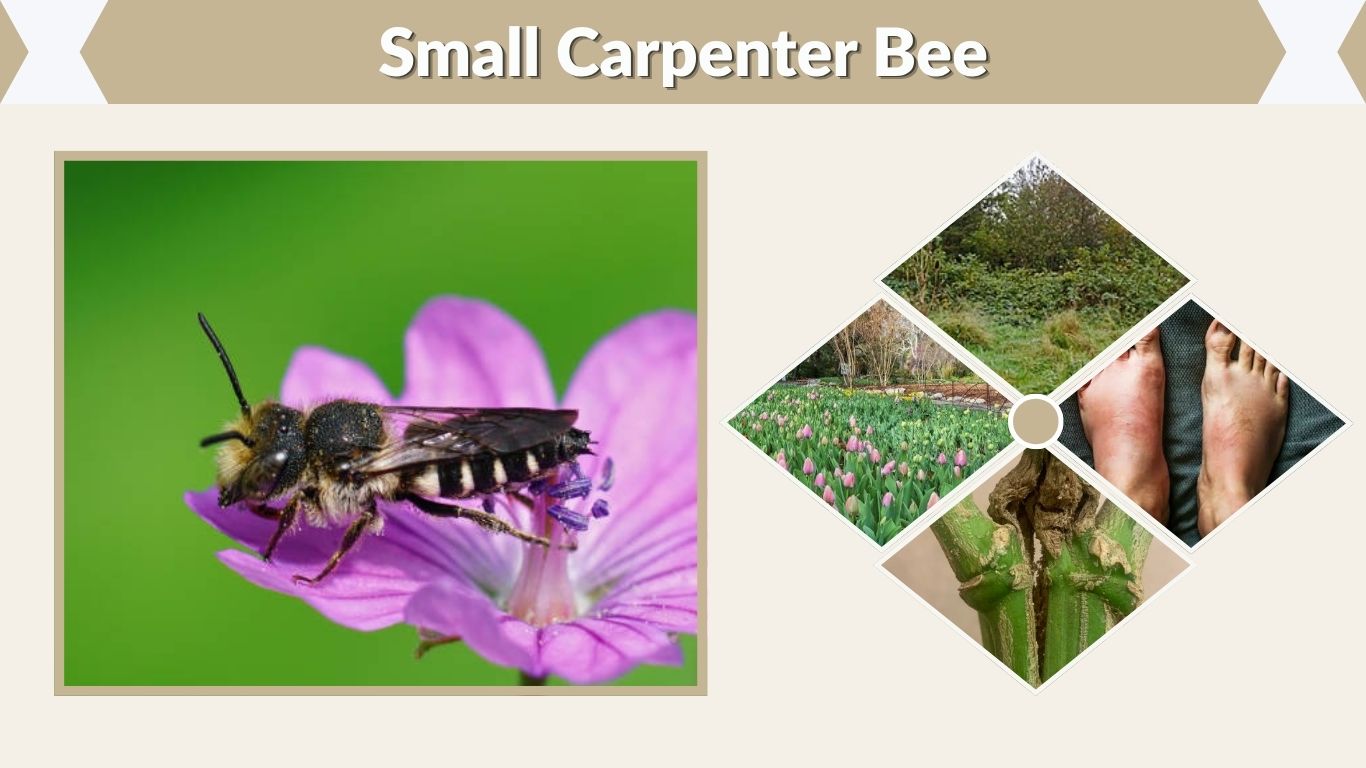
Small carpenter bees are tiny native bees that are easy to overlook in gardens, meadows, and around flowering plants. Unlike the much larger carpenter bees that tunnel into wooden structures, most small carpenter bees belong to the genus Ceratina and usually nest inside hollow or broken plant stems. Their dark, sometimes metallic bodies can make them resemble small flies or sweat bees. Learning their size, identification features, nesting habits, sting risk, and behavior makes these beneficial pollinators much easier to recognize.
What Is a Small Carpenter Bee?
Small carpenter bees are members of the genus Ceratina, a widespread group of small bees related to the larger carpenter bees in the genus Xylocopa. Instead of drilling substantial holes into decks or buildings, they usually create nests inside soft plant stems. They are generally solitary or only loosely social and play an important role in pollinating wild and cultivated plants.
Small Carpenter Bee Scientific Name
Small carpenter bees primarily belong to the genus Ceratina within the family Apidae. There are numerous Ceratina species across North America and other parts of the world.
One well-studied species is Ceratina calcarata, commonly known as the small carpenter bee. Different species vary somewhat in color, size, habitat, and nesting behavior.
Are There Really Small Carpenter Bees?
Yes. Not every carpenter bee is the large, thick-bodied insect commonly seen hovering around decks and fences.
Small carpenter bees are a distinct group. Although related to large carpenter bees, they are much smaller and usually live in plant stems rather than large pieces of wood. Their behavior also tends to be less noticeable around homes.
Small Carpenter Bee Identification
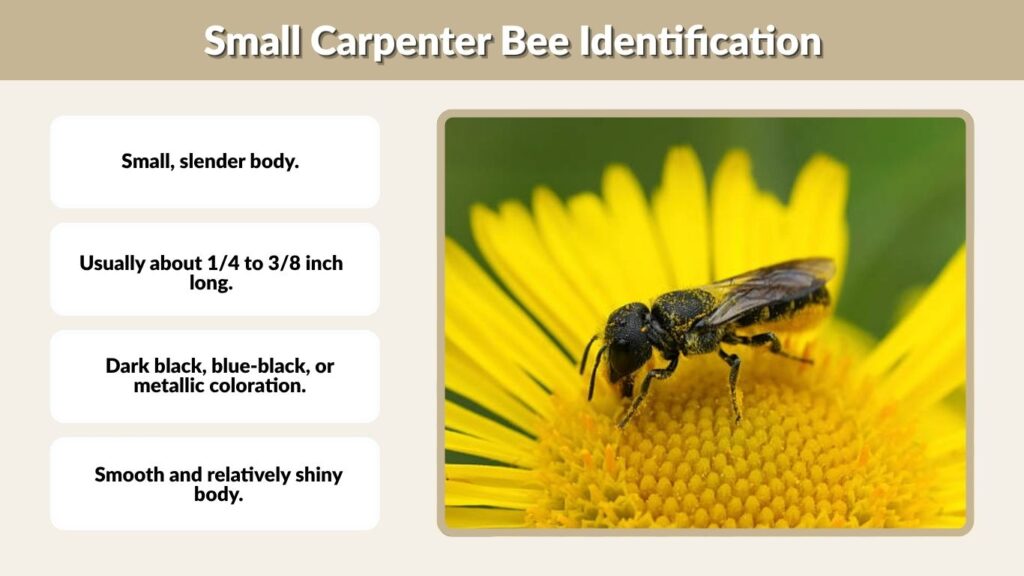
Identifying a small carpenter bee can be challenging because several other tiny bees have similar appearances. Most are narrow-bodied, dark-colored, and noticeably smaller than common large carpenter bees. Metallic reflections may appear blue, green, or bronze depending on the species and lighting.
Key Identification Features
Common characteristics include:
- Small, slender body
- Usually about 1/4 to 3/8 inch long
- Dark black, blue-black, or metallic coloration
- Smooth and relatively shiny body
- Sparse body hair compared with bumblebees
- Narrow abdomen
- Small pale or yellow facial markings in some species
- Frequent visits to tiny garden and wildflowers
Small Black Carpenter Bee
A tiny black bee visiting flowers may be a species of Ceratina. Small carpenter bees often appear glossy black or dark blue.
Their bodies are generally slimmer and less hairy than those of many other bees. Some species have metallic reflections that become visible when sunlight strikes their abdomen or thorax.
Small Blue or Metallic Carpenter Bees
Certain small carpenter bees can appear dark blue, bluish-green, or metallic.
The coloration is usually subtle rather than bright. A bee that looks black from a distance may reveal a blue or green sheen when observed closely. This metallic appearance sometimes causes people to confuse small carpenter bees with sweat bees.
Small Carpenter Bee Size
Small carpenter bees are dramatically smaller than the familiar large carpenter bees. Their compact dimensions allow them to nest inside thin stems that would be completely unsuitable for larger species. Their small size also means they often go unnoticed even when several individuals are living in a garden.
How Small Are Small Carpenter Bees?
Most small carpenter bees measure roughly 1/4 to 3/8 inch in length, although exact size depends on species and individual.
They are often comparable in size to many sweat bees and considerably smaller than honey bees or large carpenter bees.
Large vs Small Carpenter Bees
The primary differences include:
- Small carpenter bees: Usually 1/4–3/8 inch long
- Large carpenter bees: Often 1/2–1 inch long
- Small species: Typically narrow and slender
- Large species: Broad and heavy-bodied
- Small species: Commonly nest in plant stems
- Large species: Tunnel into substantial pieces of wood
- Small species: Often unnoticed around buildings
- Large species: Frequently seen hovering near wooden structures
Are Female Carpenter Bees Smaller Than Males?
Size differences between males and females vary by species. In small carpenter bees, females are not necessarily much smaller than males.
Sex is often better determined by facial markings, body structures, or behavior rather than size alone. Females are responsible for preparing nests and collecting pollen for developing offspring.
Small Carpenter Bee Nest
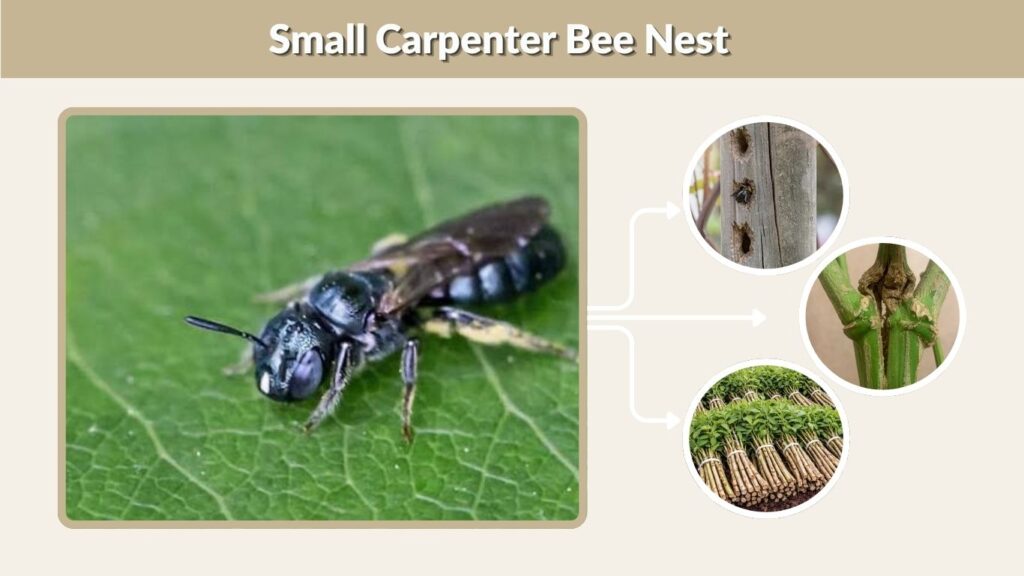
Small carpenter bees usually do not excavate solid structural lumber. Instead, females prefer broken, hollow, or soft-centered stems. They remove the soft material inside the stem and create a narrow nesting tunnel divided into separate chambers for their offspring.
Where Small Carpenter Bees Nest
Common nesting locations include:
- Broken raspberry or blackberry canes
- Elderberry stems
- Sumac stems
- Rose canes
- Hollow weed stems
- Dead flower stalks
- Soft twigs
- Pithy branches
- Standing dead garden stems
What Does a Small Carpenter Bee Nest Look Like?
A nest may appear as a tiny round opening at the end of a broken stem. Because the entrance can be only a few millimeters wide, it is easily overlooked.
Inside, the female creates a tunnel and divides it into brood cells. Each chamber contains an egg and a supply of pollen mixed with nectar.
Small Carpenter Bee Hole Size
Their nest entrances are much smaller than the roughly half-inch holes associated with large carpenter bees.
The exact hole size depends on the species and stem being used, but openings are commonly only a few millimeters across. A very small hole in a dead plant stem may therefore belong to a Ceratina bee.
Do Small Carpenter Bees Sting?
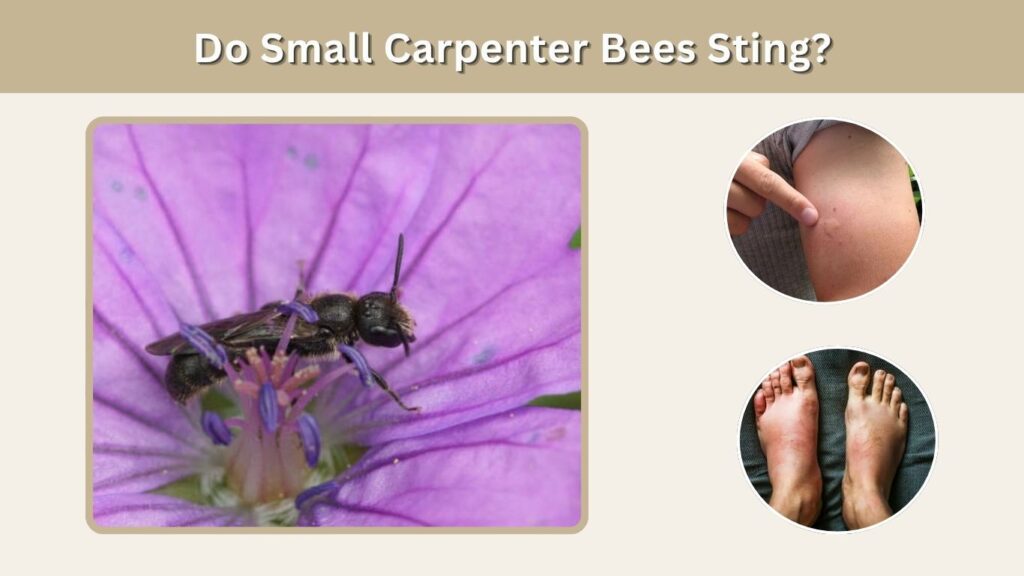
Small carpenter bees have a peaceful reputation and rarely sting people. Females possess stingers, but they generally use them only when physically trapped or handled. Their tiny size and nonaggressive behavior make accidental stings uncommon.
Can Small Carpenter Bees Sting?
Female small carpenter bees are physically capable of stinging.
However, they do not typically defend nests aggressively in the way some social bees and wasps do. A person can often observe them visiting flowers without any significant risk.
Males cannot sting because male bees lack functional stingers.
Small Carpenter Bee Sting Symptoms
When a sting does occur, possible effects include:
- Brief pain or burning
- Redness
- Minor swelling
- Itching
- Local tenderness around the sting site
Most reactions remain localized. Anyone who develops severe swelling, difficulty breathing, faintness, or other symptoms of a serious allergic reaction should seek emergency medical attention.
Do Small Carpenter Bees Bite?
Their jaws are primarily used for manipulating nesting material and plant tissue rather than biting people. They are not considered biting pests.
Reports of a “small carpenter bee bite” are more likely to involve a sting, another insect, or confusion about the bee’s behavior.
Small Carpenter Bee Habitat and Behavior
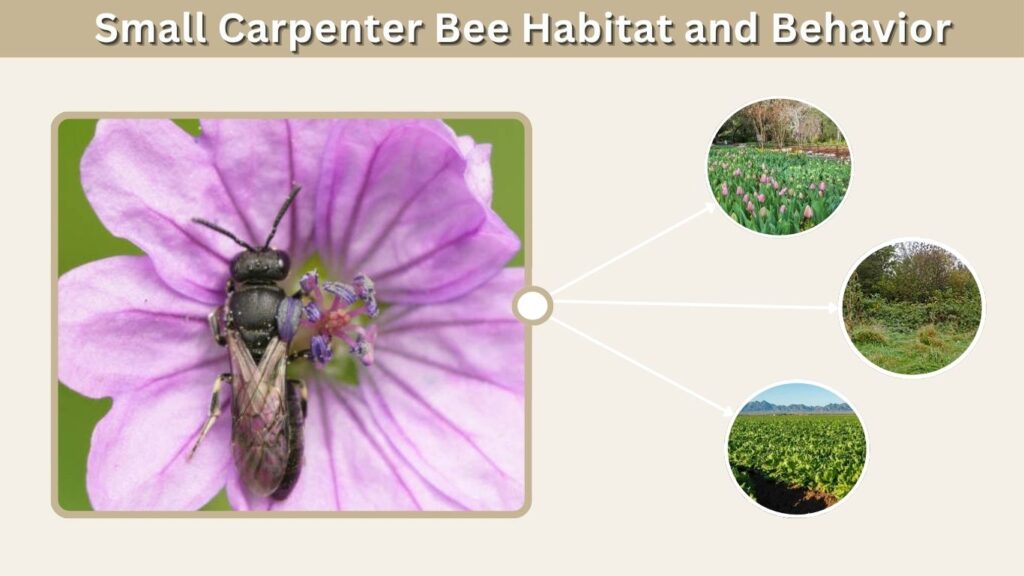
Small carpenter bees occupy a wide range of habitats wherever suitable flowering plants and nesting stems are available. Gardens can provide excellent habitat when gardeners leave some dry stems standing. Adults spend much of their time collecting pollen and nectar while females also search for stems suitable for nesting.
Where Small Carpenter Bees Live
They may occur in gardens, woodland edges, farms, fields, prairies, parks, and suburban landscapes.
Different Ceratina species occur across many areas of North America, including states such as Ohio, Kansas, Oklahoma, Oregon, Georgia, and numerous surrounding regions.
Small Carpenter Bee Life Cycle
A female prepares a stem nest and creates individual chambers for her young. She places pollen and nectar into each chamber before laying an egg.
The larva feeds on the stored provisions and eventually develops into an adult. Some small carpenter bees show unusually advanced parental behavior, with mothers remaining near offspring longer than is typical for many solitary bee species.
Are Small Carpenter Bees Good Pollinators?
Despite their tiny bodies, small carpenter bees contribute significantly to pollination. They visit many small flowers that larger bees may overlook and transfer pollen while collecting food for themselves and their developing larvae.
Plants They Commonly Visit
Small carpenter bees may forage on:
- Sunflowers
- Asters
- Goldenrod
- Blackberries
- Raspberries
- Mint flowers
- Daisies
- Native wildflowers
- Vegetable blossoms
- Small flowering herbs
Why They Are Beneficial
Their value extends beyond individual garden plants. Small carpenter bees contribute to native plant reproduction and overall pollinator diversity.
Because different bee species forage under different environmental conditions and prefer different flower shapes, maintaining diverse native bee populations helps create more stable pollination networks.
How to Support Small Carpenter Bees
Gardeners can encourage them by:
- Leaving some hollow or pithy stems standing
- Growing native flowering plants
- Providing flowers throughout spring and summer
- Avoiding unnecessary insecticide use
- Leaving some natural areas undisturbed
- Keeping dead stems until emerging bees have left
How to Get Rid of Small Carpenter Bees
In most situations, removal is unnecessary. Small carpenter bees rarely damage buildings because they primarily nest in stems rather than structural wood. Their ecological benefits generally outweigh any inconvenience they cause around gardens.
If bees are nesting somewhere undesirable, removing or trimming the particular dead stem after the nesting season is usually enough. Avoid spraying broad-spectrum pesticides, since these chemicals can kill beneficial bees and other pollinating insects.
FAQs
Are small carpenter bees dangerous?
No. Small carpenter bees are generally peaceful and pose little danger to people. Females can sting when directly threatened, but stings are uncommon.
How big is a small carpenter bee?
Most are around 1/4 to 3/8 inch long. They are considerably smaller and slimmer than the familiar large carpenter bees.
Where do small carpenter bees build nests?
They usually nest inside broken or hollow plant stems, pithy twigs, raspberry canes, rose stems, and similar plant material.
Are small carpenter bees black?
Many species appear black or blue-black. Some have metallic blue, greenish, or bronze reflections that become more noticeable in bright light.
Should I get rid of small carpenter bees?
Usually not. They are beneficial native pollinators and normally cause little or no structural damage. Leaving suitable stems and flowers can actually help support healthy local pollinator populations.