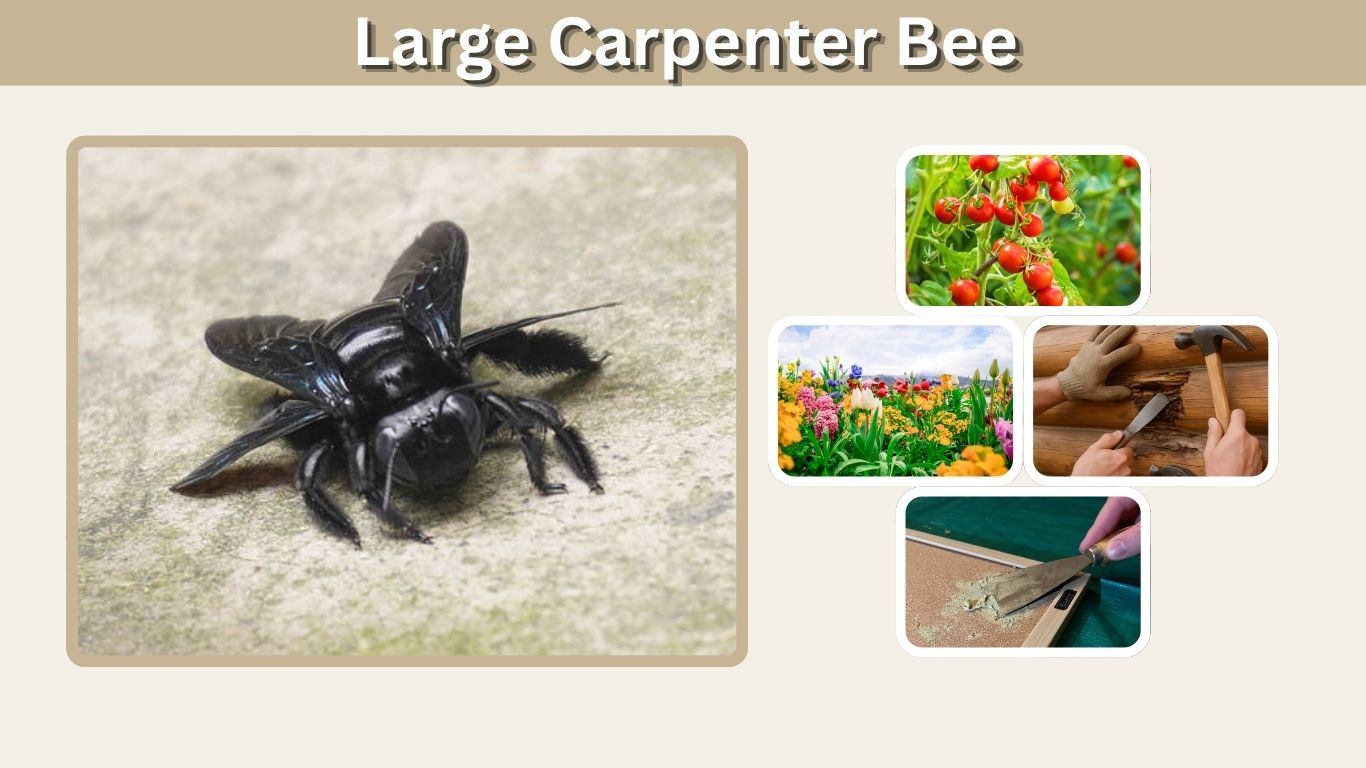
The large carpenter bee is a robust, heavy-bodied bee best known for its shiny abdomen and habit of tunneling into wood to build nests. Most large carpenter bees belong to the genus Xylocopa and can look similar to bumblebees at first glance. They are important pollinators and are usually not aggressive toward people, although females can sting if handled or threatened. This guide explains large carpenter bee identification, size, nesting behavior, sting risk, species differences, pollination benefits, and practical ways to manage them around homes.
What Is a Large Carpenter Bee?
Large carpenter bees belong primarily to the genus Xylocopa in the family Apidae. They occur in many warm and temperate regions around the world. Unlike honey bees, carpenter bees do not build large wax colonies. Females usually excavate individual tunnels inside wood, where they create chambers for their offspring.
Large Carpenter Bee Identification
Typical identifying features include:
- Large, heavy body
- Length commonly around 0.5–1 inch
- Broad head and strong jaws
- Dark or black body coloration
- Shiny, relatively hairless abdomen
- Hairy thorax
- Powerful wings
- Loud buzzing sound
- Females usually darker-faced
- Males may have pale or yellow facial markings
The shiny abdomen is one of the easiest ways to separate many carpenter bees from bumblebees.
Large Black Carpenter Bee
A large black carpenter bee is usually a member of Xylocopa. Depending on the species, the entire insect may appear glossy black, metallic blue-black, or dark brown.
Some species have yellow hairs on the thorax, creating a black-and-yellow appearance. Others are almost completely dark.
Female carpenter bees often appear more intimidating because of their large jaws and solid black faces, but they usually avoid stinging unless directly threatened.
How Large Are Carpenter Bees?
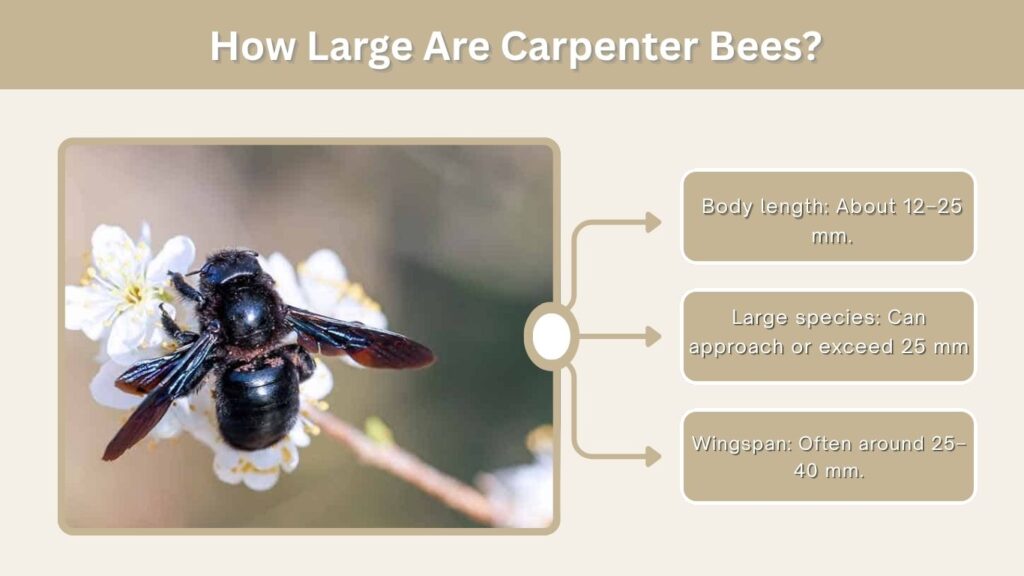
Carpenter bees are among the larger bees people commonly encounter around houses and gardens. Size varies considerably between species, with tropical carpenter bees often growing larger than those found in cooler climates.
Large Carpenter Bee Size
Typical measurements include:
- Body length: About 12–25 mm
- Large species: Can approach or exceed 25 mm
- Wingspan: Often around 25–40 mm
- Body shape: Thick, broad, and muscular
- Female size: Often similar to or slightly larger than males
Eastern Carpenter Bees commonly grow to around ¾ to 1 inch long, while some tropical species can be even larger.
Their size, dark coloration, and loud flight make them appear more threatening than they really are.
Are Carpenter Bees Larger Than Bumblebees?
Not always. Carpenter bees and bumblebees overlap considerably in size.
Some large carpenter bees may appear bigger because their bodies are broad and their abdomens are shiny and prominent. Large bumblebees can be equally bulky.
The easiest distinction is usually not size but abdomen texture. Bumblebee abdomens are generally covered with dense hairs, while carpenter bees typically have smooth, shiny abdominal surfaces.
Do Large Carpenter Bees Sting?
Large carpenter bees may look intimidating when they hover around people, but their actual sting risk is relatively low. Males frequently behave aggressively around nesting territories, yet they cannot sting. Females possess stingers but usually use them only when strongly provoked.
Large Carpenter Bee Sting Facts
Important facts include:
- Male carpenter bees cannot sting
- Female carpenter bees can sting
- Females rarely sting without provocation
- Handling or squeezing a female increases sting risk
- A sting can cause pain, redness, and swelling
- Allergic reactions are possible in sensitive people
- Carpenter bees do not normally attack in swarms
If a large bee repeatedly hovers directly in front of you, it may be a male defending its territory.
This behavior is usually bluffing rather than an attempt to sting.
Are Large Carpenter Bees Dangerous?
Generally, no.
Carpenter bees are considered relatively docile pollinators. The biggest concern around homes is usually wood damage rather than stinging.
However, anyone with a serious bee-sting allergy should avoid handling carpenter bees or approaching active nest entrances unnecessarily.
Large Carpenter Bee Nest
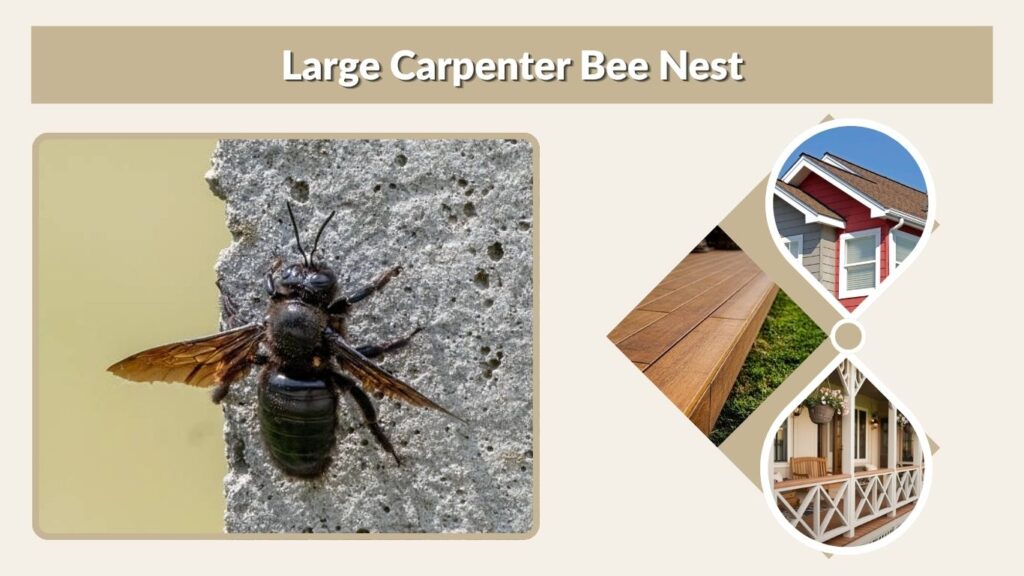
Carpenter bees get their name from their ability to excavate wood. A female uses powerful jaws to create a round entrance hole before turning and tunneling along the wood grain. Inside, she divides the tunnel into individual chambers containing pollen, nectar, and an egg.
Where Large Carpenter Bees Nest
Common nesting locations include:
- Wooden decks
- Porch railings
- Roof eaves
- Fascia boards
- Wooden fences
- Pergolas
- Sheds
- Barns
- Outdoor furniture
- Dead tree limbs
- Unpainted timber
- Weathered structural wood
Carpenter bees strongly prefer unfinished, weathered, or soft wood.
Painted or properly sealed surfaces are less attractive.
How Large Is a Carpenter Bee Nest?
Carpenter bees do not create huge communal hives.
A nest entrance is usually a nearly round hole roughly ½ inch across. The tunnel may extend several inches into the wood before turning parallel with the grain.
A female constructs multiple brood chambers inside the tunnel. Each chamber contains a food supply and one egg.
Old tunnels may be reused and enlarged over several years, meaning repeated nesting in the same board can eventually create extensive internal galleries.
Large Carpenter Bee Behavior
Carpenter bees are primarily solitary, although several females may nest near one another when suitable wood is available. This can make a building appear to have a colony even though each female is largely responsible for her own nesting tunnel.
Why Carpenter Bees Hover Around People
Carpenter bees commonly:
- Hover around nest entrances
- Patrol wooden structures
- Chase other insects
- Investigate movement
- Return to the same nesting area each spring
- Reuse old nest tunnels
- Fly quickly around rooflines and decks
- Make loud buzzing sounds
Territorial males are responsible for much of the hovering behavior seen around people.
They may fly directly toward a person and stop only a short distance away. Although intimidating, these males lack stingers.
Why Do Carpenter Bees Return Every Year?
Suitable nesting wood can remain attractive for years.
Adult females may reuse old tunnels, while newly emerged bees can establish nests close to where they developed.
The smell and existing openings may also make previously used wood easier to occupy. Without repairing and sealing nesting sites, homeowners may notice carpenter bees returning to the same area each spring.
Large Carpenter Bees as Pollinators
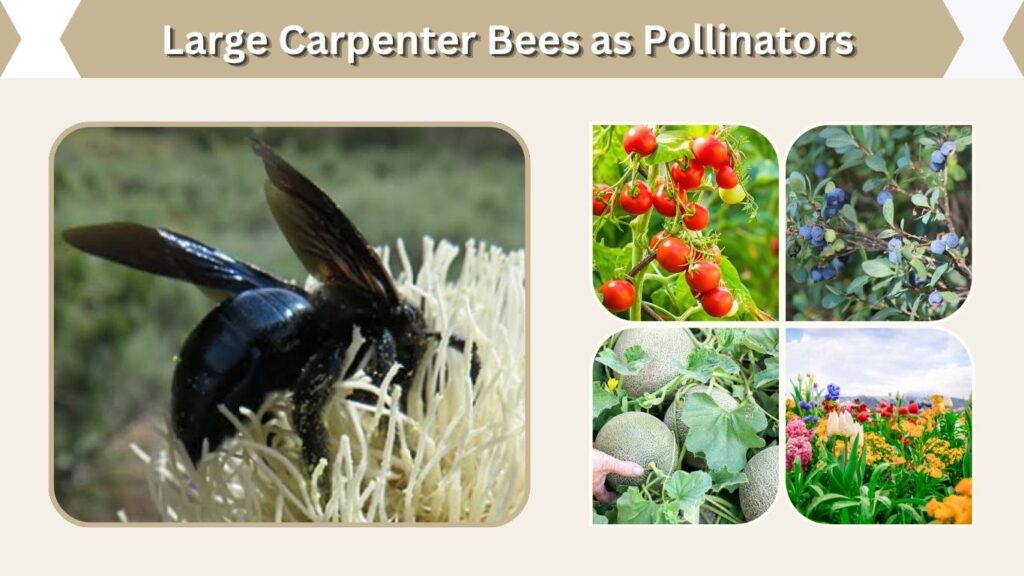
Carpenter bees provide significant ecological value. Their large bodies allow them to carry substantial amounts of pollen, and some species can perform a specialized behavior known as buzz pollination.
Plants Pollinated by Carpenter Bees
Large carpenter bees may visit:
- Tomatoes
- Eggplants
- Blueberries
- Passionflowers
- Melons
- Squash
- Garden flowers
- Native wildflowers
- Fruit blossoms
- Agricultural crops
During buzz pollination, the bee vibrates its flight muscles while gripping a flower. The vibration releases pollen that may otherwise remain trapped inside the flower’s anthers.
This makes carpenter bees valuable pollinators in natural ecosystems and agricultural landscapes.
Large Carpenter Bee vs Other Bees
People frequently confuse carpenter bees with bumblebees, hornets, and other large flying insects. Observing the abdomen, body hair, nest location, and flight behavior usually makes identification easier.
Carpenter Bee vs Bumblebee
Key differences include:
- Carpenter bee: Usually shiny abdomen
- Bumblebee: Fuzzy abdomen
- Carpenter bee nest: Tunnels inside wood
- Bumblebee nest: Usually in cavities or underground
- Carpenter bee: Mostly solitary
- Bumblebee: Social colony
- Carpenter bee male: Often territorial near wooden structures
- Bumblebee worker: Commonly gathers pollen near flowers
Carpenter Bee vs Large Hornet
Hornets have noticeably narrower waists and less body hair than carpenter bees.
Carpenter bees have broad, bee-like bodies designed for carrying pollen, while hornets possess smoother bodies and strong predatory jaws.
Hornets can also be more defensive around their social nests. Carpenter bees do not create large paper nests or colonies containing hundreds of workers.
How to Get Rid of Large Carpenter Bees
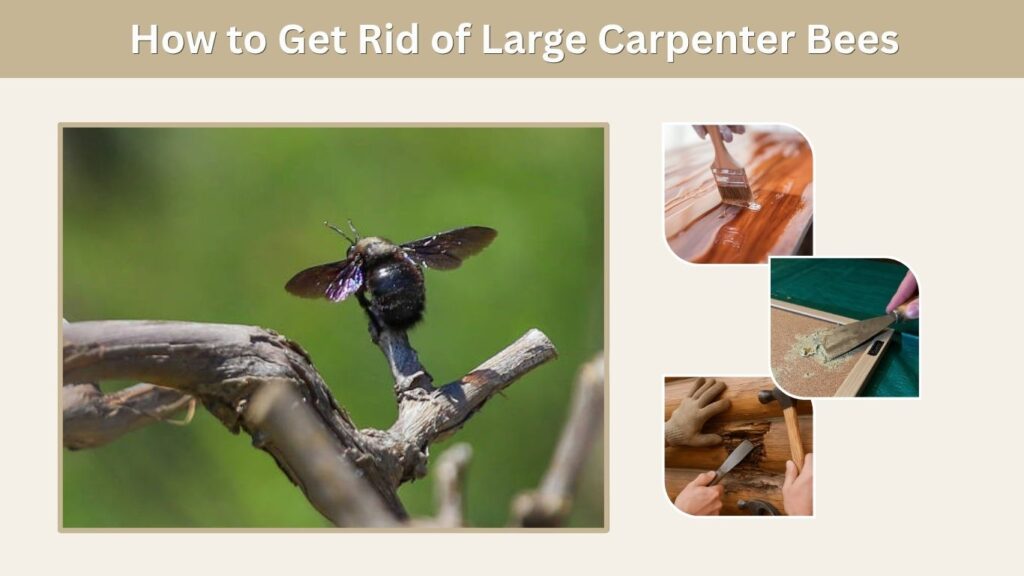
Because carpenter bees are useful pollinators, prevention is often better than immediately destroying them. The goal should be to discourage nesting in buildings while allowing bees to forage elsewhere.
Managing Large Carpenter Bees
Effective methods include:
- Paint unfinished wooden surfaces
- Apply exterior-grade wood sealant
- Repair damaged boards
- Replace severely tunneled timber
- Fill abandoned nest holes after bees leave
- Use hardwood or composite materials where practical
- Inspect decks and eaves each spring
- Provide alternative nesting wood away from structures
- Keep vulnerable wooden surfaces maintained
Do not seal an actively occupied hole while adult bees are inside, as they may create another exit or die within the structure.
If extensive nesting has developed in structural wood, professional pest management may be appropriate.
FAQs
1. What is the scientific name for a large carpenter bee?
Large carpenter bees generally belong to the genus Xylocopa. Many different species occur throughout the world.
2. Do large carpenter bees sting?
Females can sting, but they rarely do unless handled or threatened. Male carpenter bees cannot sting even though they often behave aggressively.
3. How big can carpenter bees get?
Many carpenter bees measure around ½ to 1 inch long. Some tropical species may grow even larger.
4. Why is a large carpenter bee in the same place every year?
Carpenter bees often reuse old nesting tunnels or return to suitable untreated wood. Existing nest sites can remain attractive for multiple generations.
5. Are large carpenter bees good for gardens?
Yes. Large carpenter bees are important pollinators and can pollinate many flowers, vegetables, and crops. Their main drawback is the structural damage caused when females repeatedly tunnel into wooden buildings.