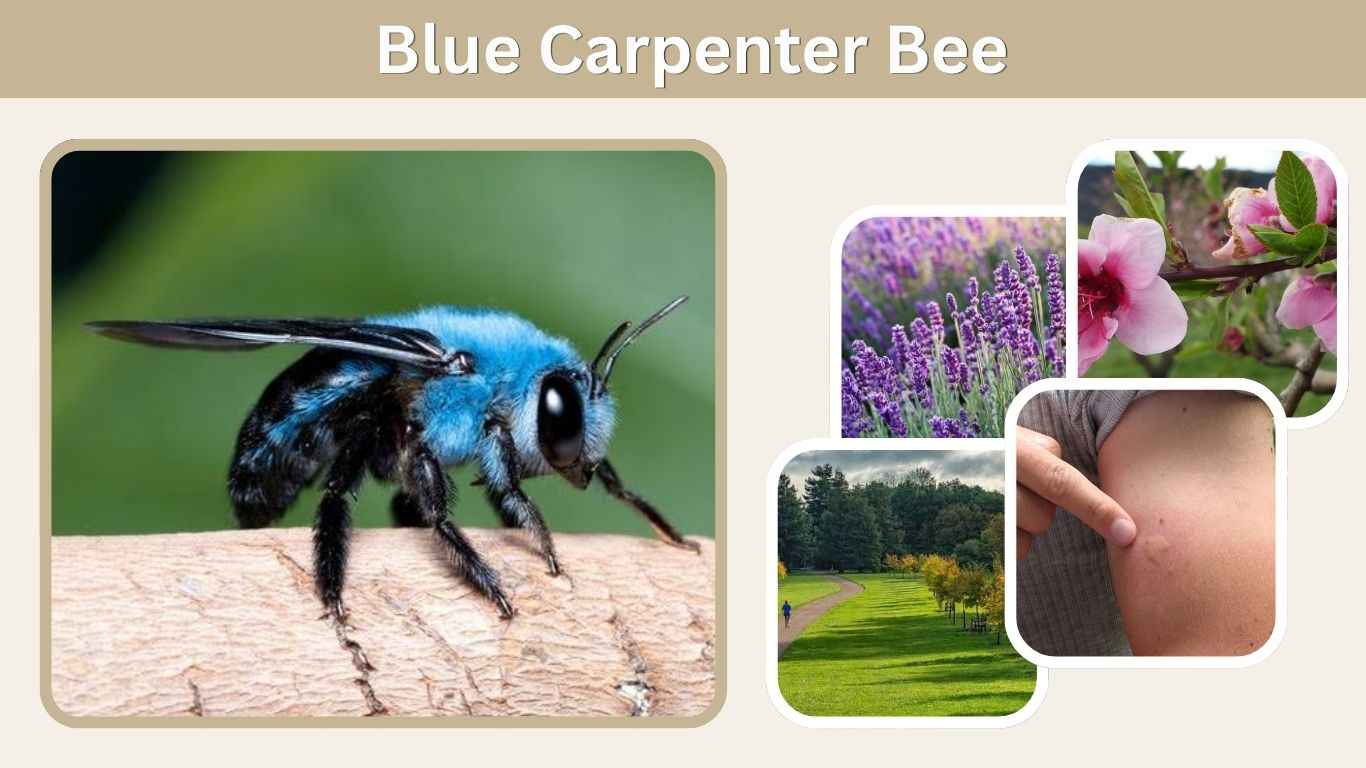
The blue carpenter bee (Xylocopa caerulea) is a large, eye-catching bee known especially for the brilliant blue hairs covering females. Native mainly to South and Southeast Asia, this unusual pollinator can reach more than 20 mm in length. Despite its intimidating size and loud flight, it is generally not aggressive toward people. Blue carpenter bees get their name from their nesting behavior: females use powerful jaws to excavate tunnels in wood where they raise their young.
What Is a Blue Carpenter Bee?
The blue carpenter bee is a species of large carpenter bee in the family Apidae. Its scientific name is Xylocopa caerulea. Although several carpenter bees can show blue or metallic coloration, X. caerulea is particularly distinctive because females have dense, genuinely blue-pigmented hairs rather than simply blue-reflecting wings. Research has confirmed that this coloration comes largely from pigments within the hairs.
Identification
A female blue carpenter bee can usually be recognized by these features:
- Scientific name: Xylocopa caerulea
- Body size: Around 22–23 mm on average
- Thorax: Covered with striking blue hairs
- Abdomen: Mostly dark, with blue hairs on portions of the abdomen
- Wings: Dark brown to blackish with some metallic reflections
- Body shape: Large, broad, and robust
- Legs: Strong and dark
- Flight: Fast, powerful, and often accompanied by noticeable buzzing
The intense blue coloration is most obvious in females. Males are considerably duller and may appear dark, brownish, or olive-toned rather than bright blue.
How Big Is a Blue Carpenter Bee?
The blue carpenter bee is a relatively large species. Adults average about 23 mm long, or just under one inch. Their heavy bodies and broad wings can make them look even larger when flying.
Their size is one reason people occasionally mistake them for bumblebees or even large wasps.
Are Blue Carpenter Bees Dangerous?
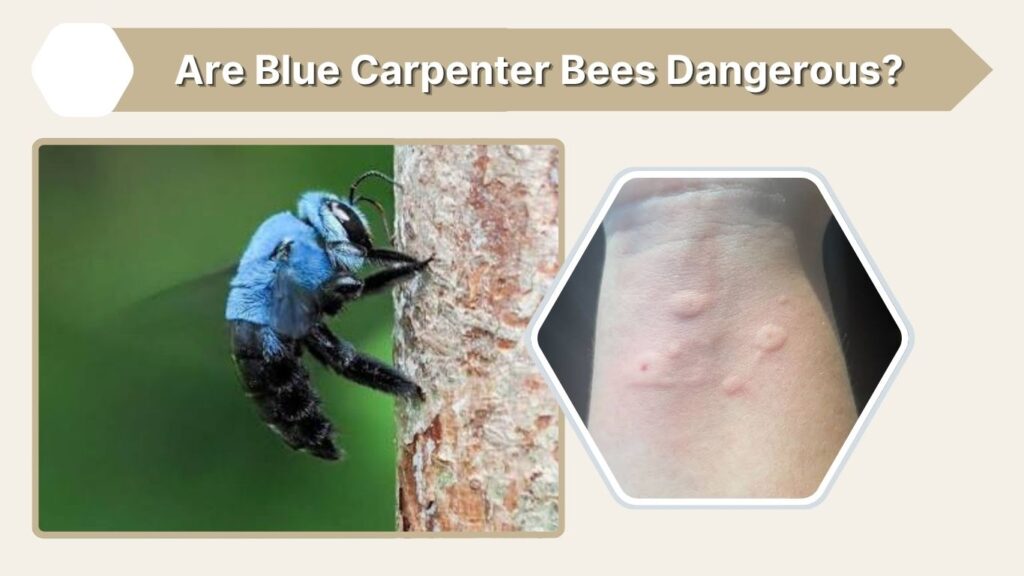
Their large size can make blue carpenter bees look threatening, especially when one flies close to a person. However, carpenter bees normally concentrate on flowers, nesting sites, and mating rather than attacking humans.
They should still be handled carefully because female bees are capable of defending themselves.
Do Blue Carpenter Bees Sting?
Female blue carpenter bees can sting, but they generally do so only when handled, trapped, squeezed, or seriously threatened.
Male carpenter bees cannot sting because male bees do not possess a functional stinger.
To avoid being stung:
- Do not handle a carpenter bee with bare hands.
- Avoid squeezing or trapping one.
- Do not deliberately disturb an active nest.
- Allow a bee flying around flowers to move away naturally.
A carpenter bee investigating you is usually not preparing to attack.
Do Blue Carpenter Bees Bite?
Blue carpenter bees possess powerful mandibles because females need to excavate wood. However, biting people is not their normal defensive behavior.
Their jaws are primarily tools for nest construction, manipulating materials, and feeding rather than attacking humans.
Blue Carpenter Bee Male vs Female
Blue carpenter bees display noticeable sexual differences, which means males and females do not look exactly alike. The vivid blue appearance most people associate with this species is primarily characteristic of the female.
Scientific examination of Xylocopa caerulea has documented strong differences in appearance between the sexes.
Female Blue Carpenter Bee
Females typically have:
- Brilliant blue hairs covering much of the thorax
- Blue hairs along portions of the abdomen and head
- A large, robust body
- Strong jaws used for nest excavation
- A functional stinger
Male Blue Carpenter Bee
Males are much less vividly colored. Their bodies can appear dark with dull olive, brownish, or greenish tones depending on the individual and lighting.
They cannot sting, although males may fly around animals or people while defending a territory or searching for females.
Where Do Blue Carpenter Bees Live?
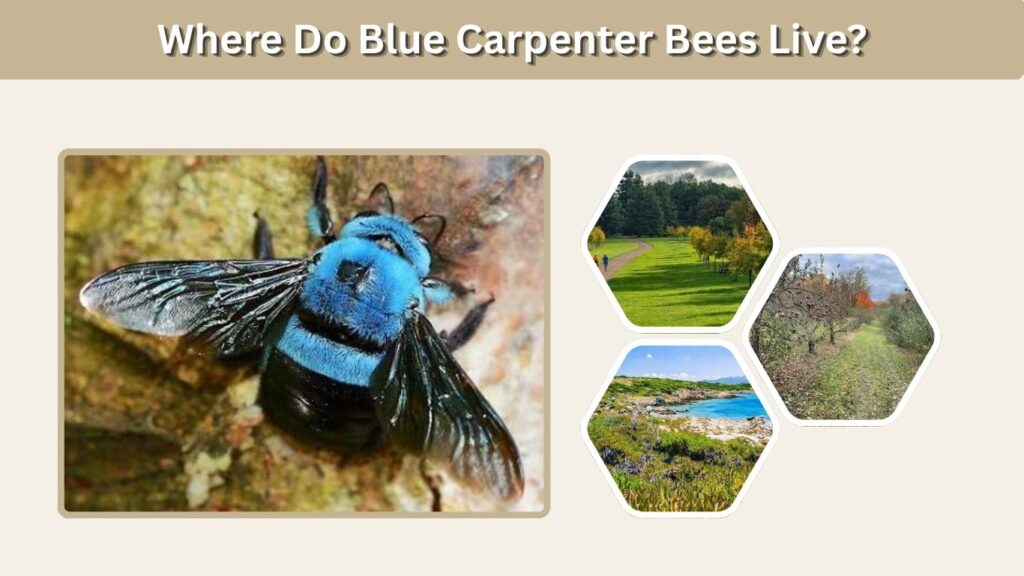
Blue carpenter bees are primarily Asian insects. Records place Xylocopa caerulea across portions of India, southern China, and Southeast Asia, including countries such as Thailand, Vietnam, Cambodia, Malaysia, Singapore, Myanmar, and Indonesia.
Blue Carpenter Bee Habitat
A suitable habitat generally combines plenty of flowers with wood that can be used for nesting. They may occur around:
- Tropical and subtropical forests
- Forest edges
- Gardens
- Parks
- Agricultural landscapes
- Orchards
- Areas with dead trees
- Places containing wooden structures
A scientific study has also recorded X. caerulea in tropical forest habitat on Hainan, China.
Are Blue Carpenter Bees Found in Australia?
The name “blue carpenter bee” can cause confusion in Australia because Australia has its own blue or metallic carpenter bees.
However, the species discussed here, Xylocopa caerulea, is primarily associated with South and Southeast Asia and southern China. A blue carpenter bee photographed in Australia should therefore not automatically be identified as X. caerulea without closer examination.
Are Blue Carpenter Bees Found in the UK?
Xylocopa caerulea is not considered a typical native UK bee. Its natural distribution is centered much farther south and east in Asia.
People in Britain may occasionally confuse dark carpenter bees with blue reflections for the true blue carpenter bee.
Blue Carpenter Bee Nest
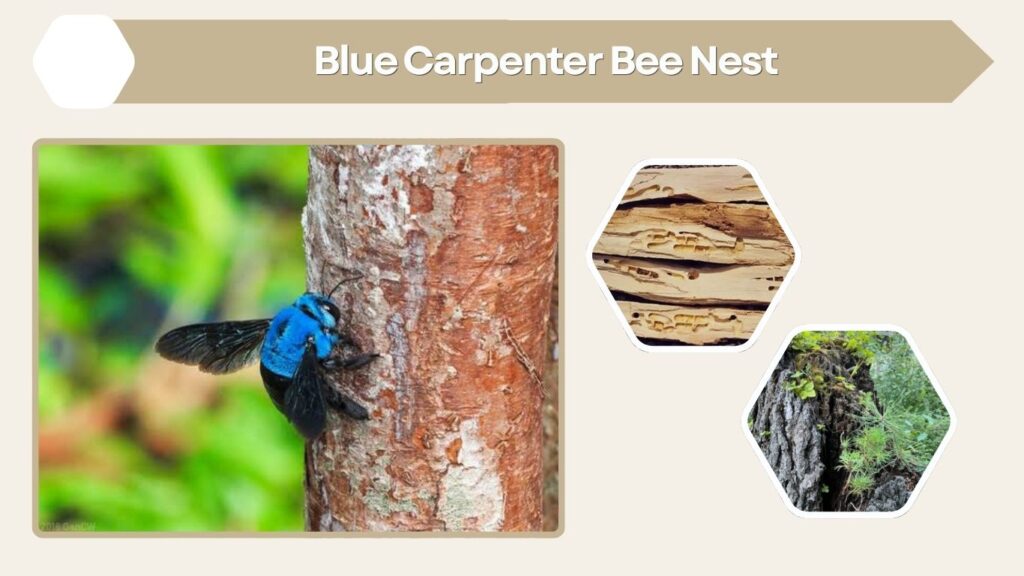
Like other large carpenter bees, these insects are named for their ability to excavate nesting tunnels in wood. They do not eat wood like termites. Instead, the female removes wood to create a protected nursery for her offspring.
Records for X. caerulea specifically describe it as a wood-nesting carpenter bee.
How the Nest Is Built
A female normally searches for suitable wood and begins chewing a round entrance using her powerful mandibles.
Inside, she forms a tunnel containing brood chambers. Each developing bee receives a supply of pollen and nectar. The female lays an egg with the food provision and separates brood areas using partitions.
Young larvae remain protected inside the wooden nest while they develop.
Are Carpenter Bee Nests Harmful?
A single nest normally causes limited damage. Problems become more significant when bees repeatedly use structural timber or when several generations excavate the same piece of wood.
Outdoor deadwood, tree branches, and other natural nesting material can reduce competition for artificial wooden structures.
What Do Blue Carpenter Bees Eat?
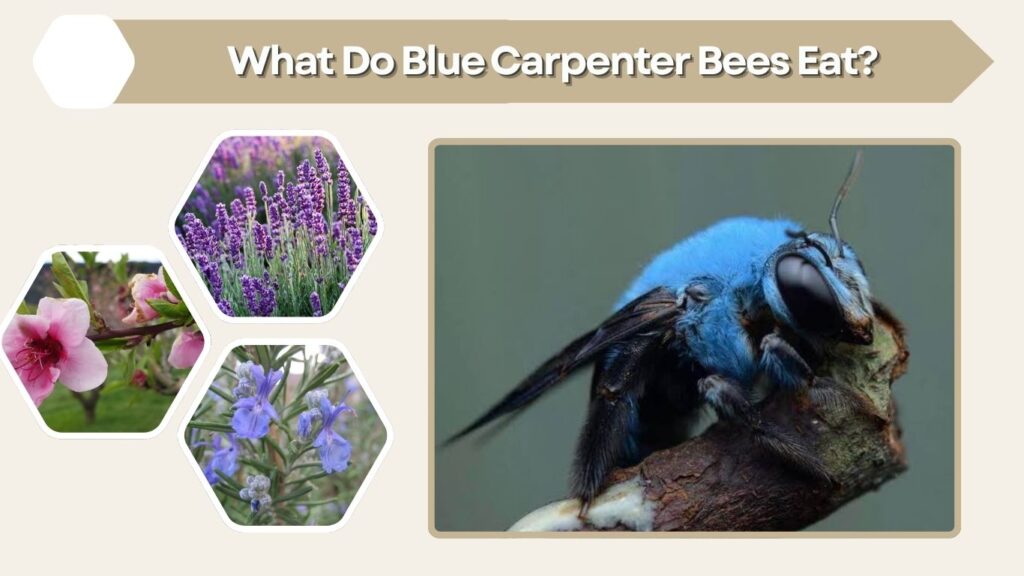
Adult blue carpenter bees mainly depend on flower nectar for energy and pollen as a protein-rich resource, particularly for provisioning their offspring.
Their large bodies allow them to carry substantial quantities of pollen between flowers, helping plants reproduce.
Do Blue Carpenter Bees Make Honey?
Blue carpenter bees do not produce large stores of honey like honey bees.
Females collect nectar and pollen and prepare concentrated food provisions inside individual brood chambers. Some descriptions loosely refer to the nectar component as honey, but carpenter bees do not maintain honey-filled communal hives from which people harvest honey.
Why Is the Blue Carpenter Bee Blue?
The female’s extraordinary color is not simply a trick produced by iridescent wings.
Research examining Xylocopa caerulea found that its bright thoracic hairs contain blue pigment. Tiny structures within the hairs scatter light and enhance the color, producing the vivid blue appearance.
Is the Blue Carpenter Bee Rare?
The species may look exceptionally exotic, but “rare” depends on location.
It has a broad Asian distribution, including parts of China and numerous Southeast Asian countries. Nevertheless, it may be uncommon locally and is much less familiar to most people than honey bees or bumblebees.
Its unusual blue appearance also means individual sightings tend to attract considerable attention.
Interesting Blue Carpenter Bee Facts
Blue carpenter bees combine unusual coloration with the specialized behavior typical of large carpenter bees.
- Their scientific name is Xylocopa caerulea.
- Females have brilliant blue hairs.
- Males are much duller than females.
- Adults average about 23 mm long.
- Females can sting, while males cannot.
- They excavate nesting chambers in wood.
- They do not consume wood for food.
- Their diet is based primarily on nectar and pollen.
- They do not maintain honey-producing colonies like honey bees.
- Their natural range is concentrated in South and Southeast Asia and southern China.
- The blue coloration of females comes from pigmented body hairs.
- They serve as pollinators while visiting flowers.
FAQs
1. What is the scientific name of the blue carpenter bee?
The true blue carpenter bee discussed here is Xylocopa caerulea, a large member of the carpenter bee genus Xylocopa.
2. Can a blue carpenter bee sting you?
Yes, females can sting when seriously threatened or handled. Males cannot sting. These bees are generally not aggressive toward humans.
3. How big does a blue carpenter bee get?
Adults average about 23 mm in body length, making them considerably larger and heavier-looking than many familiar bee species.
4. Where is the blue carpenter bee found?
Xylocopa caerulea occurs primarily across parts of India, southern China, and Southeast Asia, including Malaysia, Singapore, Thailand, Vietnam, Cambodia, and Indonesia.
5. Does the blue carpenter bee produce honey?
Not in the way honey bees do. Females collect nectar and pollen to make food provisions for their larvae, but they do not establish large colonies containing harvestable stores of honey.