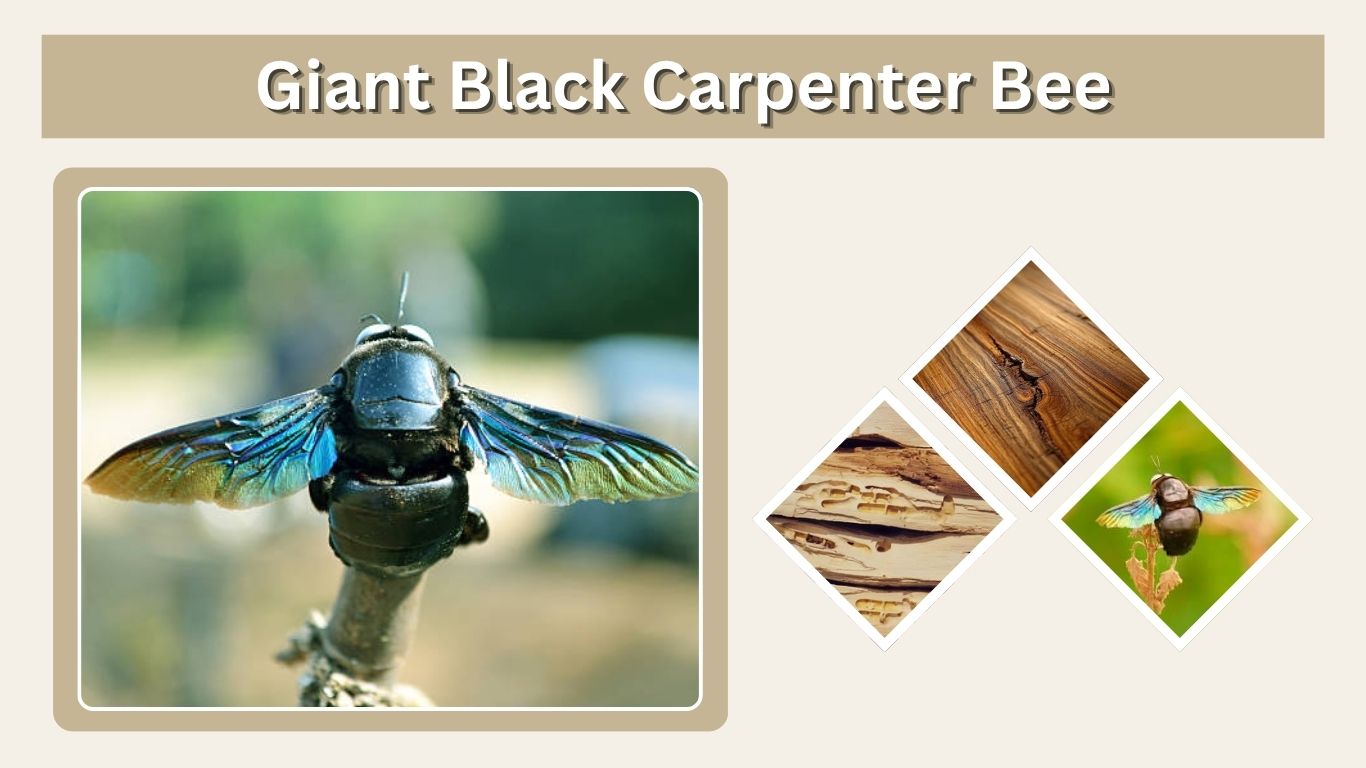
The giant black carpenter bee is an impressive, heavy-bodied bee usually belonging to the genus Xylocopa. These bees are recognized by their glossy black bodies, powerful wings, loud buzzing, and habit of excavating nests in wood or bamboo. Some tropical species grow considerably larger than familiar garden bees, which can make them appear intimidating. Despite their appearance, giant carpenter bees are generally important pollinators rather than aggressive pests. This guide covers their size, identification, sting, nesting behavior, major species, look-alikes, and safe management.
What Is a Giant Black Carpenter Bee?
“Giant black carpenter bee” is a general description rather than the common name of one single species. Many large Xylocopa species appear almost entirely black or blue-black. They belong to the family Apidae and are related to other carpenter bees and bumblebees. Most are solitary or loosely social rather than members of enormous colonies.
Giant Black Carpenter Bee Identification
Look for these typical characteristics:
- Large, thick, heavy body
- Glossy black or blue-black abdomen
- Dark wings that may show violet or blue reflections
- Broad head
- Powerful jaws
- Hair concentrated mainly around the thorax
- Relatively smooth abdomen
- Strong, rapid flight
- Very noticeable buzzing sound
- Frequent visits to large flowers
- Nest holes in dead wood, timber, or bamboo
Color varies between species and sexes. Some males may be yellow, golden, pale, or partially covered with light-colored hairs even when females of the same species are black.
How Big Are Giant Carpenter Bees?
The genus Xylocopa contains some exceptionally large bees. Many familiar carpenter bees measure around 12–25 mm long, while certain tropical species can become larger and much broader.
Their bulky bodies and dark wings can make them appear even bigger while flying.
One particularly large species is the Giant Bornean Carpenter Bee, Xylocopa latipes, also known as the Broad-handed or Broad-legged Carpenter Bee. It is among the most impressive members of the carpenter bee group.
Giant Carpenter Bee Species
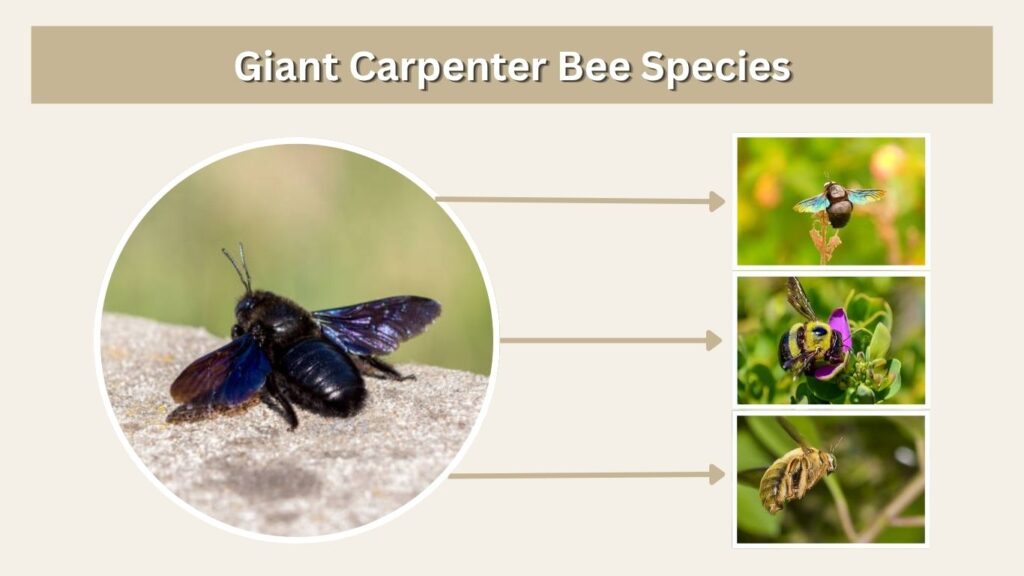
Hundreds of Xylocopa species occur around the world, particularly in tropical and subtropical environments. Several receive “giant” descriptions because of their exceptional body size. The Giant Bornean and Giant Indian Carpenter Bees are particularly noteworthy, although their biology differs in interesting ways.
Giant Bornean Carpenter Bee
The Giant Bornean Carpenter Bee, commonly associated with Xylocopa latipes, is a very large tropical carpenter bee occurring in parts of Asia.
Notable characteristics include:
- Scientific name: Xylocopa latipes
- Large, robust body
- Predominantly dark coloration
- Strong wings
- Extremely broad front legs in males
- Wood or bamboo nesting behavior
- Powerful buzzing flight
- Important flower-visiting behavior
The unusually broad front legs of males are particularly distinctive and explain names such as Broad-handed Carpenter Bee.
Giant Indian Carpenter Bee
The Giant Indian Carpenter Bee, Xylocopa tranquebarica, is especially remarkable because of its nighttime activity.
Unlike most bees, which depend heavily on daylight for navigation, this species can forage under extremely low light conditions. Research has described it as an obligately nocturnal carpenter bee capable of flying even on very dark nights.
Large eyes and specialized vision help it locate flowers and navigate when other bees have stopped foraging.
Do Giant Black Carpenter Bees Sting?
Their enormous size naturally makes people wonder whether giant carpenter bees are dangerous. Female carpenter bees possess functional stingers, but they are generally reluctant to use them unless they are trapped, handled, or directly threatened. Males can behave much more aggressively around territories but cannot sting.
Giant Carpenter Bee Sting Facts
Important points include:
- Females can sting.
- Males cannot sting.
- Females usually avoid unnecessary confrontation.
- Territorial males may fly directly toward people.
- Handling a female greatly increases the likelihood of being stung.
- A sting can cause immediate pain and localized swelling.
- Individual reactions to bee venom vary.
- Serious allergic reactions require urgent medical attention.
The Giant Bornean Carpenter Bee has been included in scientific comparisons of insect sting pain, confirming that females of very large Xylocopa can deliver a painful sting.
Are Giant Carpenter Bees Dangerous?
Normally, giant carpenter bees pose little danger when left undisturbed.
A male may hover around your face, follow your movements, or repeatedly approach you. This is territorial behavior rather than evidence that it is preparing to sting.
Females are usually more focused on collecting pollen, gathering nectar, and preparing nests.
Avoid grabbing, stepping on, or trapping any large bee against your skin.
Where Do Giant Carpenter Bees Nest?
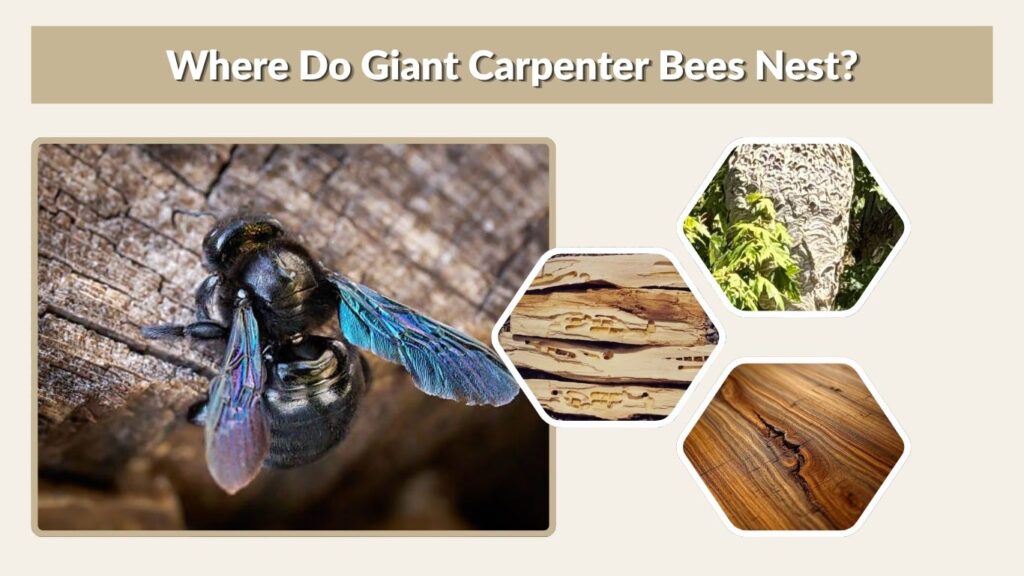
Carpenter bees do not eat wood. Instead, females use their powerful mandibles to excavate it. The resulting tunnel becomes a protected nursery where eggs develop. Depending on the species, nests may be created in dead branches, logs, bamboo, timber, fences, or wooden structures.
Giant Carpenter Bee Nest Structure
A typical nest may contain:
- A rounded entrance hole
- A tunnel leading into the wood
- Galleries following the wood grain
- Several individual brood chambers
- Pollen and nectar stored as larval food
- One egg placed in each prepared chamber
- Partitions separating developing offspring
Females repeatedly fly between flowers and nests while provisioning the brood chambers.
Although several carpenter bees may nest close together, this does not necessarily mean they have formed a honey bee-like colony.
Why Carpenter Bees Return to the Same Wood
Suitable nesting material can be valuable, so old tunnels are sometimes reused.
A female may enlarge an existing gallery rather than excavating an entirely new one. Generations of repeated nesting can eventually cause more significant damage to structural timber.
This is why a few holes in untreated wood may become a recurring problem if the area remains unchanged for several years.
Giant Black, Blue, Gold and Violet Carpenter Bees
Carpenter bees can display surprisingly diverse coloration. Structural coloration on their bodies and wings may produce blue, violet, greenish, or metallic reflections. Males of certain species can look dramatically different from females.
Common Carpenter Bee Color Forms
Large carpenter bees may appear:
- Glossy black
- Blue-black
- Metallic violet
- Dark blue
- Black with yellow hairs
- Golden or yellow
- Black with pale facial markings
- Black with iridescent wings
A “giant blue carpenter bee” or “giant violet carpenter bee” may therefore still belong to Xylocopa.
Color alone is not enough for exact species identification. Location, sex, body structure, wing color, facial markings, and other anatomical characteristics also need to be considered.
Giant Resin Bee vs Carpenter Bee
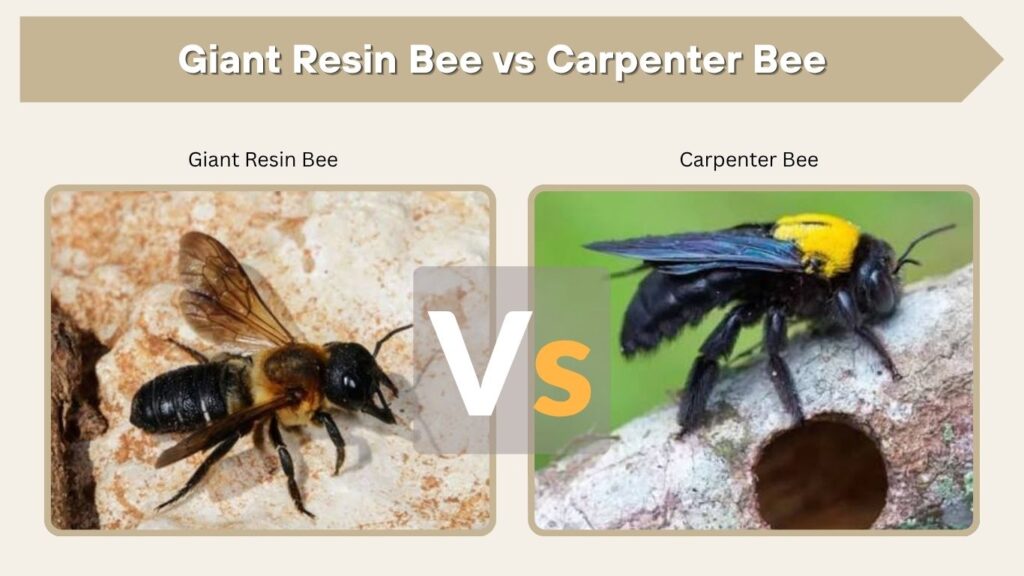
The Giant Resin Bee can easily be confused with a dark carpenter bee because both are large solitary bees. However, they belong to different genera and use different nesting strategies.
Giant Resin Bee vs Giant Carpenter Bee
Key differences include:
- Carpenter bees: Usually belong to Xylocopa
- Giant Resin Bee: Belongs to Megachile
- Carpenter bee: Can excavate tunnels into wood
- Resin bee: Usually occupies existing cavities
- Carpenter bee: Often has a shiny abdomen
- Resin bee: Has a somewhat different, leafcutter-bee body structure
- Carpenter bee: Uses strong jaws for wood excavation
- Resin bee: Uses plant resins and other materials when constructing nest cells
Both can be useful pollinators and neither should automatically be treated as a dangerous insect.
Is Wallace’s Giant Bee a Carpenter Bee?
No. Wallace’s giant bee (Megachile pluto) is not a carpenter bee.
It is a giant resin/leafcutter-type bee in the genus Megachile. Females can reach about 38 mm in body length and have an extraordinary wingspan, making the species the largest known living bee.
Its huge jaws and black coloration can resemble a gigantic carpenter bee in photographs, which likely explains some of the confusion.
How to Manage Giant Carpenter Bees
Giant carpenter bees provide valuable pollination, so they normally do not need to be removed simply because they visit flowers. Management becomes more relevant when females repeatedly excavate structural wood around a house.
How to Discourage Carpenter Bees
Practical options include:
- Paint exposed unfinished timber.
- Seal vulnerable wooden surfaces.
- Repair damaged boards.
- Replace badly deteriorated wood.
- Maintain decks, railings, and eaves.
- Inspect existing holes before sealing them.
- Close abandoned tunnels after bees have left.
- Use composite or less attractive building materials when replacing wood.
- Provide suitable natural nesting habitat away from buildings.
- Avoid handling or disturbing active females.
Never immediately plug a hole when you know a bee is still inside. An occupied bee may attempt to create another exit.
For widespread nesting that is damaging important structural timber, professional inspection can help determine the extent of the galleries.
FAQs
1. What is a giant black carpenter bee?
It is generally a very large, dark-colored bee belonging to the genus Xylocopa. The phrase can describe several species rather than one specific bee.
2. Do giant black carpenter bees sting?
Female carpenter bees can sting, but they generally do so only when handled or seriously threatened. Males cannot sting.
3. What is the Giant Bornean Carpenter Bee?
The Giant Bornean Carpenter Bee is Xylocopa latipes, a particularly large Asian carpenter bee also called the Broad-handed Carpenter Bee.
4. Why are some giant carpenter bees blue or violet?
Microscopic structures on their bodies and wings can reflect light in ways that create blue, violet, or metallic appearances. Color also varies among species and sexes.
5. Is the world’s largest bee a carpenter bee?
No. Wallace’s giant bee (Megachile pluto) is regarded as the largest known living bee, but it belongs to Megachile, not Xylocopa, so it is not a carpenter bee.