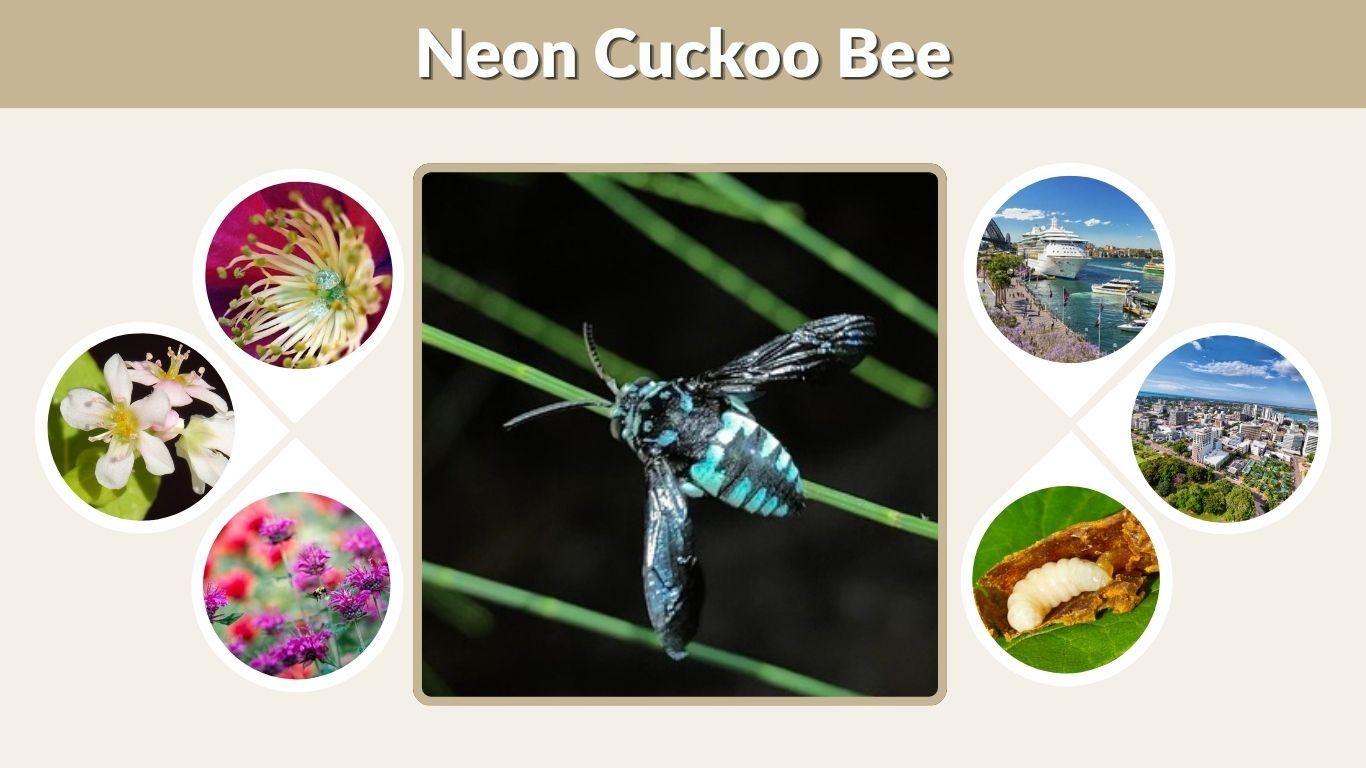
The Neon Cuckoo Bee is one of Australia’s most striking native bees, instantly recognizable by the brilliant blue patches covering its black body. Scientifically known as Thyreus nitidulus, this bee has an unusual reproductive strategy: instead of building its own nest, the female lays eggs in the nests of other bees. Despite its dramatic appearance, it is not aggressive toward people. This guide covers Neon Cuckoo Bee identification, size, diet, habitat, sting risk, life cycle, brood-parasitic behavior, and its connection with Blue-banded Bees.
What Is a Neon Cuckoo Bee?
The Neon Cuckoo Bee (Thyreus nitidulus) belongs to the family Apidae and genus Thyreus. It is a native Australian bee known for its vivid blue-and-black coloration. Unlike social honey bees, it does not live in a colony with workers or construct a hive. It is instead a cuckoo, or cleptoparasitic, bee that depends on nests made by other bees for reproduction.
Neon Cuckoo Bee Identification
Important features include:
- Scientific name: Thyreus nitidulus
- Family: Apidae
- Genus: Thyreus
- Length: Around 10 mm, with cuckoo bees in this group generally about 10–14 mm
- Body: Stocky and mainly black
- Markings: Brilliant turquoise or neon-blue hair patches
- Wings: Light brown with a purple sheen
- Antennae: Long and dark
- Lifestyle: Solitary and brood parasitic
- Host: Mainly Blue-banded Bees of the genus Amegilla
The bright blue areas are produced largely by patches of specialized hairs rather than blue body pigment.
Why Is It Called a Cuckoo Bee?
Its name comes from behavior similar to cuckoo birds.
A female does not prepare a nest and food supply for her own offspring. Instead, she searches for a suitable nest made by another bee and secretly places her egg inside.
The host unwittingly provides both shelter and food for the developing cuckoo bee.
Where Do Neon Cuckoo Bees Live?
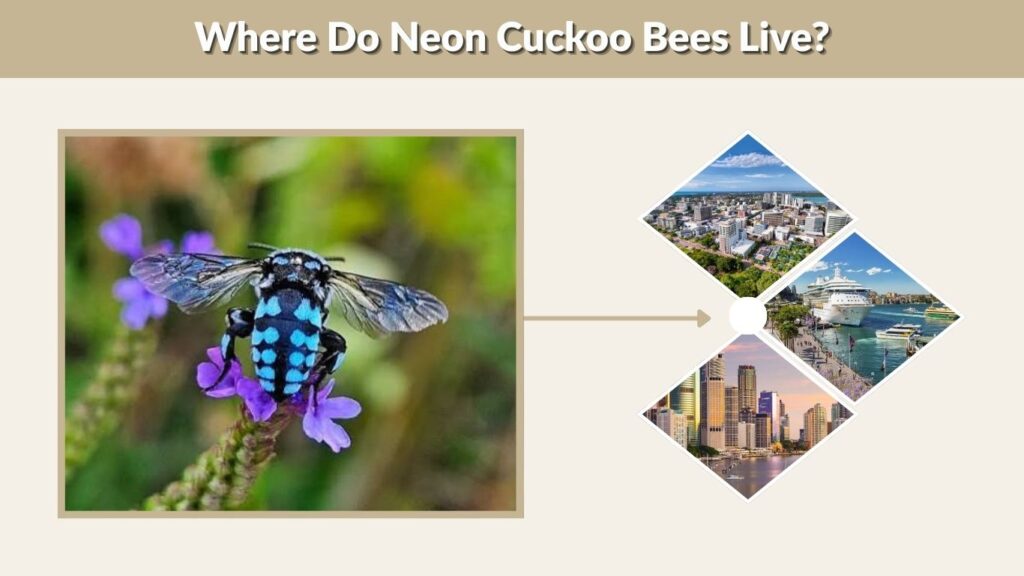
Neon Cuckoo Bees are strongly associated with places where their host bees occur. They can be encountered in natural bushland as well as urban gardens where flowering plants and suitable Blue-banded Bee nesting areas are available. Australian Museum information lists cuckoo-bee habitats including forests, woodlands, heath, and urban environments.
Neon Cuckoo Bee Distribution
They are associated with:
- Eastern Australia
- Northern Australia
- New South Wales
- Queensland
- Parts of South Australia
- Northern Territory
- New Guinea and nearby regions for T. nitidulus populations
Occurrence records confirm Thyreus nitidulus as an accepted Australian species, although the wider taxonomy includes geographic forms and related Thyreus species.
Neon Cuckoo Bee in Australia
The species is especially famous in Australia because its vivid coloration makes it one of the most recognizable native bees.
Gardens supporting Blue-banded Bees may occasionally attract Neon Cuckoo Bees as well. Planting flowering native plants and avoiding unnecessary pesticide use can help support native bee communities.
Neon Cuckoo Bee and Blue-banded Bees
The most fascinating feature of the Neon Cuckoo Bee is its relationship with Blue-banded Bees. Rather than constructing a nest, the female watches for an opportunity to enter the nest of an Amegilla bee and lay an egg inside an unfinished brood cell.
How the Brood Parasitism Works
The basic process is:
- A Blue-banded Bee excavates a nesting burrow.
- She creates individual brood cells.
- Each cell is stocked with pollen and nectar.
- The female Neon Cuckoo Bee searches for an unattended nest.
- She enters and deposits her own egg.
- The host later seals the brood cell.
- The cuckoo larva develops using the stored provisions.
The Australian Museum describes this strategy as the defining feature of cuckoo bees.
What Happens to the Blue-banded Bee Larva?
The Neon Cuckoo Bee larva consumes the food originally collected for the host’s offspring.
As a result, the Blue-banded Bee offspring does not successfully develop in the parasitized cell. This relationship is known as cleptoparasitism, meaning that one species essentially steals resources collected by another.
Despite sounding destructive, cuckoo bees are natural components of native ecosystems rather than introduced pests.
Neon Cuckoo Bee Life Cycle
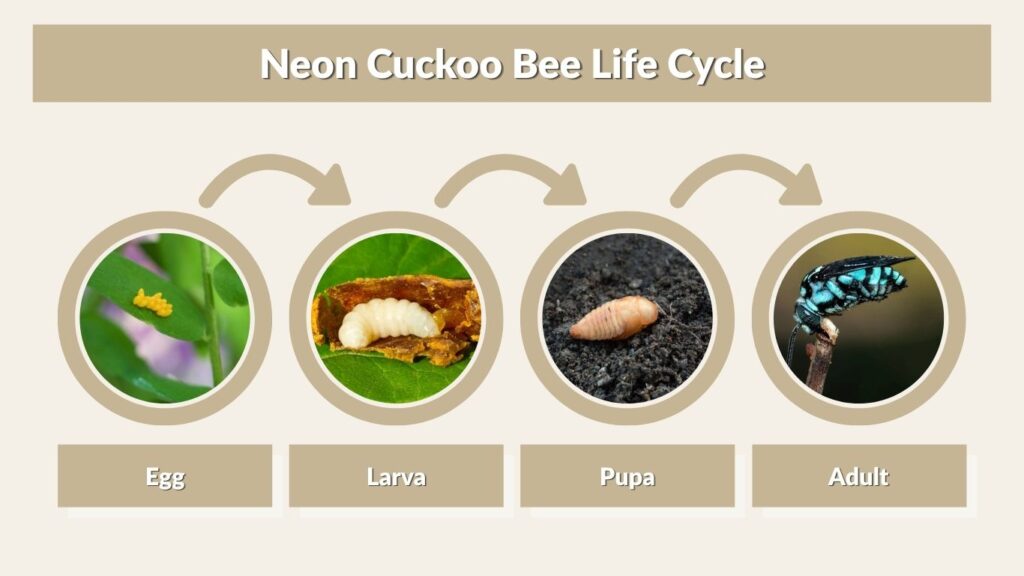
The Neon Cuckoo Bee undergoes complete metamorphosis, progressing through egg, larva, pupa, and adult stages. The biggest difference from ordinary solitary bees is that its immature stages develop inside another species’ nest rather than one constructed by its mother.
Egg and Larva
The female places her egg into an appropriate host brood cell while it remains accessible.
After hatching, the larva consumes the pollen-and-nectar food supply stored in the chamber.
It grows inside this protected environment without needing either parent to provide additional care.
Pupa and Adult
Once fully developed, the larva pupates inside the brood cell.
It eventually completes metamorphosis and emerges as an adult Neon Cuckoo Bee.
Adults then spend their lives feeding, mating, and—in the case of females—searching for host nests in which to continue the cycle.
What Do Neon Cuckoo Bees Eat?
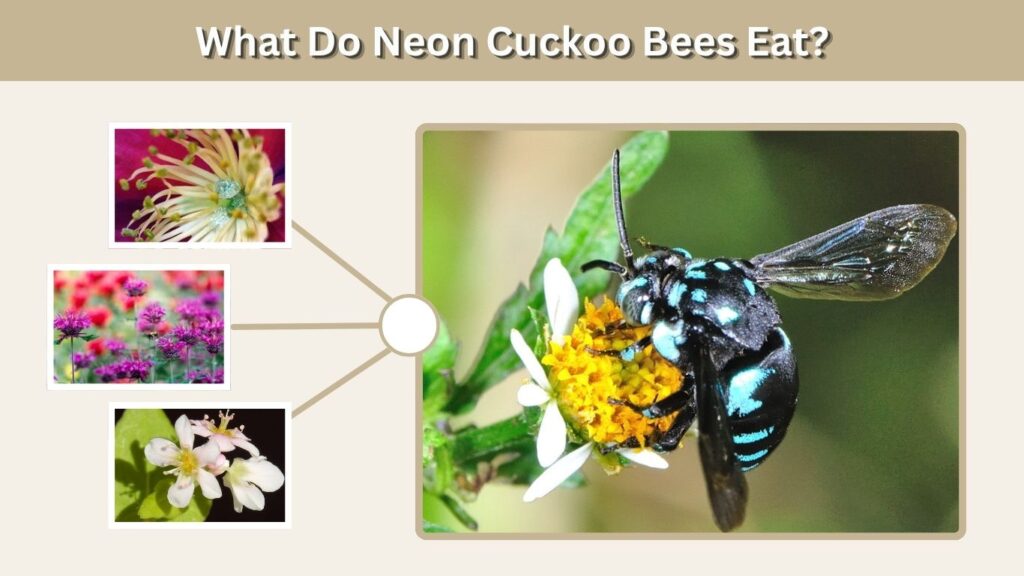
Adult Neon Cuckoo Bees visit flowers for nectar. Although females do not collect the pollen-and-nectar provisions needed to raise offspring, they still need carbohydrates to fuel flight and other activities.
Adult Diet
Adults may obtain food from:
- Flower nectar
- Sugary plant resources
- Nectar from native garden flowers
- Flowering plants also visited by other native bees
Because they visit flowers, adult cuckoo bees can still transfer pollen between plants while feeding.
What Do the Larvae Eat?
The larvae have a very different diet.
They consume the pollen-and-nectar provisions collected by the host Blue-banded Bee. They therefore benefit directly from all the work performed by the female host before the cell is sealed.
Do Neon Cuckoo Bees Make Honey?
No. Neon Cuckoo Bees do not produce or store harvestable honey.
They are not social honey bees and do not maintain large permanent colonies. They also do not build their own brood nests.
Australian native bee information notes that solitary species do not maintain the surplus honey stores associated with social honey-producing bees.
Do They Have a Queen?
No.
There is no queen-worker social system. Adult females reproduce independently, and each seeks out appropriate host nests in which to lay eggs.
This lifestyle is fundamentally different from European honey bees and Australian stingless bees that form organized colonies.
Do Neon Cuckoo Bees Sting?
Female Neon Cuckoo Bees are capable of stinging, as are females of most Australian native bee species. However, Australian native solitary bees are generally not aggressive and usually sting only when physically trapped, grabbed, or stepped on.
Is a Neon Cuckoo Bee Dangerous?
For most people, encountering one in a garden is not dangerous.
You can reduce the chance of a sting by:
- Avoiding grabbing the bee
- Allowing it to leave naturally
- Wearing shoes outdoors
- Avoiding disturbing resting bees
- Teaching children not to handle unfamiliar insects
As with other bee species, allergic reactions to stings are possible. Anyone experiencing breathing difficulty, facial or throat swelling, dizziness, or other signs of a severe allergic reaction after a sting should seek emergency medical attention.
Female Neon Cuckoo Bee
Female Neon Cuckoo Bees are responsible for finding host nests and depositing eggs. Interestingly, females lack the pollen-carrying structures required by bees that provision their own offspring because cuckoo bees have no need to transport large quantities of pollen back to a nest.
Female Behavior
A female may spend considerable time observing areas where Blue-banded Bees are nesting.
Rather than attacking the host directly, she takes advantage of periods when the nest owner leaves to gather additional pollen or nectar.
Successful reproduction therefore depends heavily on locating healthy populations of appropriate host bees.
Neon Cuckoo Bee vs Blue-banded Bee
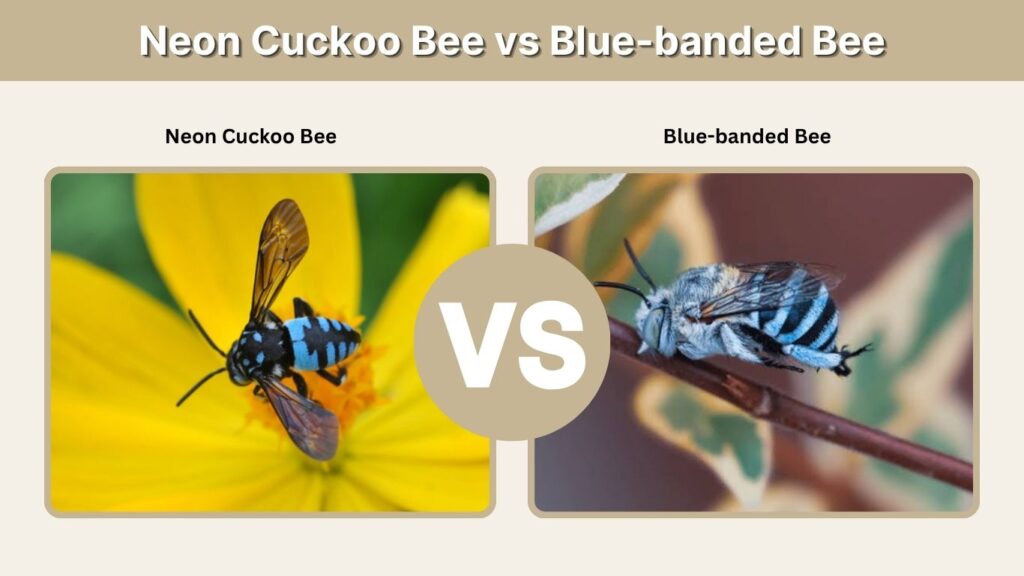
These two native Australian bees are closely connected but have very different lifestyles.
Main Differences
Neon Cuckoo Bee:
- Brilliant turquoise-blue patches
- Does not construct a nest
- Does not gather larval food provisions
- Parasitizes other bee nests
- Stocky black body
- Female lacks pollen-carrying scopal hairs
Blue-banded Bee:
- Usually has distinct bands across the abdomen
- Female builds her own nesting burrow
- Collects pollen and nectar for larvae
- Provides the nest exploited by cuckoo bees
- Known for buzz pollination
Their relationship is one of the most interesting examples of brood parasitism among Australian insects.
Neon Cuckoo Bee in Minecraft Productive Bees
Some searches for “Neon Cuckoo Bee” refer not to the real Australian insect but to the Productive Bees Minecraft mod.
The mod contains a virtual Neon Cuckoo Bee inspired by the real cuckoo-bee lifestyle. According to the current Productive Bees documentation, players do not obtain it through ordinary bee breeding.
How to Get Neon Cuckoo Bee in Productive Bees
In the mod, the Neon Cuckoo Bee can spawn from a Blue Banded Bee nest.
A chance to produce the cuckoo bee occurs when the Blue Banded Bee returns with nectar, so flowers should be available nearby. This deliberately imitates the real-world connection between cuckoo bees and Amegilla hosts.
The exact mechanics can change between Productive Bees versions, so in-game documentation or JEI should be checked when playing a particular Minecraft release.
FAQs
What is the scientific name of the Neon Cuckoo Bee?
The accepted scientific name is Thyreus nitidulus. It belongs to the family Apidae and genus Thyreus.
How big is a Neon Cuckoo Bee?
Adults are around 10 mm long, while Australian cuckoo bees in this group generally fall around 10–14 mm.
Is the Neon Cuckoo Bee a brood parasite?
Yes. Females place eggs in nests constructed by other bees, especially Blue-banded Bees, and their larvae use the host’s stored pollen and nectar.
Can Neon Cuckoo Bees sting?
Females are capable of stinging, but native solitary bees are generally not aggressive. Stings are most likely if a bee is trapped, stepped on, or handled.
Why is the Neon Cuckoo Bee blue?
Its spectacular blue appearance comes largely from patches of bright blue hairs contrasting against its black body. These markings make Thyreus nitidulus one of Australia’s most distinctive native bees.