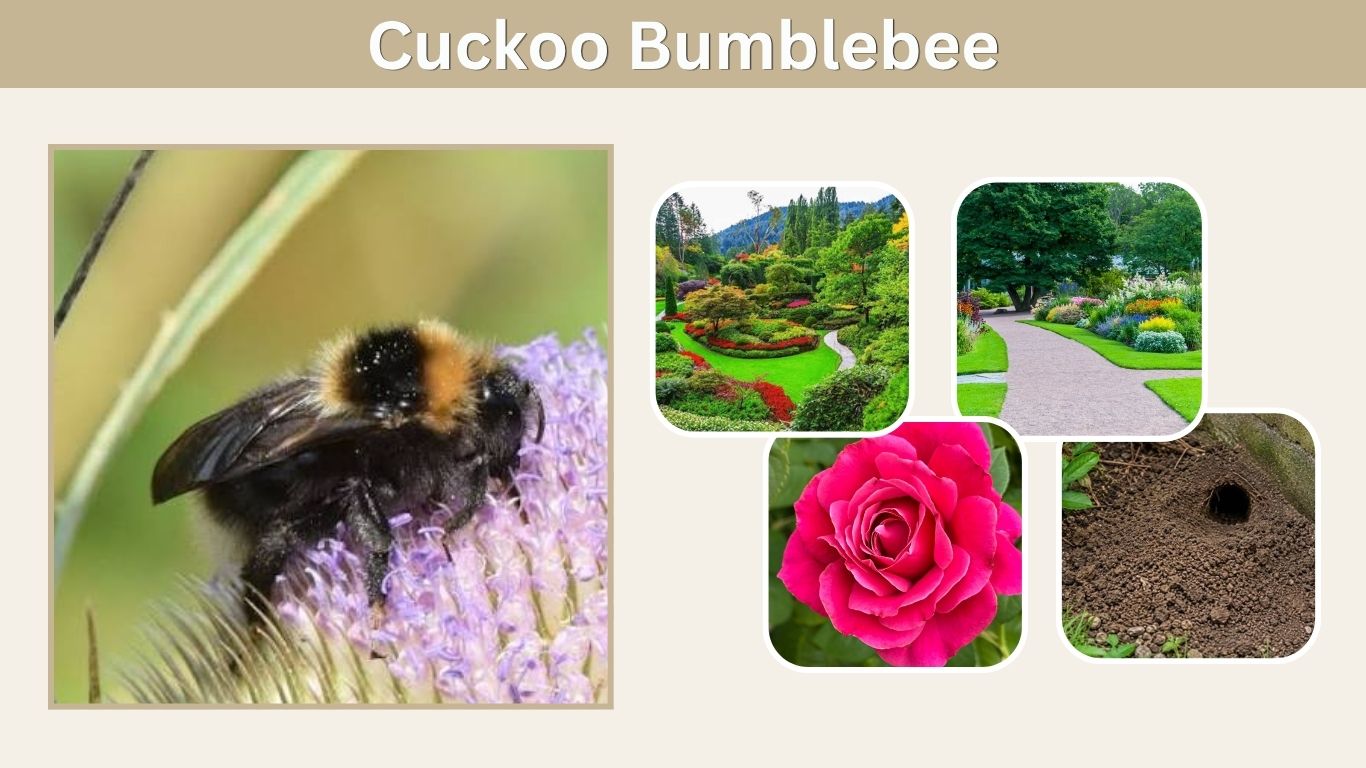
A cuckoo bumblebee is a social parasite that takes over the established nest of another bumblebee species. Instead of producing workers and building its own colony, a female enters a host nest and uses the resident workers to raise her offspring. Cuckoo bumblebees still visit flowers for food and can contribute to pollination, but females lack pollen baskets because they do not collect pollen for larvae. Their unusual life cycle, smoky wings, sparse hair, and dependence on host species distinguish them from ordinary social bumblebees.
What Is a Cuckoo Bumblebee?
Cuckoo bumblebees belong to the genus Bombus and subgenus Psithyrus. They were once commonly classified as a separate genus, but modern classification places them among the bumblebees.
Classification
- Kingdom: Animalia
- Phylum: Arthropoda
- Class: Insecta
- Order: Hymenoptera
- Family: Apidae
- Genus: Bombus
- Subgenus: Psithyrus
They are called cuckoo bumblebees because their reproductive strategy resembles that of cuckoo birds. They place their offspring under the care of another species rather than raising them independently.
Social Parasites Rather Than Nest Builders
A social bumblebee queen starts a nest, produces workers, and supplies the first brood. A cuckoo female cannot establish this kind of colony. She must locate a sufficiently developed host nest and take control of its workforce.
Cuckoo bumblebees produce reproductive females and males but no worker caste. Their complete dependence on other bumblebees makes them vulnerable when their preferred hosts decline.
Cuckoo Bumblebee Identification
Color patterns differ considerably among species, and several cuckoo bumblebees imitate their hosts. Identification therefore requires more than looking at the yellow bands or tail color.
What Does a Cuckoo Bumblebee Look Like?
Common identifying features include:
- Hind legs: Hairy and relatively narrow, without pollen baskets.
- Wings: Frequently darker or smokier than those of social species.
- Hair: Often shorter or sparser, exposing parts of the shiny exoskeleton.
- Abdomen: May appear more pointed in females.
- Color: Black with combinations of yellow, white, orange, or red markings.
- Pollen loads: Females do not carry packed pollen on their hind legs.
- Behavior: Often spends longer resting or feeding on flowers than worker bees.
These characteristics are useful clues, but they are not equally obvious in every species. Clear photographs of the back, face, tail, and hind legs improve identification.
Female and Male Cuckoo Bumblebees
Females search for host nests and can sting. They are sometimes informally called cuckoo queens, although they do not find colonies in the manner of social bumblebee queens.
Males appear later in the season and mainly feed, search for females, and mate. They do not have stingers. Neither sex performs worker duties or collects pollen for a nest.
Cuckoo Bumblebee vs. Ordinary Bumblebee
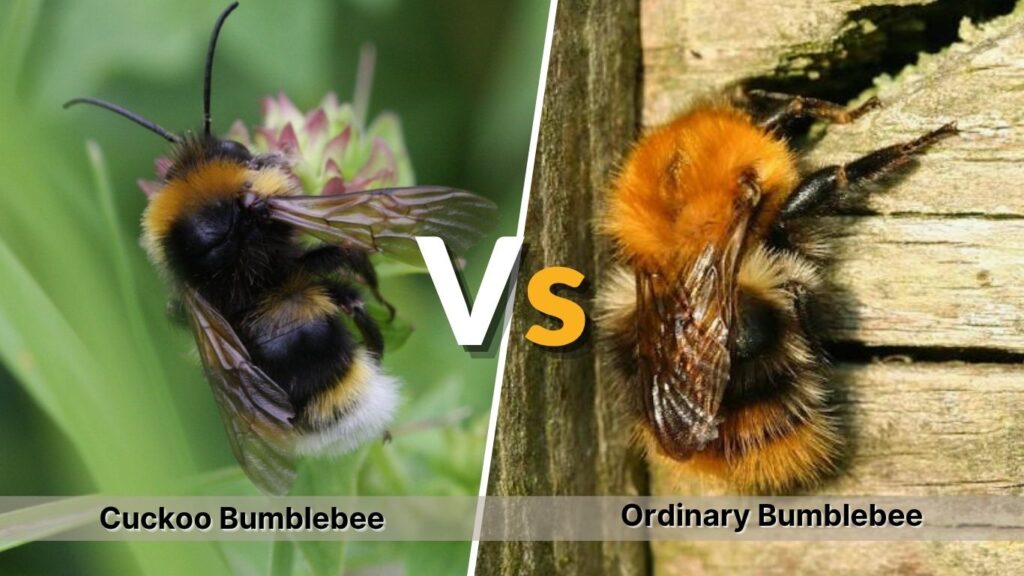
The clearest differences involve colony structure and pollen collection. However, males of social species also lack pollen baskets, so a hairy hind leg alone cannot always identify a cuckoo.
Main Differences
| Feature | Cuckoo bumblebee | Social bumblebee |
| Starts its own nest | No | Queen does |
| Produces workers | No | Yes |
| Female pollen baskets | Absent | Present |
| Uses another species’ nest | Yes | No |
| Wing appearance | Often dark or smoky | Commonly clearer |
| Body hair | Often sparse | Usually denser |
| Colony role | Social parasite | Queen, worker, or male |
Female social bumblebees have broad, smooth pollen baskets fringed by stiff hairs. Cuckoo females instead have fully hairy hind legs without the smooth collecting surface.
Do Cuckoo Bumblebees Collect Pollen?
They may become dusted with pollen while visiting flowers, but they do not form pollen loads for larvae. Host workers supply the food used to raise cuckoo offspring.
Adults visit flowers primarily for their own nectar needs. Males and females may still transfer pollen accidentally while moving among blossoms.
How a Cuckoo Bumblebee Takes Over a Nest
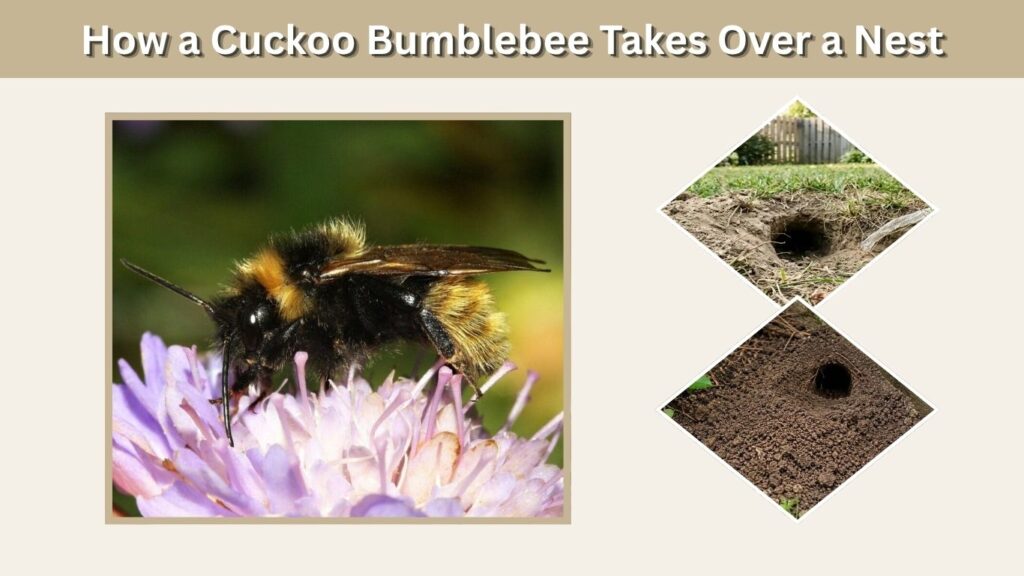
Timing is essential. A female normally emerges after her host queen has established a nest and produced workers. Entering too early provides too few workers, while entering a large, well-defended colony may make takeover more difficult.
Finding and Entering the Host Nest
The female searches habitats occupied by her preferred host. She may investigate vegetation, soil openings, abandoned rodent burrows, or other places where bumblebees nest.
Once inside, she may hide temporarily and acquire the nest’s odor before confronting the queen. The details differ among cuckoo and host species.
Taking Control of the Colony
The cuckoo may dominate, injure, displace, or kill the host queen. She then lays her own eggs while the surviving host workers continue foraging and tending brood.
The takeover is not always successful. Workers may attack the intruder, and the outcome depends partly on the colony’s size and development. Researchers note that cuckoo females need nests developed enough to contain workers but not so strong that they cannot be controlled.
Larvae and the End of the Cycle
Host workers feed the developing cuckoo larvae. The brood becomes new females and males rather than workers.
After leaving the nest, adults feed and mate. Males die later in the season, while newly mated females find sheltered places to overwinter. They emerge the following year and repeat the cycle.
Major Cuckoo Bumblebee Species
Species differ by region, coloration, host preference, and conservation status. Common names can also vary between countries, making scientific names useful.
Well-Known Species
- Lemon cuckoo bumblebee — Bombus citrinus
- Suckley’s cuckoo bumblebee — Bombus suckleyi
- Variable cuckoo bumblebee — Bombus variabilis
- Indiscriminate cuckoo bumblebee — Bombus insularis
- Gypsy cuckoo bumblebee — Bombus bohemicus
- Southern cuckoo bumblebee — Bombus vestalis
- Red-tailed cuckoo bumblebee — Bombus rupestris
- Field cuckoo bumblebee — Bombus campestris
- Forest cuckoo bumblebee — Bombus sylvestris
- Barbut’s cuckoo bumblebee — Bombus barbutellus
Ashton’s cuckoo bumblebee is a North American name historically associated with Bombus ashtoni, which is now generally treated as Bombus bohemicus. Similar species may require microscopic examination.
Lemon and Variable Cuckoo Bumblebees
The lemon cuckoo bumblebee is a North American species with yellow markings that can resemble those of its hosts. Its precise identification should consider facial coloration, abdominal pattern, sex, and geographic range.
The variable cuckoo bumblebee lives in parts of North America and is appropriately named because its markings can vary. It is easily confused with other black-and-yellow cuckoo species.
Suckley’s Cuckoo Bumblebee
Suckley’s cuckoo bumblebee occurs across much of North America and depends on host bumblebees to raise its offspring. Canadian assessments report that it has been encountered less frequently than in the past despite increased survey effort.
European and British Species
Six cuckoo species are regularly recognized in Britain: Southern, Gypsy, Forest, Barbut’s, Red-tailed, and Field cuckoo bumblebees. The Southern cuckoo uses Buff-tailed bumblebee nests, while the Red-tailed cuckoo is associated with Red-tailed bumblebees.
Host association is a useful clue because cuckoo species are usually found within the ranges of their hosts.
Habitat, Diet and Range
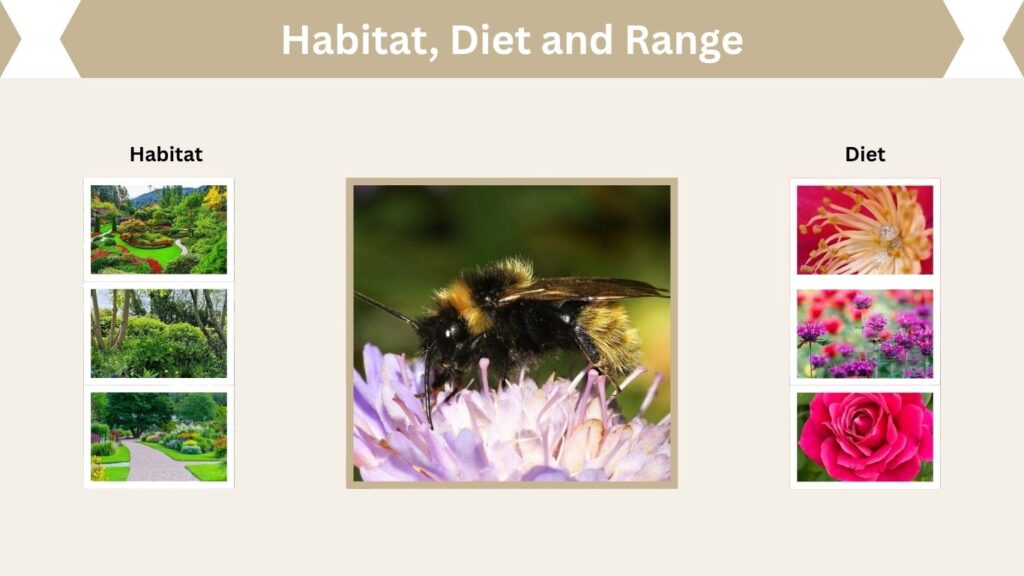
Cuckoo bumblebees require both continuous flowers and suitable host colonies. Their habitat is therefore determined partly by the needs of the social bumblebees they exploit.
Habitat
Depending on the species, they may inhabit:
- Gardens and parks
- Meadows and grasslands
- Heathland and moorland
- Forest edges
- Agricultural landscapes
- Mountain and boreal habitats
- Open countryside containing host nests
They do not construct independent hives. The nests they occupy may occur underground, in abandoned rodent burrows, beneath vegetation, or in other protected cavities selected by the host queen.
Diet
Adults consume nectar from flowers such as thistles, brambles, dandelions, knapweed, and scabious. They may visit many additional plants where their tongue length permits access.
The larvae eat provisions delivered by host workers. Unlike ordinary worker bumblebees, adult cuckoos do not gather pollen specifically for their offspring.
Sting Risk and Nest Removal
Cuckoo bumblebees are not hunting people, pets, or livestock. Females possess a reusable sting and may defend themselves when trapped, squeezed, or handled.
Are Cuckoo Bumblebees Aggressive?
Their aggression is mainly directed toward bees during nest invasion. A flower-feeding individual normally has no reason to attack a person.
Avoid touching or capturing one by hand. Anyone with a known serious insect-sting allergy should follow their established medical plan after a sting.
Should a Cuckoo Bumblebee Nest Be Removed?
There is no independent cuckoo nest to remove; the insect is occupying a social bumblebee colony. Bumblebee nests are temporary and usually decline naturally after their seasonal cycle.
Leave the nest undisturbed when possible. If it is in a high-risk location, contact a local bee specialist or licensed pest professional for species-sensitive advice.
Conservation of Cuckoo Bumblebees
Protecting cuckoo bumblebees requires protecting their hosts. If a host disappears from an area, the dependent cuckoo species may also vanish even when flowers remain available.
How to Help
- Grow native plants that flower from spring through autumn.
- Avoid unnecessary insecticide use.
- Preserve undisturbed soil, vegetation, and potential nest areas.
- Retain some sheltered overwintering habitat.
- Support surveys that record both cuckoo and host bumblebees.
- Photograph unusual bees without disturbing them.
Suckley’s and Ashton’s cuckoo bumblebees are among the species of conservation concern in parts of North America. Their scarcity also makes reliable records especially valuable.
FAQs
Does a Cuckoo Bumblebee Have a Queen?
A reproductive female takes over a host colony, but she does not establish her own worker-producing nest like a social bumblebee queen.
Do Cuckoo Bumblebees Kill Other Bees?
A female may injure or kill the host queen during a takeover. Host workers are usually retained because they raise the cuckoo’s brood.
How Big Is a Cuckoo Bumblebee?
Size varies by species and sex. Many are medium-sized or large bumblebees; for example, Gypsy cuckoo adults have been reported at approximately 12–18 millimeters long.
Can Cuckoo Bumblebees Sting?
Females can sting, while males cannot. Stings are most likely when a bee is trapped or handled.
Are Cuckoo Bumblebees Pollinators?
Adults can transfer pollen while drinking nectar, but they do not collect pollen to feed larvae. Their ecological role also includes naturally regulating and interacting with host bumblebee populations.