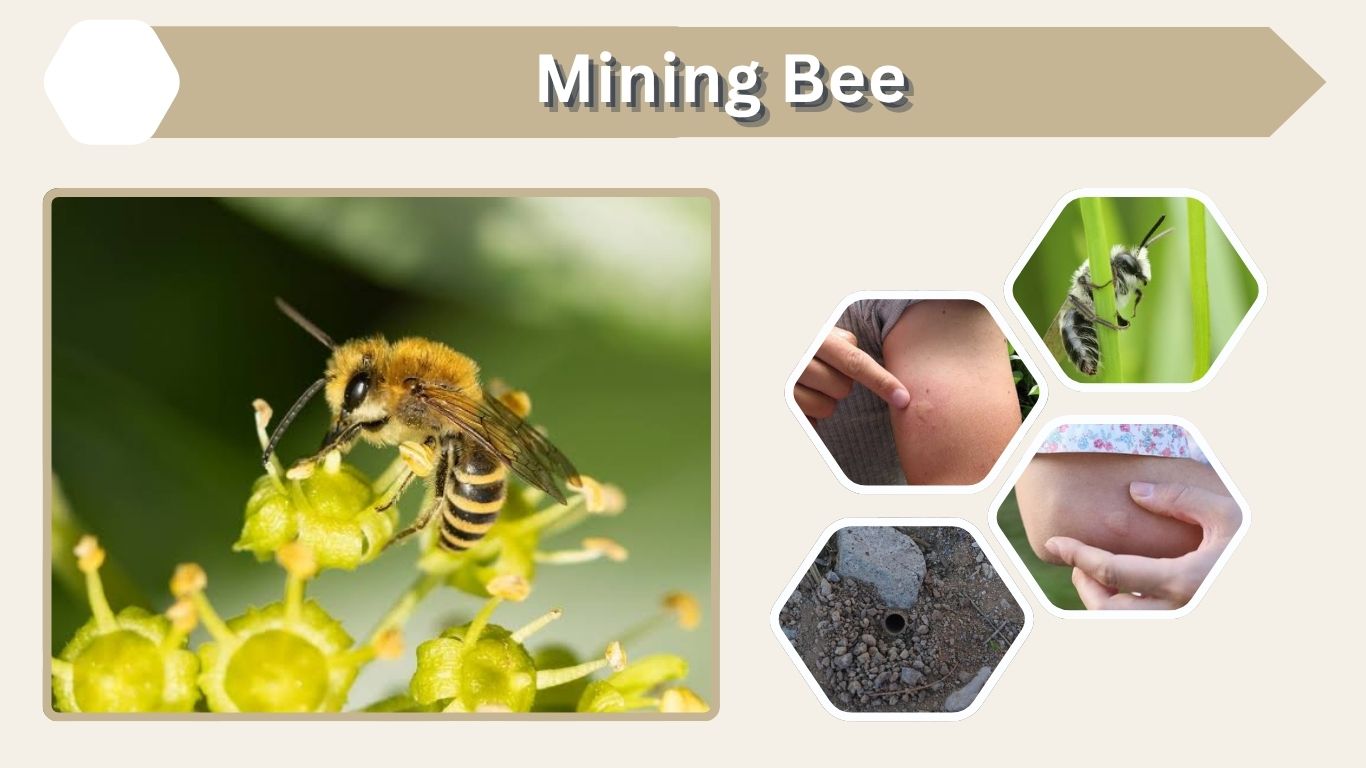
Mining bees are solitary, ground-nesting bees best known for digging small tunnels in lawns, gardens, fields, and sandy soil. Most commonly belong to the genus Andrena, a large and diverse group containing bees of many colors and sizes. Unlike honey bees, mining bees do not normally form large defensive colonies or produce harvestable honey. Females construct underground nests and gather pollen for their offspring. These gentle native pollinators are especially valuable in spring, when many species visit fruit trees and early wildflowers.
What Is a Mining Bee?
The name “mining bee” comes from the females’ habit of excavating underground tunnels. Andrena is one of the largest bee genera, and individual species may look surprisingly different from one another. Some are black and gray, others orange or brown, and sizes can range from only a few millimeters to bees approaching honey-bee size.
Mining Bee Identification
Common characteristics include:
- Small to medium-sized bee
- Usually hairy rather than smooth-bodied
- Colors ranging from black and gray to brown or orange
- Females carry pollen on hairs on their hind legs
- Many have characteristic facial grooves beside the eyes
- Often seen flying close to bare soil
- Females disappear into small holes in the ground
Because hundreds of species exist, color alone is rarely enough for exact identification.
What Does a Mining Bee Look Like?
Many mining bees resemble small honey bees, but their appearance varies significantly.
Some females are covered with orange hairs, while others have shiny black abdomens and pale bands. Males are often slimmer and may differ considerably from females of the same species.
The most useful clue is often behavior. A bee repeatedly entering a small soil tunnel in spring is much more likely to be a mining bee than a honey bee.
Mining Bee Nests and Holes
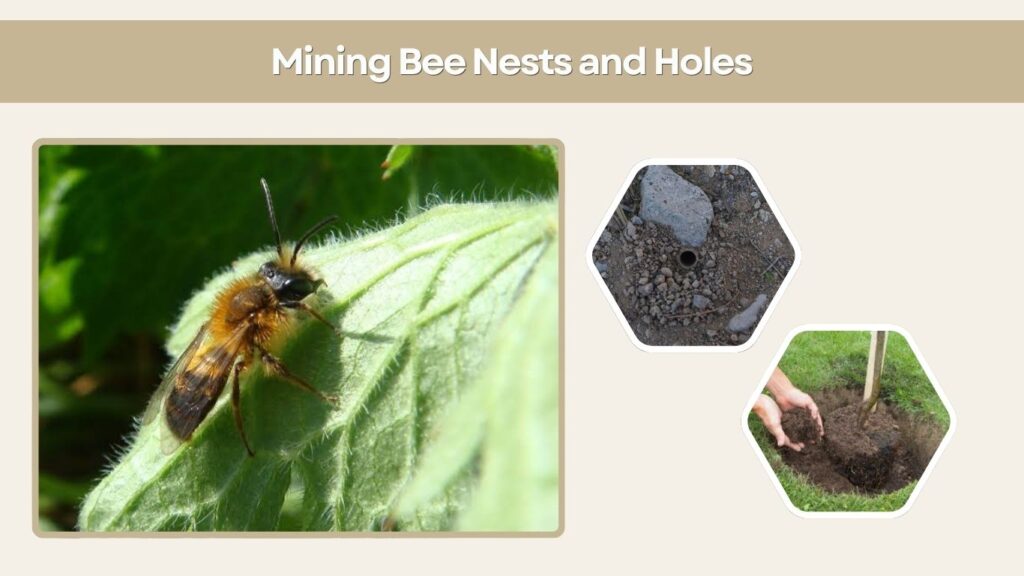
Mining bees spend much of their life underground. Females choose suitable soil and excavate tunnels containing individual brood chambers. Although each female usually tends her own nest, many females may choose the same favorable patch of ground. This can create hundreds of entrances close together and give the misleading appearance of a large social colony.
What Does a Mining Bee Nest Look Like?
Typical signs include:
- A round hole in the soil
- A small mound of loose earth around the entrance
- Volcano-shaped piles of excavated soil
- Several holes grouped together
- Bees entering and leaving during sunny weather
- Nest sites in lawns, pathways, banks, flowerbeds, or bare ground
Ashy Mining Bee burrows, for example, may be approximately 10–20 cm deep.
Mining Bee Colony vs Individual Nest
Most mining bees are solitary.
A female builds and provisions her own nest instead of depending on worker bees. She collects pollen and nectar, places the food inside a brood cell, lays an egg, and seals the chamber.
When dozens of nests occur together, the group is called a nesting aggregation, not a honey-bee-style colony.
Some mining bees can show communal nesting behavior, but they still differ greatly from the highly organized societies of honey bees.
Mining Bee Life Cycle
Mining bees undergo complete metamorphosis through egg, larva, pupa, and adult stages. Many familiar species are active for only a short period each year, particularly during spring. The rest of their lives may be spent developing underground. Their emergence is often timed with the flowering of plants that provide the pollen needed to provision their nests.
Egg and Larval Development
After completing a brood chamber, the female places a supply of pollen mixed with nectar inside it and lays an egg nearby.
The egg hatches into a larva that consumes the stored food rather than leaving the underground cell to forage.
Once fully developed, it enters the pupal stage and eventually transforms into an adult.
Adult Emergence
In species such as the Ashy Mining Bee, developing young remain underground until the following spring.
Adults then emerge, mate, and begin another nesting cycle. This means a lawn may suddenly become busy with mining bees for several weeks and then appear completely inactive for the rest of the year.
Common Types of Mining Bees
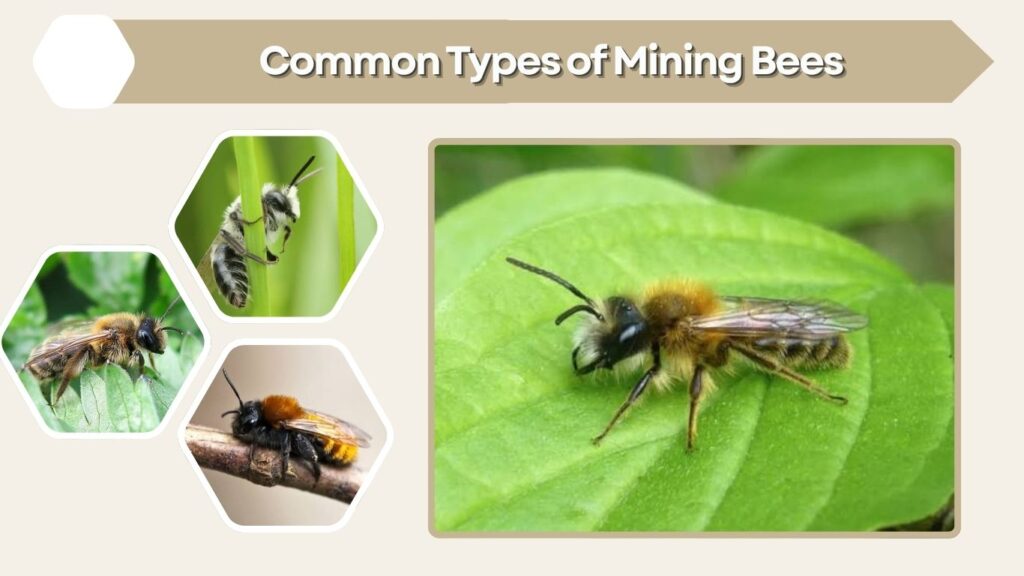
There are many mining bee species, and different regions support different communities. Britain alone has roughly 65–67 Andrena species, while North America also supports a diverse native Andrena fauna. Several species have distinctive colors, preferred flowers, or seasonal activity that make identification somewhat easier.
Ashy Mining Bee
The Ashy Mining Bee (Andrena cineraria) is one of the easiest species to recognize.
Females have glossy black abdomens and striking bands of pale gray or whitish hair across the thorax. They can reach about 1.5 cm long and commonly nest in sunny areas with sparse vegetation.
They visit willow, blackthorn, dandelions, buttercups, and other spring flowers.
Tawny Mining Bee
The Tawny Mining Bee (Andrena fulva) has bright reddish or ginger-colored hairs on the upper surface of the female’s body, contrasting with a darker underside and head.
It frequently nests in lawns, flowerbeds, parks, orchards, and grassy banks.
Its spring activity coincides with the flowering of apple, cherry, pear, and other fruit trees, making it a valuable pollinator.
Chocolate Mining Bee
The Chocolate Mining Bee (Andrena scotica) is another relatively large mining bee, with females roughly 11–15 mm long according to Buglife’s Scottish bee guide.
Its body has brownish coloration that gives the species its common name. Like other Andrena, it nests in soil and gathers pollen to provision underground brood cells.
Other Mining Bees
Other names you may encounter include:
- Yellow-legged Mining Bee
- Early Mining Bee
- Spring Beauty Mining Bee
- Chestnut Mining Bee
- Aster Mining Bee
- Coneflower Mining Bee
- Clark’s Mining Bee
- Grey-backed Mining Bee
- Frigid Mining Bee
- Death Camas Mining Bee
Some are pollen specialists associated with particular groups of flowering plants, while others visit a wider range of flowers.
Do Mining Bees Sting?

Mining bees can cause concern when hundreds suddenly emerge from a lawn, but their nesting behavior is very different from that of yellowjackets or honey bees. Because females primarily defend their individual nests rather than a large communal hive, mining bee aggregations are generally considered low-risk around people when left undisturbed.
Are Mining Bees Aggressive?
Mining bees are generally gentle.
Females are capable of stinging, but they are unlikely to do so unless handled, trapped against the skin, or seriously disturbed.
Males may fly around nest areas while searching for females, creating considerable activity. Male bees have no functional sting and cannot sting people.
For most nesting aggregations, control is unnecessary.
Ashy Mining Bee Sting
Ashy Mining Bees are solitary and are not normally aggressive toward people.
Their numerous burrows may make a lawn look heavily infested, but each female is concentrating primarily on constructing her own nest and gathering pollen.
Watching from a reasonable distance is usually all that is required.
Mining Bee vs Honey Bee
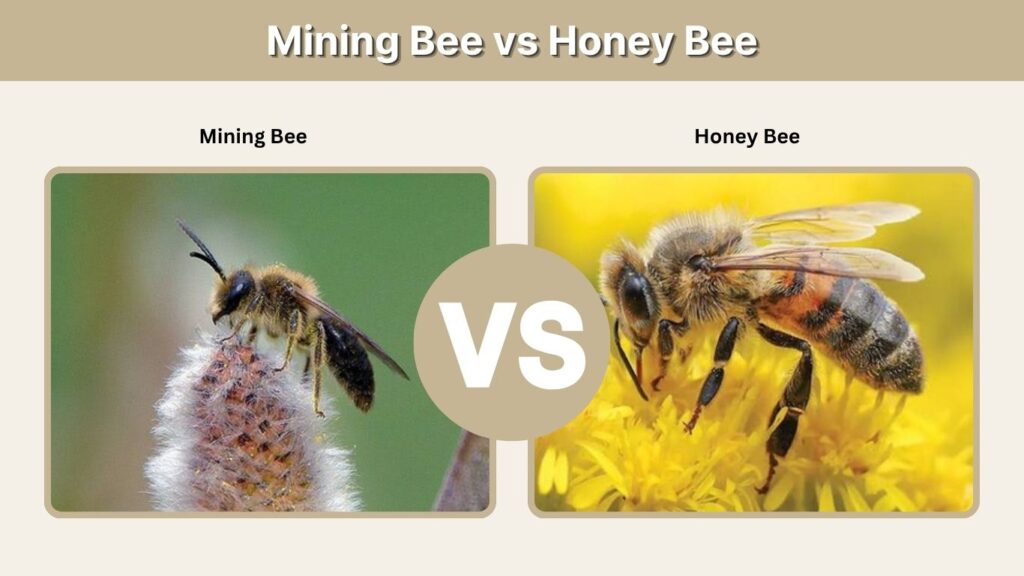
Mining bees and honey bees are both important pollinators, but their nesting and social systems are very different. Honey bees live in organized colonies containing a queen and thousands of workers. Mining bees generally live independently, even when many females nest together in the same patch of soil.
Key Differences
Mining bees dig nests in soil, usually live solitarily, do not create large honey stores, and often appear seasonally.
Honey bees live socially in cavities or managed hives, construct wax comb, store honey, and maintain permanent colonies containing thousands of individuals.
A cluster of holes scattered across a lawn is therefore much more characteristic of ground-nesting bees than honey bees.
Should You Get Rid of Mining Bees?
Mining bees generally do not need to be removed. They are native pollinators, and many species are active for only a few weeks. Their nests also do not normally cause significant permanent damage to healthy lawns. Mining bees are especially valuable around orchards because Andrena species can be important pollinators of spring-blooming crops.
How to Discourage Mining Bees Naturally
If nesting occurs somewhere unsuitable, avoid pesticides when possible.
Mining bees commonly prefer exposed, well-drained soil. Improving lawn density can therefore make an area less attractive over time. Maintaining healthy grass and covering large bare patches reduces available nesting habitat.
If nests are in a location where nobody is at risk, leaving them alone is usually the simplest approach.
FAQs
1. What is the scientific name of a mining bee?
Many common mining bees belong to the genus Andrena, in the family Andrenidae. “Mining bee” refers to a large group rather than one species.
2. Are mining bees dangerous?
Generally, no. They are typically docile solitary bees. Females can sting if directly handled or threatened, but they are not normally aggressive around their nests.
3. Why are there so many mining bee holes in my lawn?
Many females may independently choose the same sunny, well-drained soil. This creates a nesting aggregation containing numerous separate nests.
4. Do mining bees make honey?
No. They collect nectar and pollen, but they do not establish large colonies or store harvestable quantities of honey like honey bees.
5. Are mining bees good for the garden?
Yes. Mining bees are valuable pollinators, and many are especially active when fruit trees and early spring flowers are blooming.