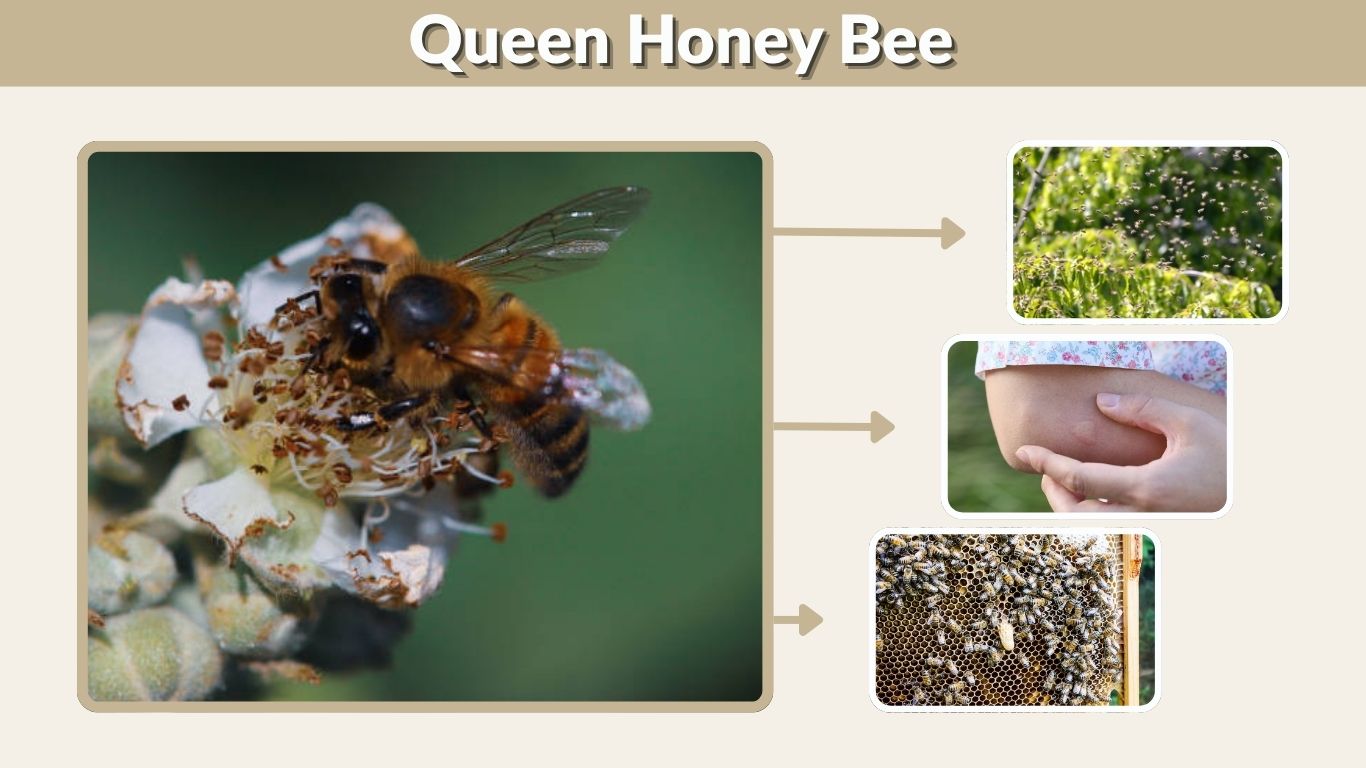
The queen honey bee is the primary reproductive female in a honey bee colony and the mother of nearly every worker and drone living inside the hive. She is recognizable by her long abdomen, relatively large body, and the group of workers that often surrounds and attends her. A healthy queen can lay thousands of eggs during periods of strong colony growth and may survive for several years. Her development, mating behavior, pheromones, and egg-laying ability are essential to maintaining a productive honey bee colony.
What Is a Queen Honey Bee?
A healthy honey bee colony normally contains one queen, thousands of female workers, and a seasonal population of male drones. The queen is the colony’s principal reproductive female. Unlike workers, her reproductive organs are fully developed, allowing her to produce the eggs needed to maintain and expand the population.
What Does the Queen Honey Bee Do?
The queen has two especially important functions: laying eggs and producing pheromones.
During periods of strong brood production, a healthy queen can lay more than 2,000 eggs per day. Her pheromones also affect worker behavior and help maintain the colony’s social organization. Workers constantly interact with the queen and distribute her chemical signals throughout the colony.
Is There Only One Queen in a Hive?
Most established honey bee colonies have one functioning queen.
Temporary exceptions occur during queen replacement. For example, an aging queen and her daughter may briefly coexist during supersedure. Colonies may also raise numerous developing queens when preparing to swarm or replace a missing queen, but usually only one ultimately becomes the established laying queen.
What Does a Queen Honey Bee Look Like?
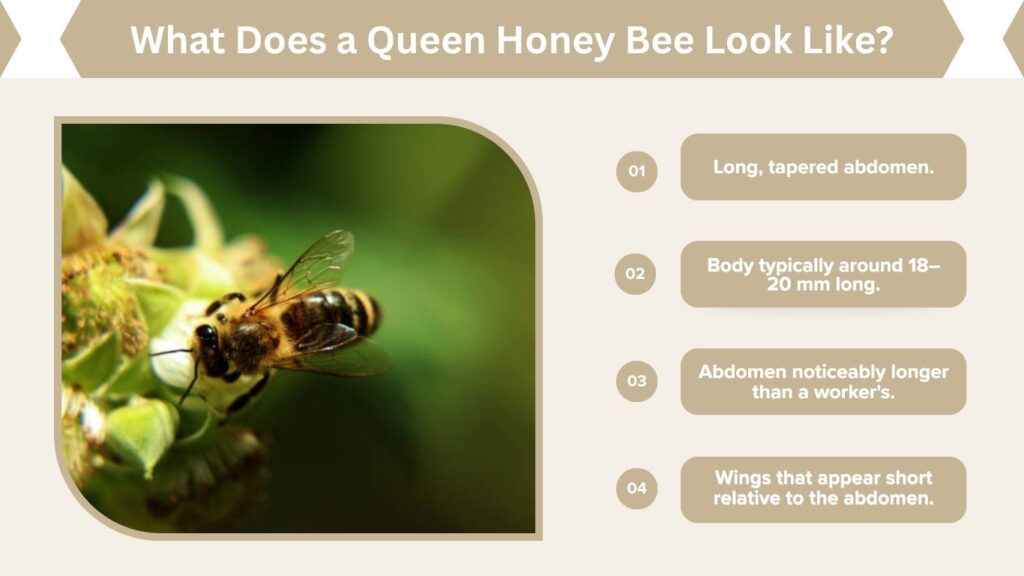
Finding the queen among thousands of workers can initially be difficult. Color alone is unreliable because queens may range from golden brown to very dark depending on genetics. Body proportions are much more useful. A mature laying queen has an elongated abdomen that extends noticeably beyond the tips of her wings.
Queen Honey Bee Identification
Look for these characteristics:
- Long, tapered abdomen
- Body typically around 18–20 mm long
- Abdomen noticeably longer than a worker’s
- Wings that appear short relative to the abdomen
- Long legs
- Smooth, relatively shiny abdomen
- Workers frequently surrounding or following her
- Deliberate movement across brood comb
Workers generally measure about 10–15 mm, making a mature queen noticeably larger and longer-bodied.
How to Find the Queen Honey Bee
Instead of examining every bee individually, watch the behavior of the colony.
A laying queen is usually located on brood frames containing eggs or young larvae. Workers may form a loose circle around her, often called a retinue. They face her, touch her, groom her, feed her, and help distribute her pheromones.
Beekeepers sometimes mark a queen’s thorax with a small colored dot to make her easier to locate during inspections.
Queen Honey Bee Life Cycle
A queen develops from the same type of fertilized egg that could produce a worker. The difference comes largely from how the larva is fed and raised. Workers select very young female larvae and provide them with abundant royal jelly throughout larval development, triggering queen development rather than worker development.
Queen Honey Bee Development Stages
The life cycle includes:
- Egg – The egg remains in the cell for about three days.
- Larva – Nurse workers feed the queen-destined larva large amounts of royal jelly.
- Capped queen cell – The developing larva pupates inside an elongated queen cell.
- Pupa – Transformation into an adult takes place inside the sealed cell.
- Virgin queen – The adult emerges roughly 16 days after the egg was laid.
- Mated queen – After maturation and mating flights, she returns and begins producing fertilized eggs.
Queen development is faster than worker or drone development.
What Does a Queen Cell Look Like?
Queen cells differ dramatically from ordinary horizontal brood cells.
They are large, elongated structures that hang vertically from the comb and are often compared in appearance to a peanut shell. Their location can provide clues about why the colony is producing a queen.
Swarm cells are commonly found near comb edges, while emergency and supersedure cells may occur across the comb face.
How Is a Queen Honey Bee Made?
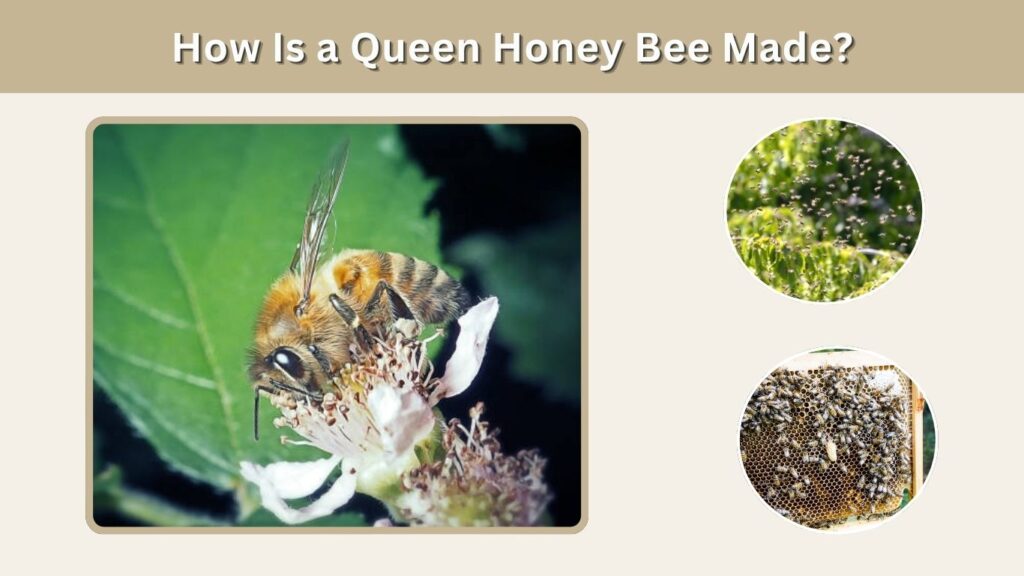
A queen is not genetically destined to become queen from the moment the egg is laid. Fertilized female eggs have the potential to develop into either workers or queens. Nutrition during larval development is a major factor determining which pathway they follow.
Role of Royal Jelly
All very young honey bee larvae initially receive royal jelly. However, larvae selected to become queens continue receiving large amounts of it throughout development.
Worker-destined larvae transition to a different diet after the first few days. Queen-destined larvae continue receiving intensive royal-jelly feeding, allowing their reproductive organs and other queen characteristics to develop fully.
Why Does a Colony Make a New Queen?
A colony normally raises queens for three reasons:
- Swarming: The colony reproduces by dividing.
- Supersedure: Workers replace an aging or poorly performing queen.
- Emergency replacement: The existing queen suddenly dies or disappears.
Workers can raise an emergency queen from a sufficiently young female larva when necessary.
Queen Honey Bee Mating and Egg Laying
A newly emerged queen is initially a virgin. After maturing, she leaves the colony on one or more mating flights and mates with drones away from the hive. She stores sperm inside a specialized organ called the spermatheca and can use this stored sperm over a long period.
How Does a Queen Produce Workers and Drones?
The queen controls whether an egg is fertilized as she lays it.
A fertilized egg develops into a female—normally a worker, or potentially another queen under appropriate rearing conditions. An unfertilized egg develops into a male drone.
After completing mating, a queen may begin laying eggs within roughly 48 hours after returning and settling into the colony.
How Many Eggs Does a Queen Honey Bee Lay?
During peak colony growth, a productive queen can lay more than 2,000 eggs in a single day.
Egg production changes with colony size, food availability, season, weather, and queen quality. Egg laying usually increases during periods when abundant pollen and nectar allow workers to support large quantities of developing brood.
Queen Honey Bee Lifespan
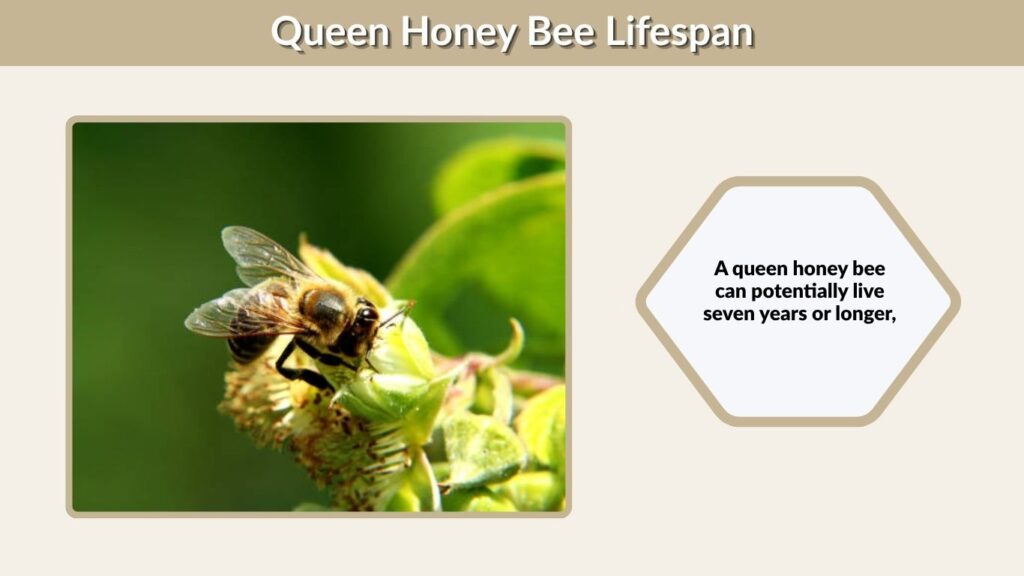
Queens live much longer than summer worker bees. Their protected position inside the colony and specialized biological role allow them to survive for years under favorable circumstances.
How Long Does a Queen Honey Bee Live?
A queen honey bee can potentially live seven years or longer, although her reproductive performance typically declines much sooner.
Queen productivity commonly falls after the first one or two years. For this reason, beekeepers may replace an older queen before she reaches her maximum biological lifespan.
What Happens When a Queen Gets Old?
A declining queen may produce fewer eggs or an increasingly irregular brood pattern. Her pheromone production may also change.
Workers can detect declining queen quality and begin raising a replacement through supersedure. A daughter queen can sometimes coexist temporarily with the older queen before eventually becoming the colony’s primary reproductive female.
Queen Honey Bee vs. Worker Bee
Both queens and workers are female honey bees, but they have dramatically different roles and physical characteristics. A queen specializes in reproduction, while workers perform nearly all of the colony’s everyday labor.
Queen vs. Worker Differences
Queen honey bee:
- Around 18–20 mm long
- Long, tapered abdomen
- Fully developed reproductive organs
- Lays nearly all colony eggs
- May survive for years
- Does not normally forage
- Produces important queen pheromones
Worker honey bee:
- Around 10–15 mm long
- Shorter abdomen
- Usually reproductively inactive
- Nurses larvae
- Builds and maintains comb
- Forages for nectar, pollen, water, and propolis
- Guards and cleans the colony
The queen’s abdomen is much longer and larger than that of a typical worker.
Queen Honey Bee vs. Drone
Drones are male honey bees whose primary reproductive function is mating with virgin queens. Although drones can look large, their body shape is different from that of a queen.
How to Tell Them Apart
A queen has a long, tapered abdomen. A drone has a broader, rounder body and exceptionally large compound eyes that nearly meet at the top of the head.
Drones do not have stingers. Queens do have stingers, although they rarely use them against humans.
Can a Queen Honey Bee Sting?
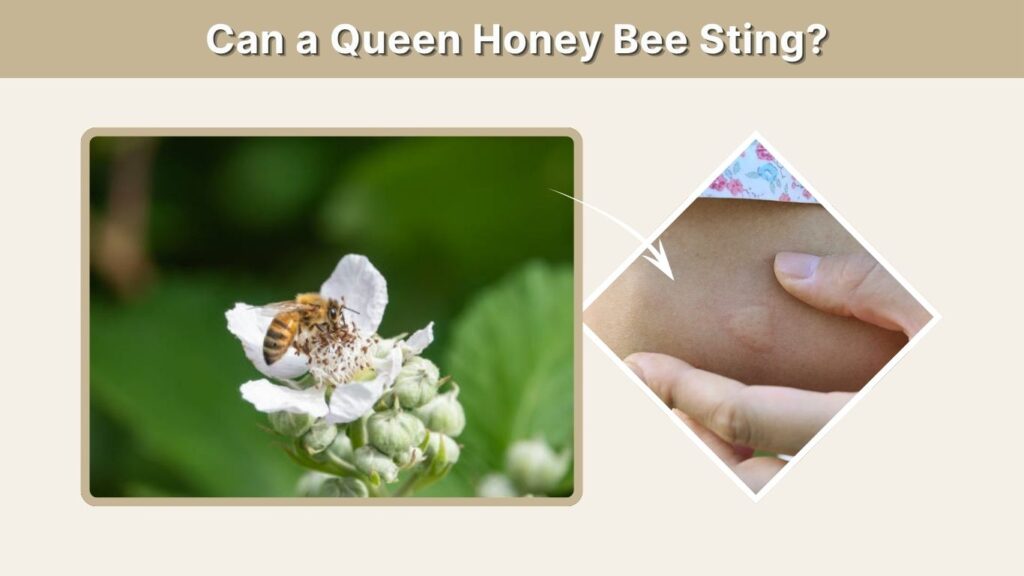
Yes. A queen honey bee possesses a modified ovipositor that functions as a stinger. However, queen stingers differ from the strongly barbed stingers of workers.
Does a Queen Die After Stinging?
A queen’s stinger has no barbs or much smaller barbs than a worker’s, allowing her to sting without automatically dying afterward. Queens primarily use their stingers during conflicts with rival queens rather than for routine defense against people.
Interesting Queen Honey Bee Facts
The queen’s biology is highly specialized for reproduction, yet she remains dependent on thousands of workers for feeding, protection, temperature regulation, and brood care.
Queen Honey Bee Facts
- A colony normally has one laying queen.
- The queen is usually the colony’s largest female.
- She develops in about 16 days.
- Workers raise queens from young fertilized female larvae.
- Queen larvae receive abundant royal jelly.
- A productive queen may lay more than 2,000 eggs per day.
- She stores sperm after mating flights.
- Fertilized eggs produce females.
- Unfertilized eggs produce drones.
- A queen can live for several years.
- Queens can fly, particularly during mating and swarming.
- A queen has a stinger but rarely stings humans.
FAQs
What does a queen honey bee look like?
A queen has a noticeably long abdomen that extends beyond her wings. She is generally around 18–20 mm long and usually appears longer than surrounding workers.
How long does a queen honey bee live?
Queens can survive for several years and occasionally seven years or more, although their egg-laying performance often declines after the first one or two years.
How many eggs can a queen honey bee lay per day?
A strong queen can lay more than 2,000 eggs per day during peak colony growth. Egg production decreases when colony conditions or food resources are less favorable.
Can a queen honey bee sting?
Yes. Queens possess stingers and can sting more than once because their stingers are not strongly barbed like worker stingers. They mainly use them against rival queens rather than people.
What is the difference between a queen and a worker bee?
Both are female, but the queen is larger, has a longer abdomen, possesses fully developed reproductive organs, and specializes in laying eggs. Workers are smaller and perform tasks such as nursing brood, foraging, cleaning, comb building, and colony defense.