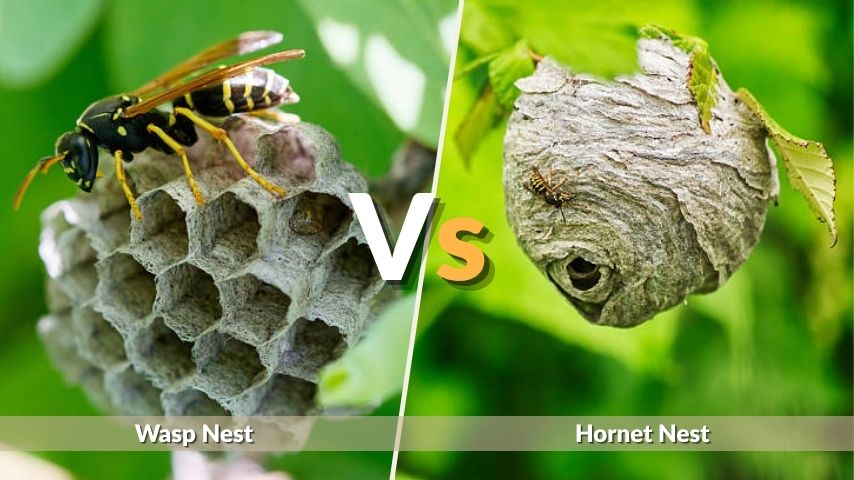
A wasp nest and a hornet nest can look similar at first, especially because both are often made from papery material. However, their size, shape, location, and danger level can be different. Knowing the difference helps you identify what is near your home and decide what to do next. Both wasps and hornets can sting, so careful observation from a safe distance is always the best first step.
Understanding Wasp and Hornet Nests
Wasps and hornets are closely related. In fact, hornets are a type of wasp. This means every hornet is technically a wasp, but not every wasp is a hornet. The confusion usually comes from common names. Homeowners often use “wasp” for paper wasps, yellowjackets, and similar insects, while “hornet” usually refers to larger social wasps that build enclosed paper nests.
Most social wasps and hornets build nests from chewed wood fibers mixed with saliva, creating a paper-like material. University of Kentucky Extension notes that wasps, hornets, and yellowjackets make paper-like nests from finely chewed wood fragments and salivary secretions.
Why Nest Identification Matters
Correct identification helps you understand risk. A small open paper wasp nest under an eave may be less urgent than a large hornet nest near a doorway or a yellowjacket nest hidden in the ground. Nest location also matters because stings usually happen when people accidentally disturb the colony. Utah State University Extension explains that hornet stings commonly occur when nests are disturbed.
Wasp Nest vs Hornet Nest at a Glance
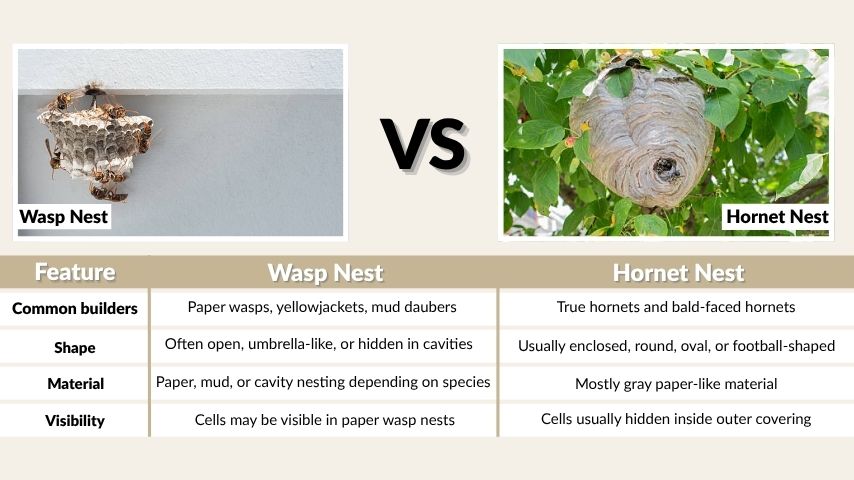
The easiest way to compare them is by looking at structure. Many paper wasp nests are open and umbrella-shaped, while hornet nests are usually enclosed in a gray paper covering. Yellowjackets, which are also wasps, may nest underground or inside wall voids.
| Feature | Wasp Nest | Hornet Nest |
|---|---|---|
| Common builders | Paper wasps, yellowjackets, mud daubers | True hornets and bald-faced hornets |
| Shape | Often open, umbrella-like, or hidden in cavities | Usually enclosed, round, oval, or football-shaped |
| Material | Paper, mud, or cavity nesting depending on species | Mostly gray paper-like material |
| Visibility | Cells may be visible in paper wasp nests | Cells usually hidden inside outer covering |
| Common location | Eaves, porch ceilings, wall voids, ground holes | Trees, shrubs, utility poles, eaves, high structures |
| Risk level | Varies by species and nest location | Often higher near active nests |
What Does a Wasp Nest Look Like?
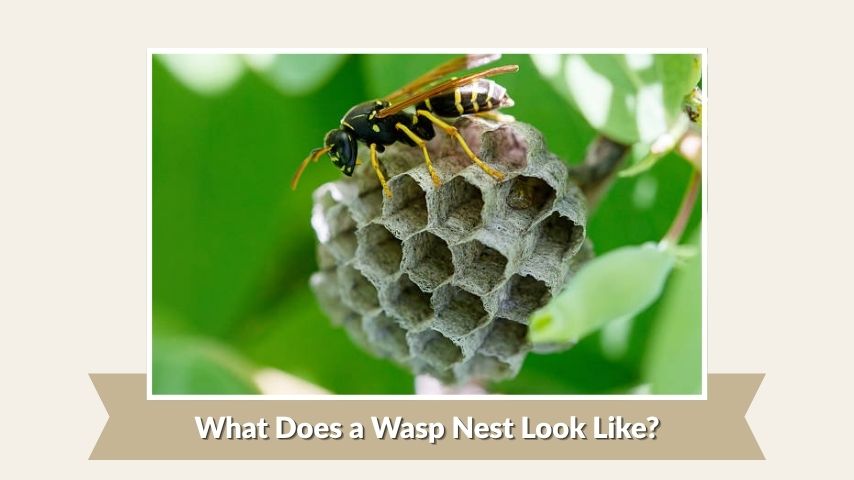
A wasp nest depends on the type of wasp. This is why “wasp nest” can describe several different structures. Paper wasps, yellowjackets, and mud daubers all build differently.
Paper Wasp Nests
Paper wasp nests are usually open and shaped like a small umbrella. You can often see the hexagonal cells from below. These nests may hang from a short stalk under porch roofs, deck railings, window frames, sheds, or eaves.
Paper wasps are often less aggressive than yellowjackets or hornets unless their nest is disturbed. Penn State Extension notes that paper wasps, yellowjackets, bald-faced hornets, and true hornets also hunt insects such as caterpillars and flies, which makes them ecologically useful despite their sting risk.
Yellowjacket Nests
Yellowjackets are wasps, but their nests are often harder to spot. They may nest underground, in wall voids, under steps, in hollow logs, or inside landscape features. The entrance may look like a small hole with insects flying in and out.
Yellowjacket nests can be especially risky because people may step near them without noticing. Lawn mowing, gardening, or moving objects near the entrance can trigger defensive behavior.
Mud Dauber Nests
Mud daubers are solitary wasps, not large social colony builders. Their nests are made from mud and may look like tubes or small clay-like patches on walls, under eaves, in garages, or on sheds. They are usually less aggressive than social wasps because they do not defend a large colony in the same way.
What Does a Hornet Nest Look Like?
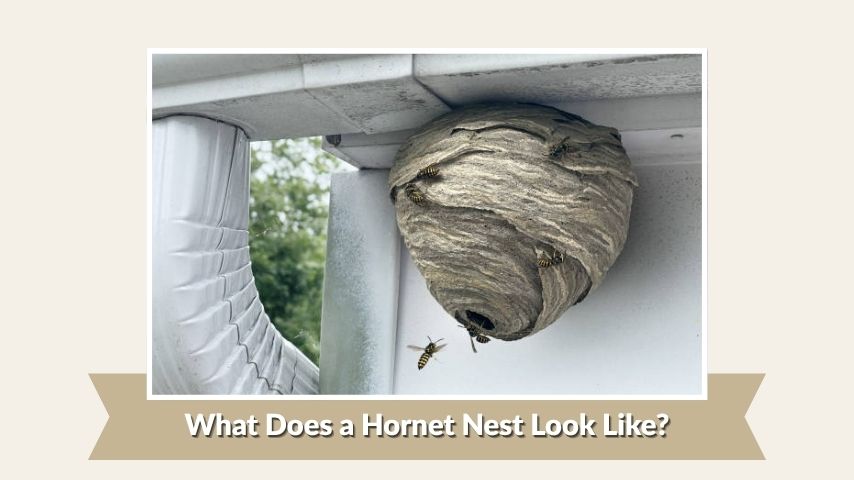
Hornet nests are often larger and more enclosed than paper wasp nests. They are usually made of gray or brown papery material and may look like a football, oval ball, or teardrop. The combs are hidden inside layers of paper.
Iowa State University Extension describes the bald-faced hornet as a social wasp that builds large gray paper nests attached to tree branches, shrubs, utility poles, or houses. The same source explains that the nest material is made from chewed wood fiber mixed with saliva.
Bald-Faced Hornet Nests
Although commonly called a hornet, the bald-faced hornet is technically a type of yellowjacket. It builds one of the most recognizable nests: a large gray enclosed paper nest with a single entrance hole, often high in a tree or attached to a structure.
These nests can become large by late summer. If the nest is high and away from people, it may be left alone until winter in many cases. If it is near a doorway, play area, walkway, or outdoor workspace, professional removal is usually safer.
True Hornet Nests
True hornets, such as the European hornet in parts of North America, may nest in hollow trees, wall voids, barns, attics, or other cavities. Their nests are enclosed and built from paper-like material, but they may be less visible if hidden inside a structure.
Main Differences Between Wasp and Hornet Nests
The biggest differences are shape, size, placement, and how exposed the comb is. Paper wasp nests are often open. Hornet nests are usually covered. Yellowjacket nests may be hidden underground or inside walls.
| Difference | Wasp Nest | Hornet Nest |
|---|---|---|
| Outer covering | Paper wasp nests often lack a full covering | Usually has a full paper envelope |
| Comb visibility | Often visible in paper wasp nests | Usually hidden inside |
| Typical size | Small to medium, depending on species | Medium to large, often larger by late season |
| Entrance | Open cells or hidden cavity entrance | Usually one visible entrance hole |
| Common danger | Accidental contact with nests near homes | Defensive colony response near large nests |
| Best action | Identify species and location first | Avoid disturbance and consider professional help |
Which Nest Is More Dangerous?
Neither nest should be handled casually. The risk depends less on the name and more on the species, nest size, location, and how close people are to it. A small paper wasp nest far from activity may be manageable. A ground yellowjacket nest beside a walkway can be highly dangerous. A large hornet nest near a door can also be risky.
University of Kentucky Extension warns that nest removal should be done with great care and that folk remedies such as gasoline or spraying nests with a garden hose are often unsuccessful and can result in multiple stings.
Why Stings Happen
Wasps and hornets usually sting to defend the nest. When a colony senses disturbance, multiple insects may respond. Some social wasps release alarm pheromones that attract other defenders, increasing the chance of multiple stings. This is why knocking down, shaking, burning, flooding, or spraying a nest without a plan can be dangerous.
Where Wasps and Hornets Build Nests
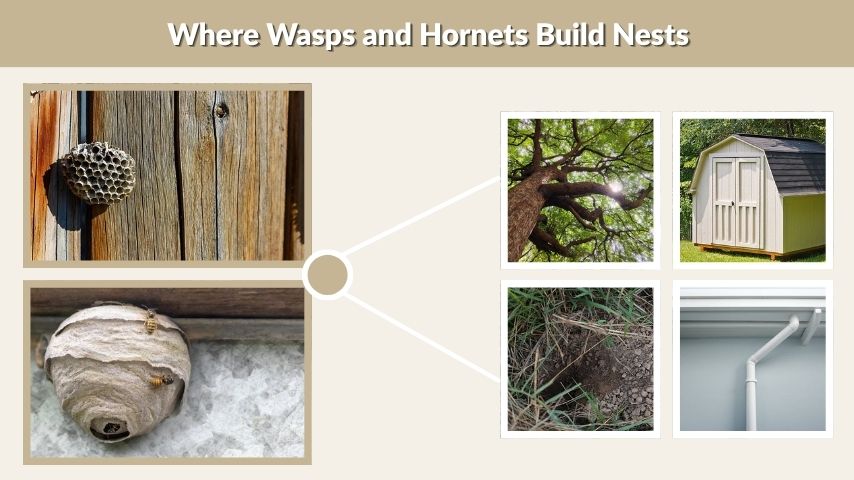
Nest location can help with identification. Paper wasps prefer protected open areas. Hornets often build enclosed nests in trees or high structures. Yellowjackets may use ground holes or hidden cavities.
Common Outdoor Nest Sites
You may find nests in:
- Under roof eaves
- Porch ceilings
- Deck railings
- Tree branches
- Shrubs
- Sheds and barns
- Wall voids
- Attics
- Ground holes
- Hollow logs
Nests near regular human activity are usually more concerning than nests far from doors, windows, seating areas, or paths.
Should You Remove a Wasp or Hornet Nest?
Not every nest needs immediate removal. If a nest is small, far from people, and not causing problems, it may be possible to leave it alone. Wasps and hornets help control pest insects and can contribute to the ecosystem. However, nests near homes, children, pets, allergic individuals, or busy outdoor areas need more caution.
When Removal May Be Needed
Removal may be necessary if the nest is:
- Near a door, walkway, patio, or deck
- Inside a wall, attic, or garage
- In the ground near mowing areas
- Close to children or pets
- Large and active
- Causing repeated stings
- Near someone with a known sting allergy
For large nests, hidden nests, hornet nests, or yellowjacket nests, professional pest control is usually the safest option.
Safe Steps Before Taking Action
Before trying anything, identify the nest from a distance. Do not stand directly under it. Do not block the entrance. Do not hit or spray the nest during the day when activity is high.
| Step | What to Do | Why It Helps |
|---|---|---|
| Observe from far away | Watch insect traffic and nest shape | Helps identify the insect safely |
| Check the location | Note if it is near people or pets | Determines urgency |
| Avoid vibration | Do not mow or hammer nearby | Vibration may trigger defense |
| Skip folk remedies | Avoid fire, gasoline, water blasting | These methods can cause injury |
| Call a pro for risky nests | Use experts for large or hidden nests | Reduces sting risk |
How to Prevent Future Nests
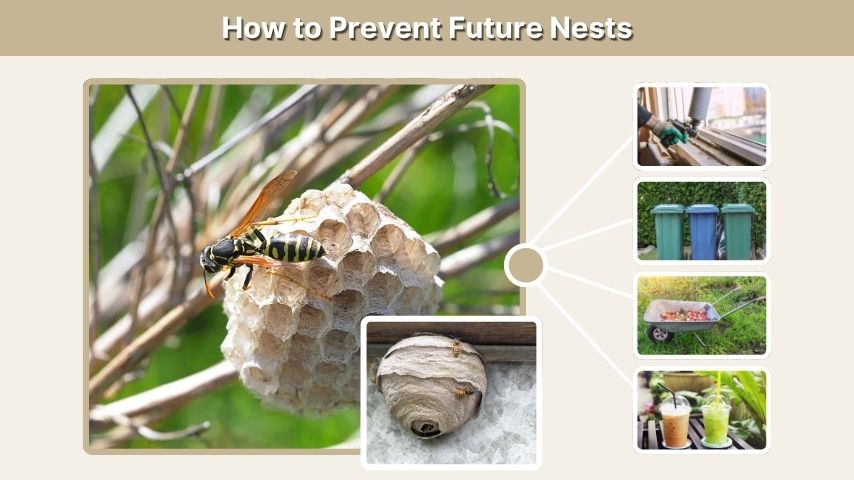
Prevention works best in early spring when queens begin building. Once a colony grows large, removal becomes more difficult and risky.
Practical Prevention Tips
Use these steps around your property:
- Seal cracks and gaps in siding
- Repair holes around rooflines and eaves
- Keep garbage bins tightly closed
- Remove fallen fruit from yards
- Clean outdoor food spills quickly
- Cover sweet drinks when eating outside
- Inspect sheds, playsets, and porch ceilings
- Fill abandoned ground holes where safe
- Keep screens and vents repaired
Fake wasp nests are sometimes sold as deterrents, but Penn State Extension notes there is no clear evidence that they reliably prevent paper wasps or yellowjackets from nesting nearby.
Wasp Nest vs Hornet Nest: Quick Identification Tips
If you can see open hexagonal cells, it is more likely a paper wasp nest. If the nest is a gray enclosed ball with a small entrance, it may be a hornet or bald-faced hornet nest. If insects are flying in and out of a hole in the ground, wall, or structure, yellowjackets are a strong possibility.
The most important rule is simple: do not disturb the nest to identify it. A clear photo taken from a safe distance can help a pest professional or extension office confirm what you are dealing with.
FAQs
Is a hornet nest bigger than a wasp nest?
A hornet nest is often bigger than a paper wasp nest, especially later in the season. Hornet nests are usually enclosed and may become football-shaped or larger. However, some yellowjacket nests can also become large while remaining hidden underground, in wall voids, or inside cavities.
How can I tell if I have a wasp nest or hornet nest?
Look at the nest shape and location from a safe distance. Open umbrella-shaped nests with visible cells are often paper wasp nests. Large gray enclosed nests in trees, shrubs, or high structures are often hornet or bald-faced hornet nests. Ground or wall entrances may indicate yellowjackets.
Are hornet nests more dangerous than wasp nests?
Hornet nests can be dangerous because hornets strongly defend their colony when disturbed. However, some wasp nests, especially yellowjacket nests in the ground or walls, can be just as risky. The danger depends on species, nest size, location, and how likely people are to disturb it.
Should I remove a wasp or hornet nest myself?
Small, early-stage paper wasp nests may sometimes be handled with caution, but large, active, hidden, ground, or hornet nests are safer for professionals. Do not use gasoline, fire, flooding, or a hose. These methods can fail and may trigger many stings or create other hazards.
Do wasps and hornets reuse old nests?
Most social wasps and hornets do not reuse the same old nest after the colony dies out, though a new queen may build in a nearby suitable area. Removing old empty nests can reduce confusion, but prevention depends more on sealing gaps, reducing food sources, and inspecting early.