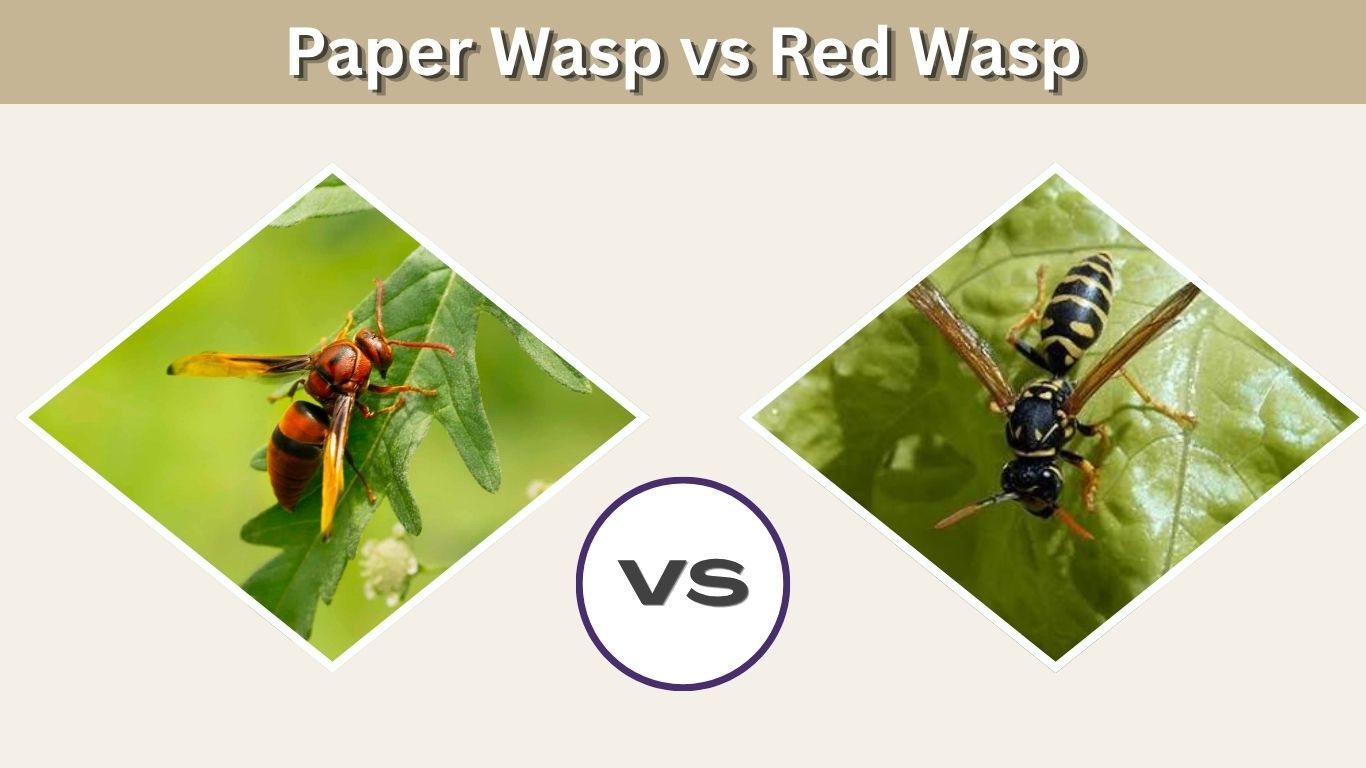
The main difference between a paper wasp and a red wasp is classification rather than biology. “Paper wasp” describes numerous social wasps in the genus Polistes, while “red wasp” commonly refers to a reddish species of paper wasp—especially the Carolina paper wasp, Polistes carolina, in the eastern United States. Therefore, a red wasp is generally a type of paper wasp, but not every paper wasp is red.
Paper Wasp vs Red Wasp at a Glance
| Feature | Paper Wasp | Red Wasp |
| Meaning | A broad group of Polistes wasps | A common name for red-colored paper wasps |
| Typical color | Brown, yellow, black, red, or combinations | Mostly rusty red or reddish brown |
| Common example | Various Polistes species | Polistes carolina |
| Body shape | Long, slender, with a narrow waist | Long and slender like other paper wasps |
| Nest | Open, umbrella-shaped paper comb | Same open paper-comb structure |
| Temperament | Usually defensive near the nest | Often strongly defensive near the nest |
| Sting | Females can sting repeatedly | Females can sting repeatedly |
| Diet | Nectar and captured insects | Nectar and captured insects |
The term “red wasp” can be used loosely for more than one reddish paper wasp. Location and close examination may therefore be necessary for exact species identification.
What Does a Paper Wasp Look Like?
Paper wasps are slender insects with narrow waists, long legs, relatively long antennae, and wings that fold lengthwise over the body while resting. Depending on the species, they may be reddish brown, black, yellow, or patterned with several colors.
Paper Wasp Identification
- Approximately ⅝ to 1 inch long
- Long, slender abdomen
- Narrow waist between the thorax and abdomen
- Long legs that often hang below the body in flight
- Two pairs of smoky or translucent wings
- Brown, black, yellow, or red coloration
- Open paper nest with visible hexagonal cells
Paper wasps look less compact than yellowjackets. Their dangling legs are particularly noticeable while they fly.
What Does a Red Wasp Look Like?
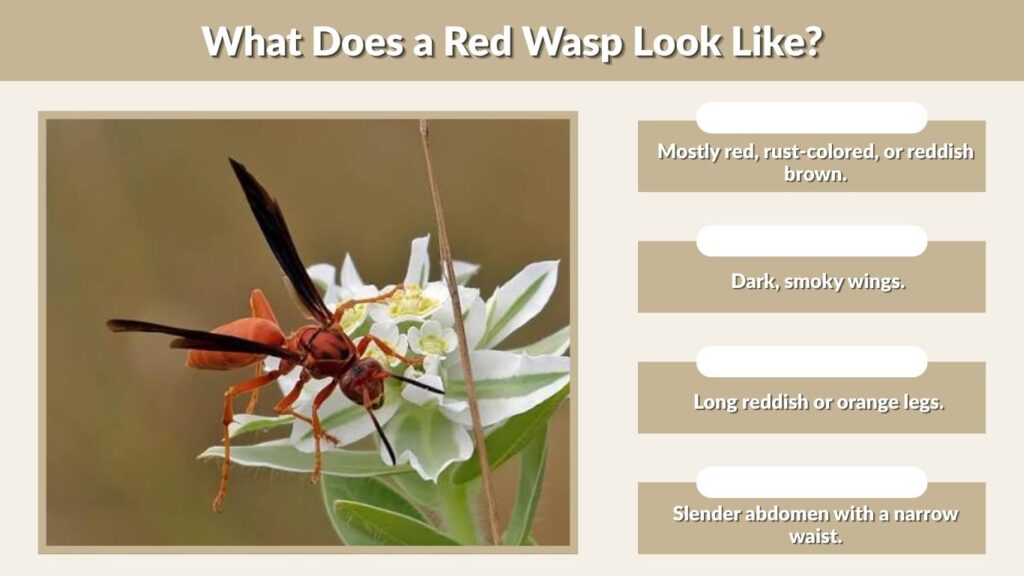
The Carolina paper wasp, commonly called a red wasp, has an almost entirely rusty red or reddish-brown body. Its wings are usually dark brown or blackish, creating a strong contrast with the brighter body.
Red Wasp Identification
- Mostly red, rust-colored, or reddish brown
- Dark, smoky wings
- Long reddish or orange legs
- Slender abdomen with a narrow waist
- Long antennae
- Body approaching 1 inch long
- Open paper nest beneath a protected surface
Polistes carolina is one of the few almost entirely rust-colored paper wasps in the eastern United States. It closely resembles other red-colored species, so a photograph may not always be sufficient for species-level identification.
Paper Wasp vs Red Wasp Nest
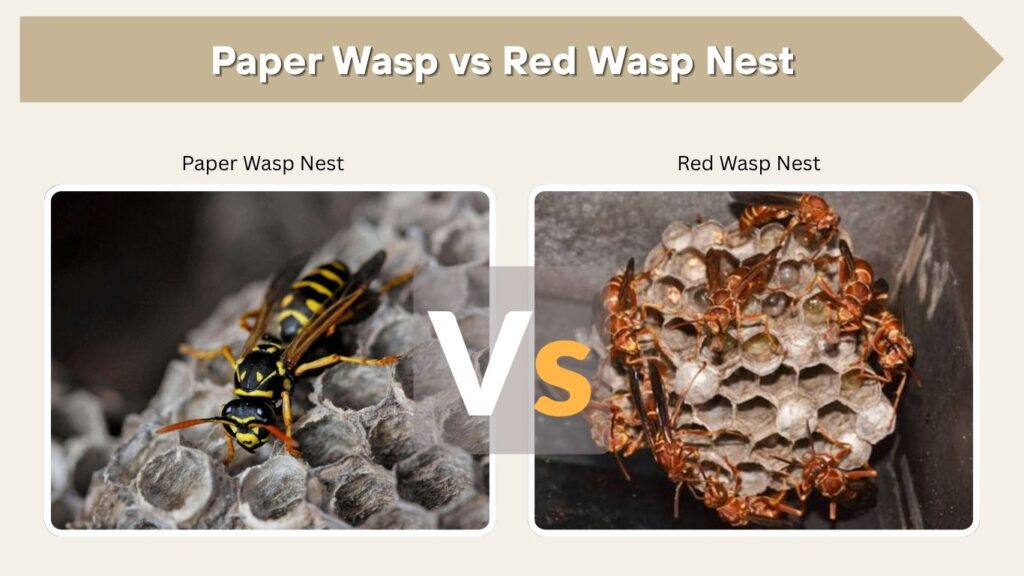
Both build the same basic type of nest. The queen scrapes weathered wood, mixes the fibers with saliva, and forms a lightweight paper comb.
Paper Wasp Nest
A typical paper wasp nest has:
- One exposed layer of hexagonal cells
- No surrounding paper envelope
- A narrow stalk attaching it to a surface
- A shape resembling an upside-down umbrella
- Adults standing directly on the exposed cells
Common nesting locations include roof eaves, porches, sheds, railings, attic spaces, outdoor furniture, grills, branches, and sheltered equipment.
Red Wasp Nest
Red wasps also construct an open, umbrella-shaped comb. Their nests may become comparatively large and are frequently attached beneath roofs, eaves, overhangs, or other sheltered structures.
Because the brood cells remain exposed, anyone approaching the nest can come close to the colony without realizing it. Vibration from opening a door, moving equipment, or mowing nearby may provoke defensive behavior.
Paper Wasp vs Red Wasp Behavior
Both are social wasps. A fertilized queen begins a new colony during spring, builds the first cells, lays eggs, and feeds the first larvae. After female workers emerge, they expand the nest, gather food, defend the colony, and care for later brood.
Paper wasps are beneficial predators. Workers capture caterpillars and other soft-bodied insects, chew them into manageable pieces, and carry the food back to developing larvae.
Adults also visit flowers and consume sugary liquids. A nest located far from doorways and other high-traffic areas can therefore provide natural garden pest control.
Which One Is More Aggressive?
There is no simple rule that every red wasp is more aggressive than every other paper wasp. Temperament varies by species, colony size, season, weather, and distance from the nest.
Both usually avoid unnecessary conflict while foraging. However, red wasps have a reputation for vigorously defending their nests when a person gets extremely close, jars the structure, or creates repeated vibrations nearby.
Paper Wasp vs Red Wasp Sting
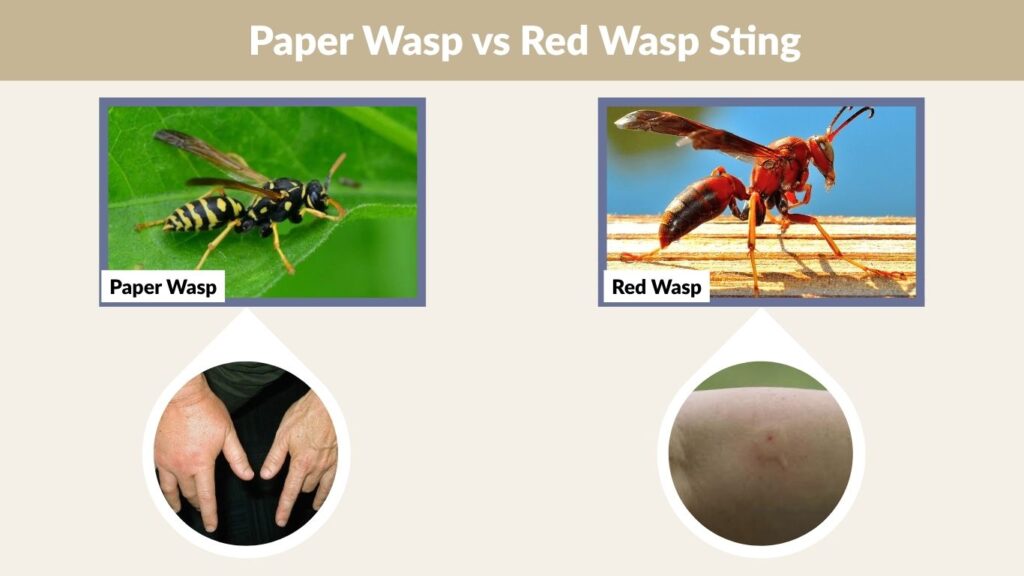
Female paper wasps—including female red wasps—possess smooth stingers and can sting repeatedly. They do not leave the stinger embedded in the skin as a honey bee typically does.
A sting commonly causes:
- Immediate sharp or burning pain
- Redness
- Local swelling
- Tenderness
- Itching
Red wasp stings are often described as particularly painful, but pain varies with sting location, number of stings, and individual sensitivity. The safest assumption is that either insect can deliver a painful sting when its nest is threatened.
Wash the area and apply a wrapped cold pack for an uncomplicated local reaction. Trouble breathing, swelling of the face or throat, faintness, widespread hives, or vomiting may indicate anaphylaxis and require immediate emergency care.
Red Paper Wasp Male vs Female
Male and female red paper wasps have similar body colors, but several features can help distinguish them.
Male Red Paper Wasp
A male generally has:
- Longer antennae with distinctly curved tips
- More yellow or pale coloring on the face
- A somewhat blunter abdominal tip
- No functional stinger
Males appear later in the colony’s seasonal cycle and primarily serve a reproductive role. They cannot sting because the stinger is a modified female egg-laying structure.
Female Red Paper Wasp
A female typically has:
- Shorter antennae with less-curved tips
- A redder or darker face
- A more pointed abdominal tip
- A functional stinger
Queens and workers are both female. Workers perform most foraging, brood care, nest construction, and colony defense.
Red Paper Wasp Queen vs Worker
A red paper wasp queen and worker are difficult to separate by appearance alone. Paper wasps have relatively simple social systems in which queens and workers are morphologically similar, without the dramatic caste differences seen in termites or some ants.
The most dependable difference is behavior:
- The queen is the colony’s main egg layer.
- Workers gather food and nesting material.
- Workers feed larvae and defend the nest.
- A spring queen may initially build and forage alone.
Queens are not necessarily much larger than workers. Without observing reproductive or colony behavior, confidently identifying a specific female as the queen can be difficult.
Red Paper Wasp vs Yellowjacket
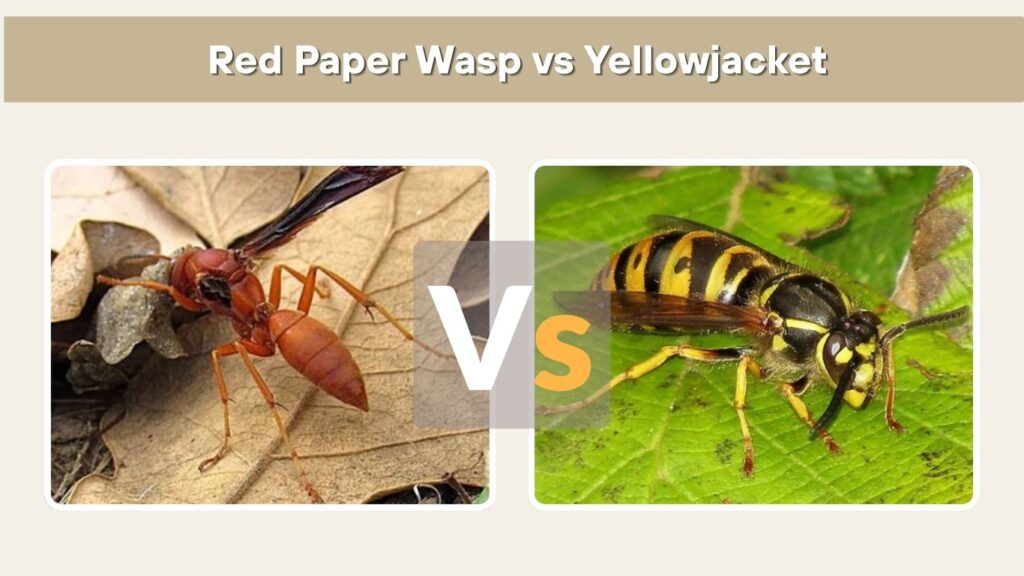
Red paper wasps and yellowjackets are both social wasps, but they differ noticeably in build, coloration, and nest construction.
| Feature | Red Paper Wasp | Yellowjacket |
| Body | Long and slender | Shorter and stockier |
| Color | Mainly rusty red | Usually black and yellow |
| Legs in flight | Hang visibly beneath the body | Held closer to the body |
| Nest | Exposed single comb | Multiple combs inside an envelope |
| Typical nest site | Eaves and sheltered surfaces | Underground cavities or wall voids |
| Colony size | Usually modest | Can contain thousands |
| Scavenging | Mainly hunts insects | Often visits food, rubbish, and drinks |
Yellowjackets are generally more compact and frequently form much larger colonies. Their nests are normally concealed underground or inside cavities, whereas the open cells of a red paper wasp nest are visible from below.
Should You Remove a Red Wasp Nest?
A nest in an isolated location may be left undisturbed because the wasps capture garden pests. Removal becomes more reasonable when the nest is beside an entrance, playground, frequently used porch, livestock enclosure, or an area occupied by someone with a serious sting allergy.
Do not knock down or spray an active nest while standing close beneath it. A licensed pest-control professional is the safest choice for a large nest, an inaccessible colony, or any situation involving a known sting allergy.
FAQs
Are red wasps and paper wasps the same?
Red wasps are generally red-colored paper wasps. Paper wasp is the broader category, while red wasp is a common name applied to species such as Polistes carolina.
Which is larger, a red wasp or a paper wasp?
A red wasp falls within the usual paper wasp size range. It may look larger than some yellow-and-brown species, but size varies between species and individual colonies.
Do male red paper wasps sting?
No. Male wasps lack stingers. Queens and workers are female and can sting repeatedly when defending themselves or their colony.
Can red wasps recognize people?
Paper wasps can learn visual information, but there is insufficient reason to assume a backyard colony personally recognizes and targets a particular human. Most attacks occur because the nest was approached or disturbed.
Do red wasps reuse old nests?
Paper wasp colonies normally last one season, and abandoned nests are generally not reused as active colonies the following year. However, new queens may select the same protected area and construct a fresh nest nearby.