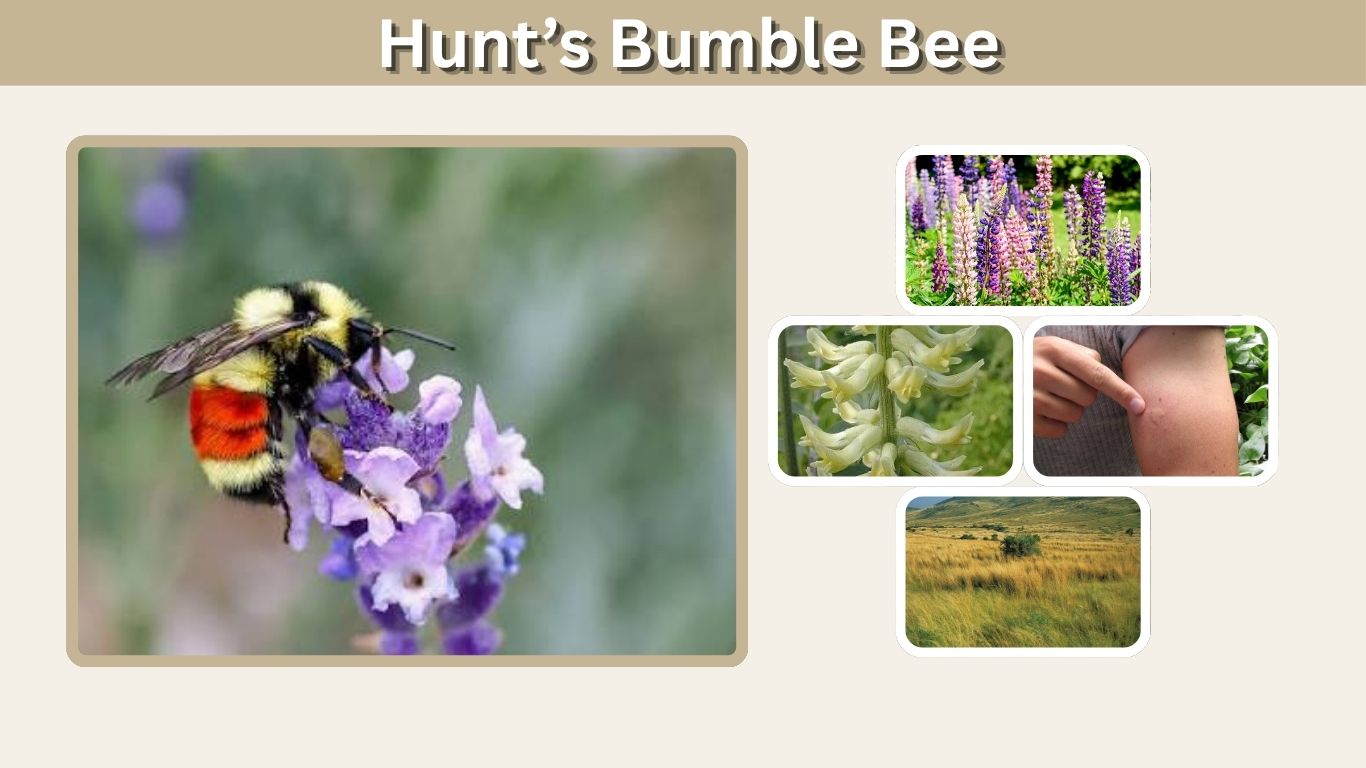
Hunt’s bumble bee (Bombus huntii) is a colorful native bumble bee of western North America, easily recognized by the bright orange band across the middle of its abdomen. It is an important pollinator of wildflowers and agricultural plants and commonly occurs in grasslands, shrublands, valleys, gardens, and other open habitats. Colonies are social and usually nest underground in abandoned rodent burrows. Although females can sting when threatened, Hunt’s bumble bees are generally peaceful around people and spend most of their time collecting pollen and nectar from flowers.
What Is Hunt’s Bumble Bee?
Hunt’s bumble bee is a medium-sized social bee belonging to the family Apidae.
Its scientific name is Bombus huntii.
The species was described by Ezra Townsend Cresson? Correction: Bombus huntii is attributed to Greene, 1860 in modern taxonomic references. It occurs primarily across western North America and is considered a common bumble bee over much of its range.
| Feature | Hunt’s Bumble Bee |
| Scientific name | Bombus huntii |
| Family | Apidae |
| Genus | Bombus |
| Diet | Nectar and pollen |
| Nest | Mostly underground |
| Colony | Annual and social |
| Main colors | Yellow, black, orange |
| Conservation status | Least Concern |
| Native range | Western North America |
What Does Hunt’s Bumble Bee Look Like?
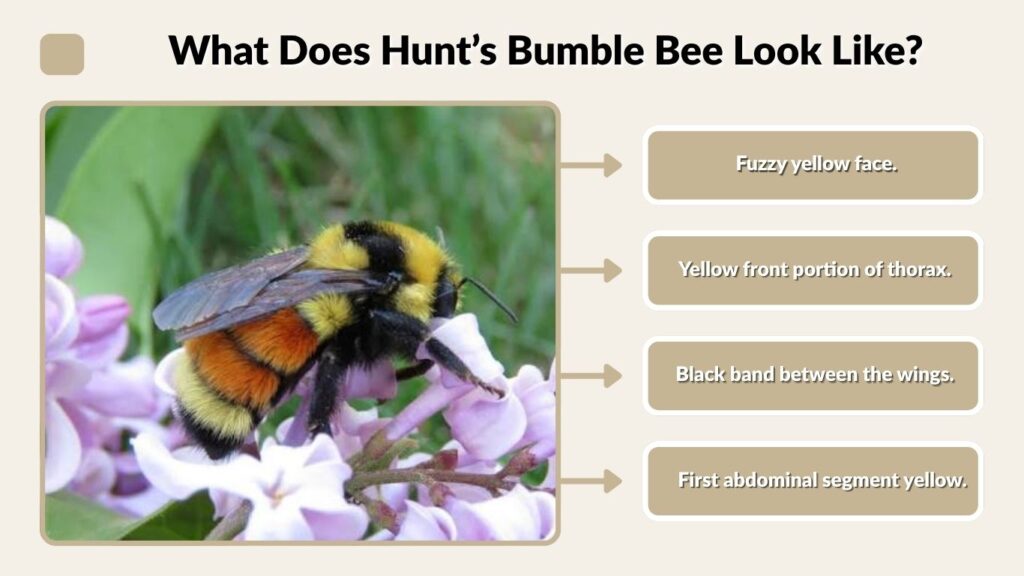
Hunt’s bumble bee has one of the more distinctive color combinations among western bumble bees.
Females typically have a yellow-haired face and a yellow thorax interrupted by a black band between the wings.
Identification Features
Look for:
- Fuzzy yellow face
- Yellow front portion of thorax
- Black band between the wings
- First abdominal segment yellow
- Second and third abdominal segments orange
- Fourth abdominal segment yellow
- Rear abdominal segments mostly black
- Dark legs
- Transparent wings
The combination of yellow–orange–orange–yellow across the first four abdominal tergites is particularly helpful for identification.
Older individuals may have faded colors, so some orange areas can appear more yellow than they do on fresh adults.
Hunt’s Bumble Bee Size
Size varies depending on whether the individual is a queen, worker, or male.
Typical measurements are approximately:
| Type | Size |
| Queen | 18–21 mm |
| Worker | 8–17 mm |
| Male | 10–15 mm |
Montana State University reports workers commonly measuring about 11–14 mm long. Queens are considerably larger because they establish colonies and produce the year’s offspring.
Where Does Hunt’s Bumble Bee Live?
Hunt’s bumble bee is primarily a species of western North America.
Its distribution includes much of the western United States and neighboring Canada. Its range extends eastward into the Great Plains and south into mountainous regions of central Mexico.
It can occur in states and regions such as:
- Washington
- Oregon
- Idaho
- Montana
- Wyoming
- Colorado
- Utah
- Nevada
- California
- New Mexico
- Parts of the Great Plains
It also occurs in portions of western Canada.
Hunt’s Bumble Bee Habitat
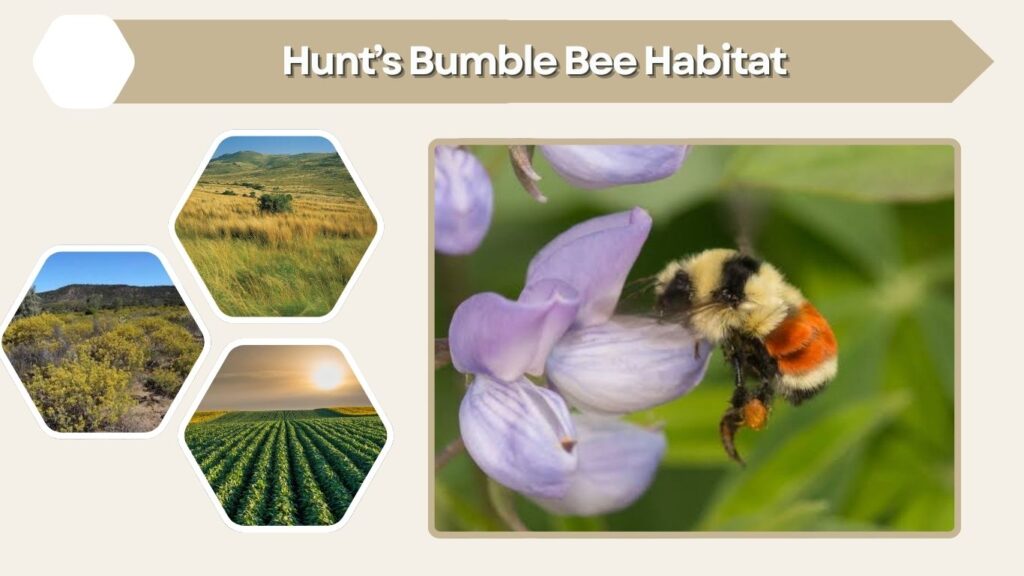
Hunt’s bumble bees occupy several relatively open habitats rather than depending on dense forest.
They may be found in:
- Grasslands
- Shrublands
- Meadows
- Agricultural areas
- Riparian corridors
- Mountain valleys
- Open woodland
- Gardens
- Roadsides
- Urban and suburban flowering landscapes
Pacific Northwest surveys found the species especially often in shrublands, developed areas, and riparian zones.
The most important habitat requirement is a reliable supply of flowers throughout the colony’s active season, together with suitable underground nesting and overwintering sites.
Where Does Hunt’s Bumble Bee Nest?
Hunt’s bumble bees usually build colonies underground.
They commonly use existing cavities instead of excavating completely new nests.
Potential nesting locations include:
- Abandoned rodent burrows
- Dry underground cavities
- Spaces beneath vegetation
- Other protected ground hollows
This behavior is typical of many bumble bee species.
A nest contains one reproductive queen along with female workers and, later in the season, males and new queens.
What Does Hunt’s Bumble Bee Eat?
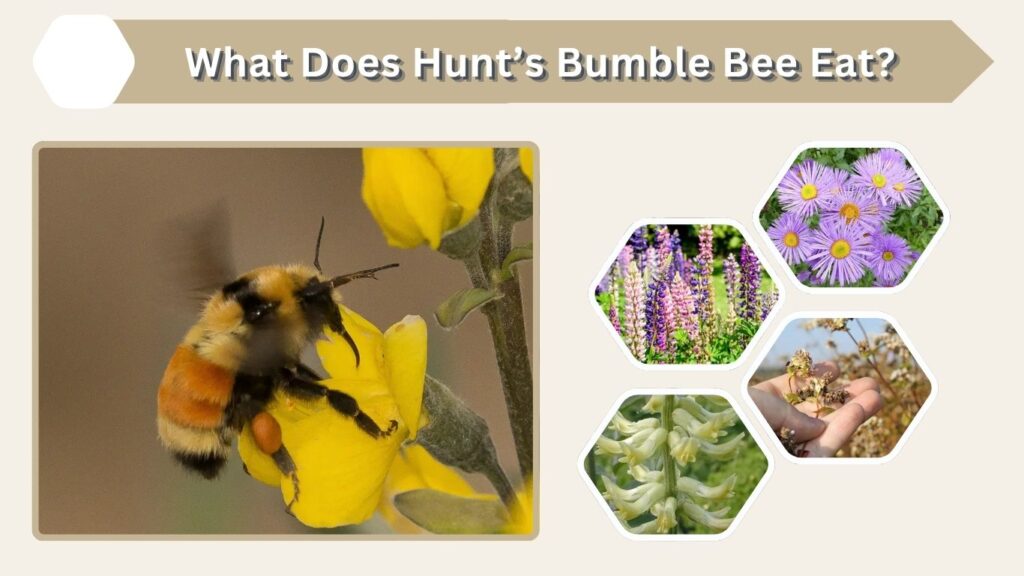
Adult Hunt’s bumble bees feed primarily on flower nectar and pollen.
Nectar supplies carbohydrates needed for energy, while pollen supplies protein, fats, and other nutrients important for growing larvae.
Flowers Visited by Hunt’s Bumble Bees
Recorded floral associations include:
- Lupines
- Milkvetches (Astragalus)
- Fleabanes (Erigeron)
- Bluebells (Mertensia)
- Golden banner (Thermopsis)
- Thistles
- Buckwheats
- Phacelia
Bumble Bee Watch specifically lists Astragalus, Erigeron, Lupinus, Mertensia, and Thermopsis among important floral associations.
Because the species uses many different flowers, it functions as a generalist pollinator.
Hunt’s Bumble Bee Life Cycle
Hunt’s bumble bee has an annual colony cycle.
The entire colony does not survive from year to year.
Spring: Queen Emerges
A fertilized queen that spent winter underground emerges when conditions become warm enough.
She begins feeding on spring flowers before searching for an appropriate nesting cavity.
Early Summer: Colony Begins
Once she finds a nest, the queen collects pollen and nectar and lays her first eggs.
She initially performs all colony duties herself.
The larvae develop through several stages before spinning cocoons and becoming pupae. Eventually, the first female workers emerge.
Summer: Workers Take Over
Workers begin:
- Collecting pollen
- Gathering nectar
- Feeding larvae
- Maintaining the nest
- Defending the colony
The queen can then concentrate mainly on laying eggs.
Late Summer and Fall: New Queens and Males
Toward the end of the season, the colony produces males and reproductive females.
New queens mate with males and begin looking for protected overwintering sites.
Workers, males, and the original queen eventually die.
Only the newly mated queens normally survive winter and begin new colonies the following spring.
Do Hunt’s Bumble Bees Sting?
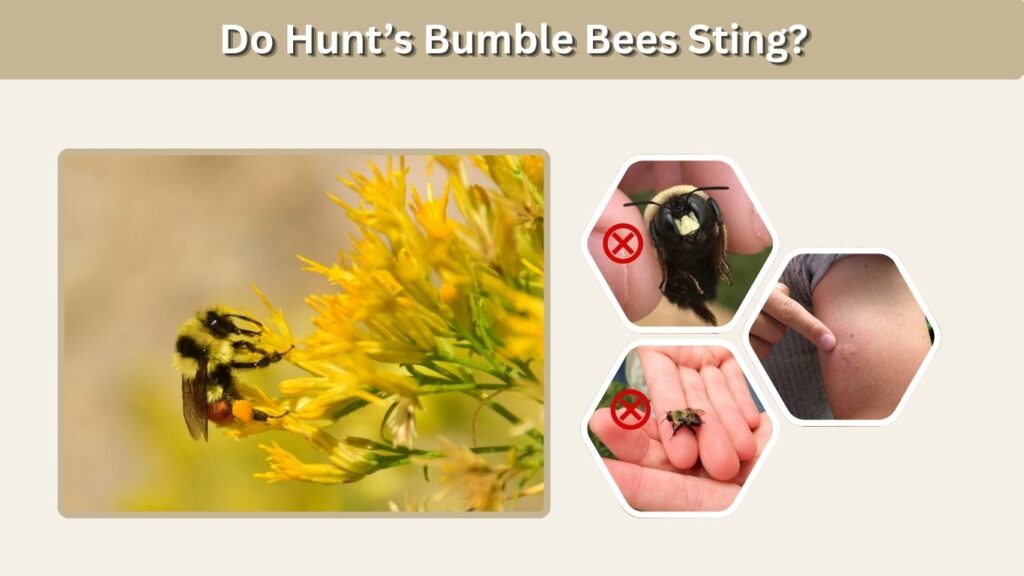
Female Hunt’s bumble bees can sting, because workers and queens possess stingers.
Males cannot sting.
Despite this ability, bumble bees normally have little interest in attacking people. They are most likely to sting when someone:
- Steps on one
- Squeezes or handles one
- Disturbs its nest
- Swats at it repeatedly
Unlike a honey bee worker, a bumble bee does not normally leave its stinger behind and therefore can sting more than once.
Watching Hunt’s bumble bees feeding on flowers from a normal distance poses very little risk.
Hunt’s Bumble Bee as a Pollinator
Hunt’s bumble bee is an important pollinator of both native plants and agricultural crops.
Bumble bees can perform buzz pollination. A bee grips a flower and rapidly vibrates its flight muscles, shaking pollen loose.
This technique is particularly useful for plants such as:
- Tomatoes
- Peppers
- Eggplants
- Various native wildflowers
Research has investigated Bombus huntii specifically as a potential commercial crop pollinator because of its broad distribution and effective foraging behavior.
Hunt’s Bumble Bee vs. Similar Bumble Bees
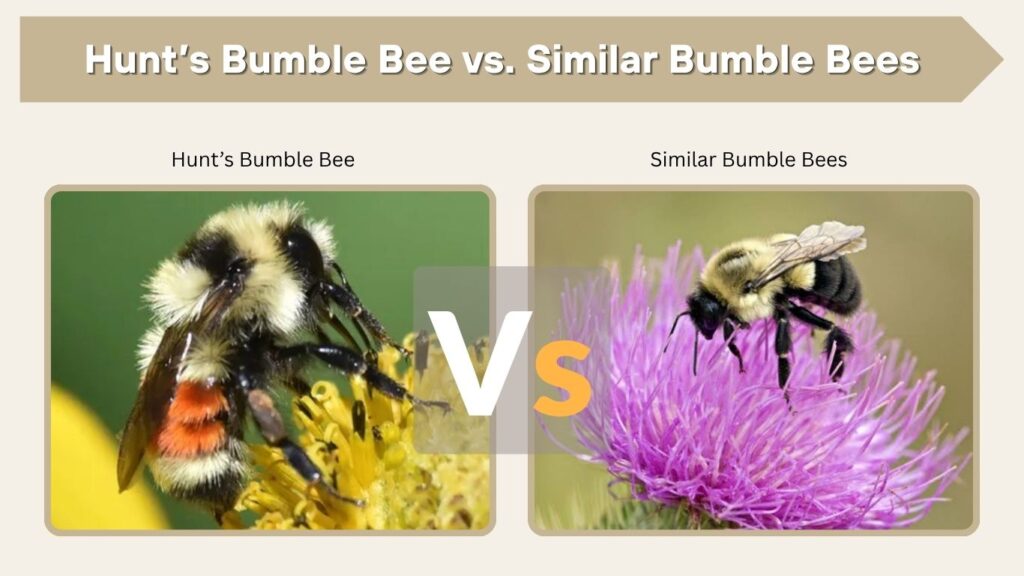
Several western bumble bees can be confused with Hunt’s bumble bee.
Common look-alikes include:
- Two-form bumble bee (Bombus bifarius)
- Black-tailed bumble bee (Bombus melanopygus)
- Forest bumble bee (Bombus sylvicola)
- Red-belted bumble bee (Bombus rufocinctus)
The orange second and third abdominal segments combined with yellow first and fourth segments are among the strongest clues for identifying B. huntii.
Is Hunt’s Bumble Bee Endangered?
Hunt’s bumble bee is not currently considered endangered.
The Pacific Northwest Bumble Bee Atlas lists it as Least Concern and describes it as stable across its broad range. It remains a commonly encountered species in many parts of western North America.
Like other pollinators, however, local populations can still be affected by:
- Habitat loss
- Loss of flowering plants
- Pesticide exposure
- Drought
- Climate changes
- Pathogens
Maintaining diverse native flowers and undisturbed nesting areas can help support local populations.
Interesting Hunt’s Bumble Bee Facts
- Its scientific name is Bombus huntii.
- It is native to western North America.
- Workers commonly measure roughly 11–14 mm.
- Its abdomen contains distinctive orange bands.
- Most nests are underground.
- Colonies survive for only one season.
- Only newly mated queens normally overwinter.
- Females can sting, but males cannot.
- It feeds on both nectar and pollen.
- Hunt’s bumble bees can perform buzz pollination.
- The species is currently considered Least Concern.
- It is an important pollinator of wildflowers and crops.
FAQs
1. How do you identify Hunt’s bumble bee?
Look for a fuzzy bee with a yellow face, yellow thorax with a black band between the wings, and a distinctive abdomen. The first segment is yellow, the next two are orange, the fourth is yellow, and the rear is mostly black.
2. Where is Hunt’s bumble bee found?
Hunt’s bumble bee occurs across much of western North America, including western Canada and the western United States. Its distribution extends east into portions of the Great Plains and south into mountainous regions of Mexico.
3. What does Hunt’s bumble bee eat?
Adults drink nectar for energy and collect pollen as an important food source for developing larvae. They visit many flowering plants, including lupines, milkvetches, fleabanes, bluebells, thistles, buckwheats, and phacelia.
4. Can Hunt’s bumble bees sting?
Queens and female workers can sting, but males cannot. Hunt’s bumble bees generally avoid people and usually sting only when physically threatened or when their underground colony is disturbed.
5. Where do Hunt’s bumble bees build nests?
They generally establish colonies below ground, often inside abandoned rodent burrows or other dry underground cavities. A single overwintered queen starts the colony in spring, and her female workers later take over foraging and brood care.