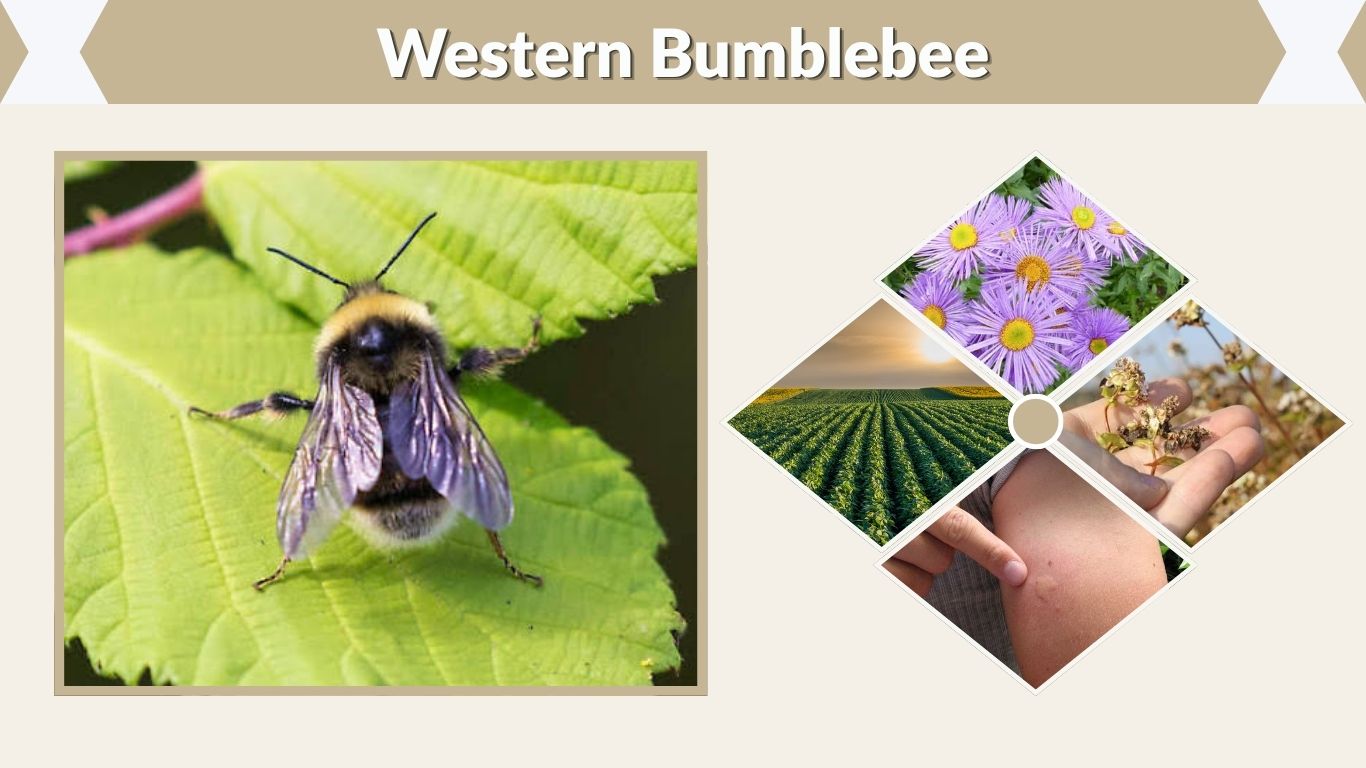
The western bumblebee (Bombus occidentalis) is an important native pollinator found across western North America. Once one of the most common bumblebees in parts of the Pacific Northwest, it has experienced major population declines in several regions since the late 1990s. Western bumblebees live in forests, meadows, grasslands, mountain areas, farms, and gardens, where they collect nectar and pollen from many flowering plants. Their fuzzy black, yellow, and often white-banded bodies can resemble other bumblebee species, making careful identification important.
What Is a Western Bumblebee?
The western bumblebee is a social bee belonging to the family Apidae and genus Bombus.
Its scientific name is Bombus occidentalis.
Colonies consist of a queen, female workers, and later in the season, males and new queens. Like most temperate bumblebees, colonies normally last for only one year.
| Feature | Western Bumblebee |
| Scientific name | Bombus occidentalis |
| Family | Apidae |
| Order | Hymenoptera |
| Diet | Nectar and pollen |
| Lifestyle | Social |
| Nest | Usually underground |
| Native range | Western North America |
| Conservation status | Vulnerable |
| Main role | Pollinator |
The species has declined particularly strongly in western portions of its historical range.
Western Bumblebee Identification
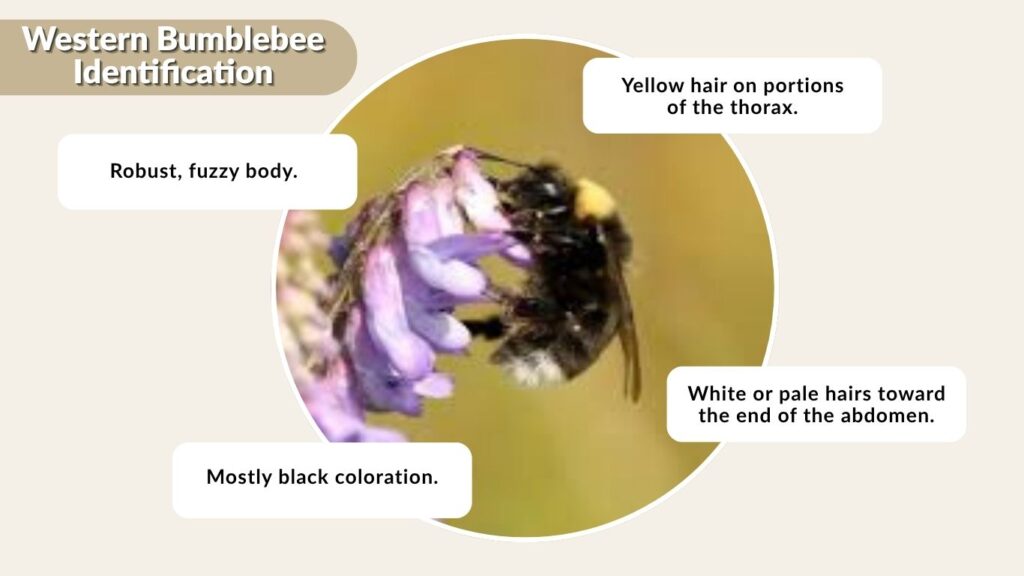
Western bumblebee coloration can vary, so identifying one by a single stripe is not always reliable.
Bumble Bee Watch notes that the species has several color forms. A useful feature is that the first abdominal segment, known as T1, is typically black, while the fifth abdominal segment usually carries white hair.
Identification Features
Look for:
- Robust, fuzzy body
- Mostly black coloration
- Yellow hair on portions of the thorax
- White or pale hairs toward the end of the abdomen
- Black first abdominal segment
- Dark legs
- Transparent to brownish wings
- Pollen baskets on the hind legs of females
Queens are larger than workers, while males can differ somewhat in hair coloration and body proportions.
Because several western species look similar, photographs showing the face, thorax, and abdominal bands are useful for accurate identification.
Western Bumblebee Range
Historically, Bombus occidentalis occupied a very large portion of western North America.
Its range extended from Alaska and western Canada south through the Pacific Northwest, California, the Rocky Mountains, and portions of Arizona and New Mexico. It also extended east into parts of the northern Great Plains.
The species has been recorded in areas including:
- Alaska
- Washington
- Oregon
- California
- Idaho
- Montana
- Wyoming
- Colorado
- Utah
- Arizona
- New Mexico
- North Dakota
- South Dakota
- Nebraska
- Western Canada
However, its current abundance is uneven. Populations remain stronger in some interior and mountainous areas, while substantial declines have occurred in California, western Oregon, western Washington, and southern British Columbia.
Western Bumblebee Habitat
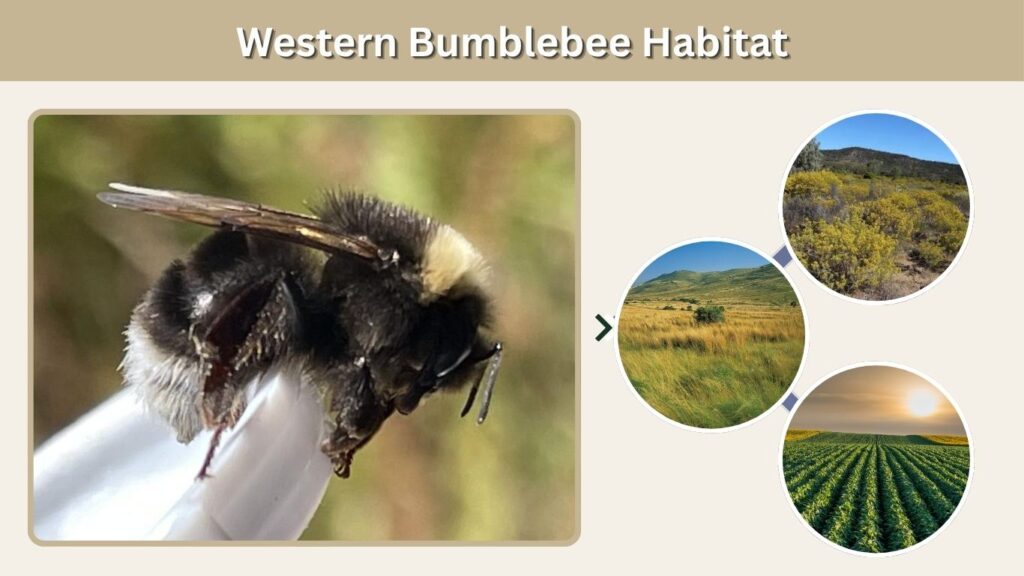
Western bumblebees can use a variety of habitats as long as they have flowers, nesting sites, and places for queens to overwinter.
Suitable environments include:
- Mountain meadows
- Grasslands
- Forest edges
- Open forests
- Shrublands
- Riparian areas
- Farms
- Gardens
- Urban green spaces
Pacific Northwest surveys have found the species in forests, meadows, and developed areas.
Western Bumblebee Nest
Western bumblebees usually nest underground, often using cavities originally created by rodents.
Recent nest studies found colonies in abandoned burrows beneath vegetation, leaf litter, and woody debris. Some nests occurred in forests, while others were in meadows, grassy areas, or forest edges.
A nest entrance may be surprisingly small and difficult to notice.
Above-ground nests are possible but appear less common.
What Do Western Bumblebees Eat?
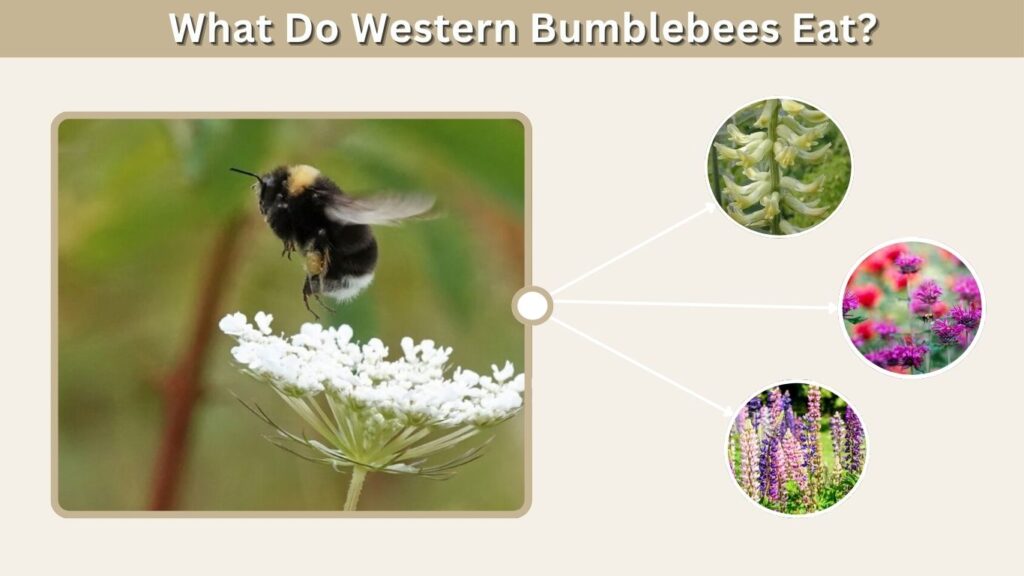
Adult western bumblebees feed on nectar and pollen.
Nectar provides carbohydrates for flight and daily activity, while pollen supplies protein and other nutrients needed by developing larvae.
Plants visited by western bumblebees include:
- Lupines
- Native thistles
- Clover
- Penstemon
- Goldenrod
- Fireweed
- Sunflowers
- Asters
- Snowberry
- Willow
- Currants
- Phacelia
Bumble Bee Watch also lists floral associations such as Erythronium, Hedysarum, Ipomopsis, Pedicularis, and Symphoricarpos.
A landscape containing flowers from early spring through fall is especially valuable because different colony stages need food throughout the season.
Why Are Western Bumblebees Good Pollinators?
Western bumblebees pollinate both wild plants and crops.
They can forage in relatively cool temperatures and low-light conditions when some other pollinators are less active.
Buzz Pollination
Like many bumblebees, they can perform buzz pollination.
The bee grabs a flower and rapidly vibrates its flight muscles, shaking pollen loose.
Plants that benefit from buzz pollination include:
- Tomatoes
- Peppers
- Cranberries
- Blueberries
- Many native wildflowers
This makes bumblebees especially valuable to both natural ecosystems and agriculture.
Western Bumblebee Life Cycle
Western bumblebee colonies follow an annual cycle.
Spring
A fertilized queen emerges from winter diapause and begins feeding on flowers.
She searches for a suitable nesting cavity, lays eggs, and raises her first group of workers.
Summer
Once workers emerge, they take over most foraging and brood care.
The queen remains in the nest and concentrates primarily on producing more offspring.
Western bumblebee observations in the Pacific Northwest occur mainly from early April through late August, with sightings peaking between mid-June and late July.
Late Summer and Fall
The colony eventually produces new queens and males.
They leave the nest and mate.
Workers, males, and the original queen eventually die as the season ends.
Winter
Newly mated queens search for underground overwintering locations and enter diapause.
These queens are normally the only colony members that survive until the following year.
Does a Western Bumblebee Sting or Bite?
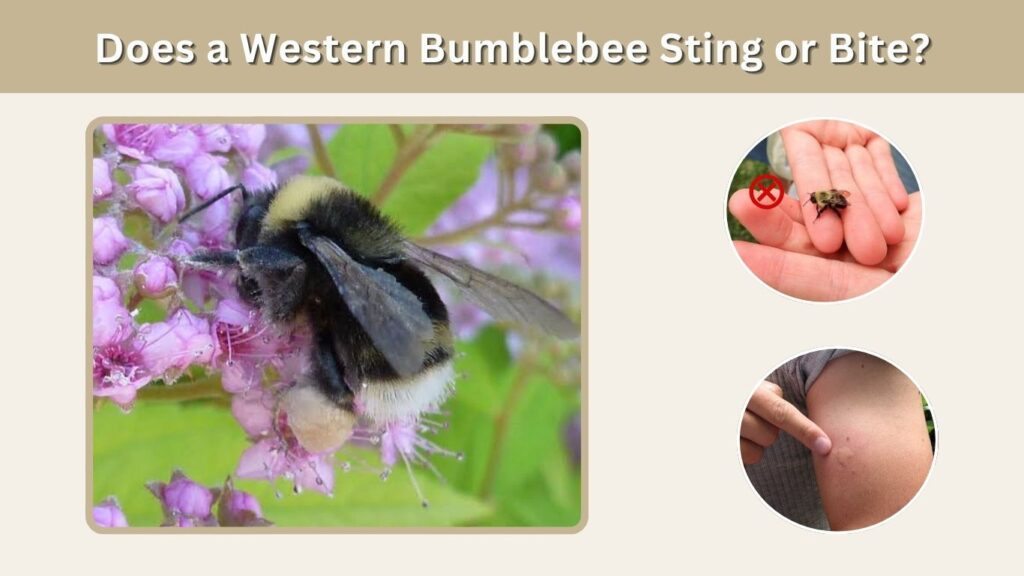
Female western bumblebees—queens and workers—can sting.
Males cannot sting because they lack stingers.
However, western bumblebees are not naturally aggressive toward humans. Most encounters involve bees quietly feeding on flowers.
Stings are most likely if someone:
- Handles a bee
- Steps on one
- Swats at it
- Disturbs its nest
- Blocks or damages a nest entrance
Unlike honey bee workers, bumblebees can potentially sting more than once because their stingers normally do not remain embedded in human skin.
They may use their jaws when manipulating materials, but their sting is the primary concern rather than a bite.
Why Is the Western Bumblebee Declining?
The western bumblebee was historically common across large areas but suffered serious declines beginning around the late 1990s.
Potential causes include several interacting factors.
Disease
Pathogens have been considered an important possible factor, particularly because commercially raised bumblebees were historically moved for agricultural pollination.
Habitat Loss
Development and changing land use can eliminate flowers, nesting cavities, and overwintering habitat.
Pesticides
Insecticides can directly affect bees, while herbicides may reduce the flowers they depend upon.
Climate Change
Western bumblebees are adapted to relatively cool environments. Research indicates that increasing temperatures may negatively affect where the species can persist.
Xerces also identifies habitat alteration, pesticides, disease, invasive species, and climate change among potential threats.
Is the Western Bumblebee Endangered?
The western bumblebee is considered a species of significant conservation concern.
It is assessed as Vulnerable by the IUCN, and the U.S. Fish and Wildlife Service continues to maintain information and status-review material for the species.
It has not disappeared across its entire range. Healthy populations still occur in some locations, particularly portions of the interior West and mountainous regions.
Protecting both flowering habitat and underground nesting areas is important for long-term recovery.
Western Bumblebee vs Eastern Bumblebee
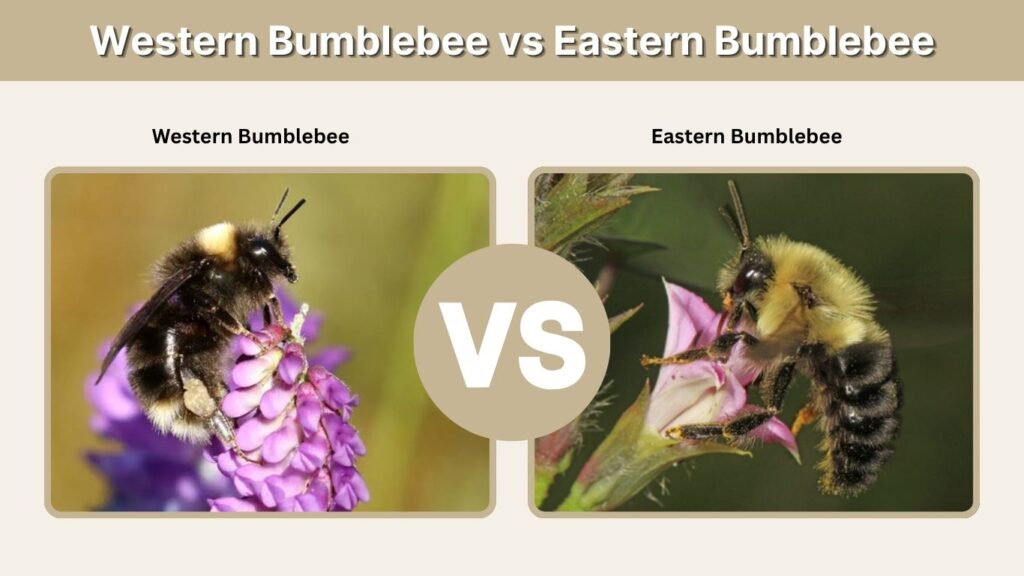
The term “eastern bumblebee” often refers to the common eastern bumblebee, Bombus impatiens.
| Feature | Western Bumblebee | Common Eastern Bumblebee |
| Scientific name | Bombus occidentalis | Bombus impatiens |
| Main range | Western North America | Eastern North America |
| Typical tail | Often white/pale | Mostly black |
| Conservation concern | Significant decline | Generally more widespread |
| Nesting | Usually underground | Usually underground |
| Diet | Nectar and pollen | Nectar and pollen |
Geographic location is often one of the strongest clues when separating these species.
Interesting Western Bumblebee Facts
- Its scientific name is Bombus occidentalis.
- It is native to western North America.
- Several different color forms exist.
- Females collect pollen using specialized hind-leg pollen baskets.
- Colonies normally survive for only one season.
- Only newly mated queens usually overwinter.
- Most nests are underground.
- The species can perform buzz pollination.
- It pollinates both crops and native wildflowers.
- Western populations have declined substantially since the late 1990s.
- Queens are larger than workers.
- Females can sting, while males cannot.
FAQs
1. How do you identify a western bumblebee?
Western bumblebees are fuzzy, robust bees with variable black, yellow, and pale markings. The first abdominal segment is typically black, and the fifth frequently has white hairs. Because several western bumblebee species look similar, location and multiple body markings should be considered together.
2. Where does the western bumblebee live?
The species occurs across western North America, historically ranging from Alaska and western Canada south through California, Arizona, and New Mexico and east into parts of the Great Plains. It occupies meadows, forests, grasslands, mountains, farms, and developed landscapes.
3. Do western bumblebees sting?
Female western bumblebees can sting, but they normally avoid humans. Stings are most likely when a bee is trapped, handled, stepped on, or defending its nest. Males cannot sting.
4. What do western bumblebees eat?
Adults consume flower nectar and pollen. They visit many plant species, including lupines, thistles, clovers, goldenrod, fireweed, asters, sunflowers, snowberry, and other native flowers. Workers also collect pollen and nectar to feed developing larvae.
5. Why is the western bumblebee declining?
Its decline likely results from a combination of disease, habitat loss and alteration, pesticide exposure, reduced floral resources, and climate change. The species remains present across much of its historical range but has become much less common in several western coastal regions.