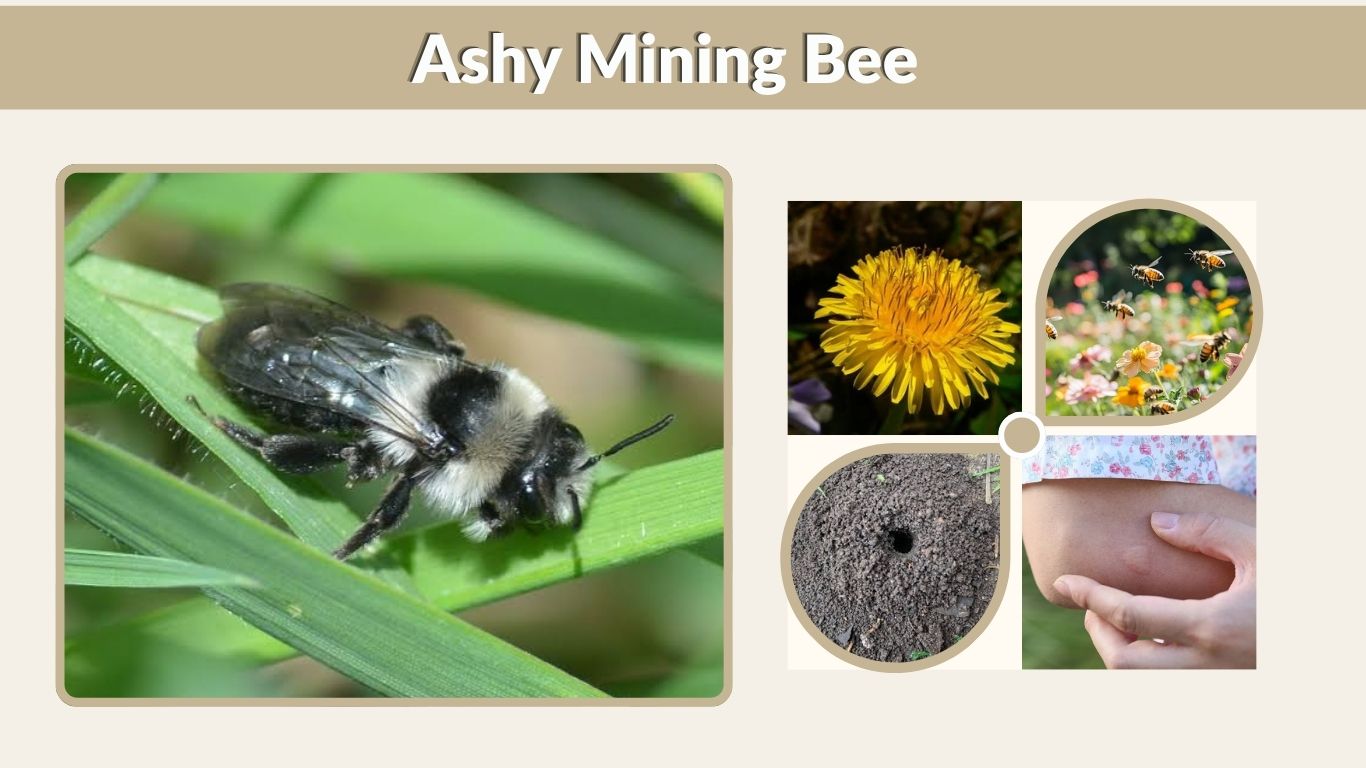
The ashy mining bee (Andrena cineraria) is a distinctive solitary bee known for its glossy black body and ash-grey hair. It appears mainly during spring, when females excavate underground nests in lawns, gardens, parks, and other sunny places. Although several bees may nest close together, each female maintains her own burrow. These gentle pollinators rarely sting and normally require no control. Understanding their appearance, behavior, habitat, and life cycle can help homeowners protect them without worrying about nearby nests.
What Is an Ashy Mining Bee?
The ashy mining bee belongs to the family Andrenidae, a large group of ground-nesting bees. It is also called the grey mining bee and has the scientific name Andrena cineraria. Its contrasting black-and-grey coloring makes the female easier to recognize than many other solitary bees.
Identification
Important ashy mining bee identification features include:
- A glossy black abdomen without bright colored bands
- Two noticeable ash-grey or whitish bands across the female’s thorax
- Dark legs covered with fine pollen-collecting hairs
- A compact body approximately 10–15 mm long
- A smaller and hairier appearance in males
- Pale facial hair that resembles a moustache on males
- Two transparent wings and relatively long antennae
The female’s thorax has a dark central band separating the two pale-haired sections. However, these hairs can fade or become worn as the bee ages.
Male vs. Female Ashy Mining Bee
A female ashy mining bee is generally larger and more strikingly patterned. She has a shiny black abdomen and two broad grey bands across her thorax. Females also carry pollen on specialized hairs on their back legs.
The male is slimmer, smaller, and usually covered with more grey hair. His pale facial hairs are particularly noticeable. Males may hover low above nesting areas while searching for newly emerged females. Male bees have no stinger and cannot sting.
Ashy Mining Bee Size
Adult females commonly measure about 10–15 mm long, while males are usually slightly smaller. Their size is comparable to that of a small honey bee. Differences in sex, age, nutrition, and hair condition can make individual bees appear larger or smaller.
Ashy Mining Bee Habitat and Geographic Range
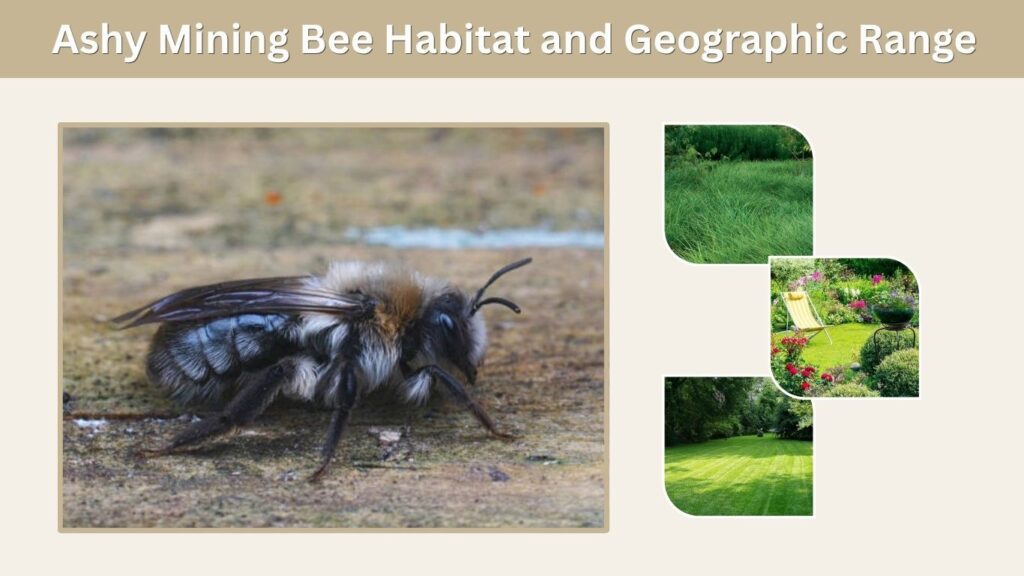
Ashy mining bees need two essential resources: sunny ground suitable for digging and plentiful spring flowers nearby. They can live in both natural and human-managed environments. According to The Wildlife Trusts, they occupy habitats ranging from grasslands and riverbanks to parks, quarries, and gardens.
Preferred Habitat
Typical ashy mining bee habitats include:
- Short lawns with thin or bare areas
- Sunny flower beds
- Roadside verges and footpaths
- Parks and playing fields
- Orchards and agricultural margins
- Open woodland edges
- Coastal and chalk grasslands
- Moorland and riverbanks
Females favor well-drained ground that receives direct sunlight. They can dig through lawns, loose soil, sandy ground, and moderately compacted surfaces.
Distribution in the UK and Ireland
Ashy mining bees are widespread across much of Britain and occur in Ireland, although local abundance varies. They are most easily noticed during spring in southern and central Britain. Records have expanded in some regions, suggesting that the species has increased its range and abundance.
Therefore, ashy mining bees are not generally considered rare throughout the UK. They may nevertheless be uncommon or absent in certain local areas.
Are Ashy Mining Bees Found in America?
The true ashy mining bee is primarily associated with Europe and nearby parts of the Palearctic region. It is not generally regarded as a common native bee of the United States. North America has numerous related Andrena species that may look similar.
An American bee should not be identified as Andrena cineraria from color alone. Clear photographs, location information, and examination by a local bee specialist may be required.
Ashy Mining Bee Nesting and Group Behavior
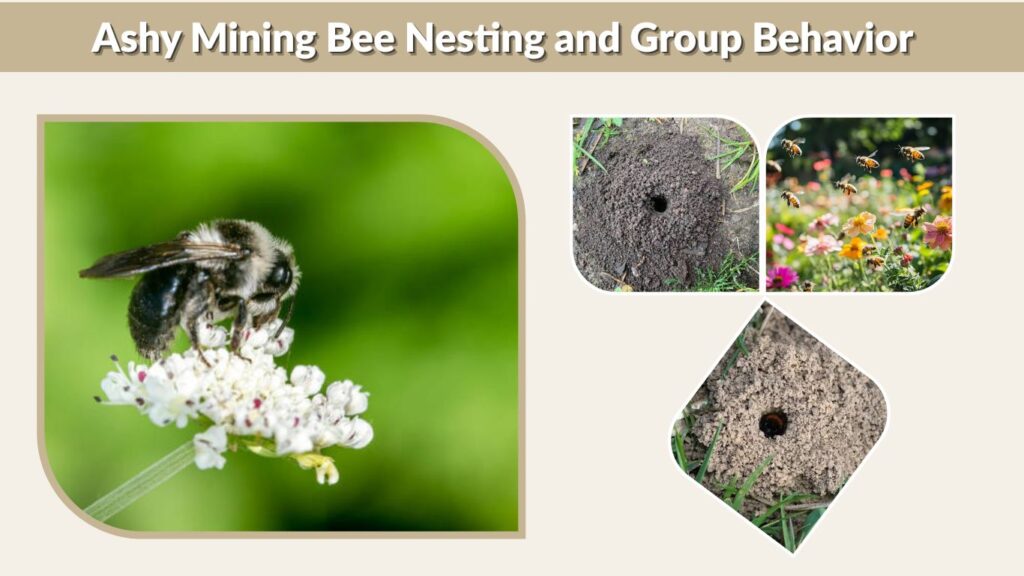
An ashy mining bee nest begins as a small round entrance surrounded by a loose mound of excavated soil. The female digs a main tunnel and constructs several side chambers underground. Because suitable nesting ground may be limited, numerous females sometimes establish their individual nests within the same small area.
What Does the Nest Look Like?
Common signs of a nesting area include:
- Pencil-sized openings in the ground
- Small volcano-shaped piles of loose soil
- Bees flying close to a lawn or flower bed
- Females repeatedly entering individual holes
- Males patrolling just above the ground
A female may temporarily close her nest entrance during rain, at night, or after completing her daily foraging. This protects the developing brood from bad weather and intruders.
Do Ashy Mining Bees Live in Large Groups?
Ashy mining bees are solitary rather than social. They do not have a queen, workers, or a communal colony like honey bees. Every female excavates and provides her own nest.
However, dozens or even hundreds of females may nest close together in an aggregation. This can resemble a colony, but the females are independent and do not collectively defend the area.
Ashy Mining Bee Diet, Pollination and Life Cycle
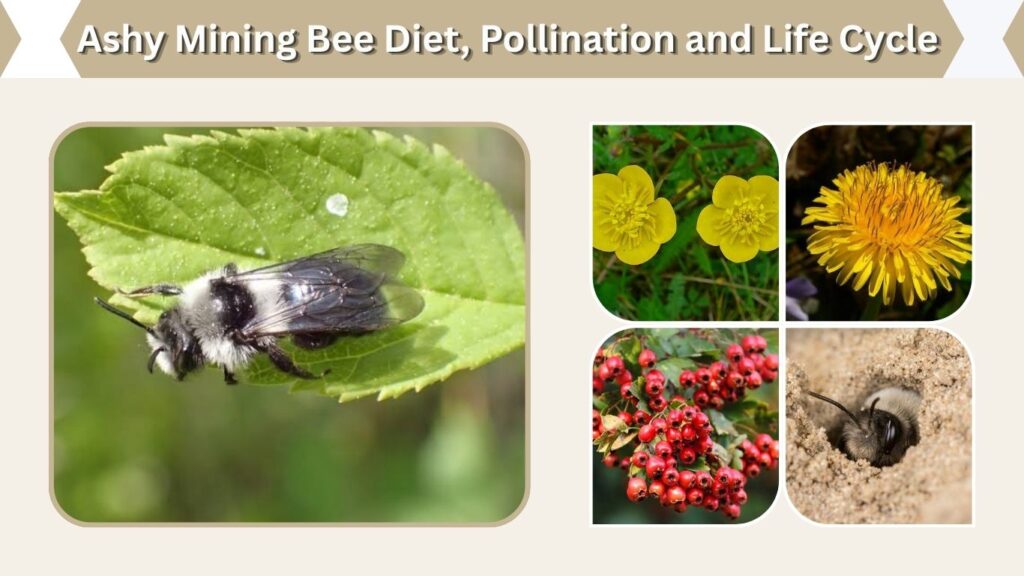
Adult ashy mining bees obtain energy from flower nectar, while females collect pollen to feed their developing offspring. They visit many kinds of spring flowers instead of depending on a single plant. Their activity makes them useful pollinators in gardens, orchards, and agricultural landscapes.
What Do Ashy Mining Bees Eat?
They commonly visit:
- Dandelions
- Buttercups
- Willows
- Hawthorns
- Fruit-tree blossoms
- Mustard-family plants
- Brambles
- Daisies and other spring wildflowers
Nectar supplies carbohydrates for adult flight and activity. Females mix pollen with nectar to create a food provision inside each underground brood cell.
Life Cycle
Adults usually become active between March and June, although weather and location can change the precise timing. Males often emerge first and patrol nesting sites for females.
After mating, each female excavates a burrow. She places a pollen-and-nectar provision in every brood cell, lays one egg, and seals the chamber. The egg hatches into a larva that consumes the stored food before pupating. The new generation remains underground and emerges the following spring. The species normally produces one generation per year.
Natural Enemies
Ashy mining bee nests may be targeted by parasitic insects, particularly Lathbury’s nomad bee. Instead of building a nest, the nomad bee places an egg inside the mining bee’s brood cell. The resulting larva consumes the stored provisions intended for the ashy mining bee.
These parasites are part of the natural ecosystem and do not normally require control.
Do Ashy Mining Bees Sting?
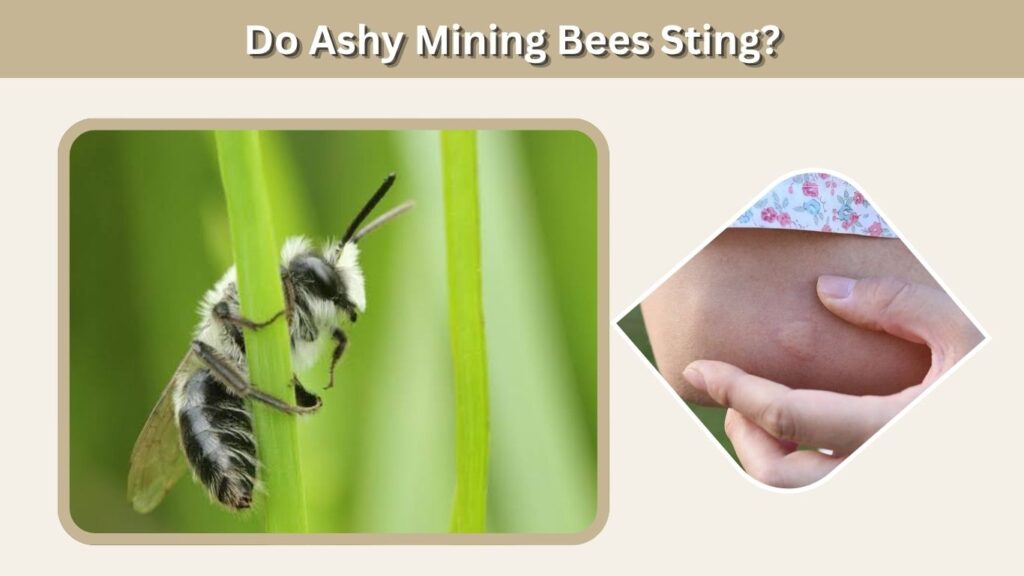
Ashy mining bees are docile insects focused on gathering pollen and constructing nests. They do not defend a communal hive, making aggressive encounters extremely unusual. A female possesses a stinger but is unlikely to use it unless trapped, squeezed, stepped on, or handled roughly.
Are Ashy Mining Bees Dangerous?
Ashy mining bees are not considered dangerous to most people. Males cannot sting, and females usually retreat into their burrows when disturbed. They are also unlikely to damage healthy lawns because the entrance holes are small and the excavated soil settles naturally.
Someone with a serious insect-venom allergy should still avoid handling any unidentified bee. Seek urgent medical assistance if a sting causes breathing difficulties, facial swelling, dizziness, or another severe reaction.
How to Get Rid of Ashy Mining Bees Safely
Removal is rarely necessary because nesting activity lasts only a short part of spring. To manage an inconvenient aggregation:
- Keep children and pets from digging around active entrances.
- Avoid mowing directly over the area while bees are flying.
- Do not pour boiling water, fuel, bleach, or insecticide into nests.
- Wait until seasonal activity has finished before repairing the lawn.
- Maintain denser grass if you want to discourage nesting next year.
- Contact a pollinator-aware professional if nests obstruct an essential entrance.
Leaving the bees undisturbed is usually the safest solution. They provide valuable pollination and naturally disappear from above ground when their short adult season ends.
Ashy Mining Bee in Productive Bees
The Ashy Mining Bee appearing in Productive Bees refers to a bee in the Minecraft mod, not the behavior of the real species. Game mechanics can vary among mod and modpack versions.
Wild or solitary bees are generally obtained by placing the correct nest in a suitable biome and using Honey Treats to encourage occupancy. Players should check JEI or the Big Book of Bees for the exact nest and biome required in their installed version. The official Productive Bees documentation also notes that an Ashy Mining Bee’s nest can occasionally produce a Nomad Bee after nectar is delivered.
FAQs
Are ashy mining bees rare?
They are common and widespread across much of Britain, although their abundance varies by region. They may be more localized in Ireland and other parts of their range.
Can ashy mining bees sting people?
Females can potentially sting, but they are extremely reluctant to do so. Males have no stinger. Avoid trapping or handling the bees.
When are ashy mining bees active?
Most adults appear from March through June. Their emergence may begin earlier during warm spring weather or occur later in cooler northern locations.
Do ashy mining bees damage lawns?
They create small holes and soil mounds but rarely cause lasting damage. Their burrows may even help aerate compacted ground.
Should I remove an ashy mining bee nest?
Usually not. The bees are beneficial pollinators, their nesting season is brief, and they are unlikely to behave aggressively. Temporary protection of the area is normally sufficient.