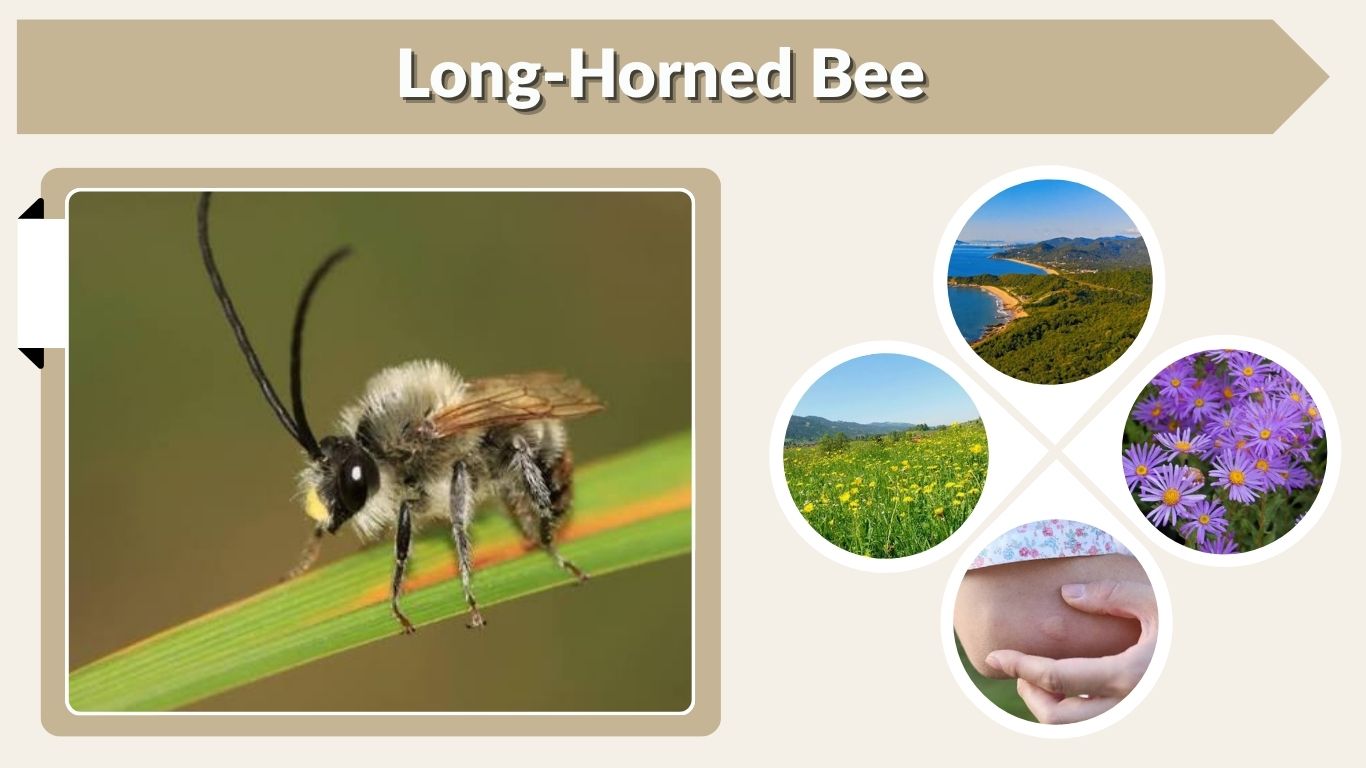
Long-horned bees are solitary native bees best recognized by the unusually long antennae of the males. They are important pollinators of sunflowers, asters, legumes, and numerous wildflowers and crops. Unlike honey bees, they do not maintain communal hives or produce harvestable honey. Females independently construct underground nests and collect pollen for their offspring. These bees are generally gentle, rarely sting, and benefit gardens and agricultural landscapes. Their appearance, nesting habits, and preferred flowers vary considerably among species.
What Is a Long-Horned Bee?
“Long-horned bee” describes a large group of bees rather than one particular species. Most belong to the tribe Eucerini within the family Apidae. Well-known genera include Melissodes, Eucera, and Svastra. Hundreds of species occur worldwide, with especially high diversity in the Americas.
Scientific Classification
Long-horned bees are classified as follows:
- Kingdom: Animalia
- Phylum: Arthropoda
- Class: Insecta
- Order: Hymenoptera
- Family: Apidae
- Tribe: Eucerini
- Common genera: Melissodes, Eucera, and Svastra
The scientific name depends on the species. For example, the common long-horned bee of Britain is Eucera longicornis, while the North American two-spotted longhorn is Melissodes bimaculatus.
Identification
Long-horned bees commonly display these features:
- Medium-sized, robust body
- Dense yellow, brown, gray, or black hair
- Exceptionally long antennae in males
- Shorter antennae and thicker bodies in females
- Pale hair bands on the abdomen in many species
- Thick pollen-carrying hairs on females’ hind legs
- Fast, energetic flight around flowers
- Dark, blue, green, or grayish eyes, depending on species
The long antennae distinguish males from many similar bees. Females can be more difficult to identify because they may resemble mining bees, leafcutter bees, or small bumble bees.
Male vs. Female Long-Horned Bees
Male and female long-horned bees can look surprisingly different. The dramatic antennae associated with this group occur mainly in males. Females are generally heavier, possess specialized pollen-carrying hairs, and spend much of their time building and provisioning underground nests.
Male Long-Horned Bee
Males usually have antennae that extend backward along or beyond much of the body. These sensitive organs help them detect chemical signals and locate females.
They frequently patrol patches of flowers at high speed, following repeated routes while searching for mates. Males do not gather pollen for nests and cannot sting. Some spend the night in groups while gripping flower heads or tall stems.
Female Long-Horned Bee
Females have shorter antennae and a broader, more robust body. Their hind legs carry dense pollen-collecting hairs known as scopae, which can resemble furry trousers.
Each female digs and provisions her own nest. Although multiple females may nest close together in favorable soil, they do not form a cooperative colony with queens and workers.
Long-Horned Bee Habitat and Distribution
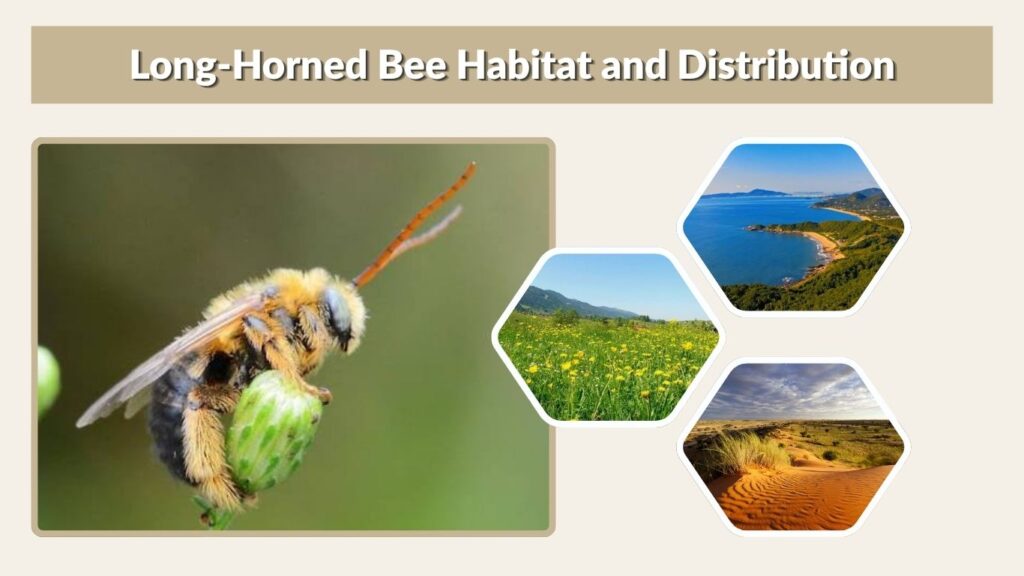
Long-horned bees occupy grasslands, meadows, deserts, coastal areas, farms, gardens, and open woodlands. They need abundant flowers as well as exposed soil suitable for nesting. Different species occur across Europe, Asia, Africa, and the Americas, so their exact habitat and seasonal activity vary.
Long-Horned Bees in North America
North American long-horned bees are found from Canada through the United States and into Mexico. They occur in California, Arizona, Colorado, Oregon, and many other states.
They are particularly noticeable in summer and early fall when sunflowers, asters, and related plants bloom. Some species favor dry western habitats, while others, including the two-spotted longhorn, are widespread in eastern regions.
Long-Horned Bee in the UK
The British long-horned bee usually refers to Eucera longicornis. It is one of the UK’s larger native solitary bees and is most strongly associated with southern England and parts of Wales. Males possess extremely long antennae, while females have a sturdier appearance.
This species favors flower-rich grasslands, coastal habitats, cliffs, banks, and other sunny areas containing suitable soil. Important pollen plants include vetches, clovers, everlasting peas, and other legumes. In the UK, it is considered a priority species and has a limited distribution. Buglife’s long-horned bee profile provides further species-specific details.
Long-Horned Bee Nest
A typical nest consists of:
- An entrance in bare or sparsely vegetated soil
- A main underground tunnel
- Several short side passages
- Individual brood chambers
- A pollen-and-nectar provision in each chamber
- One egg placed on each food supply
Females may create nesting aggregations containing many separate burrows. However, every female remains responsible for constructing and supplying her own nest. Long-horned bees do not establish honey bee-like hives.
What Do Long-Horned Bees Eat?
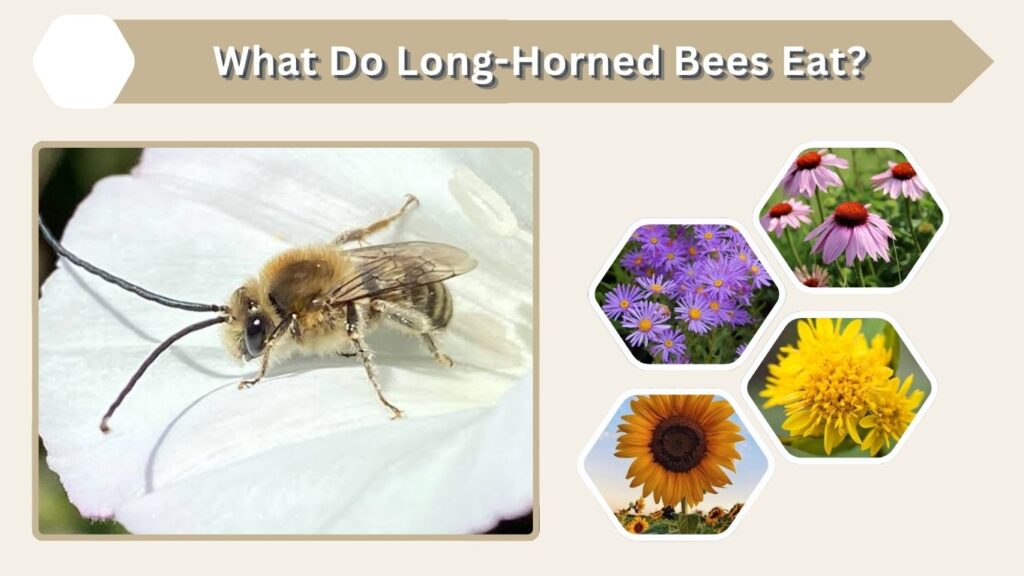
Adults drink nectar for energy. Females also collect pollen, which provides protein and other nutrients to developing larvae. Many species show strong preferences for particular plant families, although others visit a wider variety of flowers.
Favorite Flowers
Long-horned bees frequently visit:
- Sunflowers
- Asters
- Goldenrods
- Coneflowers
- Blanketflowers
- Thistles
- Vetches
- Clovers
- Alfalfa
- Melons
- Cotton
- Other native summer wildflowers
Some Melissodes species specialize in plants from the sunflower family. Others are valuable visitors to vegetable and seed crops. Long-horned bees can therefore contribute substantially to both wildflower reproduction and agricultural pollination.
Pollination Importance
The bees’ hairy bodies collect pollen as they move across flowers. Some grains are transferred to other blooms, allowing fertilization and seed development.
Several species are particularly important sunflower pollinators. The two-spotted longhorn also visits melons and various summer vegetable crops. The Xerces Society describes long-horned bees as solitary ground nesters and valuable crop pollinators in its pollinator management guide.
Can Long-Horned Bees Sonicate Flowers?
Sonication, or buzz pollination, occurs when a bee uses its flight muscles to vibrate a flower and release trapped pollen. Some solitary bees can perform this behavior, but it should not automatically be attributed to every long-horned bee species.
Flower-handling behavior varies within this diverse group. Direct observation is normally necessary to determine whether a particular species is truly sonicating or simply buzzing while collecting pollen.
Behavior, Mating, and Life Cycle
Long-horned bees are active mainly during the blooming periods of their preferred plants. Some species appear in spring, while many North American Melissodes emerge during summer or early fall. Their adult activity may last only several weeks.
Mating Behavior
Males patrol flowers and nesting locations while searching for newly emerged females. Their antennae help detect odors and other close-range signals. Courtship can involve pursuing, touching, and antennal contact before mating.
Several males may chase one female, but the activity usually ends quickly. Despite their energetic flight, males pose no stinging risk.
Life Cycle
The life cycle progresses through four stages:
- A female excavates a nest in the ground.
- She fills each chamber with pollen and nectar.
- She lays one egg on the food provision.
- The egg hatches into a feeding larva.
- The larva develops and later becomes a pupa.
- The adult emerges during the appropriate flowering season.
Many species produce one generation annually and spend much of the year developing or resting underground.
Male Sleeping Groups
Male long-horned bees sometimes gather overnight on sunflowers, grasses, or other vegetation. They grip the plant using their jaws and legs and remain inactive until temperatures rise.
A sleeping cluster can contain several males. This behavior does not represent a colony or nest; it is simply a shared resting location.
Do Long-Horned Bees Sting?
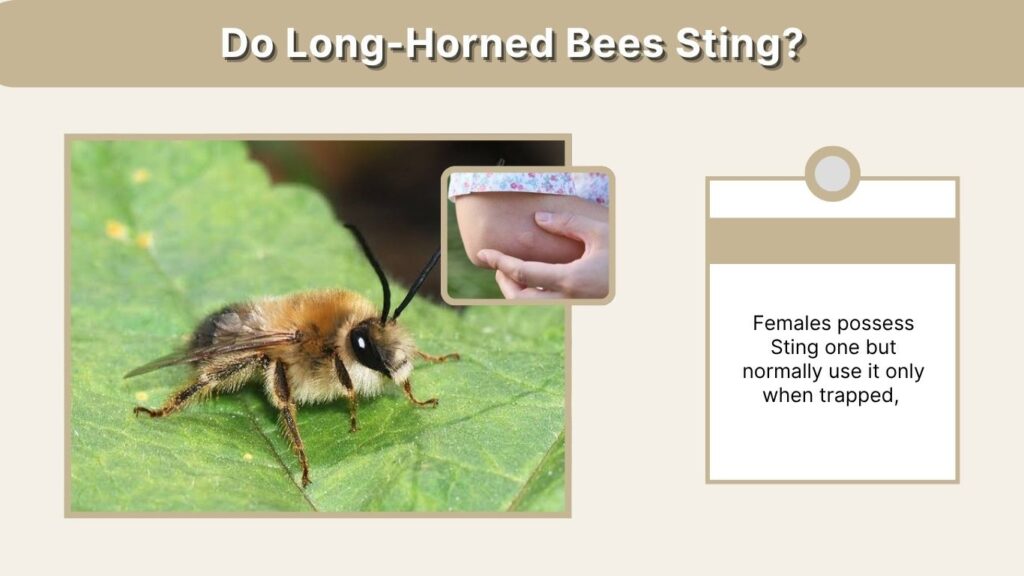
Long-horned bees are not aggressive and generally ignore people. Males cannot sting because they lack a stinger. Females possess one but normally use it only when trapped, squeezed, stepped on, or handled roughly.
Staying Safe Around Them
Follow these simple precautions:
- Observe the bees without touching them.
- Avoid standing directly on nesting entrances.
- Wear shoes near ground-nesting aggregations.
- Keep children and pets from digging into nests.
- Do not spray flowering plants with insecticide.
- Allow the short nesting season to finish naturally.
A nesting aggregation may appear busy, but it is not defended collectively like a social wasp colony or honey bee hive.
Common Types of Long-Horned Bees
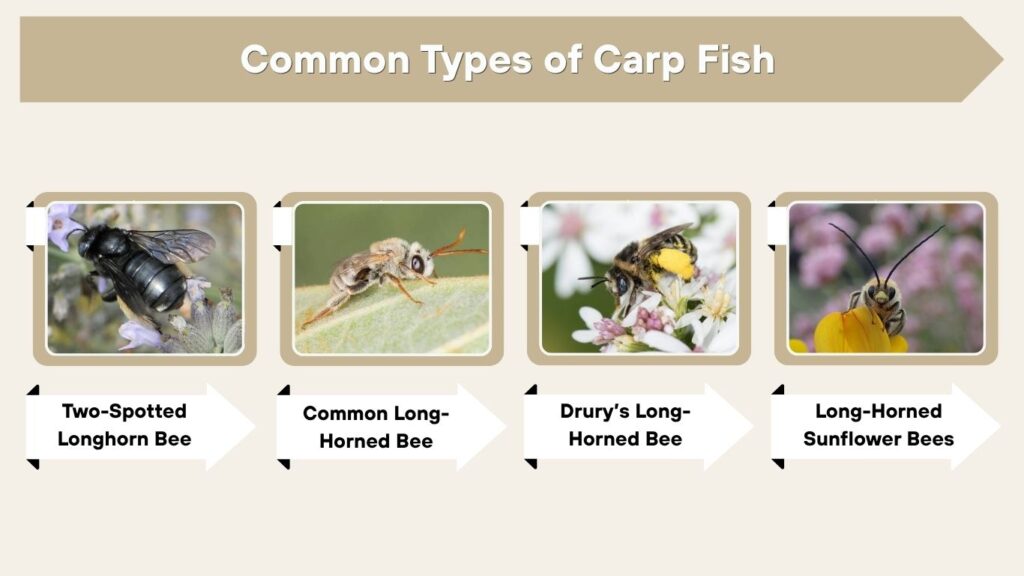
Long-horned bees include many species with different appearances and flower preferences.
Two-Spotted Longhorn Bee
Melissodes bimaculatus is primarily black, with pale hairs on its legs and two light spots near the end of the female’s abdomen. It is an important pollinator across much of the eastern United States. Penn State Extension describes males as approximately 11–13 millimeters long.
Common Long-Horned Bee
Eucera longicornis is the species most often called the long-horned bee in Britain. It depends heavily on legume-rich habitat and nests in sunny, lightly vegetated ground.
Drury’s Long-Horned Bee
Melissodes druriellus is a North American species often associated with open areas containing abundant summer flowers. Like other Melissodes, the male has noticeably elongated antennae.
Long-Horned Sunflower Bees
Several long-horned bees have strong relationships with sunflowers and related plants. Species in Melissodes and Svastra may appear in large numbers on composite flower heads during late summer.
How to Attract Long-Horned Bees
Gardens can support these pollinators by providing flowers throughout their active seasons and preserving undisturbed nesting ground. Native plants adapted to the local region generally provide the most appropriate pollen and nectar.
Bee-Friendly Garden Tips
- Plant native sunflowers, asters, and goldenrods.
- Include vetches, clovers, and other legumes.
- Grow flowers in large, visible groups.
- Leave small patches of sunny soil uncovered.
- Avoid landscape fabric over every bare area.
- Reduce mowing around flower-rich sections.
- Do not disturb active ground nests.
- Avoid insecticides, especially on blooming plants.
- Provide flowers from spring through fall.
FAQs
Are long-horned bees honey bees?
No. They are native solitary bees and do not produce harvestable honey or maintain large social colonies.
Where do long-horned bees live?
They live across many parts of the world in meadows, farms, gardens, grasslands, deserts, and coastal habitats containing flowers and nestable soil.
How far can a long-horned bee fly?
The exact distance varies by species and landscape. They generally forage relatively close to their nests when enough flowers are available but may travel farther when resources are scarce.
When do long-horned bees emerge?
Emergence depends on the species and climate. Some appear during spring, while numerous North American species are most visible in summer and early fall.
Is a black long-horned bee dangerous?
No. Dark coloration does not indicate aggression. Males cannot sting, and females rarely sting unless physically restrained or threatened.