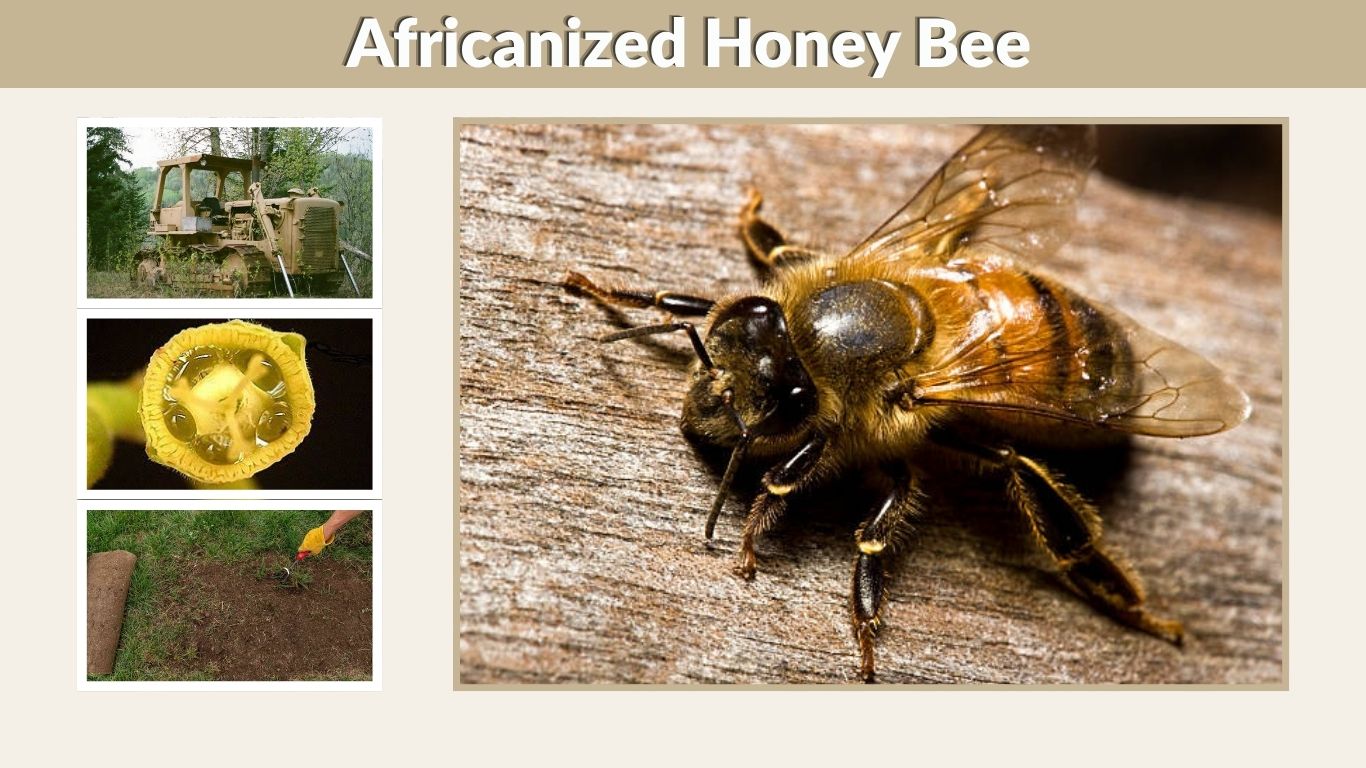
The Africanized honey bee is a type of Apis mellifera known mainly for its highly defensive colony behavior. Often called the “killer bee,” it is not a separate bee species and usually looks almost identical to common European honey bees. Africanized bees originated after African honey bees introduced into Brazil interbred with honey bees already present in the Americas. They later spread through much of South and Central America and into parts of the southern United States. Understanding their appearance, nests, behavior, and sting risk is important because visual identification alone is extremely difficult.
What Is an Africanized Honey Bee?
Africanized honey bees are populations of the western honey bee, Apis mellifera, with substantial African ancestry. They developed after bees with African ancestry were brought to Brazil during the 1950s to improve honey production in tropical environments. Some escaped or were released and interbred with European-derived honey bee populations.
The resulting bees spread rapidly through tropical and subtropical regions of the Americas. USDA records indicate that Africanized honey bees officially reached the United States through southern Texas in 1990.
Africanized Honey Bee Scientific Name
The scientific species name is Apis mellifera. Africanized honey bees are not generally treated as a separate species. Instead, they are hybrid populations resulting from crosses involving African honey bee ancestry—particularly Apis mellifera scutellata—and European honey bee lineages.
What Does an Africanized Honey Bee Look Like?
Identifying an Africanized honey bee by appearance alone is extremely difficult. It has the familiar honey bee shape, with a hairy body, transparent wings, large compound eyes, and alternating brownish and yellowish abdominal bands.
Africanized Honey Bee Identification
Typical characteristics include:
- Golden-brown to dark brown coloration
- Dark and lighter bands across the abdomen
- Hair covering much of the thorax and body
- Two pairs of transparent wings
- Six legs and two antennae
- Large compound eyes
- Worker size close to that of European honey bees
Africanized workers can average somewhat smaller than some European honey bee populations, but the difference is too small and variable to reliably identify an individual bee by sight.
USDA researchers have historically used measurements such as wing dimensions and other physical characteristics to distinguish populations. Genetic methods can also be used when more precise identification is required.
Africanized Honey Bee vs European Honey Bee
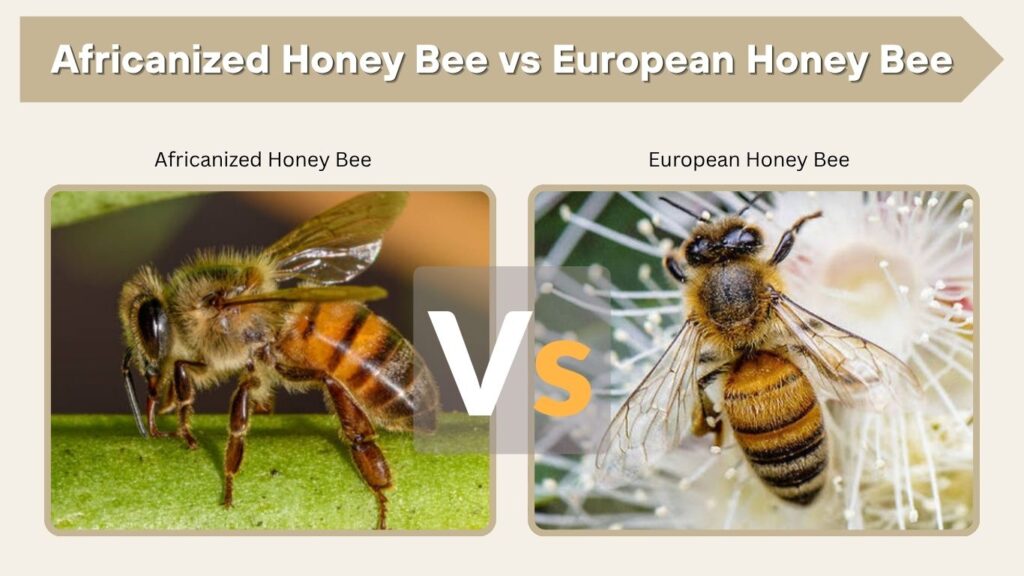
The most important difference between Africanized and European honey bees is behavior rather than appearance.
Both collect pollen and nectar, make honey, live in colonies, pollinate plants, and possess similar basic anatomy. Africanized colonies, however, tend to respond more rapidly and intensely when they perceive a threat near their nest.
Major Behavioral Differences
Africanized colonies may recruit considerably more defensive workers during a disturbance. They can also remain defensive longer after being provoked.
They have a strong tendency to swarm and establish new colonies. USDA information notes that Africanized colonies may swarm more frequently than European colonies during favorable conditions. They are also less selective about nesting cavities and may occupy spaces that European colonies would be less likely to use.
This adaptability helps explain why they have successfully colonized many warm regions.
Africanized Honey Bee Range and Origin
The modern history of Africanized honey bees in the Americas began in Brazil during the 1950s. Bees with African ancestry were imported as part of attempts to develop honey bees better suited to tropical climates.
After their establishment outside managed colonies, their descendants expanded throughout much of South America, Central America, Mexico, and eventually into the southern United States.
Africanized Honey Bee Range in the United States
Climate strongly influences their distribution. Africanized populations are better suited to warmer climates than many European-derived honey bee populations, which helps limit their expansion into colder regions.
They became established in portions of the southern and southwestern United States, with hybridization occurring between Africanized and managed European honey bee populations.
Because distribution can change over time and local populations may contain varying amounts of African ancestry, old range maps should not automatically be treated as a current indication of where every Africanized colony occurs.
Africanized Honey Bee Habitat and Nests
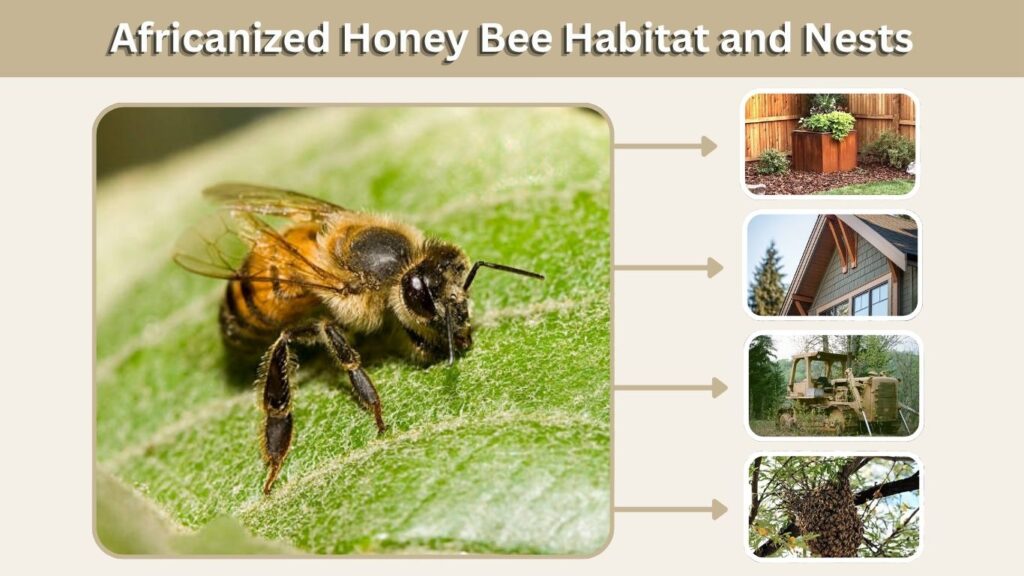
Africanized honey bees can live in many of the same environments as other honey bees, particularly warm areas with flowering plants and access to water.
Their willingness to occupy relatively small nesting spaces is one reason people sometimes encounter colonies around homes and other structures.
Where Do Africanized Honey Bees Build Nests?
Potential nesting locations include hollow trees, wall cavities, building eaves, utility boxes, abandoned equipment, old tires, containers, and other protected spaces.
USDA guidance notes that Africanized colonies may use smaller cavities and a wider variety of nest sites than European honey bees.
A temporary cluster of bees hanging from a branch is not necessarily an established nest. It may be a traveling swarm searching for a permanent location.
Are Africanized Honey Bees Aggressive?
“Aggressive” is commonly used, but highly defensive is more precise. They do not normally seek out people simply to attack them. Serious incidents usually occur when a colony believes its nest is being threatened.
Vibration, loud machinery, physical disturbance, or activity close to a nest can trigger defensive behavior.
The major concern is the number of bees that may respond. Africanized colonies can mobilize many workers quickly and may pursue a perceived threat farther than typical European honey bee colonies.
Africanized Honey Bee Sting and Attack
An individual Africanized worker bee stings in essentially the same manner as another honey bee worker. The increased danger associated with an Africanized colony comes primarily from its strong collective defensive response rather than from a completely different type of stinger.
A worker generally leaves its barbed stinger in human skin and dies after stinging.
What Should You Do During an Attack?
If numerous bees begin attacking, move quickly away from the colony and enter an enclosed building or vehicle when possible. Do not remain near the nest trying to fight the bees.
The U.S. Forest Service advises people under attack to run away and reach shelter rather than attempting to disturb or destroy the colony themselves.
Anyone with difficulty breathing, widespread swelling, dizziness, loss of consciousness, signs of an allergic reaction, or a large number of stings should receive urgent medical attention.
Africanized Honey Bee Diet and Honey

Africanized honey bees eat essentially the same foods as other honey bees. Adult workers gather nectar and pollen from flowers.
Nectar provides carbohydrates and is processed into honey, while pollen supplies important proteins, fats, vitamins, and minerals. Colonies also produce bee bread from stored pollen and nectar.
Do Africanized Bees Make Honey?
Yes. Africanized honey bees make and store honey.
Their honey is produced from floral nectar just as it is in other Apis mellifera colonies. The term “Africanized” primarily describes ancestry and colony characteristics; it does not mean that the bees produce a fundamentally different substance called Africanized honey.
Africanized Honey Bee Life Cycle
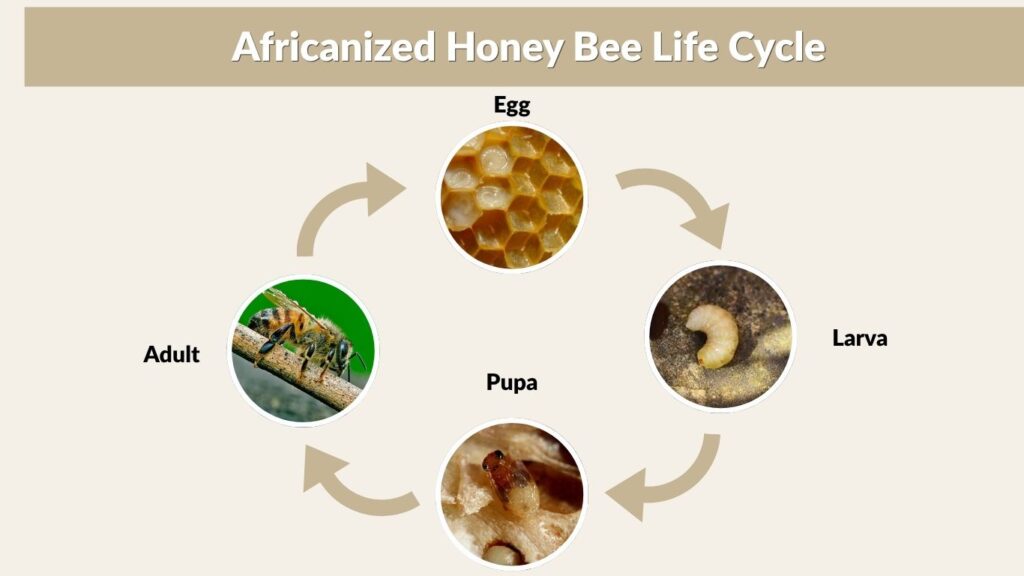
Africanized honey bees undergo complete metamorphosis, progressing through four stages:
Egg → Larva → Pupa → Adult
A colony contains a queen, female workers, and male drones. The queen lays eggs, workers perform most colony tasks, and drones primarily exist to mate with queens.
Workers feed larvae, maintain the nest, defend the colony, gather food, and care for the queen.
Africanized Honey Bee Queen
The queen is responsible for reproduction within the colony. Africanized queens look very similar to queens of European ancestry, making ancestry difficult to determine simply by examining the queen.
Frequent swarming contributes significantly to the ability of Africanized populations to spread into new areas.
Are Africanized Honey Bees Invasive?
Africanized honey bees can be considered invasive or introduced populations in areas of the Americas where their African ancestry was not historically present.
Their spread can influence managed beekeeping because Africanized drones and queens can breed with European-derived honey bees. This creates populations containing different combinations of African and European genetic ancestry.
However, Africanized bees are still honey bees and perform important ecological services, including pollinating flowering plants.
Africanized Honey Bee Removal and Control
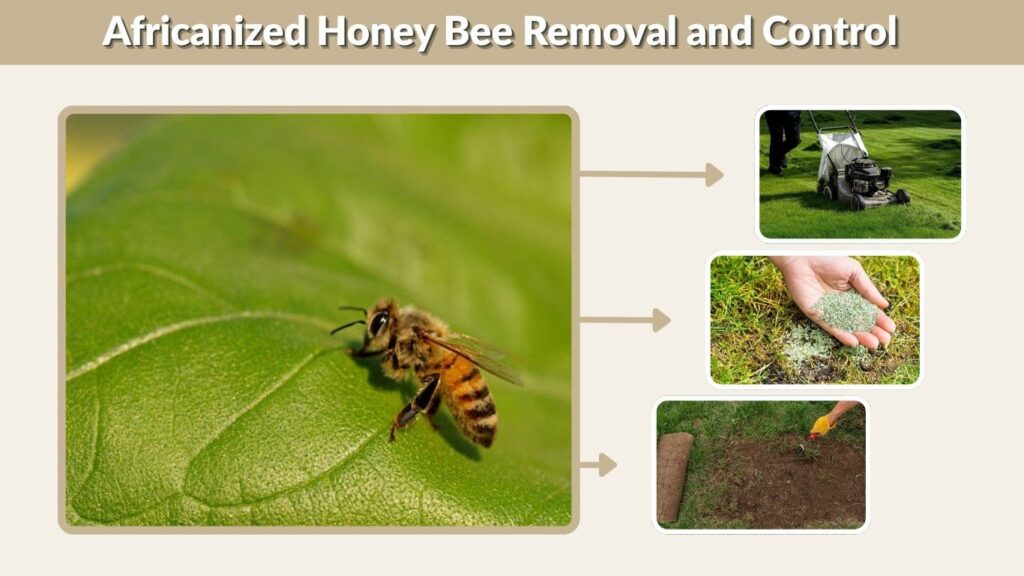
An established colony around a home, school, livestock area, or frequently used outdoor space should not be approached casually.
Spraying the entrance, striking the nest, blocking the opening, throwing objects at it, or attempting to burn it can provoke defensive behavior.
Professional removal is especially important when the colony is inside a wall, utility box, roof, tree cavity, or another difficult location.
A swarm resting temporarily on a branch may be less defensive because it does not yet have an established nest full of brood and food to protect, but it should still be left undisturbed.
Interesting Africanized Honey Bee Facts
Africanized honey bees are often misunderstood because of the dramatic “killer bee” nickname. Their individual appearance is so similar to European honey bees that experts may require physical measurements or genetic information for confident identification.
They can pollinate crops and wildflowers, produce honey, and maintain the same basic social organization as other honey bees. Their defining characteristic is their much stronger colony-defense response, along with frequent swarming and flexible nesting behavior.
Understanding these differences is more useful than trying to identify an Africanized honey bee simply by color or size.
FAQs
Can you tell an Africanized honey bee by looking at it?
Usually not reliably. Africanized and European honey bees look extremely similar, and professional identification may require measurements or genetic testing.
Why are Africanized honey bees called killer bees?
The nickname arose because Africanized colonies can defend their nests with large numbers of workers, creating the potential for many stings. The dramatic term can exaggerate the idea that they routinely hunt or randomly attack people.
Where did Africanized honey bees come from?
Their American populations trace back primarily to honey bees of African ancestry brought to Brazil during the 1950s that subsequently bred with European-derived honey bees.
Do Africanized honey bees make honey?
Yes. They gather nectar, convert it into honey, and store it in comb just as other honey bees do.
What is the biggest difference between Africanized and regular honey bees?
The clearest difference is colony behavior. Africanized colonies generally react more quickly and intensely to disturbances around their nests, while their physical appearance can be nearly indistinguishable from European honey bees.