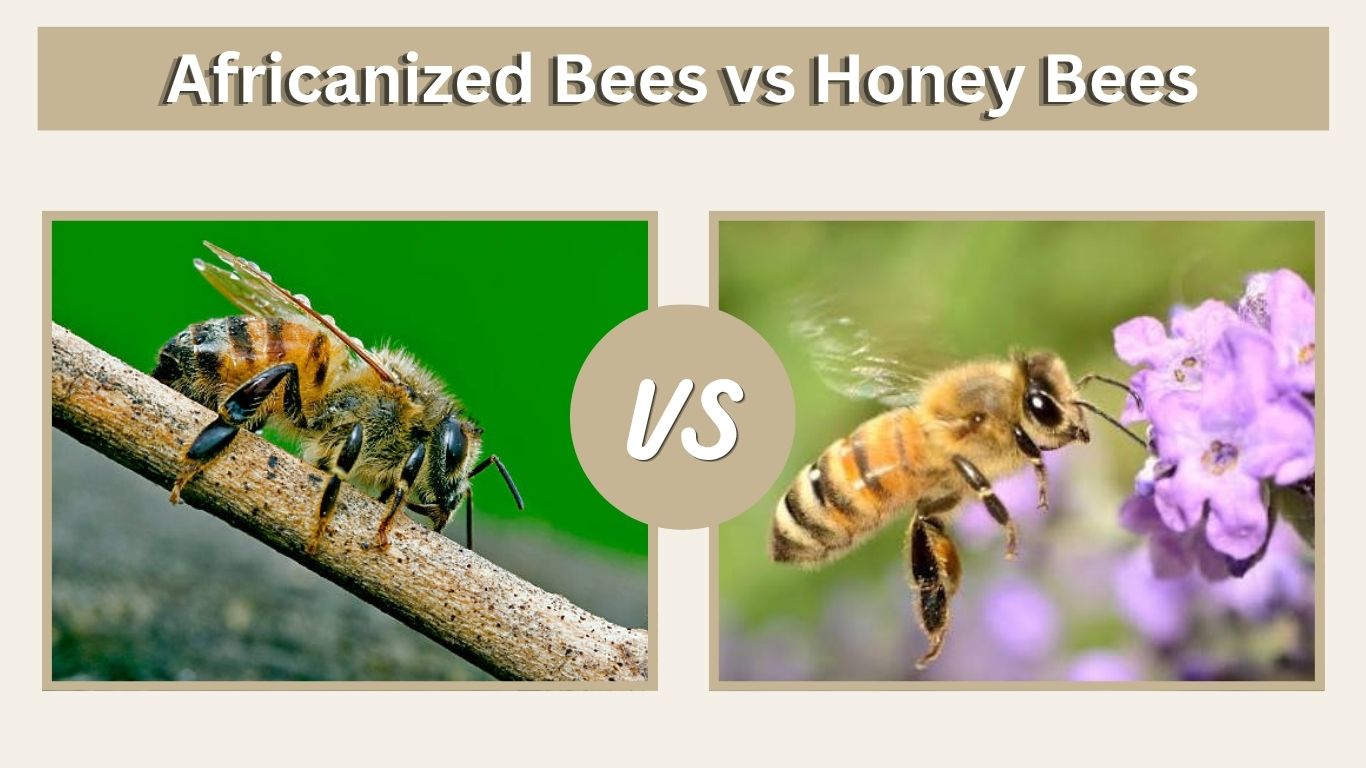
Africanized bees and regular honey bees are extremely similar in appearance, but their colony behavior can be very different. Both belong to the western honey bee species, Apis mellifera, collect nectar and pollen, produce honey, and play important roles as pollinators. The biggest difference is how strongly they defend their nests. Africanized honey bees generally respond faster, in greater numbers, and with less disturbance than typical European honey bees. This guide compares Africanized bees vs honey bees by appearance, size, temperament, sting, nests, swarming, honey production, and other important characteristics.
Africanized Bee vs Honey Bee: Quick Comparison
Africanized honey bees are not a completely separate species from the familiar European honey bee. Both are forms of Apis mellifera. Africanized populations developed from honey bees with African ancestry that spread through the Americas and mixed to varying degrees with European-derived honey bees.
| Feature | Africanized Honey Bee | European Honey Bee |
| Species | Apis mellifera | Apis mellifera |
| Appearance | Very similar | Very similar |
| Average size | Often slightly smaller | Often slightly larger |
| Nest defense | Very strong | Generally less intense |
| Response to disturbance | Faster | Usually slower |
| Number of defending bees | Often many | Usually fewer |
| Swarming | More frequent | Less frequent |
| Nest-site selection | Uses smaller, varied spaces | Generally more selective |
| Sting potency | Similar per individual sting | Similar per individual sting |
| Honey production | Yes | Yes |
| Pollination | Yes | Yes |
| Identification by sight | Usually unreliable | Usually unreliable |
Do Africanized Bees Look Different From Honey Bees?
Probably the most surprising part of the Africanized honey bee vs regular honey bee comparison is how little their appearance differs.
Both typically have hairy bodies, transparent wings, brown-to-golden coloration, dark abdominal bands, six legs, two antennae, and large compound eyes.
Can You Identify an Africanized Bee by Sight?
Usually, no.
Africanized honey bees may average somewhat smaller than European honey bees, but the difference is subtle and varies among individuals. USDA information notes that Africanized and European honey bees generally cannot be reliably distinguished simply by looking at them.
Experts may instead examine body measurements or use genetic methods when accurate identification is necessary.
Therefore, finding a particularly small or dark honey bee does not automatically mean it is Africanized.
Africanized Honey Bee vs European Honey Bee Behavior
Behavior provides the most important distinction between the two.
European honey bee colonies certainly defend themselves and can sting when threatened. Africanized colonies, however, typically have a much more intense defensive response.
Why Are Africanized Bees More Defensive?
Africanized colonies can respond to disturbances more quickly and require less stimulation before defensive behavior begins. More workers may leave the nest to participate in defense, and their defensive response may continue after the immediate disturbance.
Disturbances may include vibrations, movement, noise, or physical interference close to the colony.
Calling them highly defensive is usually more accurate than saying they are randomly aggressive. They do not normally fly through neighborhoods looking for people to attack. Problems generally occur when an established nest is disturbed.
Africanized Bee Sting vs Honey Bee Sting

An individual Africanized honey bee does not have a dramatically more powerful sting than a European honey bee.
The U.S. Forest Service notes that the sting from one Africanized honey bee is no more harmful than a sting from a typical European honey bee.
Why Are Africanized Bee Attacks More Dangerous?
The difference is primarily the number of bees that may respond.
An Africanized colony may mobilize substantially more defensive workers when threatened. This increases the possibility that a person or animal could receive numerous stings.
Like European worker honey bees, Africanized workers possess barbed stingers. When a worker stings human skin, the stinger commonly becomes lodged and the bee subsequently dies.
Anyone experiencing breathing difficulty, dizziness, extensive swelling, loss of consciousness, or numerous stings should receive urgent medical attention.
Africanized Bees vs Honey Bees: Nesting Habits

Both types establish colonies containing honeycomb, brood, stored pollen, honey, workers, drones, and a queen.
However, Africanized honey bees tend to be less selective about where they establish colonies.
Where Do Africanized Bees Nest?
Possible nesting locations include:
- Hollow trees
- Wall cavities
- House eaves
- Utility boxes
- Old tires
- Abandoned containers
- Cement blocks
- Tree cavities
- Junk piles
- Small protected spaces
USDA guidance reports that Africanized honey bees can occupy smaller cavities and a wider variety of nesting sites than European honey bees.
This adaptability can bring colonies into closer contact with people.
Which Bee Swarms More Often?
Africanized honey bees typically have a greater tendency to swarm.
Swarming occurs when part of an established colony leaves with a queen to establish another colony.
Africanized Honey Bee Swarming
According to USDA guidance, European honey bee colonies commonly swarm around once during a typical yearly cycle, whereas Africanized colonies may swarm repeatedly during favorable swarm seasons.
Frequent swarming is one reason Africanized honey bee populations have been able to expand efficiently through suitable climates.
A swarm clustered temporarily on a branch should not be confused with an established nest. Swarming bees generally have fewer resources to defend and are often less defensive, although they should still be left undisturbed.
Africanized Bee Honey vs Honey Bee Honey
Both Africanized and European honey bees produce real honey.
Workers collect flower nectar, bring it to their colony, process it, and store it in wax comb. Both also collect pollen to help meet the nutritional requirements of the colony.
Is Africanized Bee Honey Different?
There is no special substance called “killer bee honey.”
The characteristics of honey—such as flavor, aroma, and color—are strongly influenced by the flowers supplying the nectar rather than simply whether the colony is Africanized or European.
Africanized bees are therefore capable of functioning as pollinators and honey producers just like other honey bees.
African Honey Bee vs Africanized Honey Bee
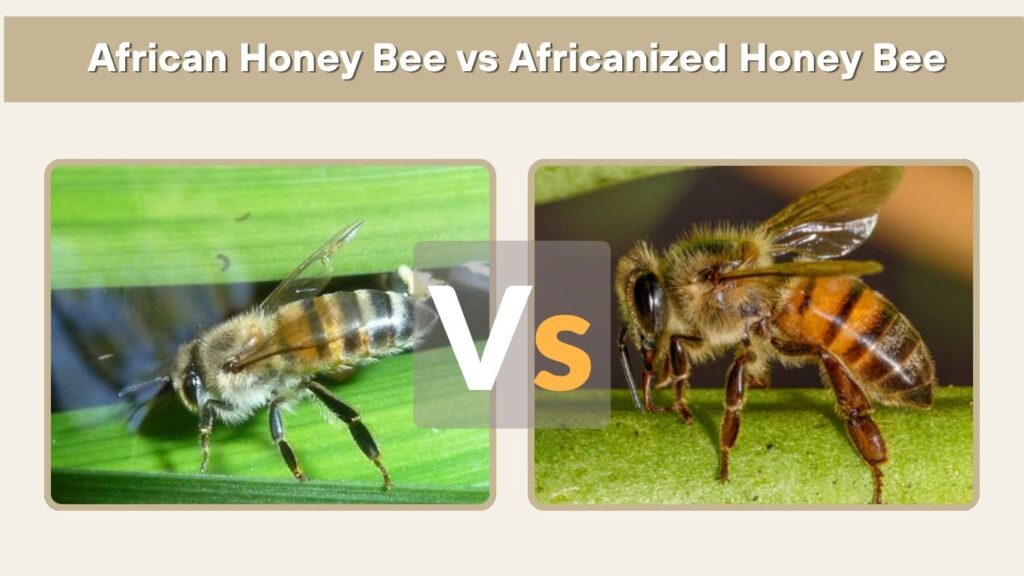
These terms should not be treated as exactly interchangeable.
An African honey bee generally refers to honey bee populations or subspecies native to Africa, such as Apis mellifera scutellata.
An Africanized honey bee refers to populations in the Americas descended substantially from African honey bees introduced into Brazil beginning in the 1950s, with varying degrees of ancestry from other honey bee populations.
That history is why “Africanized” is a more accurate term for the bees now found in parts of the Americas.
Which Is More Dangerous?
At the level of a single bee, the difference is relatively small. Both can sting and both can cause serious allergic reactions in susceptible people.
At the colony level, Africanized honey bees present a greater potential hazard because their nests are usually defended more intensely and by greater numbers of workers.
Never deliberately disturb an unknown honey bee colony to determine whether it is Africanized.
If a large number of bees begin attacking, move rapidly away from the nest and enter an enclosed building or vehicle if possible. Do not remain nearby trying to swat individual bees.
Similarities Between Africanized and European Honey Bees
Despite their behavioral differences, the two have much in common.
Both live in organized colonies containing queens, workers, and drones. Both undergo egg, larval, pupal, and adult stages. They construct wax comb, raise brood, collect pollen and nectar, make honey, communicate within their colonies, and pollinate flowering plants.
This biological similarity is expected because both belong to the same species.
FAQs
Are Africanized bees bigger than regular honey bees?
No. Africanized workers tend to be slightly smaller on average than some European honey bees, but the difference is generally too subtle for reliable visual identification.
Are Africanized honey bees more venomous?
An individual Africanized bee’s sting is not substantially more dangerous than a regular European honey bee sting. The greater danger comes from the stronger colony response and possibility of receiving many stings.
Can regular honey bees become Africanized?
European-derived honey bees and Africanized bees can interbreed because they belong to the same species. Populations can therefore contain different levels of African and European ancestry.
Do Africanized bees make honey?
Yes. Africanized honey bees collect nectar and produce honey just as other western honey bees do.
What is the main difference between Africanized bees and honey bees?
The biggest practical difference is nest-defense behavior. Africanized colonies generally react faster, respond with more defending workers, swarm more frequently, and use a broader variety of nesting spaces than typical European honey bee colonies.