
The western honey bee (Apis mellifera), also called the European honey bee, is one of the world’s best-known and most important pollinating insects. It lives in highly organized colonies containing a queen, thousands of female workers, and seasonal male drones. Western honey bees collect nectar and pollen, produce honey and wax, and pollinate many agricultural and wild plants. Although usually nonaggressive while foraging, workers can sting when defending their colony. Their complex communication, social behavior, and adaptable lifestyle make them remarkable insects.
Western Honey Bee Identification and Classification
Western honey bees are medium-sized, hairy bees with golden-brown to dark brown bodies marked by lighter abdominal bands. Their fuzzy appearance helps distinguish them from many smooth-bodied wasps. Individual appearance varies among subspecies, but all western honey bees share the same general body structure and highly social colony organization.
Scientific Name and Taxonomy
The western honey bee is classified as:
- Scientific name: Apis mellifera
- Genus: Apis
- Family: Apidae
- Order: Hymenoptera
- Class: Insecta
- Kingdom: Animalia
- Common names: Western honey bee, European honey bee
The name Apis mellifera roughly refers to a honey-bearing or honey-producing bee.
Western Honey Bee Size and Characteristics
Worker bees are generally about 12–15 mm long, although size varies. Queens are noticeably larger because of their elongated abdomens, while drones are stockier and have very large eyes.
Western honey bees have two pairs of wings, six legs, compound eyes, antennae, and a body covered with branching hairs. Worker females also have pollen-carrying structures on their hind legs.
Queen, Worker and Drone Western Honey Bees
Every healthy colony contains different castes with specialized jobs. A single reproductive queen normally lives alongside thousands of female workers. Male drones appear mainly during periods when colonies are reproducing. These castes differ in body size, lifespan, behavior, and function, but they work together as one highly organized social unit.
Western Honey Bee Queen
The queen is the primary reproductive female. She has a longer abdomen than workers and may lay well over 1,000 eggs per day during periods of rapid colony growth.
Her primary functions include reproduction and producing pheromones that help regulate colony behavior. A queen can live for several years, although beekeepers may replace queens sooner if egg production declines.
Worker and Male Honey Bees
Worker bees are sterile or functionally non-reproductive females responsible for most colony activities.
Their jobs include:
- Cleaning cells
- Feeding larvae
- Caring for the queen
- Producing wax
- Building honeycomb
- Guarding the entrance
- Ventilating the hive
- Collecting nectar, pollen, water, and plant resins
Male western honey bees are called drones. Their primary biological role is to mate with virgin queens. Drones do not have stingers and do not collect pollen or nectar.
Western Honey Bee Habitat and Range

Originally associated with Europe, Africa, and western portions of Asia, Apis mellifera has been transported by people to many other parts of the world. Today it occurs widely in North America, South America, Australia, and many other regions because of managed beekeeping, agriculture, and established feral colonies.
Where Do Western Honey Bees Live?
Western honey bees can survive in many environments as long as flowers, water, and suitable nesting sites are available. Common habitats include:
- Farmland
- Meadows and grasslands
- Orchards
- Gardens
- Forest edges
- Urban and suburban areas
- Mediterranean habitats
- Temperate woodlands
Wild or feral colonies commonly nest in hollow trees, rock cavities, wall voids, and other protected spaces.
Western Honey Bee Hive and Nest
A colony builds parallel sheets of wax honeycomb containing thousands of six-sided cells. These cells are used for raising young and storing honey and pollen.
Workers produce wax from glands on their abdomens and shape it into comb. Colonies maintain remarkably stable internal conditions by clustering for warmth during cold weather and using wing movement and evaporative cooling during hot periods.
Western Honey Bee Diet and Pollination

Western honey bees depend almost entirely on flowering plants for food. Workers collect nectar as a carbohydrate source and pollen as an important source of protein, fats, vitamins, and minerals. Their repeated movements between flowers make them valuable pollinators for numerous crops and wild flowering plants.
What Do Western Honey Bees Eat?
Their principal foods include:
- Nectar: Provides sugars and energy
- Honey: Stored, concentrated nectar used as an energy reserve
- Pollen: Provides protein and other nutrients
- Bee bread: Pollen stored and processed within cells
- Royal jelly: Glandular food used especially for queen larvae
- Water: Important for cooling and colony functions
Worker bees transform nectar into honey and store it in capped honeycomb for periods when flowers are scarce.
Plants Pollinated by Western Honey Bees
Western honey bees visit an enormous variety of flowering plants. Depending on location, they commonly pollinate fruit trees, berries, vegetables, oilseed crops, nuts, herbs, and wildflowers.
Their agricultural value comes partly from their ability to live in large colonies containing thousands of active foragers. Managed hives can therefore be transported to flowering crops when additional pollination is needed.
Western Honey Bee Sting and Safety
Worker western honey bees possess a defensive stinger. They usually sting when they believe the colony or themselves is threatened rather than deliberately hunting people. A bee feeding quietly on flowers is generally much less defensive than bees located close to an active nest.
Do Western Honey Bees Sting or Bite?
Female workers can sting. Their barbed stinger often becomes lodged in human skin, causing the bee to pull away and leave the stinger and associated structures behind.
A typical sting may produce:
- Immediate sharp or burning pain
- Redness
- Local swelling
- Itching
- Tenderness around the sting site
Honey bees can also use their mandibles to manipulate materials, but biting people is not their primary defensive mechanism.
Are Western Honey Bees Dangerous?
For most people, a single sting causes temporary localized discomfort. However, multiple stings can be dangerous, and people with severe allergies to bee venom can experience a life-threatening reaction.
Honey bee colonies should not be disturbed unnecessarily. A large swarm resting temporarily in a tree may be relatively calm, while an established colony protecting brood and stored honey may react much more defensively.
Western Honey Bee Life Cycle and Lifespan
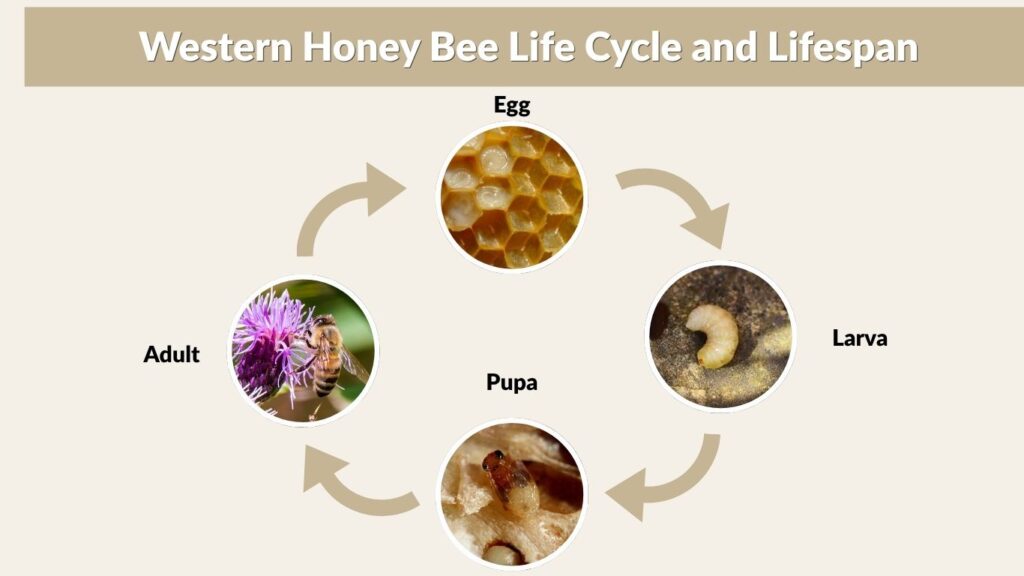
Western honey bees undergo complete metamorphosis with four stages: egg, larva, pupa, and adult. The developmental period differs among queens, workers, and drones. Colony growth is closely connected with temperature, flower availability, food reserves, and the reproductive condition of the queen.
From Egg to Adult Bee
The queen deposits an egg inside a wax cell. After about three days, the egg hatches into a small larva. Nurse workers feed and care for the growing larva before the cell is capped.
Development generally takes about:
- Queen: 16 days
- Worker: 21 days
- Drone: 24 days
Queens develop more quickly because they receive different nutrition and are raised in specialized queen cells.
How Long Does a Western Honey Bee Live?
Lifespan depends strongly on caste and season. Summer workers often live only several weeks because intensive foraging causes considerable wear. Workers produced for winter can survive for several months.
Drones usually live for weeks or a few months, although successful mating causes immediate death. Queens can survive several years under favorable conditions.
Western Honey Bee Swarming and Reproduction
Swarming is the natural method by which a honey bee colony reproduces at the colony level. When conditions are favorable and a colony becomes crowded, workers begin raising new queens. The old queen may then leave with thousands of workers to establish another nest.
What Happens During a Swarm?
A typical swarming process includes:
- Queen cells are produced
- The existing queen leaves with many workers
- The swarm temporarily clusters on a tree or structure
- Scout bees search for a suitable cavity
- The swarm moves into its new home
- A young queen takes control of the original colony
A hanging swarm can look alarming, but bees in a temporary swarm generally have no established nest or brood to defend.
Western vs. Eastern Honey Bee
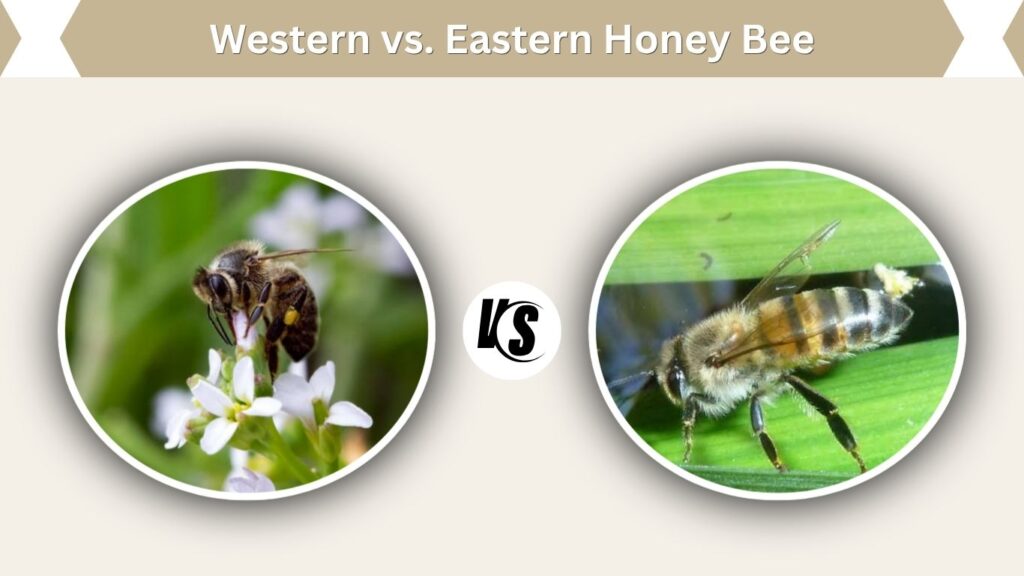
The western honey bee is Apis mellifera, while the eastern or Asian honey bee is generally known as Apis cerana. They are separate species, although both form social colonies, build comb, store honey, and are managed by humans in parts of their ranges.
Main Differences
Western honey bees generally form larger colonies and have become the dominant managed honey bee across much of the world. Eastern honey bees are native primarily to Asia and have adaptations to local predators and parasites.
Apis cerana, for example, has evolved behavioral defenses against some Asian hornets and has a long history of traditional beekeeping across its native range.
The terms European honey bee and western honey bee, however, normally refer to the same species, Apis mellifera.
FAQs
What is the scientific name of the western honey bee?
The scientific name of the western honey bee is Apis mellifera. It belongs to the family Apidae and orders Hymenoptera.
Is the western honey bee the same as the European honey bee?
Yes. Western honey bees and European honey bees are common names for Apis mellifera. The species includes numerous geographic subspecies and managed lineages.
How long does a western honey bee live?
Summer worker bees commonly survive for several weeks, while winter workers can live for several months. Queens may live several years, and drones generally survive for weeks or months unless they mate.
Does a western honey bee have a stinger?
Female worker western honey bees have barbed stingers used primarily for defense. Queens also possess stingers, while male drones do not.
Is the western honey bee endangered?
The western honey bee as a species is not generally considered on the verge of extinction because enormous numbers are maintained in managed colonies worldwide. However, individual managed and wild populations can face serious pressures from parasites, diseases, pesticides, poor nutrition, habitat changes, and other environmental stresses.