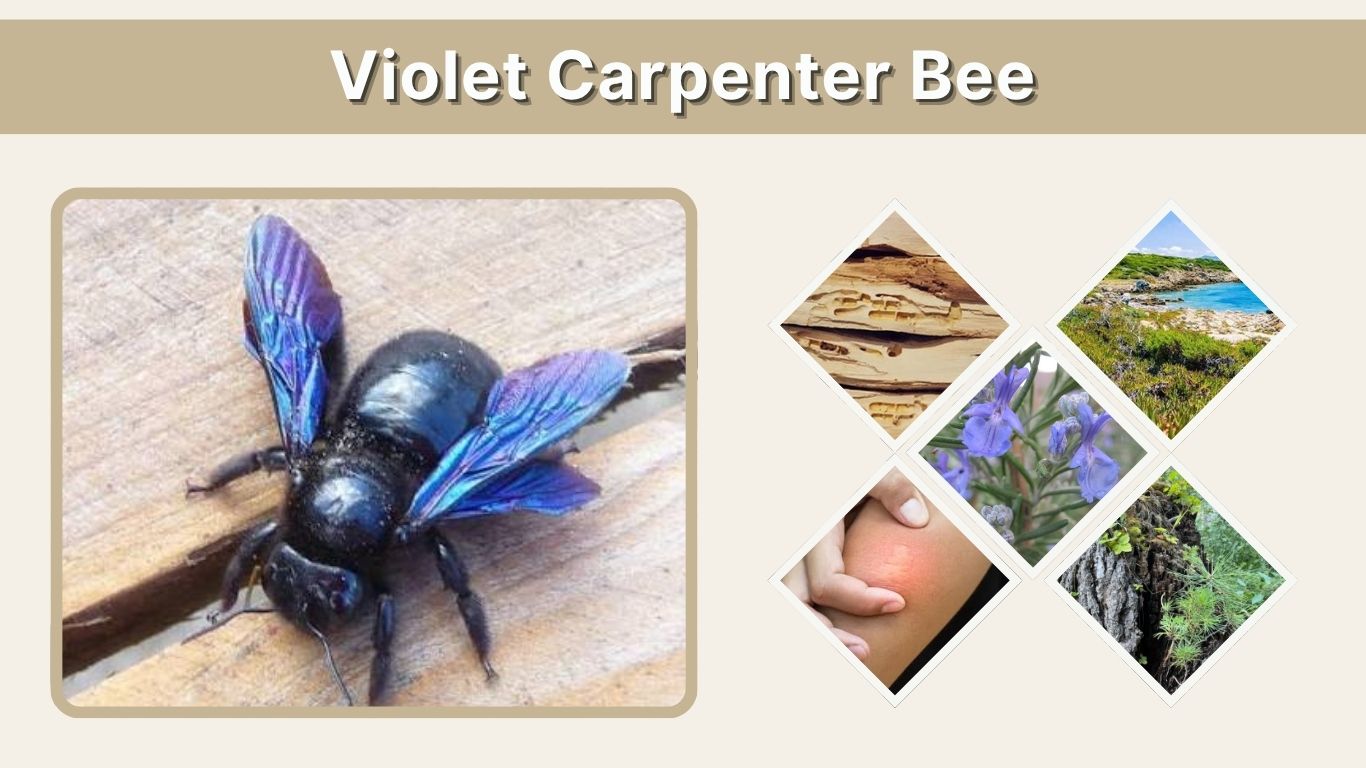
The violet carpenter bee (Xylocopa violacea) is one of Europe’s largest and most striking bees. Its glossy black body, powerful build, and violet-blue wings can make it look intimidating, but this solitary bee is generally peaceful. Violet carpenter bees are important flower visitors and pollinators, while females create nests by tunneling into dead or weathered wood. From their unusual nesting behavior to their impressive size, these bees are fascinating insects worth understanding rather than fearing.
What Is a Violet Carpenter Bee?
The violet carpenter bee belongs to the family Apidae and the genus Xylocopa. Its scientific name is Xylocopa violacea. It is particularly well known throughout parts of Europe and the Mediterranean region and also occurs farther east into parts of Asia. The species has also been expanding its range in some cooler European regions.
Identification
You can recognize a violet carpenter bee by several distinctive characteristics:
- Body color: Mostly shiny black
- Wings: Dark with strong violet, blue, or purple iridescence
- Body shape: Thick, heavy, and robust
- Body hair: Mainly dark or black
- Flight: Fast, powerful, and noticeably noisy
- Size: Commonly around 20–25 mm, although particularly large individuals may approach 30 mm
- Scientific name: Xylocopa violacea
The combination of a black body and shimmering violet wings makes this bee relatively easy to recognize, although it can sometimes be confused with closely related carpenter bees such as Xylocopa valga.
Violet Carpenter Bee Size
Adults are among the largest bees found in Europe. Many measure roughly 2 to 2.5 cm long, making them comparable in size to a large queen bumblebee. Their broad bodies and dark wings can make them appear even larger while flying.
Some females have been recorded at approximately 25–30 mm.
Despite their large size, they are not naturally aggressive toward people.
Are Violet Carpenter Bees Dangerous?
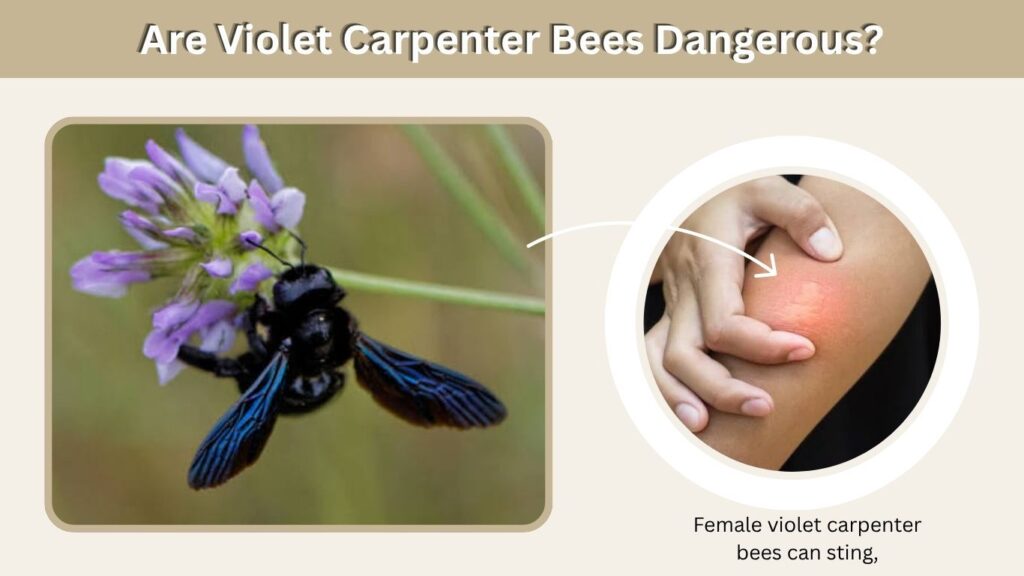
Seeing a giant black bee buzzing nearby can be alarming, especially when its wings produce a loud sound. However, violet carpenter bees are generally defensive only when threatened. They spend most of their time searching for flowers, mates, suitable nesting wood, or nesting materials.
Do Violet Carpenter Bees Sting?
Female violet carpenter bees can sting, but they rarely do so unless they are trapped, squeezed, handled, or strongly threatened.
Males cannot sting.
For most people, simply seeing one feeding on flowers or flying around the garden is not a reason for concern.
Avoid:
- Catching the bee with your hands
- Blocking an active nest entrance
- Squeezing or trapping females
- Disturbing nesting wood unnecessarily
Giving the bee space is normally enough to avoid problems.
Do Violet Carpenter Bees Bite?
Carpenter bees have strong mandibles that females use to excavate wood. However, they are not insects that normally “bite” humans for defense or food.
A sting from a defensive female is the more realistic possibility, and even that is uncommon under normal circumstances.
Violet Carpenter Bee Male vs Female
Male and female violet carpenter bees look similar from a distance. Both have dark bodies and violet-blue wings, but several characteristics can help distinguish them. One particularly useful feature involves the antennae.
How to Tell Males and Females Apart
- Male: Has 13 antennal segments
- Female: Has 12 antennal segments
- Male antennae: Usually show reddish, orange, or yellowish coloration near the tips
- Female antennae: Typically appear entirely dark
- Male: Cannot sting
- Female: Has a functional sting
- Female: Performs most nest excavation and provisioning
The colored antennal segments near the tip are particularly helpful for recognizing male Xylocopa violacea.
Violet Carpenter Bee Nest
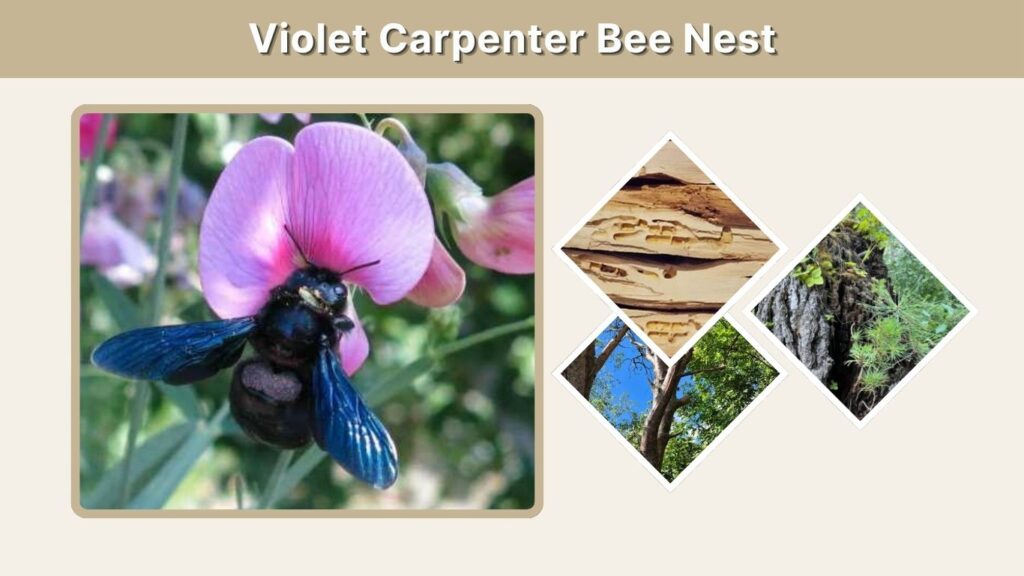
The name “carpenter bee” comes from the female’s ability to excavate nesting tunnels in wood. Unlike termites, carpenter bees do not eat wood. Instead, females use powerful jaws to remove material and construct chambers where their offspring develop.
Where Do They Nest?
Violet carpenter bees commonly choose:
- Dead tree trunks
- Dead branches
- Weathered timber
- Wooden posts
- Old beams
- Soft or decaying wood
- Hollow or damaged plant stems
- Abandoned carpenter bee tunnels
Suitable nesting sites are usually dry, relatively sheltered, and easier for females to excavate.
Research on X. violacea has documented its strong preference for woody or hollow plant substrates and the construction of long internal nesting chambers.
Inside the Nest
After creating a tunnel, the female divides the interior into individual brood cells. She gathers pollen and nectar from flowers and creates a food supply for each developing larva.
An egg is placed with the stored food, and the female creates partitions between cells. The larvae then develop inside these protected chambers.
What Do Violet Carpenter Bees Eat?
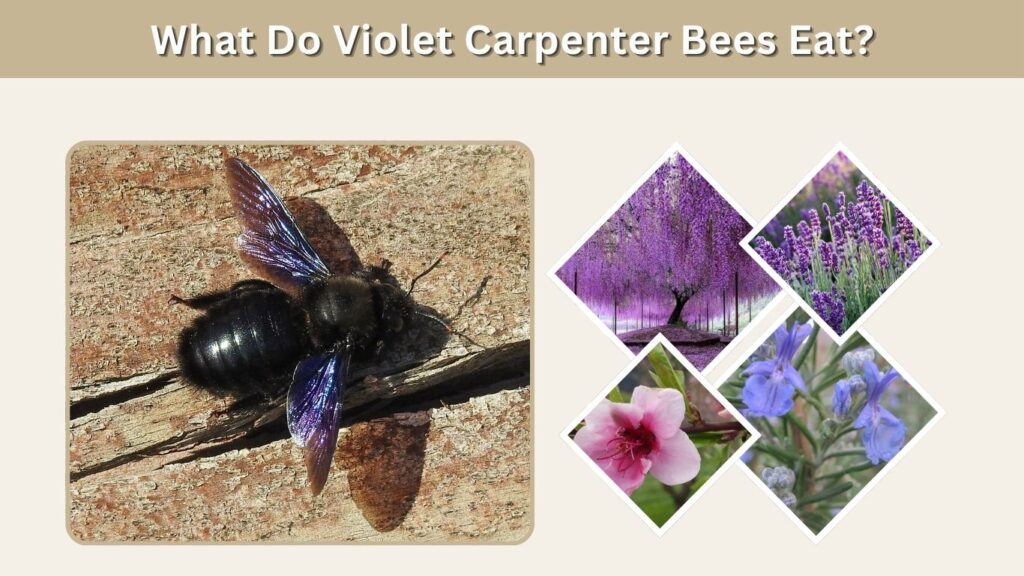
Adult violet carpenter bees feed primarily on nectar and pollen from flowers. Their large bodies allow them to visit many flowering plants and carry substantial quantities of pollen.
They commonly feed from:
- Lavender
- Wisteria
- Sage
- Rosemary
- Fruit-tree blossoms
- Legumes
- Garden flowers
- Various wildflowers
Their flower-visiting behavior makes them useful pollinators in gardens and natural habitats.
Do Violet Carpenter Bees Make Honey?
Violet carpenter bees do not produce stored honey like honey bees.
They are mostly solitary bees rather than colony-forming honey producers. Females collect nectar and pollen and combine these foods into provisions for their larvae. This material is stored inside individual brood cells rather than being accumulated as honey for a large colony.
Violet Carpenter Bees Habitat and Distribution
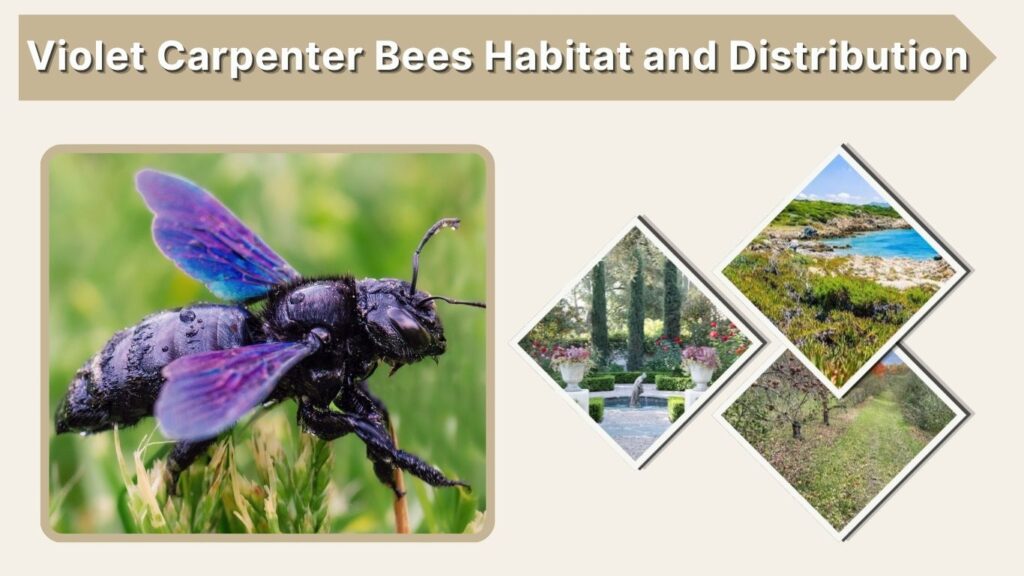
Violet carpenter bees prefer areas where flowering plants and suitable dead wood occur together. Warm, sunny locations are particularly attractive because adults require flowers for food while females need wood or hollow vegetation for nesting.
Common Habitats
They may occur in:
- Gardens
- Orchards
- Woodland edges
- Mediterranean scrub
- Parks
- Farms
- Vineyards
- Flower-rich meadows
- Rural villages
- Areas containing old trees and dead wood
Violet Carpenter Bee in the UK
The species was historically an occasional visitor to Britain, but breeding was confirmed during the 2000s. Records have increased as the species has expanded northward, although it remains far less familiar in Britain than many common bumblebees. The Wildlife Trusts notes that occasional British records occurred as far back as the nineteenth century, with breeding later confirmed in England.
Are Violet Carpenter Bees Rare?
Whether the violet carpenter bee is considered rare depends heavily on location.
It can be fairly common around warmer Mediterranean areas while remaining uncommon or locally rare toward the northern edge of its distribution.
Therefore, seeing one in Italy, southern France, Croatia, Greece, or other warmer European areas may not be particularly unusual, while a sighting farther north can be more noteworthy.
Violet Carpenter Bee Life Cycle
The life cycle revolves around mating, nest construction, egg laying, larval development, and the emergence of a new generation. Exact timing varies according to climate.
Main Life Cycle Stages
- Adults become active: Overwintered bees emerge as temperatures increase.
- Mating occurs: Males search for receptive females.
- Females find nesting sites: Suitable dead wood or hollow stems are inspected.
- Nest tunnels are prepared: Females excavate or reuse cavities.
- Food is collected: Pollen and nectar are placed inside brood cells.
- Eggs are laid: Usually one egg is associated with each food provision.
- Larvae develop: Young bees consume stored pollen and nectar.
- New adults emerge: A new generation eventually leaves the nest.
- Overwintering occurs: Adults can shelter through cooler months before becoming active again.
In temperate environments, the species generally produces one generation annually, although seasonal timing varies greatly with climate.
Interesting Violet Carpenter Bee Facts
The dramatic appearance of this bee hides several interesting adaptations.
- Violet carpenter bees are among Europe’s largest bees.
- Their wings can appear violet, blue, or purple depending on the light.
- Females excavate wood but do not eat it.
- Males cannot sting.
- Females are capable of stinging but rarely attack people.
- They are primarily solitary rather than colony-forming bees.
- Females provide pollen and nectar for each larva.
- Their loud flight often makes them appear more threatening than they really are.
- They are valuable flower visitors and pollinators.
- Their range has expanded into some cooler parts of Europe.
FAQs
1. Is a violet carpenter bee dangerous?
Generally, no. Violet carpenter bees are not aggressive insects. Females can sting if seriously threatened or handled, while males cannot sting.
2. How big is a violet carpenter bee?
Adults are commonly around 20–25 mm long, making them some of the largest bees found in Europe.
3. Where do violet carpenter bees build nests?
Females usually nest in dead, weathered, or relatively soft wood. They may use dead trees, branches, wooden structures, posts, beams, or hollow plant stems.
4. Do violet carpenter bees produce honey?
No. They do not create honey stores like honey bees. Females collect pollen and nectar mainly to prepare food provisions for developing larvae.
5. Why are violet carpenter bees black and purple?
Their bodies are predominantly black, while the wings have structural coloration that produces beautiful violet-blue or purple reflections when light strikes them from different angles.