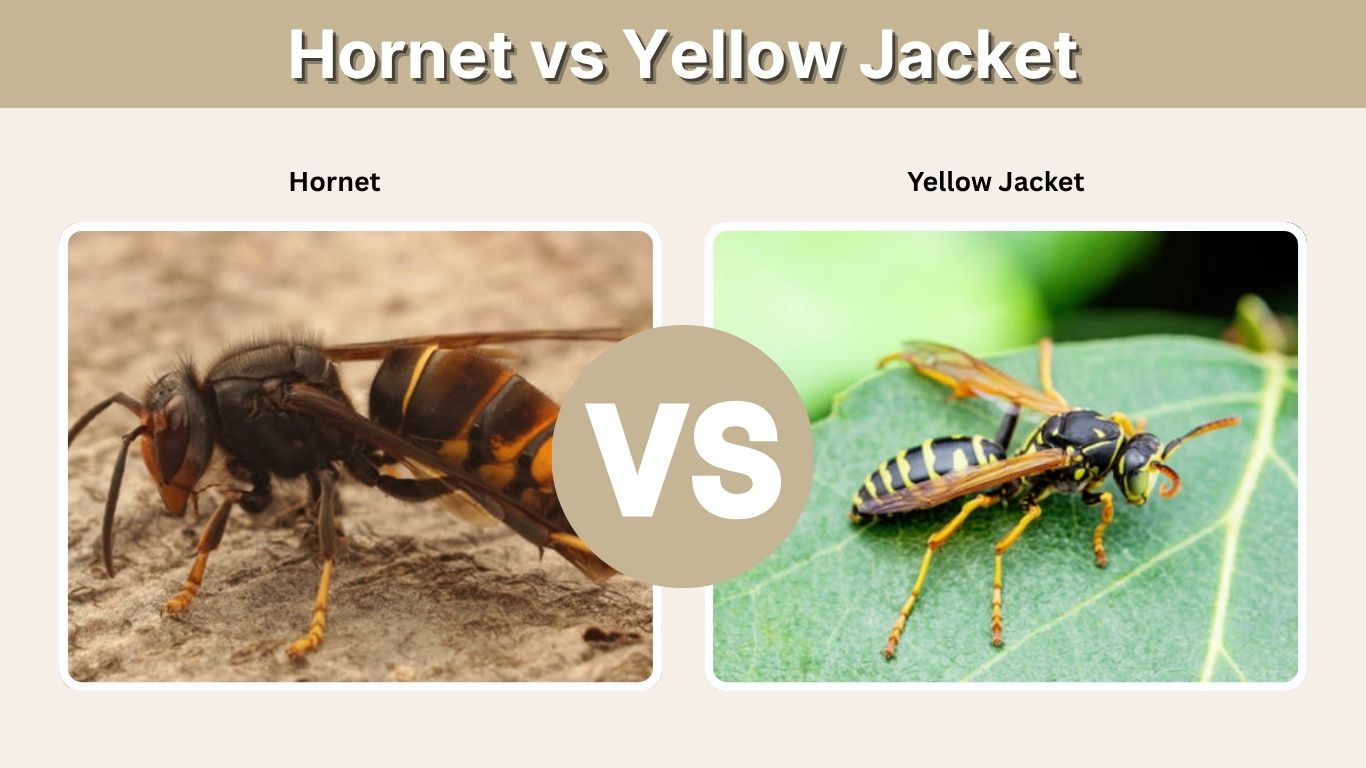
Hornets and yellow jackets are closely related social wasps, but they differ in size, color, nesting habits, and behavior. Yellow jackets are usually small, brightly patterned insects frequently seen around food, while true hornets are generally larger and may have reddish-brown, yellow, or dark markings. Confusion increases because the bald-faced hornet is not a true hornet—it is an aerial yellow jacket. Learning the differences can help you identify a nest, reduce sting risks, and decide whether professional control is necessary.
Hornet vs Yellow Jacket: Quick Comparison
Both insects belong to the wasp family Vespidae. However, “wasp” is a broad term, while yellow jackets and true hornets represent narrower groups. In North America, yellow jackets usually belong to Vespula or Dolichovespula, whereas true hornets belong to the genus Vespa.
| Feature | Yellow jacket | Hornet |
| Typical size | About 3/8–5/8 inch | Commonly 3/4 inch or larger |
| Common colors | Bright yellow and black | Brown, reddish, yellow, black or white |
| Body surface | Smooth and shiny | Smooth, with a heavier-looking body |
| Common nest sites | Underground, walls or cavities | Trees, shrubs or protected cavities |
| Food attraction | Often visits meat, sweets and garbage | More commonly hunts insects or feeds on plant sugars |
| Sting ability | Can sting repeatedly | Can sting repeatedly |
| Temperament | Often persistent around food and defensive near nests | Usually most defensive close to the nest |
Yellow jackets are approximately 3/8 to 5/8 inch long, while European hornet workers may reach an inch and queens can approach 1.3 inches. Bald-faced hornets, although technically aerial yellow jackets, are around 3/4 to 7/8 inch long.
How to Identify Hornets and Yellow Jackets
Color alone is not always enough for accurate identification. Size, body shape, feeding behavior and nest location provide stronger clues.
Yellow jacket appearance
Yellow jackets normally have:
- Bright yellow and black abdominal patterns
- A compact body with a narrow waist
- A smooth, hard surface with very little hair
- Dark antennae and folded wings when resting
- A body length of roughly half an inch
They are sometimes mistaken for honey bees, but honey bees are fuzzier, golden-brown and equipped with specialized hairs for carrying pollen. Yellow jackets are smooth and are not normally seen carrying pollen.
True hornet appearance
The European hornet is the most familiar established true hornet in much of eastern North America. It is significantly larger than a typical yellow jacket and has a reddish-brown head and thorax, with a mostly yellow abdomen marked by darker patterns. European hornets range from approximately 3/4 to 1⅜ inches long.
Bald-faced hornet appearance
A bald-faced hornet is mainly black with white or cream markings on its face and abdomen. Despite its common name, it belongs to Dolichovespula and is more accurately considered a large aerial yellow jacket. It constructs a conspicuous gray paper nest above ground.
Hornet Nest vs Yellow Jacket Nest
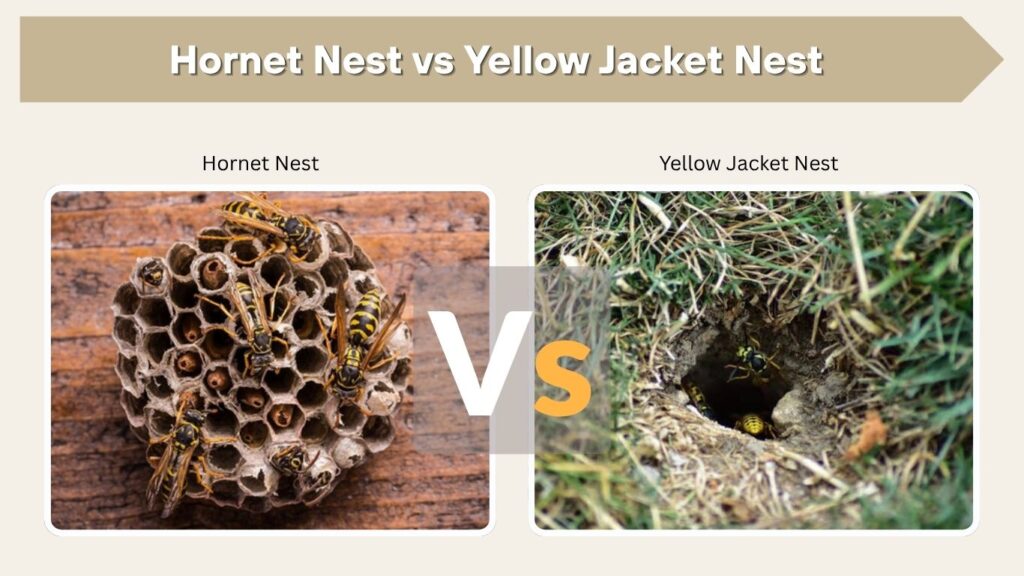
Nest placement is one of the easiest ways to distinguish these insects. Both create paper from chewed wood fibers mixed with saliva, but they frequently choose different nesting locations.
| Nest characteristic | Yellow jacket nest | Hornet nest |
| Typical location | Underground or inside a cavity | Trees, shrubs, eaves or hollow spaces |
| Visibility | Usually hidden | Often clearly visible |
| Exterior | Papery envelope, usually concealed | Gray or brown enclosed paper shell |
| Shape | Rounded nest fitted into a cavity | Football, teardrop or oval shape |
| Entrance | Small opening leading underground or into a structure | Opening commonly near the lower section |
| Colony duration | Usually one season | Usually one season |
Yellow jacket nests
Many yellow jackets nest in abandoned rodent burrows, hollow logs, landscape timbers, wall voids and attics. The small entrance may be the only visible sign of a large underground colony. Other species build aerial nests, demonstrating why nest location should not be the only identification clue.
Hornet nests
Bald-faced hornets build enclosed aerial nests in trees, shrubs or under building eaves. European hornets usually prefer protected cavities such as hollow trees, wall spaces, barns or other sheltered areas rather than exposed hanging nests.
Never strike, shake or approach an occupied paper nest to inspect it. Social wasps strongly defend their colonies, and a nest can contain hundreds or thousands of individuals.
Wasp vs Hornet vs Yellow Jacket
A wasp is not a separate insect category alongside hornets and yellow jackets. Instead, hornets and yellow jackets are both types of wasps.
| Insect | Main identification clues | Typical nest |
| Yellow jacket | Compact, smooth, yellow and black | Ground burrow or enclosed cavity |
| True hornet | Larger, heavier body; often brown and yellow | Hollow tree or structural cavity |
| Bald-faced hornet | Black and white; larger than most yellow jackets | Enclosed aerial paper nest |
| Paper wasp | Slender body with long dangling legs | Open, umbrella-shaped comb |
| Honey bee | Hairy golden-brown body; may carry pollen | Wax comb inside a hive or cavity |
Paper wasps are usually more slender than yellow jackets, with noticeably long legs that hang down during flight. Their nests consist of exposed cells without the surrounding paper envelope found on yellow jacket and hornet nests.
Hornet Sting vs Yellow Jacket Sting
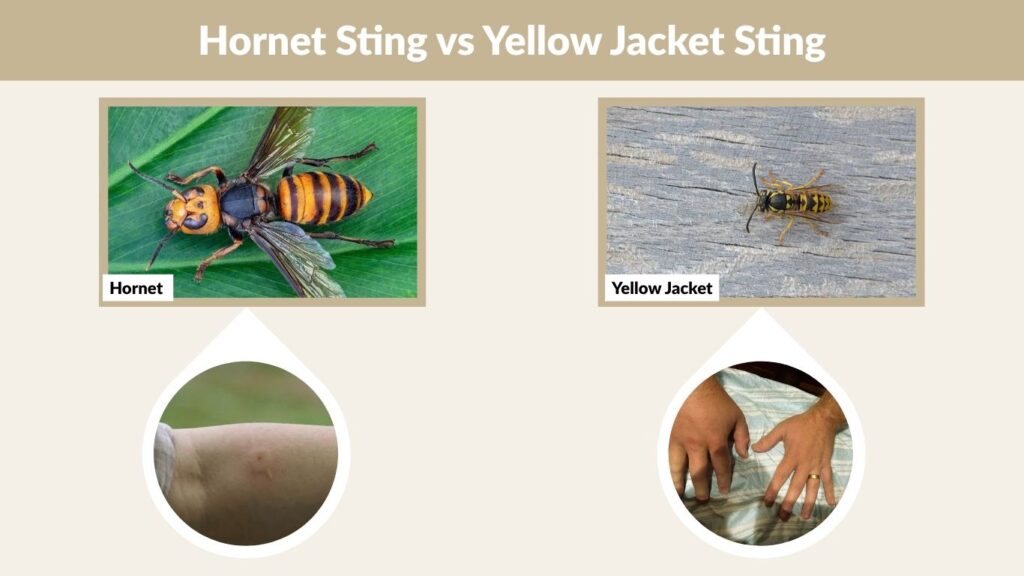
Both hornets and yellow jackets can sting repeatedly because they can withdraw their stingers without tearing them from their bodies. Honey bees differ because their barbed stinger often remains in human skin after a sting.
Which is more aggressive?
Yellow jackets are responsible for many encounters because certain species scavenge around garbage, picnics, outdoor drinks, meat and ripe fruit. Their colonies can become especially noticeable during late summer and fall.
Hornets generally do not pursue people without a reason, but they can become highly defensive when someone approaches or disturbs their nest. Individual behavior varies by species, colony size, season and distance from the nest.
Which sting hurts more?
A hornet’s larger size does not automatically make every sting more dangerous. Pain and swelling vary according to the species, sting location, number of stings and the person’s sensitivity.
Most stings cause temporary burning, redness, itching or swelling. Difficulty breathing, faintness, widespread hives, throat swelling or facial swelling can indicate anaphylaxis and require immediate emergency medical treatment.
Ground Hornet vs Yellow Jacket
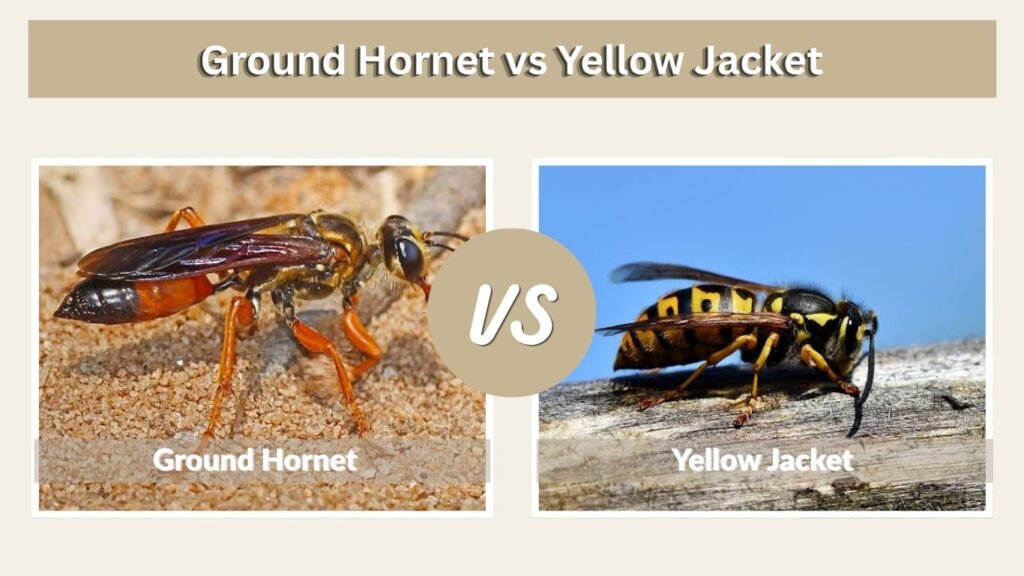
“Ground hornet” is an informal name rather than a precise identification. People may use it for ground-nesting yellow jackets, cicada killers or other large wasps.
A steady stream of small yellow-and-black insects entering one hole usually suggests a yellow jacket colony. A large solitary wasp using an individual burrow may be a cicada killer. Solitary wasps generally avoid people and do not collectively defend their nests as aggressively as yellow jackets do.
Should You Remove the Nest?
A nest in a distant tree or low-traffic area may be left alone. Social wasps hunt caterpillars, flies, spiders and other insects, so they can provide ecological benefits.
Professional treatment should be considered when a nest is:
- Near a doorway, walkway or playground
- Inside an attic, wall or ceiling
- Underground in a frequently used lawn
- Close to children or pets
- Difficult to reach without a ladder
- Near someone with a known sting allergy
Do not attempt DIY removal when allergic to stings. Pest-control professionals have protective equipment and appropriate tools for treating concealed or heavily populated nests.
FAQs
Are yellow jackets a type of hornet?
Yellow jackets and hornets are both social wasps, but typical ground-nesting yellow jackets are not true hornets. True hornets belong to the genus Vespa. However, confusing common names exist: the bald-faced hornet is technically an aerial yellow jacket rather than a true hornet.
Is a bald-faced hornet bigger than a yellow jacket?
Yes. Bald-faced hornets commonly measure about 3/4 to 7/8 inch long, while most yellow jackets range from approximately 3/8 to 5/8 inch. Bald-faced hornets are also black and white, unlike the bright yellow-and-black pattern associated with most yellow jackets.
Which is worse, a hornet or a yellow jacket?
Neither is always worse. Yellow jackets create frequent conflicts because they visit human food and often nest underground. Hornets are larger and may deliver painful stings, but encounters are usually associated with approaching their nests. Both should be treated cautiously.
Do hornets and yellow jackets reuse old nests?
Most yellow jacket, bald-faced hornet and paper wasp colonies use their nests for only one season. Fertilized queens overwinter elsewhere and establish new colonies the following spring. Old nests usually remain empty, although another colony may build nearby if conditions are suitable.
How can I tell a yellow jacket from a honey bee?
Yellow jackets have smooth, shiny bodies with sharp yellow-and-black patterns. Honey bees are golden-brown and noticeably fuzzy, especially around the thorax. Bees may carry pollen on their hind legs, whereas yellow jackets do not collect visible pollen and often investigate meat or sugary food.