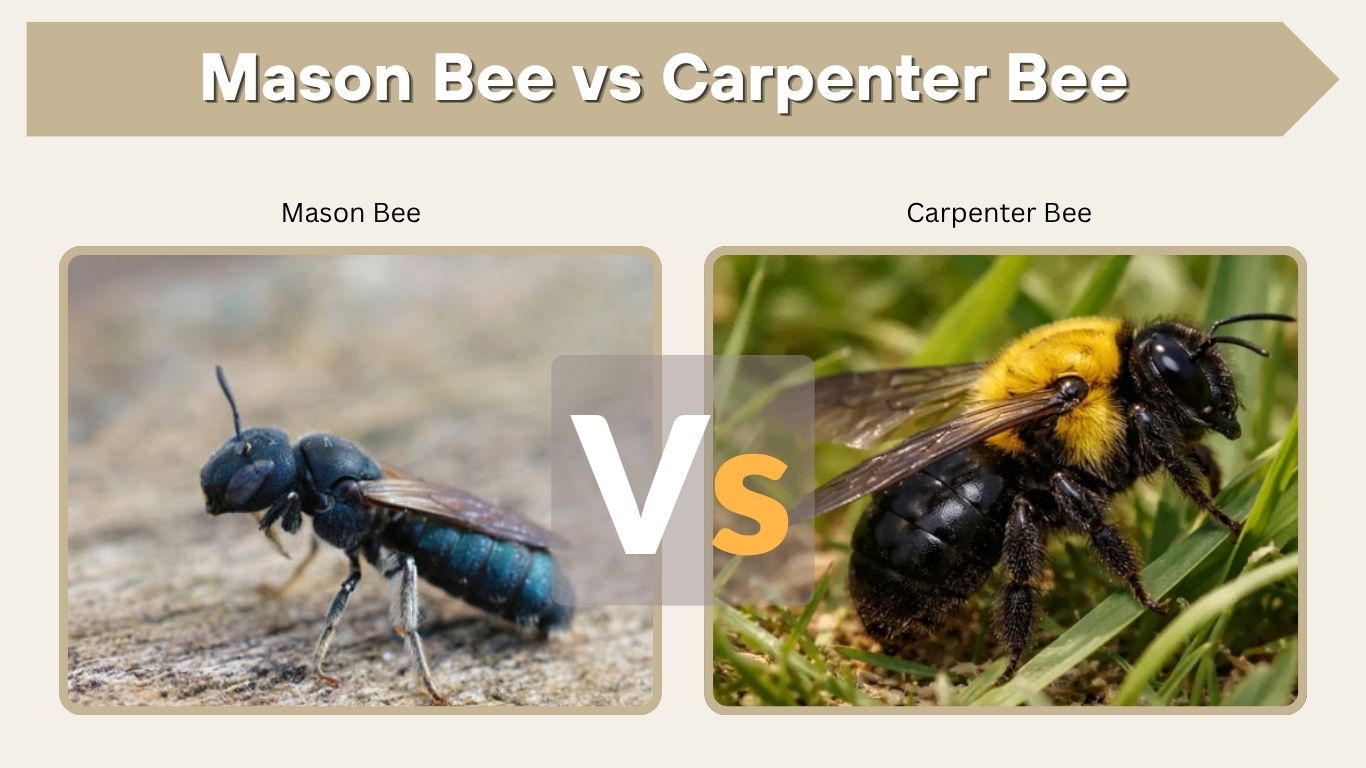
The mason bee vs carpenter bee comparison can be confusing because both are solitary native bees and valuable pollinators. However, they differ considerably in appearance, nesting habits, size, and their relationship with wood. Mason bees usually use existing holes and seal brood cells with mud, while carpenter bees excavate their own tunnels in unfinished or weathered wood. Mason bees are generally smaller and often metallic, whereas carpenter bees are much larger with shiny black abdomens. Understanding these differences helps you protect beneficial bees while recognizing when wood damage needs attention.
Mason Bee vs Carpenter Bee: Quick Comparison
Both insects are solitary bees, meaning individual females build and provision their own nests rather than forming large colonies like honey bees. Their nesting strategies, however, are almost opposite. Mason bees occupy pre-existing cavities, while carpenter bees use powerful jaws to excavate tunnels in wood.
Main Differences
- Mason bee: usually relatively small and often metallic blue, green, or dark
- Carpenter bee: large, often around 3/4–1 inch long
- Mason bee nest: existing holes, hollow stems, or bee houses
- Carpenter bee nest: tunnels excavated directly into wood
- Mason bee building material: mud partitions
- Carpenter bee building material: excavated wooden galleries
- Mason bee wood damage: normally none
- Carpenter bee wood damage: possible with repeated nesting
- Both: important flower pollinators
- Both: generally much less defensive than social bees
What Does a Mason Bee Look Like?
“Mason bee” refers to numerous species, particularly members of the genus Osmia. In North America, familiar examples include the blue orchard mason bee, Osmia lignaria. Many species have dark metallic bodies that may appear blue, green, or nearly black. Their compact appearance can make them look surprisingly different from the familiar yellow-and-black image of a bee.
Mason Bee Size and Appearance
Blue orchard mason bee females are approximately comparable in size to honey bees, while males are somewhat smaller. Other Osmia species vary considerably.
Mason bees frequently have rounded abdomens and hairs used for transporting pollen. Females of many mason bee species carry pollen on hairs beneath the abdomen rather than in pollen baskets on the hind legs.
Their metallic coloration is one of the easiest features to notice on species such as the blue orchard bee.
What Does a Carpenter Bee Look Like?
Carpenter bees are dramatically larger. The eastern carpenter bee, Xylocopa virginica, is generally about 0.75–1 inch long. It can initially resemble a bumblebee because its thorax is covered with yellowish hairs.
How to Recognize a Carpenter Bee
The abdomen provides the clearest clue. Carpenter bees typically have a large, shiny, mostly hairless black abdomen, while bumblebees remain fuzzy across much more of the abdomen.
Male carpenter bees may hover aggressively around nest entrances and fly toward people. Despite this intimidating behavior, males cannot sting. Females can sting but rarely do unless handled or strongly provoked.
Mason Bee vs Carpenter Bee Nesting Habits
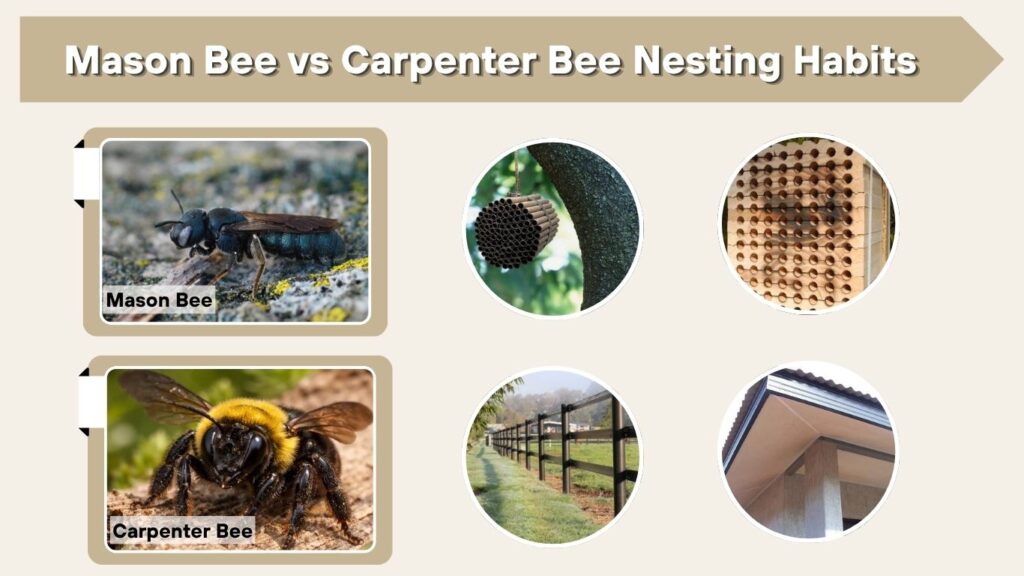
Nesting behavior is arguably the easiest way to distinguish these bees around a home. Both make individual brood chambers containing pollen and an egg, but they obtain their nesting cavities in very different ways.
How Mason Bees Nest
Mason bees do not normally excavate their own tunnels in solid wood. They search for existing cavities such as hollow stems, beetle holes, cracks, and artificial nesting tubes.
Inside the cavity, a female gathers pollen and nectar, deposits an egg, and uses mud or similar material to divide the tunnel into separate brood cells. She eventually seals the entrance with a mud plug.
This is why gardeners can encourage mason bees using properly maintained nesting tubes or removable nesting blocks.
How Carpenter Bees Nest
Female carpenter bees create their own nest galleries. They commonly select unfinished, weathered, or exposed wood and chew an almost perfectly round entrance approximately 1/2 inch in diameter.
After entering the wood, the tunnel turns and follows the grain. Galleries can extend roughly 6–12 inches and may be enlarged or reused in later years.
Common locations include:
- Decks
- Fence posts
- Fascia boards
- Eaves
- Railings
- Siding
- Outdoor furniture
- Other exposed wooden structures
Do Mason Bees Damage Wood?
Mason bees are not considered wood-boring bees. If you find one entering a wooden structure, it is usually using an existing crack, beetle tunnel, or another ready-made cavity rather than excavating sound wood.
Will Mason Bees Use Carpenter Bee Holes?
Yes, a suitable abandoned carpenter bee tunnel can potentially provide the kind of pre-existing cavity that a mason bee needs. Mason bees naturally seek holes already created by other organisms or physical processes.
Finding mud sealing an older wooden hole can therefore indicate that a mason bee has occupied an existing cavity rather than created the original damage.
Do Carpenter Bees Cause Structural Damage?
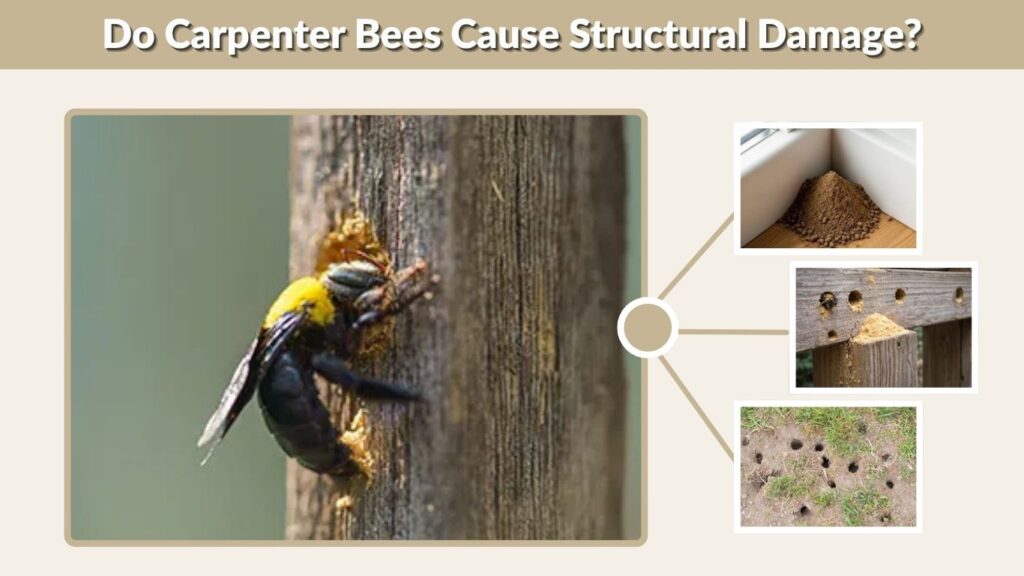
A single carpenter bee tunnel usually produces limited damage. Problems arise when the same wood is reused and expanded over several generations or when numerous females establish galleries in one structure.
Signs of Carpenter Bee Damage
Look for:
- Nearly perfect round holes about 1/2 inch wide
- Coarse sawdust beneath an entrance
- Large bees repeatedly entering wood
- Yellowish or dark staining near nest holes
- Numerous old and new tunnels in the same board
Repeated nesting may weaken wood, and secondary problems can include moisture intrusion and woodpecker damage.
Painting exposed wood and repairing cracks can discourage future carpenter bee nesting. University of Maryland Extension notes that well-maintained painted wood is rarely attacked compared with unfinished or weathered surfaces.
Mason Bee vs Carpenter Bee as Pollinators
Both bees are beneficial pollinators, so carpenter bees should not automatically be treated as pests simply because they appear around a property.
Are Mason Bees Good Pollinators?
Yes. Blue orchard mason bees are especially valuable for spring-blooming fruit crops such as apples, cherries, and pears. Their body hairs and pollen-carrying behavior allow them to transfer substantial amounts of pollen between flowers.
Mason bees also tend to forage relatively close to their nests, which makes them particularly valuable around orchards and gardens.
Are Carpenter Bees Pollinators Too?
Yes. Carpenter bees regularly visit flowers for nectar and pollen and are important native pollinators. University of Maryland Extension specifically recommends control only when they are damaging wooden structures.
Some carpenter bees can also perform buzz pollination, making them useful visitors to certain flowers.
Mason Bee vs Carpenter Bee Sting Risk
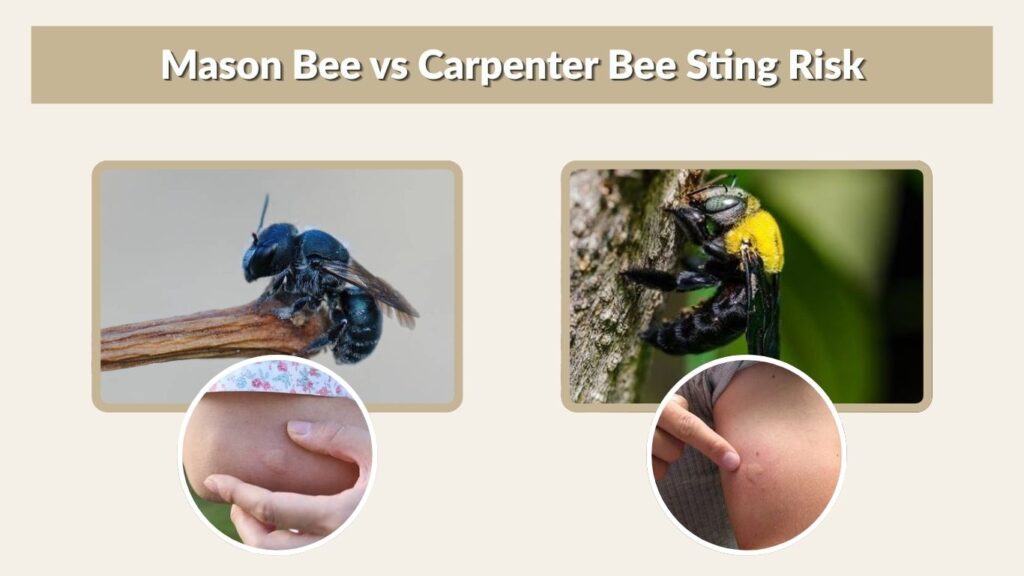
Neither species normally behaves like a defensive honey-bee colony or yellowjacket nest because both are primarily solitary.
Which One Is More Aggressive?
Mason bees are generally very docile. Females can sting, but they normally do so only when trapped or handled roughly; males cannot sting.
Male carpenter bees often appear more aggressive because they patrol nesting territories and may hover directly in front of people. They cannot sting. Female carpenter bees possess stingers but rarely sting unless seriously disturbed.
Do Mason Jar Carpenter Bee Traps Catch Mason Bees?
The keyword “mason jar carpenter bee trap” can cause confusion because “mason” refers to the glass jar, not mason bees.
A typical mason-jar carpenter bee trap is designed around the nesting behavior of carpenter bees. It attempts to attract carpenter bees through openings resembling wooden nest entrances, after which they enter a collection container.
Should You Trap Carpenter Bees?
Not every carpenter bee needs to be removed. If the bees are simply visiting flowers, they provide useful pollination and require no control.
When repeated nesting is damaging a wooden structure, prevention is generally the better long-term approach. Repair old holes at an appropriate time, fill cracks, and maintain exposed wood with paint or other suitable protective finishes.
Carpenter bee traps should not be placed around mason bee houses or used indiscriminately against beneficial solitary bees.
Mason Bee or Carpenter Bee: Which One Do You Have?
If the bee is small, metallic, and entering a pre-existing narrow cavity capped with mud, you are probably seeing a mason bee.
If it is a very large bee with a shiny black abdomen and is actively drilling a clean circular hole into exposed wood, a carpenter bee is much more likely.
Behavior and nesting evidence are often more dependable than color alone.
FAQs
1. Is a Mason Bee the Same as a Carpenter Bee?
No. Mason bees and carpenter bees belong to different groups and have different nesting habits. Mason bees use existing cavities and construct mud partitions, whereas carpenter bees excavate tunnels directly into wood.
2. Which Is Bigger, a Mason Bee or Carpenter Bee?
Carpenter bees are generally much larger. Eastern carpenter bees reach roughly 3/4–1 inch long, while many mason bees are around honey-bee size or smaller.
3. Are Mason Bees Harmful to Houses?
Usually not. Mason bees do not normally drill into solid wood. They use existing holes, cracks, hollow stems, or artificial nesting tubes.
4. Should I Kill Carpenter Bees?
Usually not simply because they are present. Carpenter bees are native pollinators. Management becomes reasonable when repeated nesting is damaging structural wood; preventive wood finishing and repair can often reduce future problems.
5. Will Carpenter Bee Traps Harm Mason Bees?
A carpenter-bee trap is intended for carpenter bees, but any poorly designed or indiscriminately positioned trap can potentially affect unintended insects. Keep pest-control devices away from mason bee nesting areas and prioritize structural prevention when possible.