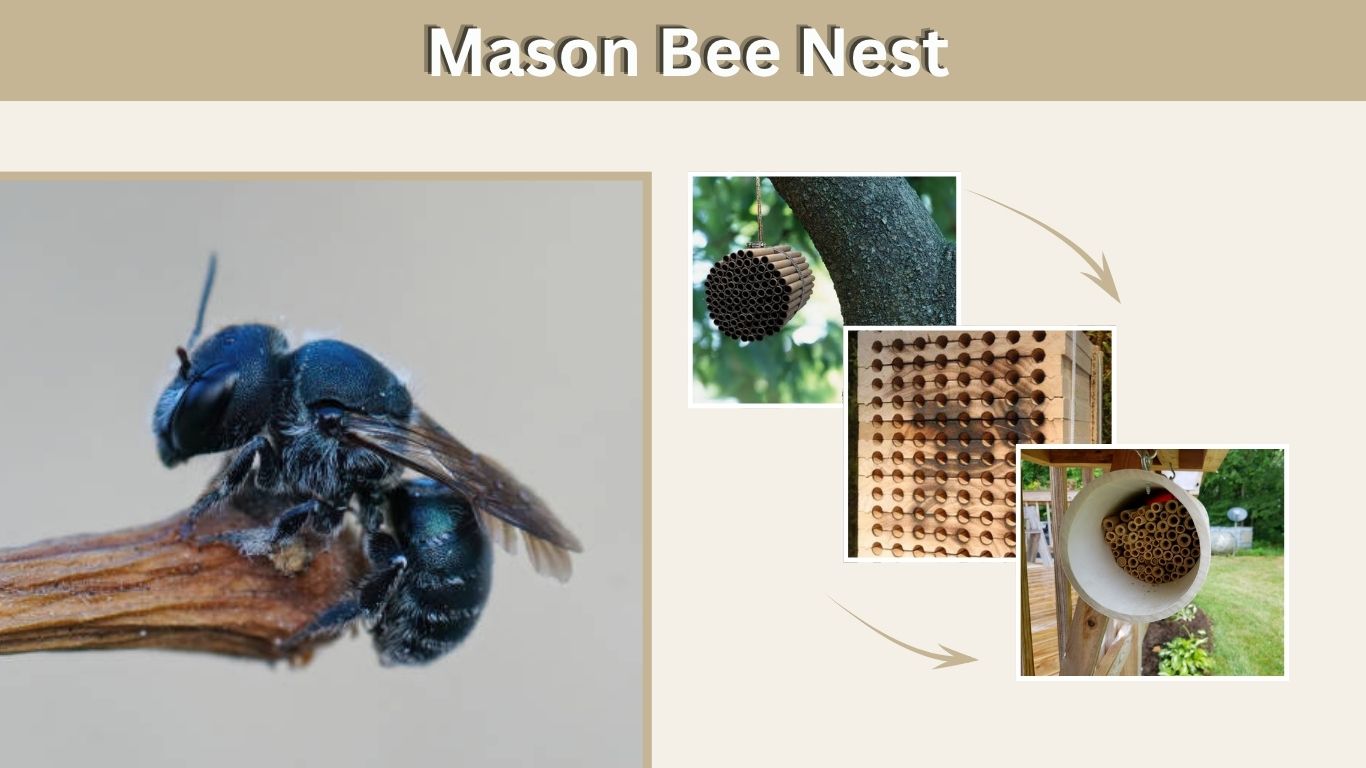
A mason bee nest provides safe nesting cavities for solitary mason bees, valuable spring pollinators that readily visit fruit trees, berries, and garden flowers. Unlike honey bees, mason bees do not build large communal hives. Females use existing holes, hollow stems, nesting tubes, or specially designed blocks, creating individual brood cells separated with mud. A well-designed nest box can encourage mason bees to remain in your garden, but tube size, depth, placement, moisture protection, and regular maintenance all matter if you want healthy bees year after year.
What Does a Mason Bee Nest Look Like?
Natural mason bee nests are usually much less obvious than honey bee hives. Mason bees are cavity nesters, so females search for existing tunnels such as old beetle holes in wood and hollow or pithy plant stems. Artificial nests imitate these natural cavities with tubes, reeds, or drilled and removable nesting systems.
Inside a Mason Bee Nest
A female starts at the back of a suitable tunnel. She gathers pollen and nectar, forms a food provision, lays an egg, and then creates a mud partition. She repeats the process toward the entrance until the tunnel contains several individual brood cells.
A completed mason bee tube typically has:
- Several brood chambers arranged in a row
- Pollen and nectar stored in each occupied cell
- One egg or developing larva per chamber
- Mud walls separating individual cells
- A visible mud plug sealing the entrance
Those mud-capped holes are one of the easiest signs that a nesting tube has been occupied by mason bees.
Mason Bee Nesting Tubes, Blocks, and Boxes
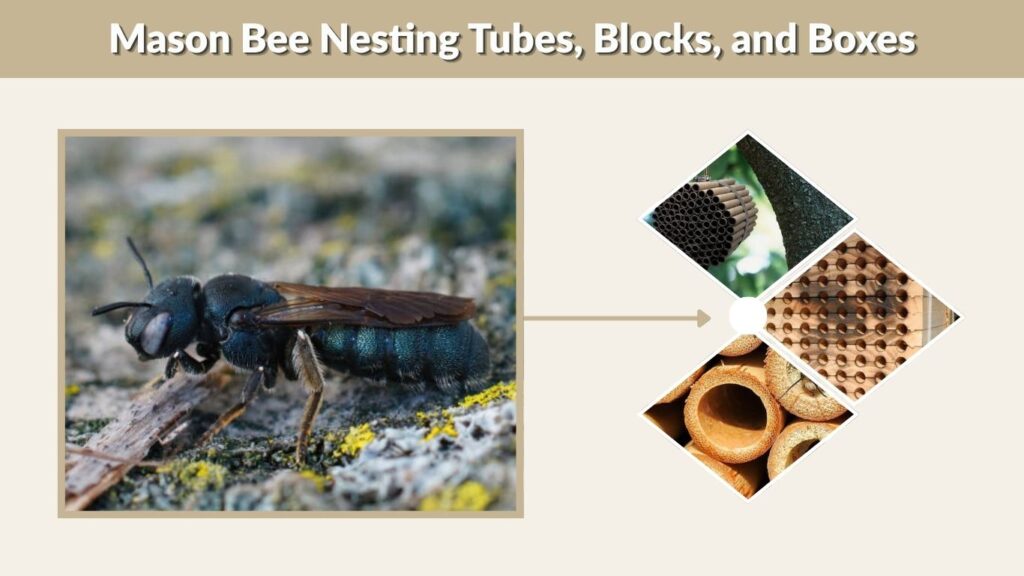
Artificial mason bee nests come in several forms, but not every design is equally easy to maintain. Good nest systems should provide appropriately sized cavities, stay dry, and ideally allow old nesting material to be replaced or opened for cleaning.
Mason Bee Nesting Tubes
For blue orchard mason bees (Osmia lignaria), Oregon State University recommends cardboard tubes with removable paper liners approximately 5/16 inch in diameter and 6 inches long, closed at the back. The liners allow cocoons to be accessed while the outer tubes may be reused.
Other tunnel-nesting bee species prefer different diameters. Washington State University notes that tunnels from about 7/32 to 3/8 inch can accommodate many cavity-nesting species, and around 6 inches of depth works well for many bees.
Mason Bee Nesting Blocks and Trays
Laminated wooden trays can be an excellent alternative because the nest can be opened after the season. Individual channels are cut into boards, and stacking them forms nesting tunnels.
This design gives gardeners access to the nest interior for inspection and cleaning. OSU recommends cleanable systems over permanent solid blocks that cannot be opened, because mites, mold, and parasites may accumulate over repeated nesting seasons.
Are Bamboo Tubes Good for Mason Bees?
Mason bees will use bamboo and hollow stems, and Xerces notes that bundles of hollow stems can provide useful nesting habitat. However, permanent bamboo nests can be difficult to open and clean. Xerces recommends regularly replacing nesting materials rather than leaving the same bee hotel indefinitely.
For managed orchard mason bees, removable paper liners, reeds, or opening trays generally make maintenance easier.
How to Make a DIY Mason Bee Nest
A mason bee nesting house does not need to be elaborate. The most important features are dry nesting cavities, a closed rear end, secure mounting, and protection from rain.
Simple DIY Mason Bee Nest
You can build a basic nest with:
- A small weather-resistant shelter with an overhanging roof
- Paper tubes or suitable natural reeds
- Nesting cavities roughly 6 inches deep for orchard mason bees
- Tubes closed at the back
- Several slightly different visual landmarks around the entrance
- A solid mounting point that prevents swinging
Washington State University even provides an educational design using rolled paper tubes placed inside a carton, demonstrating that a useful bee house can be made from relatively simple materials.
Avoid treated lumber inside the nesting cavities, and make sure the tunnel surfaces are reasonably smooth so emerging bees are not injured.
Where Should You Put a Mason Bee Nest?
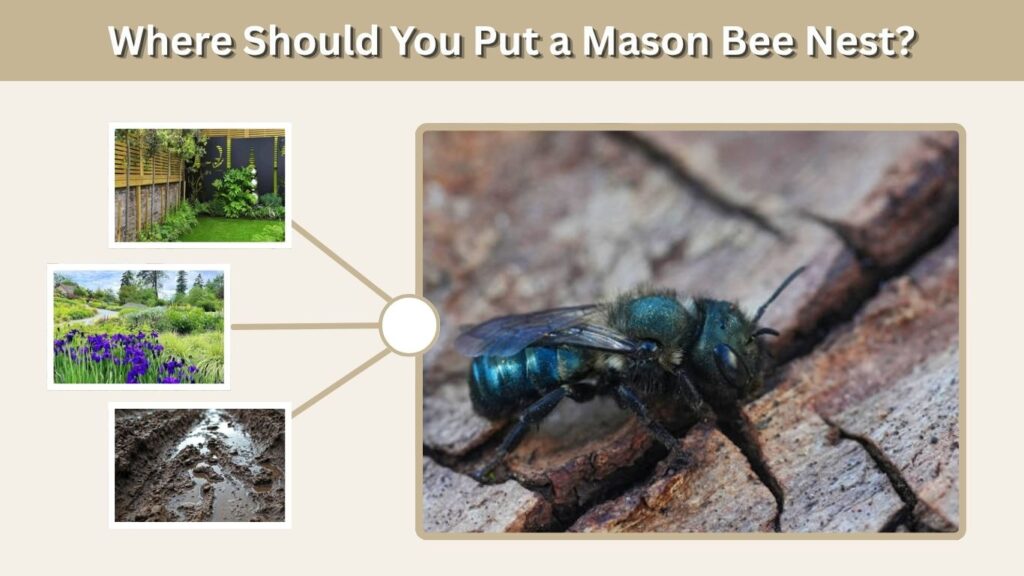
Location strongly affects whether bees accept a nest. Mason bees benefit from morning warmth, nearby flowers, suitable mud, and protection from rain and strong wind.
Best Mason Bee Nest Placement
A good location should:
- Face east, southeast, or toward morning sun
- Be firmly attached to a wall, fence, or post
- Remain protected from direct rainfall
- Have spring flowers nearby
- Provide access to moist soil or mud
- Avoid swinging or moving in the wind
- Be high enough to remain relatively undisturbed
WSU recommends southeast or south-facing placement with flowers within roughly 300 feet and access to mud. Another WSU source describes a successful nest mounted about five feet high with entrances facing southeast.
Why Mason Bees Need Mud
Mud is essential to mason bee reproduction. Females use it to construct the walls separating each offspring and to seal completed nest entrances.
A nest box surrounded by abundant flowers but located far from usable moist soil may be less attractive. If your garden becomes extremely dry during spring, maintaining a small source of damp, workable soil nearby can help nesting females.
When Do Mason Bees Start Nesting?
Mason bees are primarily spring pollinators. Timing varies with species and climate, but orchard mason bees are closely synchronized with flowering fruit trees.
For managed blue orchard bees, nesting material should be available before major orchard bloom begins. WSU recommends placing nesting materials out before apple flowering, or earlier when cherries or other fruit trees are already blooming.
Blue Orchard and Red Mason Bee Nests
The blue orchard bee (Osmia lignaria) is widely managed in North America because of its effectiveness around fruit trees. It readily uses artificial tubes and nesting blocks.
The red mason bee (Osmia bicornis) is widespread in Europe and uses similar pre-existing cavities, including natural holes and artificial nesting structures. Individual species can differ in preferred cavity dimensions and seasonal timing, so local recommendations are preferable when managing species other than the blue orchard bee.
How to Maintain a Mason Bee Nest
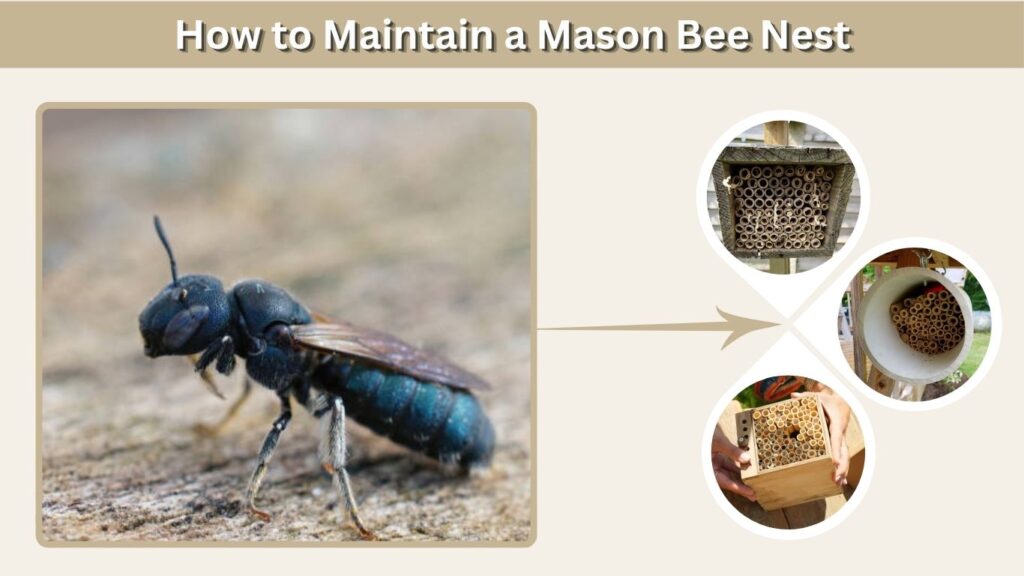
A bee hotel should not simply be hung outside and ignored for years. Concentrating many bees in one artificial structure can also concentrate mites, fungal problems, and parasites if nesting material is never replaced.
Keeping Nesting Tubes Healthy
Xerces recommends renewing hollow-stem nesting material regularly, while OSU favors tubes with removable liners or cleanable laminated blocks for managed orchard mason bees.
Good maintenance includes replacing old disposable tubes, keeping the nest dry, examining reusable systems, and avoiding overcrowded permanent bee hotels that cannot be cleaned.
Providing several smaller nesting sites can also resemble natural nesting conditions better than creating one enormous bee hotel.
What If Mason Bees Nest in a Wall?
Mason bees may use existing holes in buildings when suitable cavities are available. They are solitary bees and do not create honey-bee-style colonies inside walls.
If the bees are causing no immediate problem, allowing the current generation to finish development is often preferable to sealing an active entrance. Blocking an occupied cavity can trap developing bees.
After adults have emerged and activity has ended, unwanted openings can be repaired while a purpose-built nest box is provided nearby. If bees are entering complicated structural spaces or correct identification is uncertain, a local bee or pest professional can help determine the least disruptive solution.
Are Mason Bee Nests Dangerous?
Mason bees are generally valued as pollinators rather than treated as structural pests. They nest individually, even when many females use tubes close together.
Artificial nesting houses can therefore be placed in gardens, orchards, and educational spaces where pollination is desirable. The more significant challenge is usually maintaining clean, dry nesting material rather than protecting people from an aggressive colony.
FAQs
1. What Size Hole Is Best for a Mason Bee Nest?
For blue orchard mason bees, 5/16-inch-diameter tubes about 6 inches long are a commonly recommended size. Other cavity-nesting bees may use holes from roughly 7/32 to 3/8 inch.
2. Which Direction Should a Mason Bee House Face?
An east or southeast orientation is commonly recommended because morning sunlight helps warm the nest. Keep the house sheltered from rain and firmly mounted so it does not swing.
3. How Do I Know a Mason Bee Tube Is Occupied?
A finished mason bee nest normally has a visible mud plug across the tube entrance. Inside are multiple brood cells separated by additional mud partitions.
4. Can Mason Bees Use Carpenter Bee Holes?
Mason bees naturally use pre-existing tunnels and may occupy suitable abandoned holes when the dimensions are appropriate. They do not normally need to excavate large tunnels themselves.
5. When Should I Put Out Mason Bee Nesting Tubes?
Install nesting material before local mason bees become active in spring. For blue orchard bees, having nests available before fruit-tree bloom gives emerging females suitable cavities as soon as nesting begins.