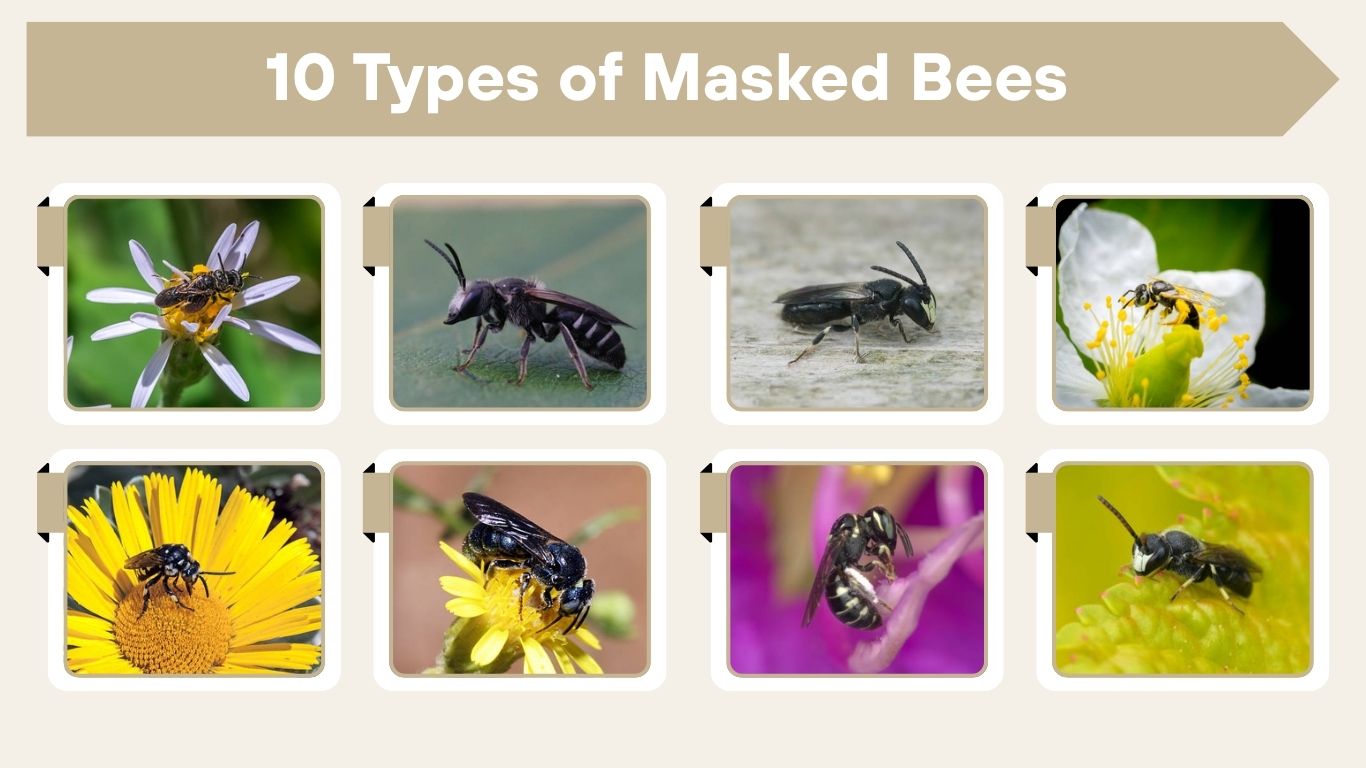
Masked bees are small, smooth-bodied solitary bees known for their pale face markings that often look like a tiny mask. Most belong to the Hylaeus group and are easy to mistake for small wasps because they have little visible hair. Unlike many bees, they do not carry pollen on their legs. Instead, females carry pollen and nectar inside their bodies to feed their young. These bees nest in small cavities, hollow stems, wood cracks, and bee hotels. Learning about different masked bees helps identify their appearance, habitat, behavior, and role as helpful pollinators.
1. Common Masked Bee
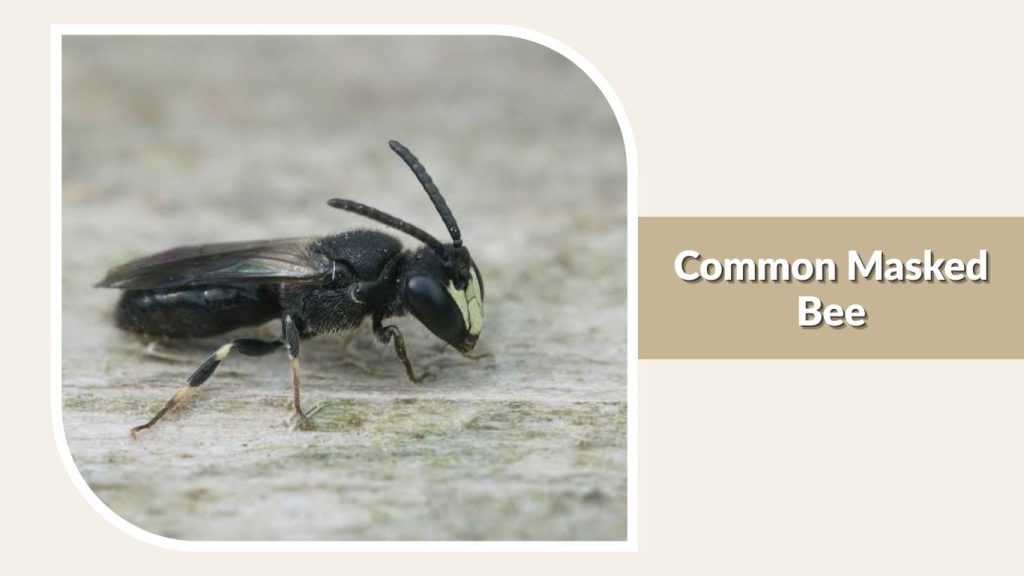
The Common Masked Bee is a small solitary bee from the Hylaeus group. It has a slim, almost hairless body and pale facial markings that look like a mask. Unlike many bees, it does not carry pollen on hairy legs. Instead, it carries nectar and pollen inside its body and later feeds them to its young.
Identification
- Small bee, usually around 4.5–7 mm long.
- Body is mostly black and slim.
- Face has pale yellow or white mask-like markings.
- Looks more like a tiny wasp than a fluffy bee.
- Body has very little visible hair.
- Females and males may have different facial markings.
- Often difficult to identify in the field without close inspection.
- Does not have large pollen baskets on the legs.
Habitat and Distribution
The Common Masked Bee is found in many open and semi-open habitats. It can live in gardens, parks, woodland edges, hedgerows, meadows, and disturbed areas near homes. It is especially adaptable and can survive in both natural and urban places.
This bee is native to the Palearctic region and is common across many parts of Europe and nearby areas. It may also appear in introduced ranges. Because it uses small cavities for nesting, it can live close to people when suitable nesting holes and flowers are available.
Behavior and Diet
The Common Masked Bee is a solitary bee, so it does not live in a large colony like honey bees. Each female prepares her own nest. Adults visit many kinds of flowers for nectar and pollen, making them generalist pollinators.
Instead of carrying pollen on leg hairs, the female stores pollen and nectar internally. She later regurgitates this food mixture inside the nest for her larvae.
Life Cycle
The female nests in small existing holes, such as hollow stems, cracks in wood, old insect tunnels, or bee hotels. She lines the nest cells with a thin waterproof secretion that helps protect the young.
Eggs hatch into larvae inside the sealed cells. The larvae feed on stored pollen and nectar, then develop into pupae. Adults usually appear during the warmer months, especially from late spring to summer.
2. Yellow-faced Masked Bee
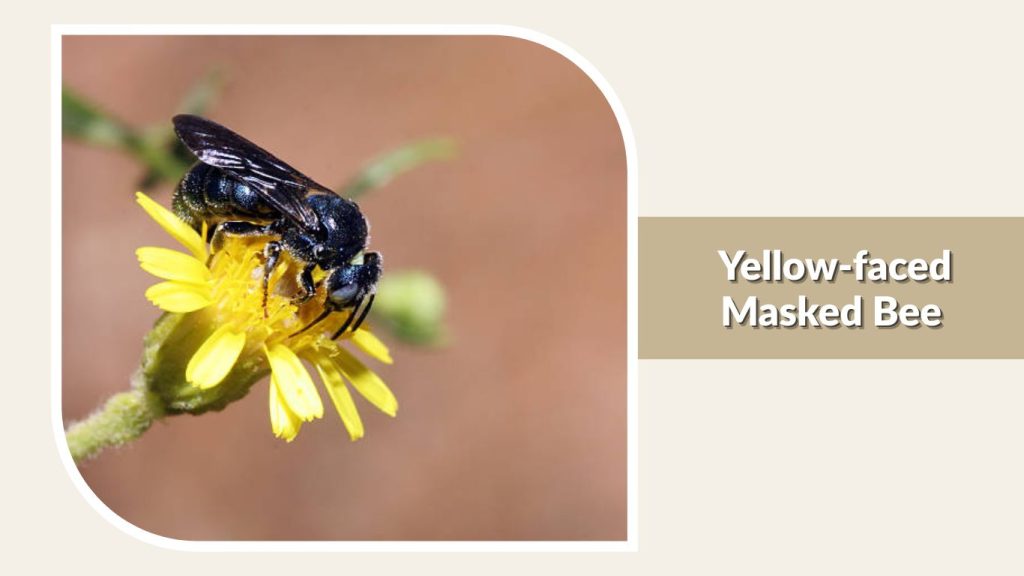
The Yellow-faced Masked Bee is a small solitary bee known for its bright yellow or pale facial markings. These markings often look like a mask, which gives the bee its common name. It belongs to the Hylaeus group and is usually smooth, dark, and less hairy than many other bees.
Identification
- Small bee with a slim black body.
- Face has yellow or pale cream markings.
- Body looks smooth and almost hairless.
- Often resembles a tiny wasp at first glance.
- Males usually have larger yellow facial markings.
- Females may have smaller marks near the eyes or face.
- Does not carry pollen on hairy legs.
- Wings are clear or lightly tinted.
- Usually seen visiting small flowers.
Habitat and Distribution
Yellow-faced Masked Bees are found in many open habitats where flowers and nesting sites are available. They may live in gardens, meadows, woodland edges, coastal areas, grasslands, and urban green spaces. Because they are small, they can use tiny nesting spaces that larger bees cannot use.
Different species of yellow-faced masked bees occur in different regions. Some are widespread, while others are more local. They often prefer places with plenty of small flowers, dry stems, or natural cavities for nesting.
Behavior and Diet
This bee is solitary, so each female builds and manages her own nest. It does not form a large colony or produce honey. Adults feed on nectar, while females collect pollen and nectar to provide food for their larvae.
Yellow-faced Masked Bees visit many types of flowers. They are often attracted to small, open blooms where their short mouthparts can easily reach nectar. Their pollination role is useful, especially for wildflowers and garden plants.
Life Cycle
The female usually nests in hollow plant stems, small holes in wood, cracks, or old insect tunnels. She creates separate brood cells and lines them with a waterproof secretion.
After laying an egg in each cell, she adds a mixture of pollen and nectar. The larva feeds inside the sealed cell, grows, pupates, and later emerges as an adult bee during the active season.
3. Hylaeus Masked Bee
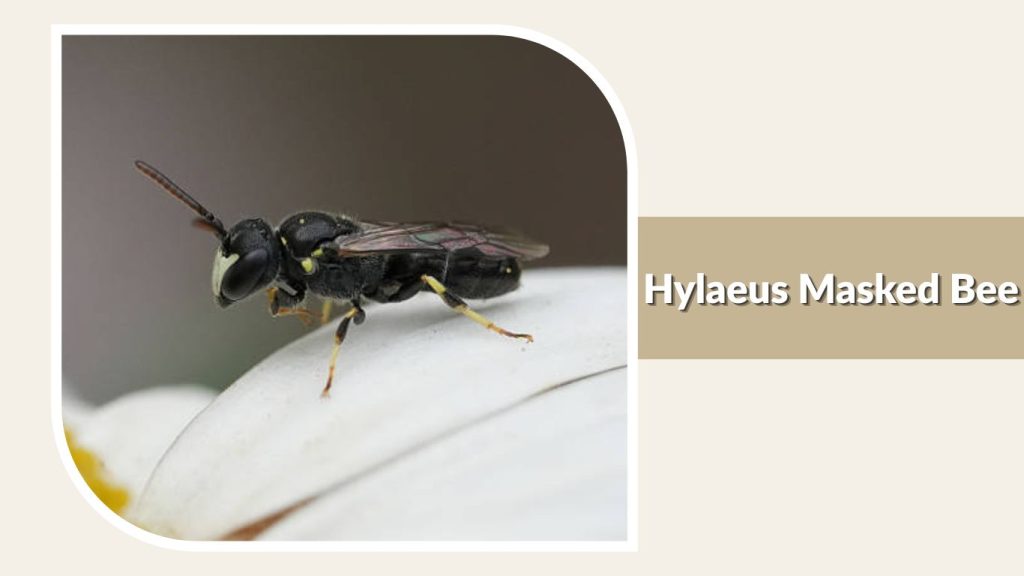
The Hylaeus Masked Bee is a small solitary bee known for its smooth black body and pale face markings. These bees are often mistaken for tiny wasps because they have very little hair. They are important pollinators of wildflowers, garden plants, and small flowering shrubs.
Identification
- Small bee with a narrow black body.
- Face usually has white, cream, or yellow mask-like markings.
- Body is smooth and not very hairy.
- Looks more like a small wasp than a typical bee.
- Does not have pollen baskets on the hind legs.
- Wings are clear or slightly smoky.
- Males often show larger facial markings than females.
- Usually seen on small open flowers.
- Fast-moving and easy to overlook because of its tiny size.
Habitat and Distribution
Hylaeus Masked Bees live in many habitats where flowers and nesting holes are available. They can be found in gardens, meadows, forest edges, grasslands, wetlands, dunes, and urban parks. Some species prefer dry open areas, while others live near shrubs, reeds, or woodland edges.
These bees occur in many parts of the world, with different species found across Europe, Asia, North America, Australia, and island regions. Their small size allows them to use narrow nesting spaces that many larger bees cannot enter.
Behavior and Diet
Hylaeus Masked Bees are solitary. Each female makes her own nest and cares for her own eggs. They do not live in honey bee-style colonies and do not make honey.
Adults feed on nectar from small flowers. Females collect both nectar and pollen, but they carry the mixture inside their crop instead of on their legs. Later, they place this liquid food inside each nest cell for the larvae.
Life Cycle
The female uses existing cavities for nesting. These may include hollow stems, beetle holes, reed tubes, cracks in wood, or artificial bee hotels. She lines each brood cell with a clear waterproof coating.
After placing food inside the cell, she lays one egg and seals it. The larva feeds, grows, pupates, and finally emerges as an adult during the warm season.
4. Hawaiian Yellow-faced Bee
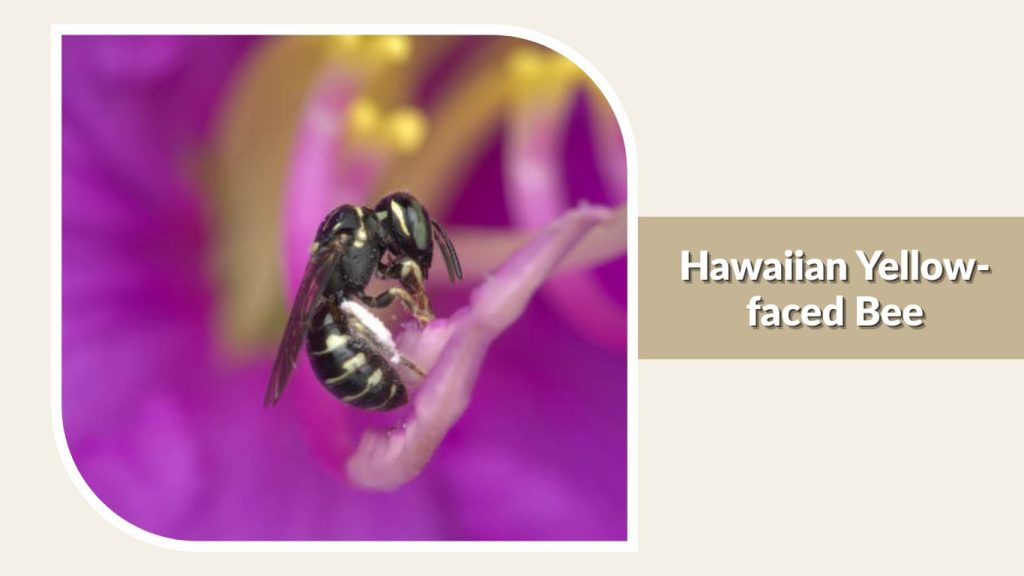
The Hawaiian Yellow-faced Bee is a small masked bee known for its pale facial markings and strong connection to native Hawaiian plants. Many species belong to the Hylaeus group. These bees are important native pollinators, but some species are now rare because of habitat loss, invasive species, and environmental changes.
Identification
- Small bee with a slender black body.
- Face has yellow or cream mask-like markings.
- Body is smooth and has very little visible hair.
- Looks similar to a tiny wasp.
- Males often have more noticeable yellow facial marks.
- Females usually have smaller facial markings.
- Does not carry pollen on hairy legs.
- Wings are clear or lightly smoky.
- Often seen around native Hawaiian flowers.
- Some species are difficult to identify without expert study.
Habitat and Distribution
Hawaiian Yellow-faced Bees are found only in Hawaii. Different species live on different islands and habitats. Some prefer coastal areas, while others live in dry forests, shrublands, lava fields, or mountain regions.
They are closely linked with native Hawaiian ecosystems. Many rely on native flowering plants for food and suitable nesting places. Some species have very limited ranges, which makes them vulnerable when their habitat is damaged or replaced by invasive plants.
Behavior and Diet
These bees are solitary, so each female builds her own nest and provides food for her young. They do not form large colonies and do not make honey. Adults feed on nectar, while females collect pollen and nectar for their larvae.
Hawaiian Yellow-faced Bees are valuable pollinators for native plants. Their small size allows them to visit delicate flowers that larger insects may ignore.
Life Cycle
Females usually nest in small natural cavities. These may include hollow stems, cracks in rocks, coral rubble, or old insect holes. Inside the nest, the female creates separate brood cells.
She places a soft mixture of pollen and nectar inside each cell, lays one egg, and seals it. The larva feeds inside the protected cell, grows, pupates, and later emerges as an adult bee.
5. Reed Masked Bee
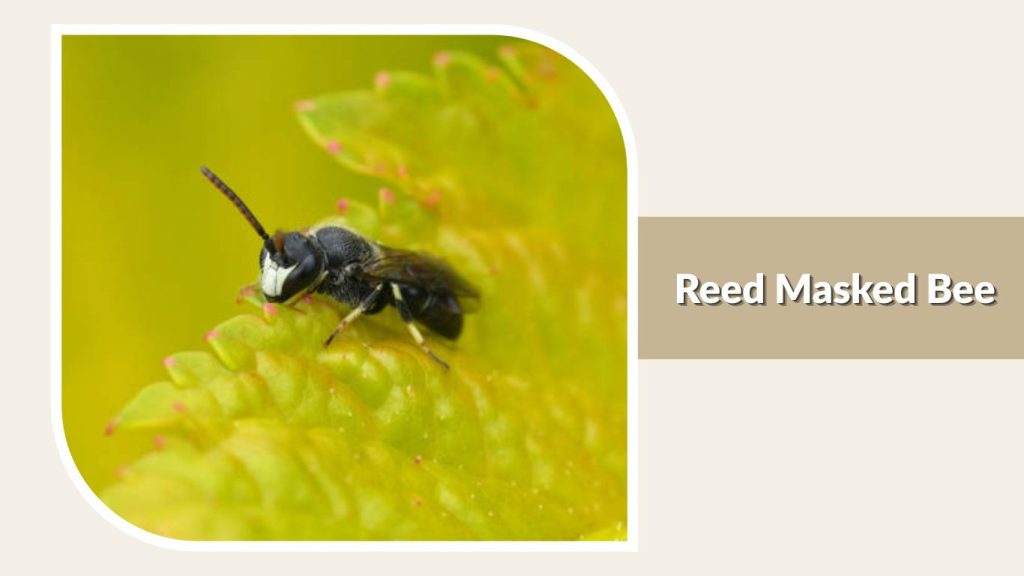
The Reed Masked Bee is a small solitary bee that often nests in hollow reed stems and other narrow plant cavities. Like other masked bees, it has a slim dark body, pale facial markings, and very little hair. It is easy to miss because of its tiny size and quick movement around flowers.
Identification
- Small bee with a narrow black body.
- Face may show pale yellow, white, or cream markings.
- Body looks smooth and almost hairless.
- Often resembles a tiny wasp.
- Wings are clear or slightly smoky.
- Does not carry pollen on the outside of its legs.
- Usually found near reeds, stems, or cavity nesting sites.
- Males often have brighter facial markings than females.
- Females may have smaller marks near the eyes or lower face.
Habitat and Distribution
Reed Masked Bees are usually found in places where hollow stems and flowers are close together. They may live near wetlands, reed beds, pond edges, marshes, garden borders, woodland edges, and wildflower areas. They can also use artificial bee hotels if the holes are small enough.
Their distribution depends on the exact species, but masked bees are found in many regions around the world. Reed-nesting types are most common in habitats with dry hollow stems, broken plant stalks, or similar natural cavities.
Behavior and Diet
The Reed Masked Bee is solitary. Each female chooses a nesting cavity and prepares her own brood cells. It does not live in a large colony or produce honey.
Adults visit small flowers for nectar. Females collect pollen and nectar, then carry the mixture inside their body instead of on hairy legs. This food is later placed in the nest for the larvae. These bees can help pollinate wildflowers, garden plants, and wetland-edge plants.
Life Cycle
The female lays eggs inside narrow cavities such as reed stems, hollow plant stalks, or old insect holes. She lines each cell with a thin waterproof secretion.
After adding pollen and nectar, she lays one egg in each cell and seals it. The larva feeds safely inside the chamber, develops into a pupa, and later emerges as an adult during the warm season.
6. Black Masked Bee
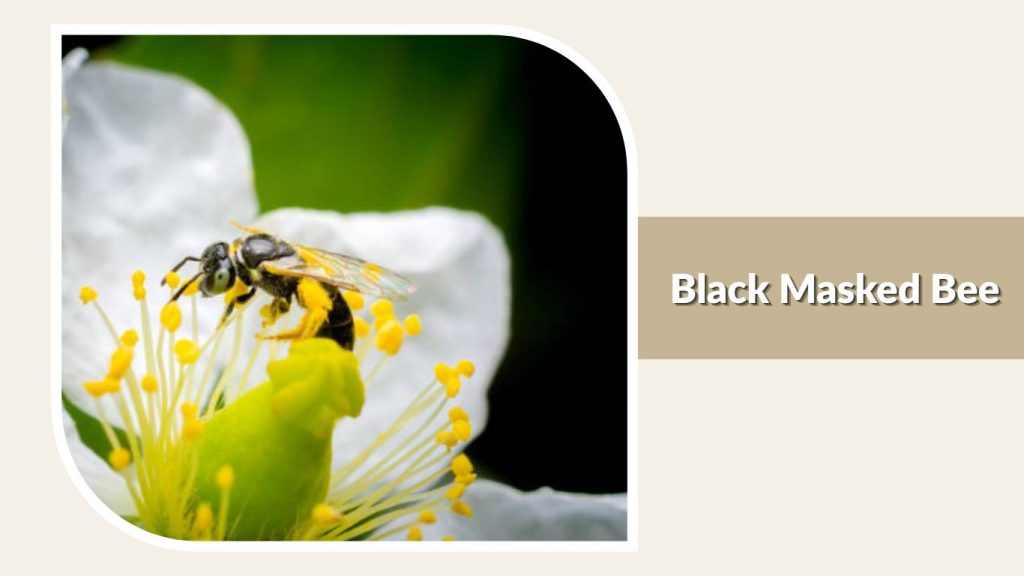
The Black Masked Bee is a small solitary bee with a dark, smooth body and pale facial markings. It belongs to the masked bee group and may look more like a tiny wasp than a typical bee. Although it is small, it plays a useful role in pollinating small flowers in gardens, meadows, and natural habitats.
Identification
- Small bee with a slim black body.
- Face may have white, cream, or pale yellow markings.
- Body is smooth with very little visible hair.
- Often mistaken for a small wasp.
- Wings are clear or lightly smoky.
- Does not have pollen baskets on the legs.
- Females usually have smaller facial marks than males.
- Males may show a more complete pale face mask.
- Usually active around small open flowers.
Habitat and Distribution
The Black Masked Bee can live in different open habitats where flowers and nesting holes are available. It may be found in gardens, grasslands, woodland edges, hedgerows, parks, and dry sunny areas. Some species also use disturbed places near buildings or fences.
Its exact range depends on the species, because many masked bees look similar. In general, black masked bees are linked with regions where Hylaeus bees are common. They often choose places with small cavities, hollow stems, or old insect tunnels for nesting.
Behavior and Diet
The Black Masked Bee is solitary, so each female builds and manages her own nest. It does not live in a large colony, make honey, or defend a hive like social bees.
Adults feed mainly on nectar from small flowers. Females collect pollen and nectar for their young, but they carry this food inside their body instead of on hairy legs. This makes them look less “dusty” than many other bees.
Life Cycle
The female usually nests inside tiny cavities, such as hollow stems, cracks in wood, reed tubes, or abandoned insect holes. She lines each brood cell with a clear waterproof coating.
After preparing the cell, she adds pollen and nectar, lays one egg, and seals the chamber. The larva feeds inside, grows, pupates, and later emerges as an adult bee.
7. Small Masked Bee
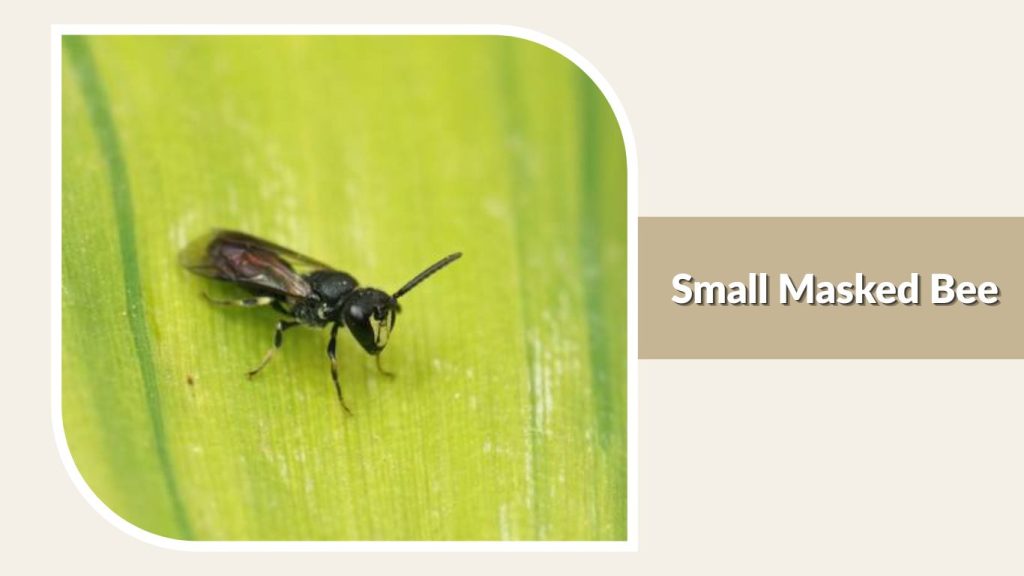
The Small Masked Bee is a tiny solitary bee with a dark body and pale facial markings. It is often overlooked because of its size and smooth wasp-like appearance. Like other masked bees, it does not carry pollen on hairy legs. Instead, it carries pollen and nectar inside its body to feed its young.
Identification
- Very small bee with a slim black body.
- Face has pale white, cream, or yellow markings.
- Body is smooth and has very little hair.
- Often looks like a tiny wasp.
- Wings are clear or slightly tinted.
- Does not have pollen baskets on the hind legs.
- Males usually have larger pale face markings.
- Females may show smaller markings near the eyes.
- Usually seen moving quickly on small flowers.
- Easy to miss because of its tiny size.
Habitat and Distribution
The Small Masked Bee can live in many places where flowers and small nesting spaces are available. It may be found in gardens, parks, grasslands, meadows, woodland edges, hedgerows, and roadside plants. It often uses tiny natural holes that larger bees cannot enter.
Its distribution depends on the exact species, but small masked bees occur in many regions where Hylaeus bees are present. They are especially common in flower-rich habitats with hollow stems, dry plant stalks, old wood, or small cracks for nesting.
Behavior and Diet
The Small Masked Bee is solitary. Each female builds her own nest and prepares food for her larvae. It does not live in a colony and does not make honey.
Adults feed on nectar from small open flowers. Females collect pollen and nectar, then store the mixture internally. Later, they place this liquid food inside each nest cell. Because they visit many small blooms, they help pollinate wildflowers and garden plants.
Life Cycle
The female nests in narrow cavities such as hollow stems, reed tubes, old beetle holes, or cracks in wood. She lines each cell with a thin waterproof secretion.
After adding pollen and nectar, she lays one egg inside the cell and seals it. The larva feeds safely inside, grows, pupates, and later emerges as an adult during warm weather.
8. Slender Masked Bee
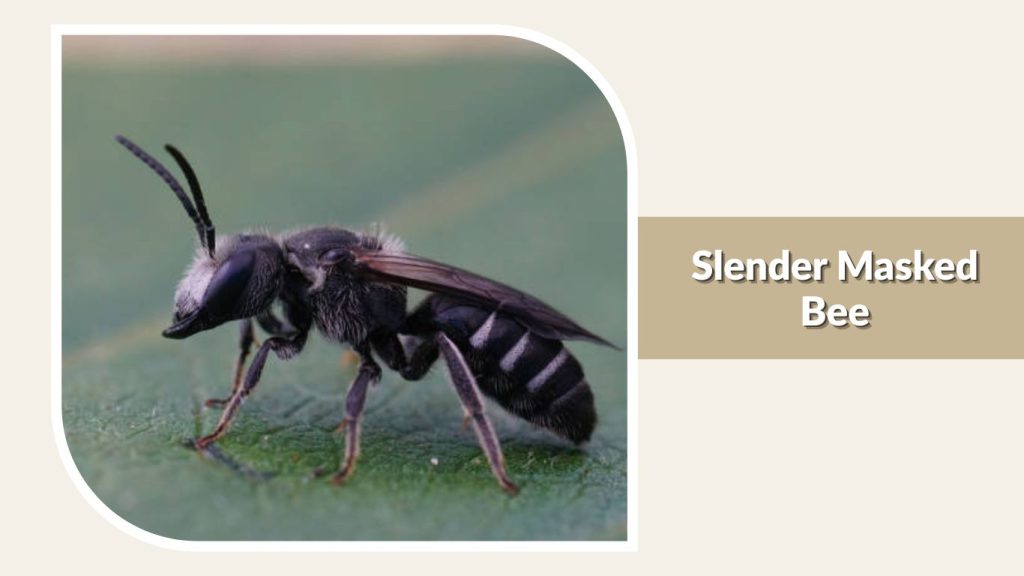
The Slender Masked Bee is a small, narrow-bodied bee with a smooth black appearance and pale facial markings. It belongs to the masked bee group and is often mistaken for a tiny wasp. Its slim body helps it enter narrow nesting holes, hollow stems, and small cracks where it raises its young safely.
Identification
- Small bee with a long, slender black body.
- Face has pale yellow, white, or cream markings.
- Body is smooth with very little visible hair.
- Looks similar to a small wasp.
- Wings are clear or slightly smoky.
- Does not carry pollen on hairy legs.
- Males often have larger pale facial markings.
- Females usually have smaller marks near the eyes or face.
- Often seen visiting small open flowers.
- Moves quickly and may be hard to notice.
Habitat and Distribution
The Slender Masked Bee is usually found in flower-rich places with plenty of small nesting cavities. It may live in gardens, meadows, grasslands, woodland edges, hedgerows, sandy areas, parks, and roadside vegetation. It prefers habitats where flowers and dry stems are close together.
Its exact distribution depends on the species, but slender masked bees occur in regions where Hylaeus bees are common. They can survive in both natural and human-shaped habitats if suitable flowers and nesting holes are available.
Behavior and Diet
The Slender Masked Bee is solitary, so each female builds and manages her own nest. It does not form colonies, produce honey, or defend a hive like social bees.
Adults feed on nectar from small flowers. Females collect pollen and nectar for their larvae, but they carry this food inside the body instead of on the legs. This makes the bee look clean and smooth compared with many fuzzy bees.
Life Cycle
The female chooses a narrow cavity, such as a hollow stem, reed tube, old beetle hole, or small crack in wood. She lines the brood cells with a thin waterproof secretion.
She adds pollen and nectar, lays one egg in each cell, and seals the chamber. The larva feeds inside, grows, pupates, and later emerges as an adult during the warm season.
9. Coastal Masked Bee
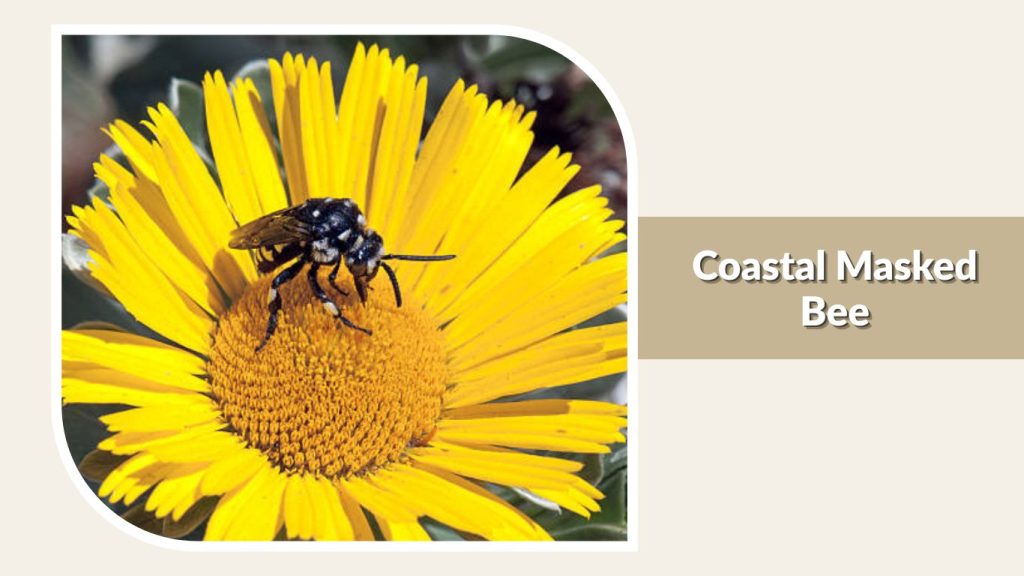
The Coastal Masked Bee is a small solitary bee that lives in coastal habitats where flowers, sand, shrubs, and nesting cavities are available. Like other masked bees, it has a smooth dark body and pale face markings. It is not a honey-making bee, but it helps pollinate seaside plants and other small flowering vegetation.
Identification
- Small bee with a slim black body.
- The face has pale yellow, white, or cream mask-like markings.
- My body is smooth and has very little hair.
- Often looks like a tiny wasp.
- Wings are clear or lightly smoky.
- Does not carry pollen on hairy legs.
- Males usually have stronger facial markings than females.
- Females may have smaller marks near the eyes.
- Often found near coastal flowers, dunes, or sandy areas.
- Can be difficult to identify without close inspection.
Habitat and Distribution
The Coastal Masked Bee is usually linked with seaside environments. It may live in coastal dunes, sandy grasslands, beach edges, saltmarsh borders, coastal scrub, and flower-rich areas near the shore. These habitats provide both food plants and small nesting spaces.
Its distribution depends on the exact species, but coastal masked bees are found in regions where suitable shoreline habitats remain healthy. They often rely on native coastal plants, dry stems, old wood, or small natural cavities for nesting.
Behavior and Diet
The Coastal Masked Bee is solitary. Each female prepares her own nest and provides food for her larvae. It does not live in a large colony or make honey like honey bees.
Adults visit small coastal flowers for nectar. Females collect pollen and nectar, then carry the food inside their body. This food is placed inside the nest for the young. By visiting flowers, coastal masked bees support pollination in fragile seaside ecosystems.
Life Cycle
The female usually nests in narrow cavities, such as hollow stems, old insect holes, cracks in wood, or dry plant stalks. She lines each cell with a thin waterproof coating.
After adding pollen and nectar, she lays one egg in each brood cell and seals it. The larva feeds inside, grows, pupates, and later emerges as an adult during the active warm season.
10. Australian Masked Bee
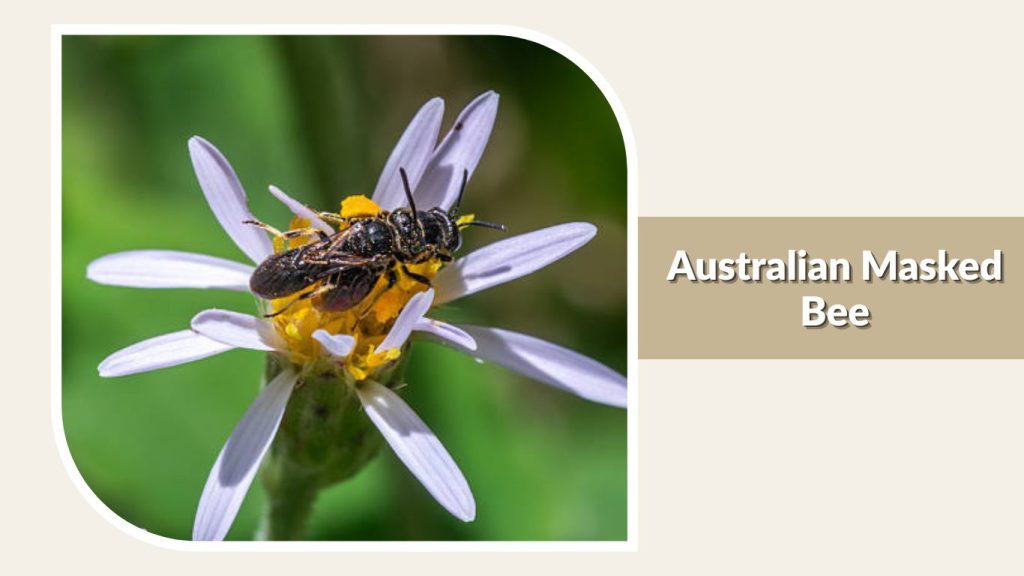
The Australian Masked Bee is a small solitary bee known for its smooth black body and pale facial markings. It belongs to the Hylaeus group, which includes many wasp-like bees. These bees are useful native pollinators and can be found around flowers, gardens, bushland, and dry nesting sites across different parts of Australia.
Identification
- Small bee with a slim black body.
- The face has yellow, white, or cream mask-like markings.
- The body looks smooth and has very little visible hair.
- Often resembles a tiny wasp.
- Wings are clear or slightly smoky.
- Does not carry pollen on hairy back legs.
- Males usually have larger pale facial markings.
- Females often have smaller marks near the eyes or lower face.
- Usually seen visiting small open flowers.
- Some species are difficult to identify without close study.
Habitat and Distribution
Australian Masked Bees live in many habitats, including gardens, parks, bushland, woodland edges, coastal scrub, grasslands, and dry open areas. They are often found where small flowers and nesting cavities are available. Some species may also use holes in timber, hollow stems, or artificial bee hotels.
These bees occur in different parts of Australia, depending on the species. They are especially important in native ecosystems because they visit many local flowering plants. Their small size helps them use narrow spaces and tiny blossoms that larger bees may ignore.
Behavior and Diet
The Australian Masked Bee is solitary, so each female builds her own nest. It does not form a large colony or make honey. Adults feed mainly on nectar from flowers, while females collect pollen and nectar to feed their larvae.
Unlike many fuzzy bees, Australian Masked Bees carry food inside their body. The female later places this soft pollen and nectar mixture inside the nest cells for her young.
Life Cycle
The female usually nests in small cavities, such as hollow stems, cracks in wood, old insect holes, or reed-like tubes. She lines each brood cell with a thin waterproof secretion.
After preparing the cell, she adds food, lays one egg, and seals it. The larva feeds inside the protected chamber, grows, pupates, and later emerges as an adult bee during warm weather.
FAQs
What are masked bees?
Masked bees are small solitary bees from the Hylaeus group. They are usually black, smooth, and almost hairless, with pale markings on the face. These markings often look like a mask. Unlike honey bees, masked bees do not live in large colonies or produce honey.
Why are they called masked bees?
They are called masked bees because many species have white, cream, or yellow markings on the face. These markings can look like a small mask, especially in males. The pattern can vary by species, so close inspection is often needed for accurate identification.
Do masked bees sting?
Masked bees can sting, but they are not aggressive. They are solitary bees and do not defend a large hive like honey bees or wasps. Most people can watch them safely on flowers. However, it is still best not to catch, squeeze, or disturb them.
Where do masked bees make their nests?
Masked bees usually nest in small existing cavities. They may use hollow plant stems, reed tubes, cracks in wood, old beetle holes, or bee hotels. The female lines each cell with a thin waterproof coating before adding food and laying an egg.
Are masked bees good for gardens?
Yes, masked bees are useful garden pollinators. They visit many small flowers for nectar and pollen. Because they are tiny, they can pollinate flowers that larger bees may ignore. Planting native flowers and leaving hollow stems can help support them.