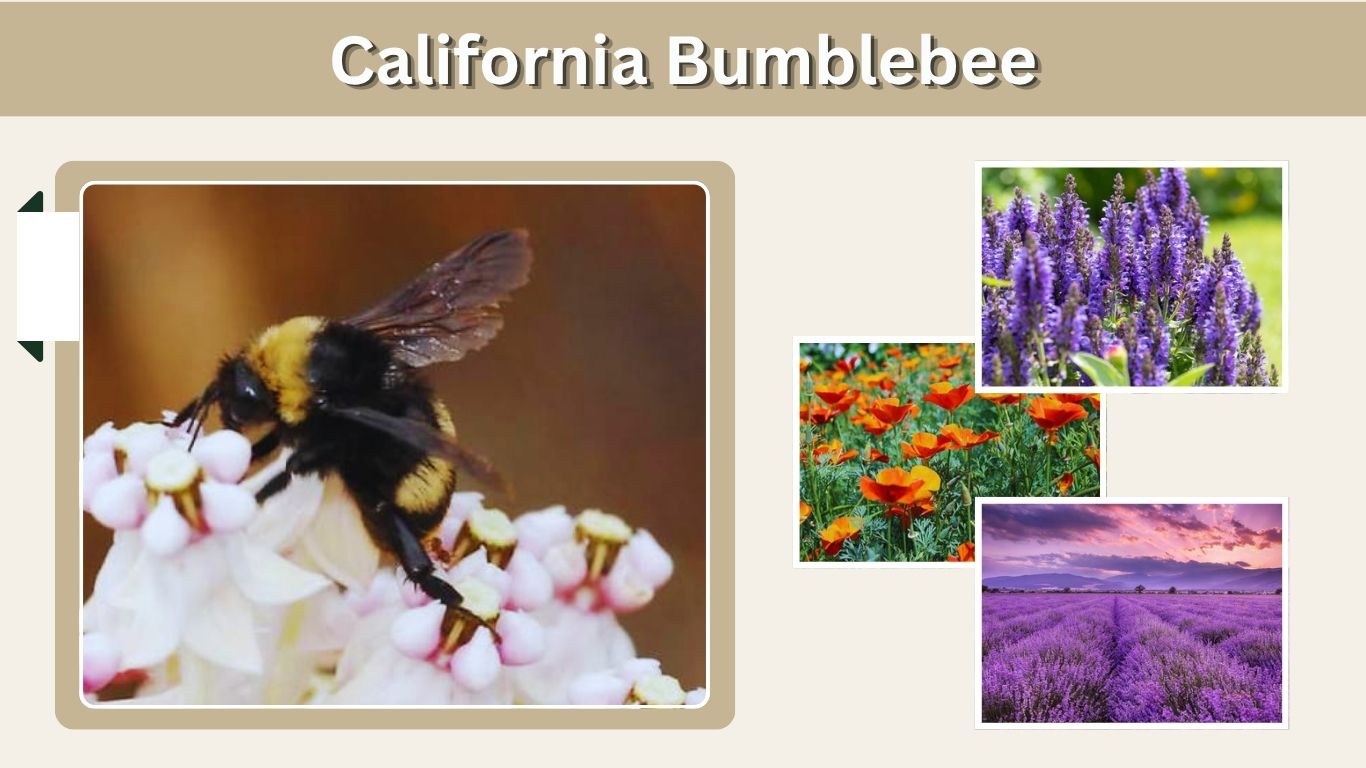
The California bumblebee is part of a diverse group of native pollinators found from coastal gardens and Southern California scrublands to northern forests and mountain meadows. California supports about 25 bumblebee species, ranging from common black-and-yellow species to much rarer bees facing serious population declines. One of the most frequently encountered is the yellow-faced bumblebee (Bombus vosnesenskii). Other notable species include the California bumblebee, black-tailed bumblebee, Crotch’s bumblebee, and western bumblebee.
What Is a California Bumblebee?
“California bumblebee” can have two meanings. It may refer broadly to any bumblebee living in California, or more specifically to a species named the California bumblebee, Bombus californicus.
Bumblebees belong to the genus Bombus. They are generally large, fuzzy bees with robust bodies and combinations of black, yellow, orange, red, or pale hairs.
California has approximately 25 species, providing plenty of variation in appearance and distribution.
California Bumblebee Identification
Typical bumblebee characteristics include:
- Large, rounded body
- Dense fuzzy hairs
- Black and yellow, orange, red, or white markings
- Two pairs of wings
- Relatively long antennae
- Powerful flight
- Hairy hind legs used by females to transport pollen
- Frequent visits to nectar-rich flowers
Identification to species can be difficult because several California bumblebees have remarkably similar patterns.
Common Bumblebee Species in California
California’s varied landscapes support many different Bombus species. Some are widespread, while others have restricted distributions or have experienced substantial declines.
| Species | Scientific Name | Typical Appearance |
| Yellow-faced bumblebee | Bombus vosnesenskii | Mostly black with yellow face/thorax and pale abdominal band |
| California bumblebee | Bombus californicus | Black and yellow, pattern varies |
| Black-tailed bumblebee | Bombus melanopygus | Black/yellow with variable abdominal coloration |
| Western bumblebee | Bombus occidentalis | Black and yellow with pale abdominal tip |
| Crotch’s bumblebee | Bombus crotchii | Mostly black with yellow markings |
| Franklin’s bumblebee | Bombus franklini | Black with yellow markings |
| Obscure bumblebee | Bombus caliginosus | Dark with yellow markings |
| Morrison bumblebee | Bombus morrisoni | Often extensively yellow and black |
California wildlife officials currently track several of these species because of conservation concerns.
Yellow-Faced Bumblebee
The yellow-faced bumblebee (Bombus vosnesenskii) is one of the most familiar California species.
Its body is predominantly black, with conspicuous pale-yellow hair around the front of the thorax and usually a pale band toward the end of the abdomen.
UC sources describe B. vosnesenskii as the dominant or most common bumblebee species across much of California.
These bees frequently visit garden flowers as well as native vegetation and play an important role as pollinators.
Black Bumblebee in California
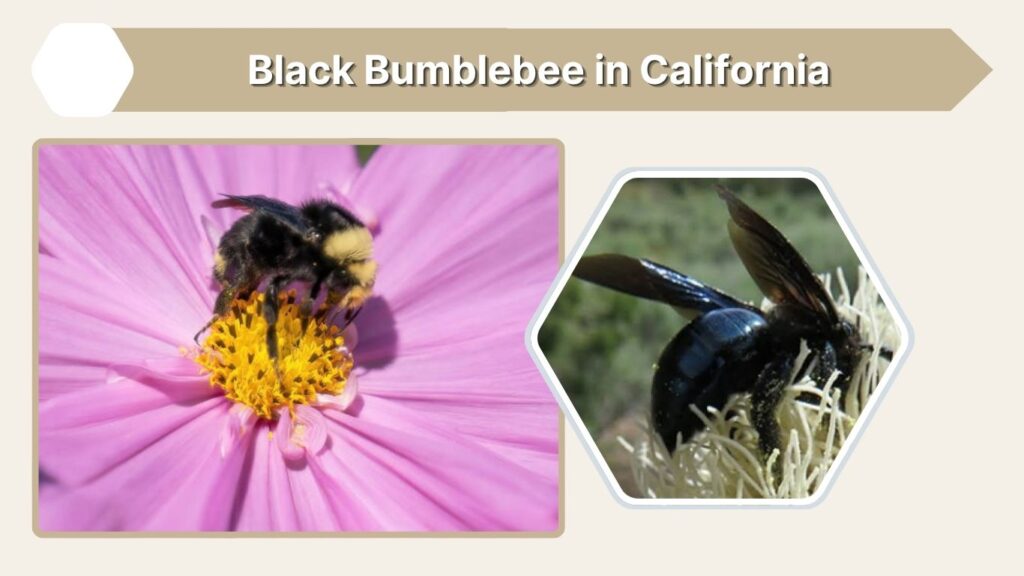
Seeing a large black bumblebee in California does not automatically mean you are looking at a true bumblebee.
Several Bombus species are predominantly black, but California also has large black carpenter bees that are frequently confused with bumblebees.
Black Bumblebee vs. Carpenter Bee
One particularly noticeable species is the Valley carpenter bee (Xylocopa varipuncta).
Female Valley carpenter bees are large and solid black, whereas males are dramatically different—they are golden or blond-colored with greenish eyes. UC Davis describes the female as solid black and the species as California’s largest carpenter bee.
A simple comparison:
| Feature | Bumblebee | Carpenter Bee |
| Abdomen | Usually noticeably hairy | Often smoother/shinier |
| Body | Fuzzy throughout | Thorax fuzzy, abdomen often less hairy |
| Nest | Often underground | Usually tunnels in wood |
| Shape | Broad and rounded | Large and robust |
| Social behavior | Usually colonies | Mostly solitary |
If the bee is huge, almost completely black, and has a relatively shiny abdomen, a female carpenter bee may be a better identification than a black bumblebee.
Bumblebees in Northern California
Northern California contains habitats ranging from coastal areas to the Sierra Nevada and Klamath region, allowing several bumblebee species to occur.
The yellow-faced bumblebee is widespread, while species such as the western bumblebee have historically occurred in northern and mountainous areas.
Franklin’s bumblebee has an exceptionally restricted historical range centered on the Klamath Mountains of northern California and southern Oregon. California wildlife officials report that its last known California detection occurred in 1998, and the species is federally endangered.
Black-Tailed Bumblebee
The black-tailed bumblebee, Bombus melanopygus, can also be encountered in California.
Color can be confusing because populations and individuals may show different amounts of yellow, black, or reddish coloration. That variability is one reason photographs alone sometimes cannot provide confident species identification.
Bumblebees in Southern California
Southern California also supports several native bumblebee species despite its warmer and often drier environment.
UC research notes that seven bumblebee species occur in San Diego County, including the yellow-faced bumblebee and Crotch’s bumblebee.
Gardens, chaparral, coastal vegetation, foothills, and areas with long-lasting floral resources can all provide feeding habitat.
Crotch’s Bumblebee
Crotch’s bumblebee (Bombus crotchii) is an important Southern and Central California species from a conservation perspective.
CDFW describes it as native primarily to the lower two-thirds of California and notes major population declines associated with pressures including agricultural intensification and urbanization. The species nests underground.
Its conservation status means potential sightings are especially valuable for monitoring programs.
Brown and Yellow Bumblebees in California
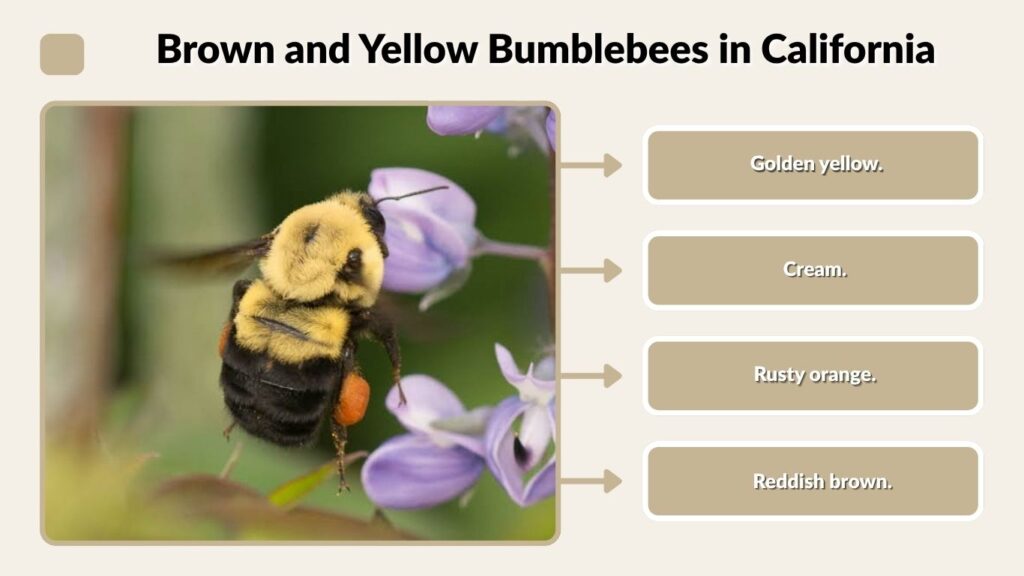
Not every California bumblebee matches the familiar sharply defined black-and-yellow pattern.
Body hairs may appear:
- Golden yellow
- Cream
- Rusty orange
- Reddish brown
- Dark brown
- Nearly black
Color can also differ between queens, workers, males, geographic populations, and species.
Consequently, identifying a “brown California bumblebee” based only on color is difficult. Location, facial coloration, abdominal bands, body size, and other anatomical characteristics may all be needed.
California Bumblebee Queen
A bumblebee queen is usually the largest individual in a colony.
California bumblebees generally form annual colonies. A mated queen survives the colony’s inactive season and later searches for a nesting location. Once established, she produces the first generation of workers.
Workers then take over much of the colony’s foraging and maintenance.
Many bumblebees use underground cavities, including abandoned rodent burrows. UC sources describe California yellow-faced bumblebees living in ground-nesting social colonies.
Later in the colony cycle, new queens and males are produced. Mated queens eventually establish the next generation.
What Do California Bumblebees Eat?
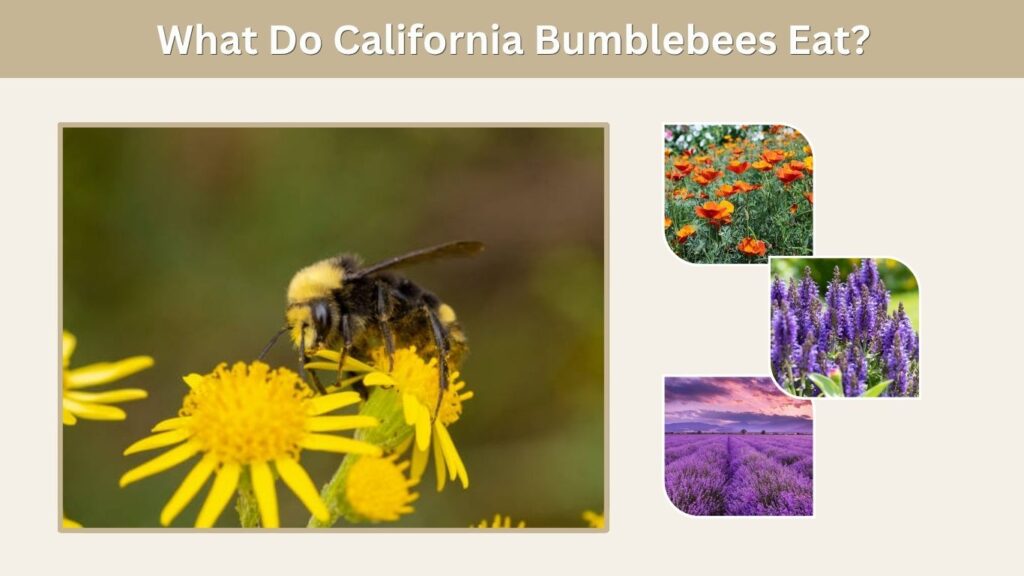
Adult bumblebees primarily collect nectar and pollen from flowers.
Nectar supplies carbohydrates for energy, while pollen provides protein and other nutrients needed especially for developing larvae.
California bumblebees can visit many kinds of flowers. UC observations have recorded yellow-faced bumblebees feeding from plants such as:
- California poppies
- Salvia
- Lavender
- Milkweed
- Catmint
- Honeysuckle
- Mexican sunflower
- Basil
Their large hairy bodies make them effective at carrying pollen between flowers.
Why Are California Bumblebees Important?
Bumblebees are major native pollinators.
They pollinate wildflowers and contribute to agricultural production. Their ability to perform buzz pollination is especially useful for certain flowers: the bee vibrates its flight muscles to shake pollen loose from the anthers.
California wildlife authorities emphasize that bumblebees contribute to both natural ecosystems and agricultural harvests.
Declining populations are therefore important not only for individual bee species but also for plant communities and food systems.
Are California Bumblebees Endangered?
Some are experiencing serious conservation problems, but not every California bumblebee is endangered.
Four species have received particular attention under the California Endangered Species Act:
- Crotch’s bumblebee (Bombus crotchii)
- Franklin’s bumblebee (Bombus franklini)
- Western bumblebee (Bombus occidentalis)
- Suckley’s cuckoo bumblebee (Bombus suckleyi)
CDFW’s current conservation materials continue to treat these four as CESA candidate bumblebees, which gives candidate species legal protections comparable to listed threatened or endangered species while the state process continues. Franklin’s bumblebee is also federally endangered.
Major threats identified by CDFW include habitat loss, climate change, disease, and pesticide exposure.
Did California Really Rule That a Bumblebee Is a Fish?
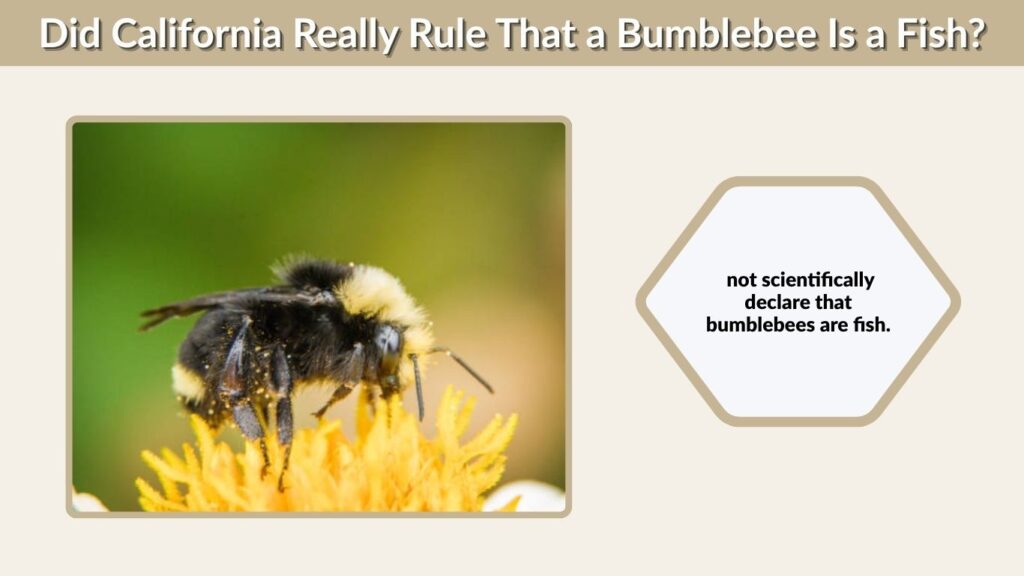
This unusual claim has a real legal basis, but it is often explained incorrectly.
California did not scientifically declare that bumblebees are fish.
The dispute concerned the California Endangered Species Act. California’s Fish and Game Code uses “fish” as a specialized legal term broad enough to include invertebrates. In the 2022 Almond Alliance of California v. Fish and Game Commission decision, the Court of Appeal concluded that the statutory category was not restricted to aquatic invertebrates and could therefore cover terrestrial invertebrates such as bumblebees.
So biologically:
Bumblebee = insect
Under this particular California statutory framework:
Bumblebee = an invertebrate that can fall within the legal definition associated with “fish.”
The ruling allowed California to consider bumblebee species for protection under CESA; it did not change their biological classification.
Do California Bumblebees Sting?
Female bumblebees—including queens and workers—can sting. Unlike honeybees, their stinger is not barbed in the same way, so a bumblebee is capable of stinging more than once.
Bumblebees are generally focused on collecting food rather than attacking people. Problems are more likely when a bee is trapped, stepped on, squeezed, or its nest is disturbed.
Male bees do not possess functional stingers. UC Davis specifically notes this distinction in discussions of California native bees.
FAQs
How many bumblebee species live in California?
California supports approximately 25 bumblebee species. They occupy habitats ranging from Southern California gardens and coastal areas to northern forests and mountain environments. Several species have declined enough to receive special conservation attention.
What is the most common bumblebee in California?
The yellow-faced bumblebee (Bombus vosnesenskii) is widely described as one of California’s most common or dominant bumblebee species. It is mostly black with distinctive yellow hair near its head and another pale band toward the rear.
What is the big black bee in California?
A very large, nearly solid-black bee may actually be a female Valley carpenter bee (Xylocopa varipuncta) rather than a bumblebee. Female Valley carpenter bees are black, while males are strikingly golden or blond.
Are California bumblebees endangered?
Some are. Crotch’s, Franklin’s, western, and Suckley’s cuckoo bumblebees are currently treated as CESA candidate species in California. Franklin’s bumblebee is also federally listed as endangered. Other widespread species remain much more common.
Why does California call bumblebees fish?
It is a legal classification, not a biological one. A California appellate court determined that the Fish and Game Code’s specialized definition of “fish,” which encompasses invertebrates, is broad enough to cover terrestrial invertebrates such as bumblebees for purposes of endangered-species protection.