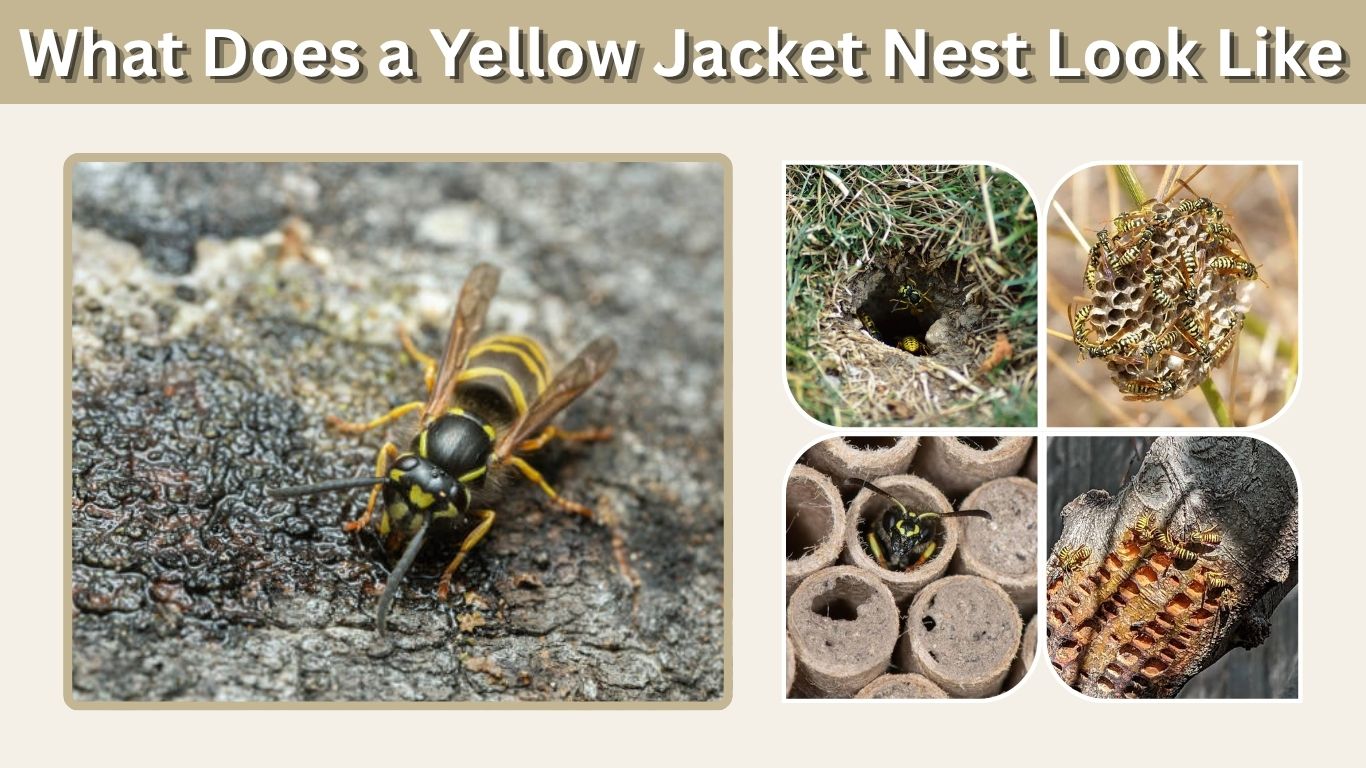
A yellow jacket nest usually looks like a hidden papery nest with a small entrance hole. Many yellow jacket nests are underground, so you may not see the full nest at first. Instead, the biggest clue is a steady stream of yellow-and-black wasps flying in and out of one hole in the soil, wall, foundation, tree cavity, or other protected space. Yellowjackets nest in ground holes, wall cavities, or enclosed gray paper nests with one main entrance.
What Does a Yellow Jacket Nest Look Like From Outside?
From the outside, a yellow jacket nest may look like nothing more than a small hole. This is why people often find nests by accident while mowing, gardening, or walking near the entrance.
Common Outside Signs
- Small round hole in the ground
- Wasps flying in and out repeatedly
- Entrance near grass, soil, roots, logs, or foundations
- Buzzing activity around one spot
- Gray papery material around some openings
- Wasps becoming defensive when you get close
Oregon State University notes that yellowjackets enter and leave nests through a small hole, and many insects moving in and out of a ground or wall hole is a key sign of a nest.
What Does a Yellow Jacket Ground Nest Look Like?
A yellow jacket ground nest often starts in an old rodent burrow, soil cavity, hollow root space, or gap under a landscape timber. The visible part may only be a dark hole in the ground, sometimes surrounded by loose dirt, dry grass, or plant roots.
Ground Nest Identification
| Feature | What You May See |
| Entrance | Small hole in soil or grass |
| Nest body | Usually hidden underground |
| Wasp traffic | Many wasps entering and leaving |
| Material | Gray papery carton inside the cavity |
| Risk level | High if stepped on or disturbed |
NC State Extension explains that yellowjacket nests are usually subterranean and may occur under landscape timbers or other hidden places. The opening, tunnel, and cavity may be lined with gray carton-like paper material.
What Does a Yellow Jacket Nest Look Like Inside?
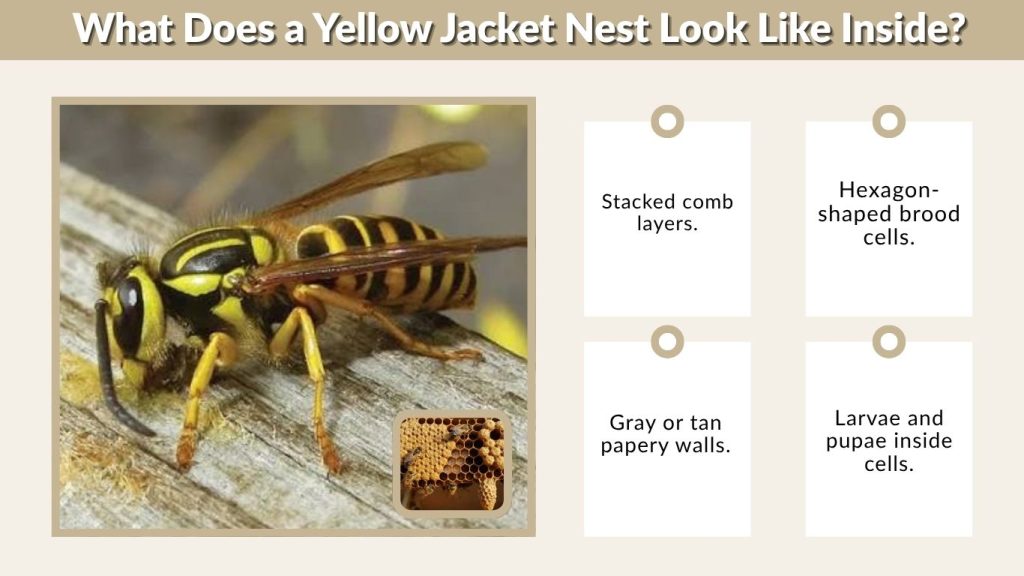
Inside, a yellow jacket nest is made of papery material created from chewed wood fibers. It has layers of comb, similar to stacked paper wasp nests, but yellow jacket nests are usually enclosed inside a protective paper covering.
Inside Structure
- Stacked comb layers
- Gray or tan papery walls
- Hexagon-shaped brood cells
- Larvae and pupae inside cells
- Protective outer carton
- One or more entrance tunnels depending on location
NC State Extension describes the inside as layers of paper-like comb stacked several deep and surrounded by a thick carton covering.
What Does an Underground Yellow Jacket Nest Look Like?
An underground yellow jacket nest usually cannot be fully seen unless it is dug up, which is dangerous and not recommended. From above, you may only notice a hole with fast wasp traffic. Underground, the nest can spread into a cavity and contain several layers of comb.
Yellowjackets can build large papery nests underground and also in protected places such as under foundations, patios, and wall voids.
What Does an Aerial Yellow Jacket Nest Look Like?
Some yellowjackets build nests above ground. These aerial nests may look like gray paper balls, cones, or egg-shaped structures hanging from trees, shrubs, building overhangs, or other protected spots.
Aerial yellowjackets can build paper nests above ground, often in trees, and they may defend these nests aggressively.
Yellow Jacket Nest vs Paper Wasp Nest
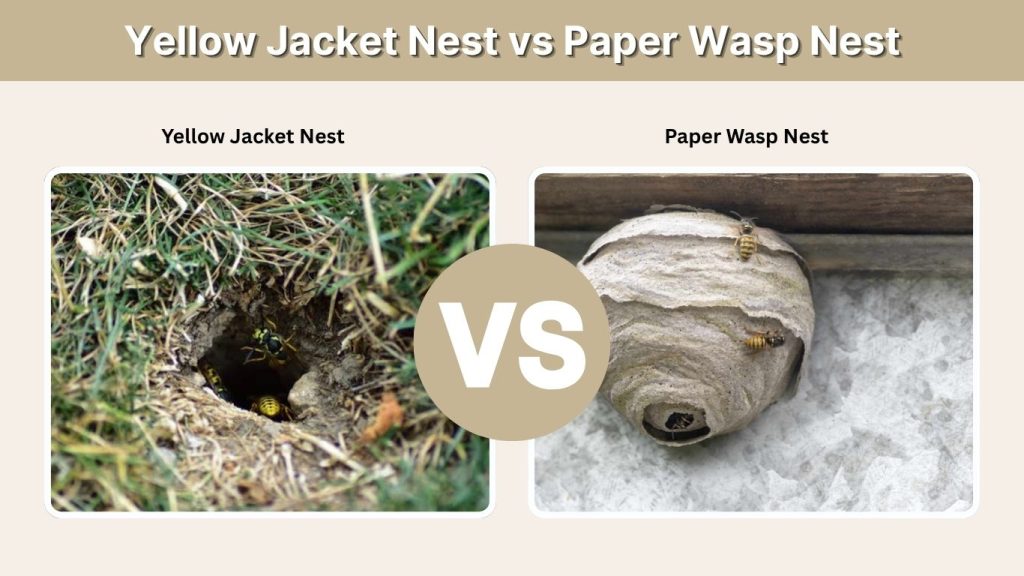
Yellow jacket nests are often confused with paper wasp nests. The easiest difference is that paper wasp nests usually have open, visible comb cells, while yellow jacket nests are often enclosed or hidden.
| Nest Type | Appearance | Location |
| Yellow jacket nest | Enclosed gray paper or hidden hole | Ground, wall, foundation, tree, cavity |
| Paper wasp nest | Open umbrella-shaped comb | Eaves, porch ceilings, branches |
| Bald-faced hornet nest | Large enclosed gray paper nest | Trees, shrubs, buildings |
UC IPM notes that paper wasps build open-cell paper nests under eaves, while yellowjackets often nest in ground holes, wall cavities, or enclosed gray paper nests.
Are Yellow Jacket Nests Dangerous?
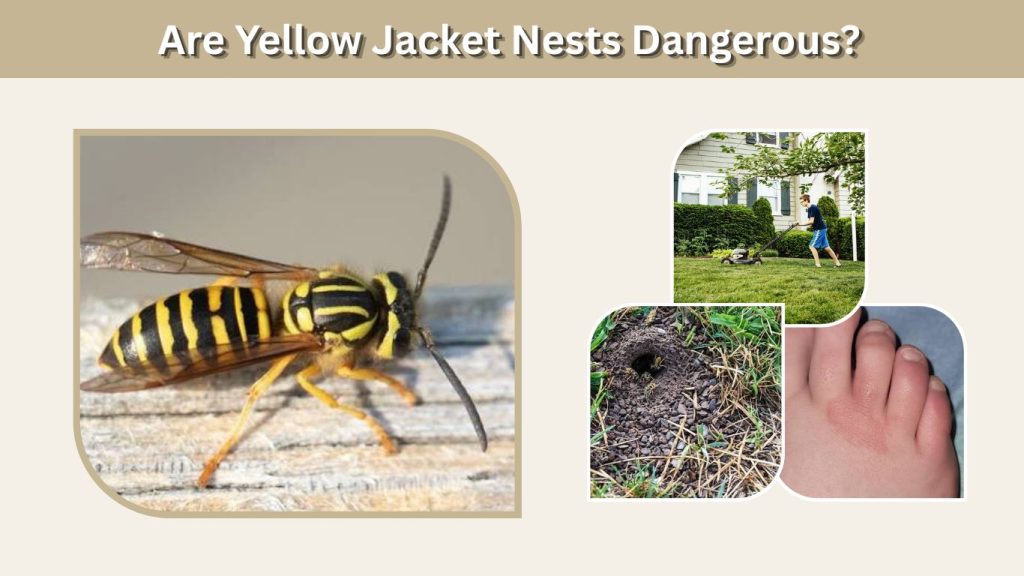
Yes, yellow jacket nests can be dangerous when disturbed. Yellowjackets defend their nests and may sting repeatedly. The risk is higher if the nest is near a doorway, walkway, lawn, children’s play area, or garden path.
Warning Signs to Stay Away
- Wasps fly directly at you
- Loud buzzing near one spot
- Wasps gather around a ground hole
- You feel stings after mowing or stepping nearby
- Nest is near a house entrance or patio
- Someone nearby has a sting allergy
NC State Extension warns that yellowjackets can swarm out aggressively when their nest is disturbed, and people with severe allergies may need prompt medical attention after a sting.
Do Yellow Jackets Reuse the Same Nest?
In many climates, yellow jacket nests are seasonal and are not reused the next year. NC State Extension states that yellowjackets do not reuse old nests, and only mated queens overwinter in sheltered places.
However, do not assume an active-looking nest is abandoned. If wasps are still flying in and out, treat it as active.
FAQs
What does a yellow jacket nest look like in the ground?
A yellow jacket ground nest usually looks like a small hole in soil, grass, mulch, or near roots. The full nest is hidden underground. The clearest sign is many yellow jackets flying in and out of the same hole.
What does a yellow jacket nest look like inside?
Inside, a yellow jacket nest has stacked layers of papery comb with many small hexagon-shaped cells. These cells hold eggs, larvae, and pupae. The comb layers are usually surrounded by a gray or tan paper-like covering.
What color is a yellow jacket nest?
Most yellow jacket nests are gray, gray-brown, or tan because they are made from chewed wood fibers mixed with saliva. Ground nests may be hard to see because the papery part is hidden inside soil or a cavity.
Is a yellow jacket nest the same as a bee nest?
No. Yellow jackets are wasps, not bees. They are smoother and more brightly striped than many bees, and they can be more defensive around nests. Some people call them “yellow jacket bees,” but that name is not accurate.
Should I remove a yellow jacket nest myself?
Do not disturb a yellow jacket nest just to inspect it. If the nest is close to people, pets, doors, or walkways, contact a pest control professional or local extension service. Nests can be dangerous when disturbed, especially for people with sting allergies.