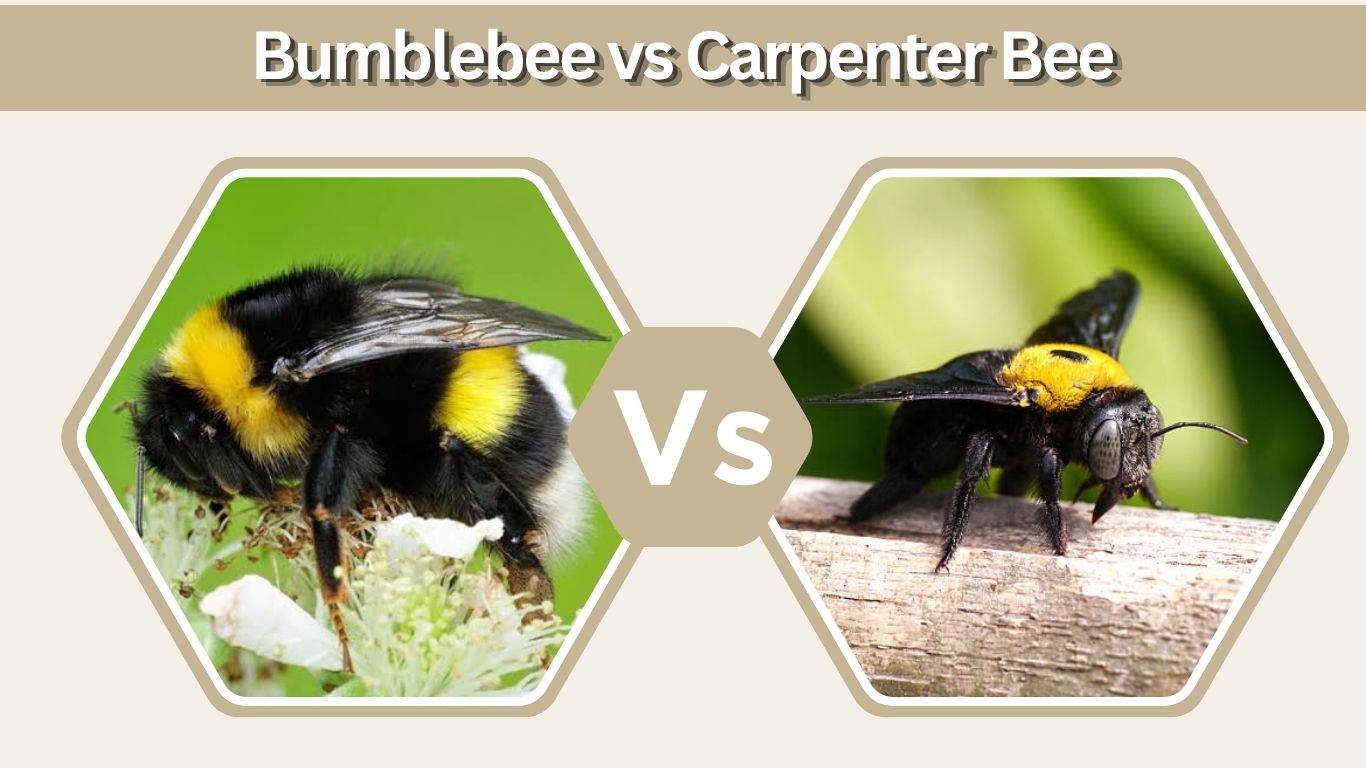
At first glance, a bumblebee and carpenter bee can look almost identical. Both are large, powerful bees that may have black-and-yellow coloring and frequently visit flowers. The easiest way to tell them apart is usually the abdomen: bumblebees are fuzzy across most of their bodies, while many large carpenter bees have a smooth, shiny, mostly black abdomen. Their nesting habits are also very different. Bumblebees typically establish social colonies in cavities, often underground, whereas carpenter bees excavate tunnels in wood for nesting.
Bumblebee vs Carpenter Bee: Quick Comparison
Although both are valuable pollinators, their appearance, nesting behavior, and relationship with homes differ considerably.
| Feature | Bumblebee | Carpenter Bee |
| Abdomen | Hairy and fuzzy | Often smooth, shiny and black |
| Overall body | Very fuzzy | Fuzzy thorax, less hairy abdomen |
| Nest | Usually existing cavities, often underground | Tunnels excavated in wood |
| Social behavior | Social colonies | Usually solitary or loosely social |
| Wood damage | No | Possible |
| Female can sting | Yes | Yes |
| Male can sting | No | No |
| Typical behavior near homes | Forages around flowers | May hover around decks, eaves and wooden structures |
| Pollinator | Yes | Yes |
The shiny abdomen versus fuzzy abdomen is usually the fastest visual clue. Purdue University Extension specifically distinguishes carpenter bees by their shiny black abdomen from the hairy, often yellowish abdomen of bumblebees.
What Does a Bumblebee Look Like?
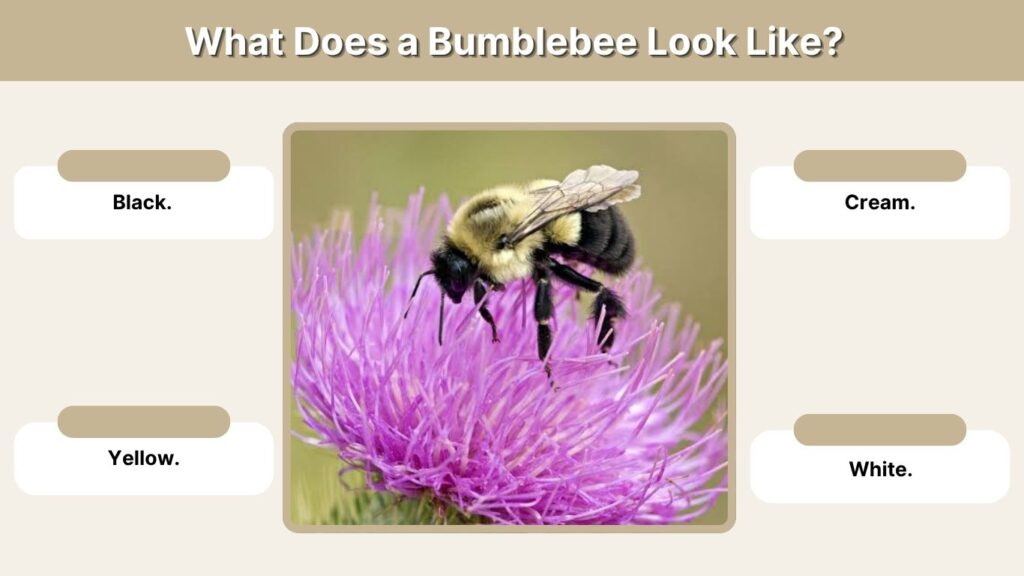
Bumblebees belong to the genus Bombus. They are large, robust bees covered with dense hair that creates their characteristic fluffy appearance.
Color varies by species, but many have combinations of:
- Black
- Yellow
- Cream
- White
- Orange
- Rusty red
The abdomen remains noticeably hairy, although the exact pattern differs between species.
Bumblebee Identification
Look for a bee with a rounded, densely fuzzy abdomen rather than a polished-looking rear end.
Bumblebees are social native bees. A typical colony includes a queen and workers, with males and new queens produced later in the colony cycle.
You will often notice workers traveling between flowers and their nest rather than repeatedly hovering around wooden siding.
What Does a Carpenter Bee Look Like?
Large carpenter bees belong to the genus Xylocopa. Some species strongly resemble bumblebees because their thorax is covered in yellow, tan, or pale hair.
The major difference appears toward the rear.
Carpenter Bee Identification
A typical large carpenter bee has:
- Large, robust body
- Hairy thorax
- Mostly black coloration
- Smooth or shiny upper abdomen
- Less abdominal hair than a bumblebee
- Dark wings
- Powerful flight
Penn State Extension notes that most of the upper abdomen of the eastern carpenter bee is hairless and shiny black, whereas a bumblebee’s abdomen is covered with hair.
If you see a big black-and-yellow bee and cannot decide which one it is, look at the abdomen first.
Carpenter Bee vs Bumblebee Size
Size alone is not a reliable way to identify these bees because there is considerable overlap.
Both can look surprisingly large compared with honey bees and many other native bees. Queens are also larger than workers in bumblebee species, further complicating size comparisons.
Instead of relying on size, check:
Abdomen + nest location + behavior
A shiny abdomen combined with a perfectly round hole in wood strongly suggests a large carpenter bee. A fully fuzzy bee entering a ground cavity is much more consistent with a bumblebee.
Carpenter Bee vs Bumblebee Nest
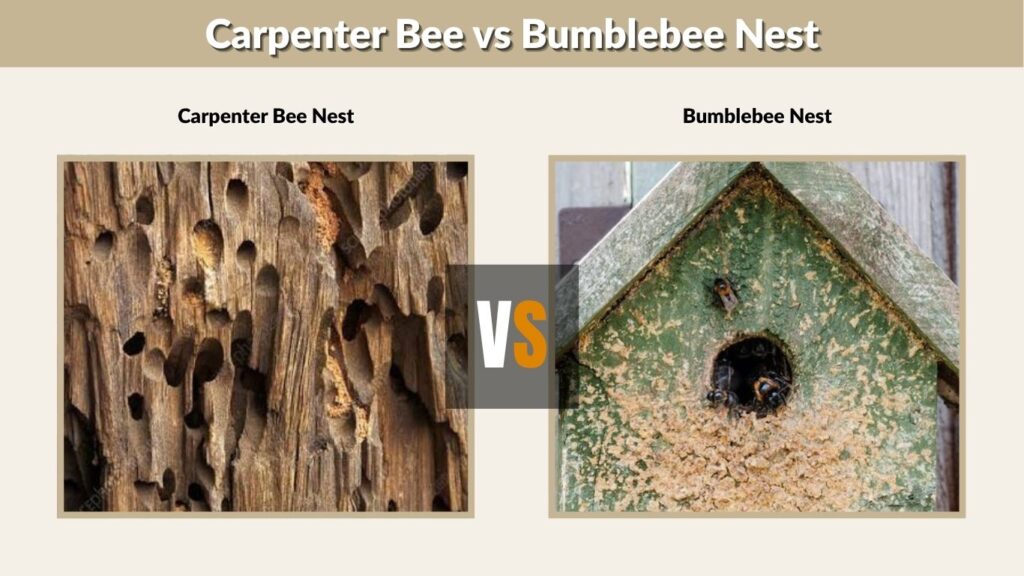
Their nesting behavior is one of the clearest differences.
Where Do Bumblebees Nest?
Bumblebees generally use pre-existing cavities rather than drilling their own tunnels in structural wood.
Depending on species, nesting sites can include:
- Abandoned rodent burrows
- Cavities beneath vegetation
- Spaces under sheds
- Hollow areas
- Occasionally above-ground cavities
Bumblebees live socially, so a nest can contain a queen and numerous workers.
Where Do Carpenter Bees Nest?
Large carpenter bees are named for their ability to excavate nesting galleries in wood.
Common nesting locations around buildings include:
- Decks
- Eaves
- Fascia boards
- Fences
- Porch railings
- Barn timbers
- Other exposed wooden structures
Penn State notes that females construct nests in trees or wooden parts of buildings, and bees hovering around eaves or drilling wood are a strong indication of carpenter bee activity.
They are not eating the wood. They are removing it to create nesting tunnels.
Do Carpenter Bees Damage Wood?
Yes, carpenter bees can damage wood because females excavate galleries where they create brood cells.
A small amount of activity may cause limited cosmetic damage, but the problem can become greater when galleries are reused or expanded over several seasons.
Bumblebees do not excavate wood in this manner.
Therefore, finding round holes accompanied by large bees around a deck or eave points much more strongly toward carpenter bees than bumblebees.
Bumblebee vs Carpenter Bee Sting
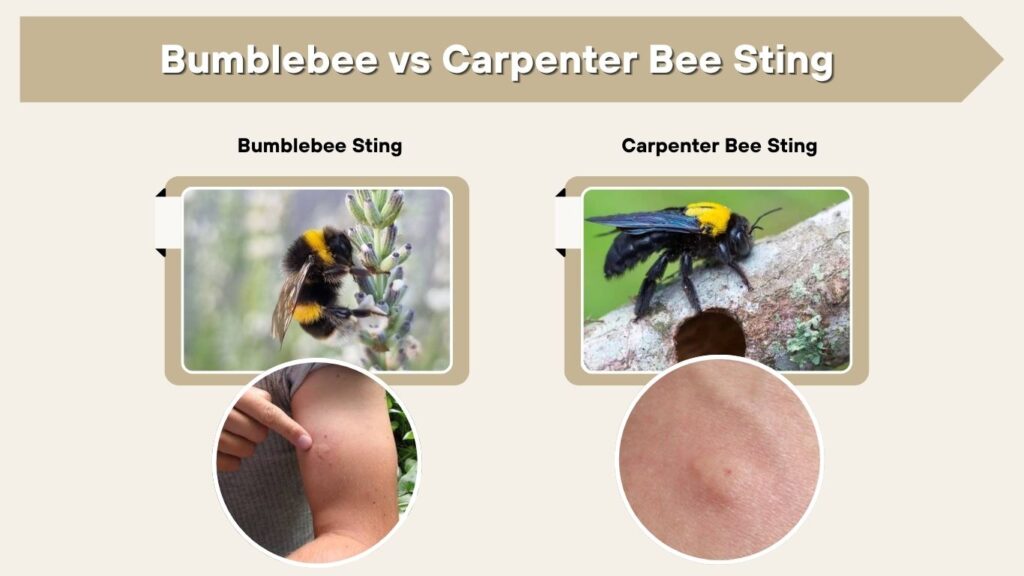
Both groups have females capable of stinging, but encounters do not automatically result in stings.
Do Bumblebees Sting?
Female bumblebees can sting, particularly when trapped or when their colony is seriously disturbed.
Male bumblebees cannot sting because male bees lack the egg-laying structure from which the stinger evolved.
Avoid disturbing an active bumblebee nest, especially if multiple workers are entering and leaving the same location.
Do Carpenter Bees Sting?
Female carpenter bees possess stingers but generally sting only when seriously provoked or handled.
Male carpenter bees can behave much more dramatically. They may hover directly in front of people or fly toward perceived intruders while defending territory. However, male carpenter bees cannot sting. Mississippi State University Extension notes that females can sting but usually do not, while males lack stingers.
So an intimidating carpenter bee repeatedly hovering around you may actually be a harmless male.
Male Carpenter Bee vs Bumblebee
Male eastern carpenter bees can sometimes be recognized by their facial coloration.
In the eastern carpenter bee, males have a pale or white facial area, while females have darker faces.
Males are also responsible for much of the territorial hovering seen around carpenter bee nesting areas.
A bumblebee foraging among flowers generally moves from bloom to bloom rather than spending long periods hovering around the same section of wooden structure.
Eastern Carpenter Bee vs Bumblebee
The eastern carpenter bee (Xylocopa virginica) is particularly likely to be confused with bumblebees in eastern North America.
Its thorax can be covered with yellowish hairs, creating a bumblebee-like appearance. But its upper abdomen is largely black, shiny, and relatively hairless.
A bumblebee’s abdomen is noticeably fuzzier.
This gives you a simple rule:
Fuzzy rear = probably bumblebee
Shiny black rear = probably large carpenter bee
The rule works well for common eastern species, although North America has multiple species and natural variation means identification should not rely on a single feature in every situation.
Bumblebee vs Carpenter Bee vs Honey Bee
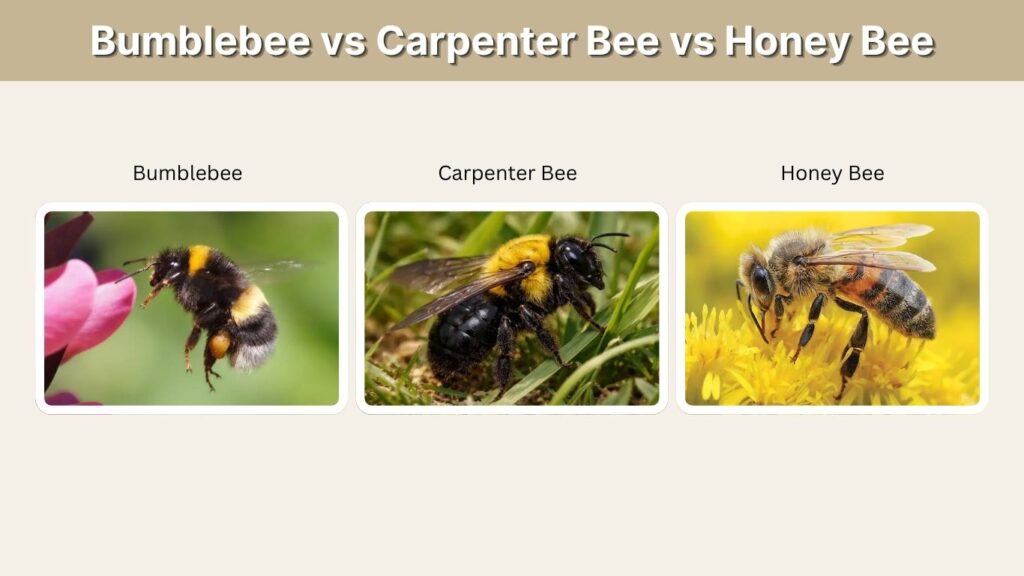
Honey bees are easier to separate because they are generally more slender and less bulky than either bumblebees or large carpenter bees.
| Feature | Bumblebee | Carpenter Bee | Honey Bee |
| Build | Large and chunky | Large and chunky | Smaller and more slender |
| Hair | Very fuzzy | Fuzzy thorax, shiny abdomen in many species | Moderately hairy |
| Nest | Usually cavities | Wood galleries | Large social colonies in cavities/hives |
| Social? | Yes | Usually solitary | Yes |
| Wood damage | No | Can occur | No |
| Main visual clue | Fuzzy abdomen | Shiny abdomen | Smaller brown/golden body |
Bumblebees and honey bees are both familiar social bees, while most bee species overall are solitary.
Which Is Better for Pollination?
Both bumblebees and carpenter bees are valuable pollinators, so seeing either visiting flowers is normally beneficial.
Bumblebees are especially effective on many flowers because their large hairy bodies transport pollen well, and many can use vibration during pollination. Carpenter bees also visit numerous flowering plants and transfer pollen as they forage.
Providing diverse flowers from spring through fall and reducing pesticide exposure can support native bee communities. University of Minnesota Extension specifically recommends a diversity of flowering plants and pesticide-free habitat for bees.
The main conflict with carpenter bees arises when nesting occurs in wooden structures—not from the bee simply visiting your garden.
FAQs
What is the main difference between a bumblebee and a carpenter bee?
Look at the abdomen. Bumblebees generally have hairy, fuzzy abdomens, while large carpenter bees commonly have smooth, shiny, mostly black upper abdomens. Carpenter bees also excavate nesting tunnels in wood, whereas bumblebees usually use existing cavities.
Which is bigger, a carpenter bee or bumblebee?
Their sizes overlap considerably, so body size alone is unreliable for identification. Both can be large, chunky bees. Examining abdominal hair, nesting location, and behavior is usually much more useful than trying to identify them based solely on size.
Which hurts more, a bumblebee or carpenter bee sting?
Both females are capable of stinging, and individual reactions vary. The more important behavioral difference is that male carpenter bees cannot sting despite their aggressive-looking hovering. Female carpenter bees usually sting only when provoked or handled.
Do bumblebees drill holes in wood?
No. Bumblebees generally use existing cavities and do not excavate the characteristic wood tunnels made by large carpenter bees. Large round holes in decks, eaves, fences, or similar wood accompanied by large bees are more consistent with carpenter bee nesting.
How can I tell a black carpenter bee from a bumblebee?
Check whether the abdomen is shiny or fuzzy. An eastern carpenter bee typically has a shiny, relatively hairless black upper abdomen. A bumblebee normally has dense hair across the abdomen, often with yellow, white, orange, or other colored bands.