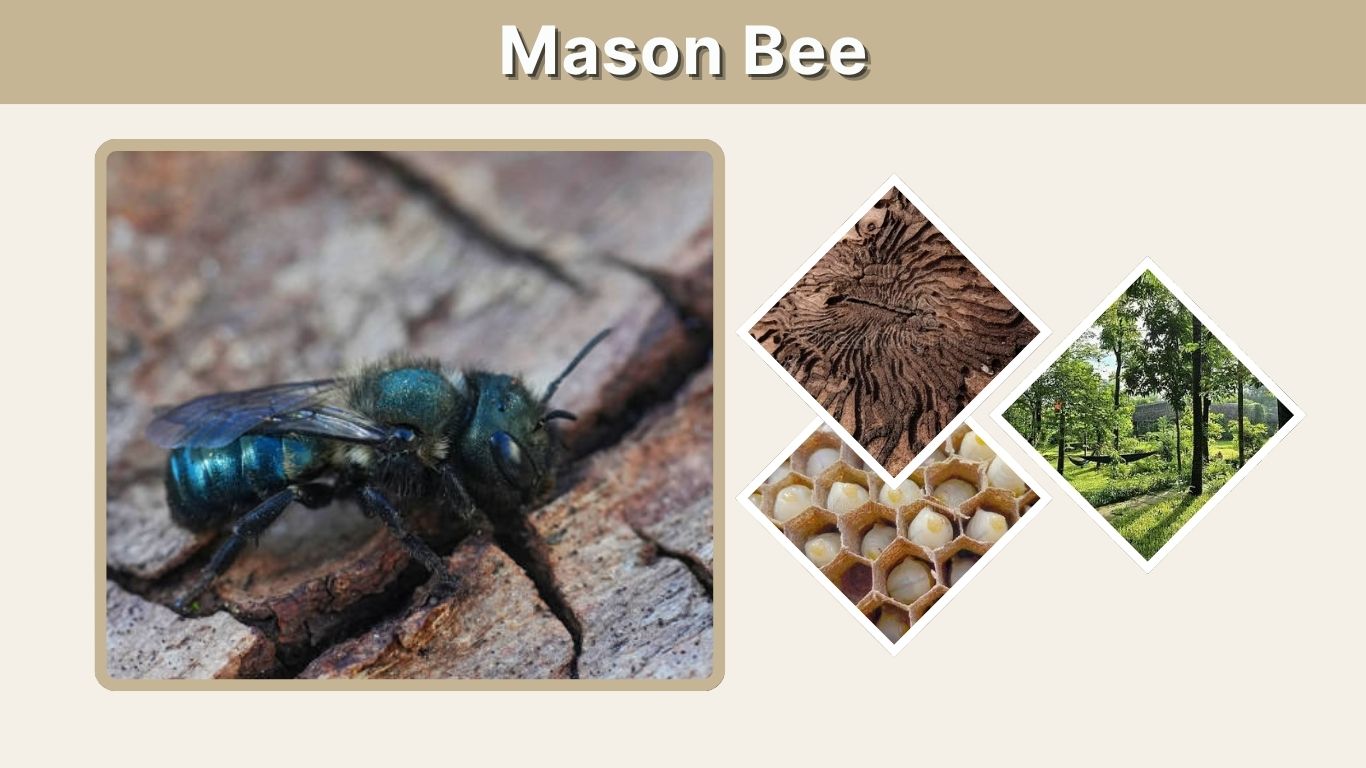
The mason bee is a solitary, gentle pollinator known for nesting in small holes and sealing its nest chambers with mud. Unlike honey bees, mason bees do not live in large colonies or produce harvestable honey, yet they can be highly effective pollinators of fruit trees and garden plants. Many species belong to the genus Osmia, including the well-known Blue Orchard Mason Bee. This guide covers mason bee identification, habitat, houses, nesting tubes, cocoons, sting behavior, life cycle, pollination, and key differences from other bees.
What Is a Mason Bee?
Mason bees are solitary bees in the family Megachilidae. The name comes from their habit of using mud or clay-like material to divide and seal nesting chambers. Instead of building communal hives, individual females create their own nests. They are important spring pollinators and are especially associated with orchards, gardens, flowering trees, and other places offering both blossoms and suitable nesting cavities.
Mason Bee Identification
- Usually small to medium-sized bees
- Many species have metallic blue, green, or black coloration
- Often appear darker and less hairy than honey bees
- Carry pollen mainly on hairs beneath the abdomen
- Females commonly gather mud for nest construction
- Usually seen flying individually rather than in large colonies
- Frequently nest inside narrow holes or tubes
What Does a Mason Bee Look Like?
Mason bees vary considerably by species. Some are metallic blue, while others may appear dark brown, black, reddish, or slightly green.
Their bodies are typically compact, and females have specialized pollen-carrying hairs called a scopa beneath the abdomen. When filled with pollen, this area may appear yellow or orange.
Unlike honey bees, mason bees generally lack the obvious yellow-and-black striped pattern many people associate with bees.
Blue Orchard Mason Bee
The Blue Orchard Mason Bee is one of the best-known North American mason bees. Adults have a dark metallic blue coloration and are valued for pollinating apples, cherries, pears, and other spring-blooming fruit trees.
They become active early in the season when orchard flowers begin opening. Their tendency to visit many flowers efficiently makes them particularly useful around home orchards and commercial fruit-growing areas.
Mason Bee Habitat and Nesting
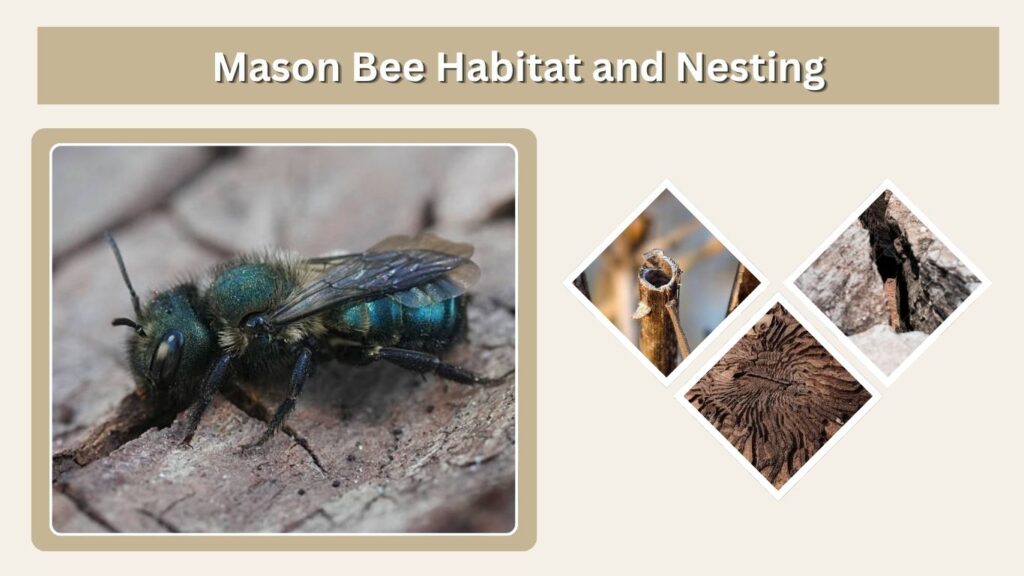
Mason bees need three basic resources: flowering plants for food, narrow cavities for nesting, and suitable mud for building nest partitions. They do not excavate large nests like many ground bees. Instead, females use existing holes in hollow stems, wood, beetle burrows, or specially designed nesting tubes.
Where Do Mason Bees Nest?
Common nesting locations include:
- Hollow plant stems
- Existing holes in wood
- Beetle tunnels
- Small cracks and cavities
- Mason bee nesting blocks
- Paper or cardboard nesting tubes
- Reed or bamboo tubes
- Purpose-built mason bee houses
Each female selects a cavity and creates a sequence of individual brood chambers inside it.
Why Do Mason Bees Need Mud?
After collecting pollen and nectar, a female places food inside a nesting chamber and lays an egg. She then constructs a mud wall to separate that chamber from the next one.
This process continues until the nesting tunnel contains several sealed chambers. Finally, the female closes the entrance with additional mud.
A nearby source of moist, workable soil can therefore be important for successful nesting.
Mason Bee Larvae and Cocoons
After an egg hatches, the larva feeds on the pollen and nectar stored by its mother.
It remains protected inside its individual chamber while growing. Eventually, the mature larva spins a cocoon and completes development inside it.
The fully developed bee normally remains protected within the nest through the colder season and emerges when suitable spring temperatures return.
Mason Bee House and Nesting Tubes
A mason bee house provides artificial nesting cavities for solitary bees. Unlike a honey bee hive, it is not a colony home managed by a queen. Instead, numerous independent females may use separate tubes in the same structure. Proper design, placement, protection from rain, and regular maintenance are important because poorly maintained bee houses can accumulate parasites and disease.
Where to Put a Mason Bee House
For effective placement:
- Mount the house securely rather than allowing it to swing
- Choose a location receiving morning sunlight
- Protect nesting tubes from heavy rain
- Position it near spring-blooming flowers
- Provide suitable mud nearby
- Keep the entrance unobstructed
- Avoid areas frequently treated with insecticides
A southeast- or east-facing location often provides helpful morning warmth, encouraging bees to become active earlier in the day.
Mason Bee Tubes and Nesting Blocks
Nesting tubes should provide tunnels of suitable diameter and depth while protecting developing bees.
Paper liners, cardboard tubes, drilled blocks, and natural reeds are commonly used. Removable or replaceable nesting materials make annual cleaning and cocoon management easier.
Permanently drilled blocks that cannot be opened or cleaned may become increasingly difficult to maintain over multiple seasons.
DIY Mason Bee House
A simple DIY mason bee house can be created using a weather-protected container filled with appropriate nesting tubes or reeds.
The most important factors are not decoration but tunnel quality, protection from rain, secure mounting, and good maintenance.
Avoid leaving old, contaminated nesting materials indefinitely. Replacing tubes or properly cleaning reusable systems can reduce the buildup of mites, parasites, mold, and other problems.
Mason Bee Life Cycle
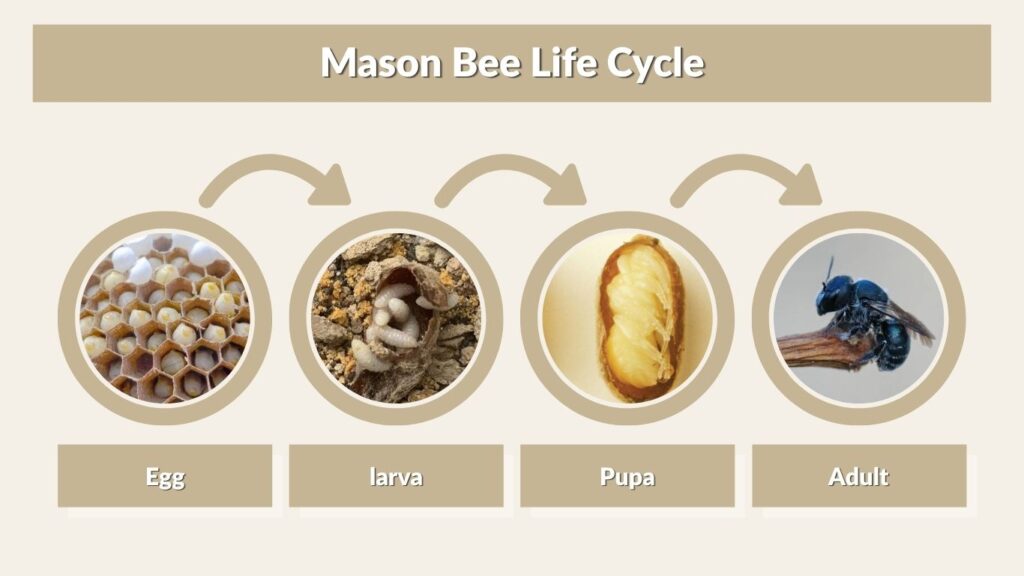
The mason bee life cycle is closely synchronized with spring flowering. Adults generally emerge when warming temperatures coincide with abundant blossoms. Males usually appear first, followed by females. After mating, females spend several weeks gathering pollen, building nests, and laying eggs before the next generation develops inside sealed chambers.
Mason Bee Life Cycle Stages
- Egg: Laid on a stored pollen and nectar provision
- Larva: Feeds inside the sealed nesting chamber
- Prepupa: Stops feeding and prepares for transformation
- Pupa: Develops adult body structures
- Adult: Forms inside the cocoon and waits for emergence
- Emergence: Leaves the nest when spring conditions become favorable
This cycle typically produces one generation per year in many temperate mason bee species.
Do Mason Bees Sting?
Female mason bees possess a stinger, but they are generally very reluctant to sting.
Because each female is responsible only for her own nest and does not defend a large honey colony, she has little reason to attack people approaching a nesting house.
Stings are uncommon and usually occur only if a female is trapped, squeezed, or handled roughly. Male mason bees cannot sting.
How Long Do Mason Bees Live?
The visible adult stage is relatively short. Adult females may remain active for only several weeks while constructing nests and provisioning brood cells.
However, the complete life cycle spans much longer because the developing bee remains inside its nest for many months.
Most of its life may therefore be spent as an immature or dormant adult protected within a cocoon.
Mason Bees vs. Other Bees
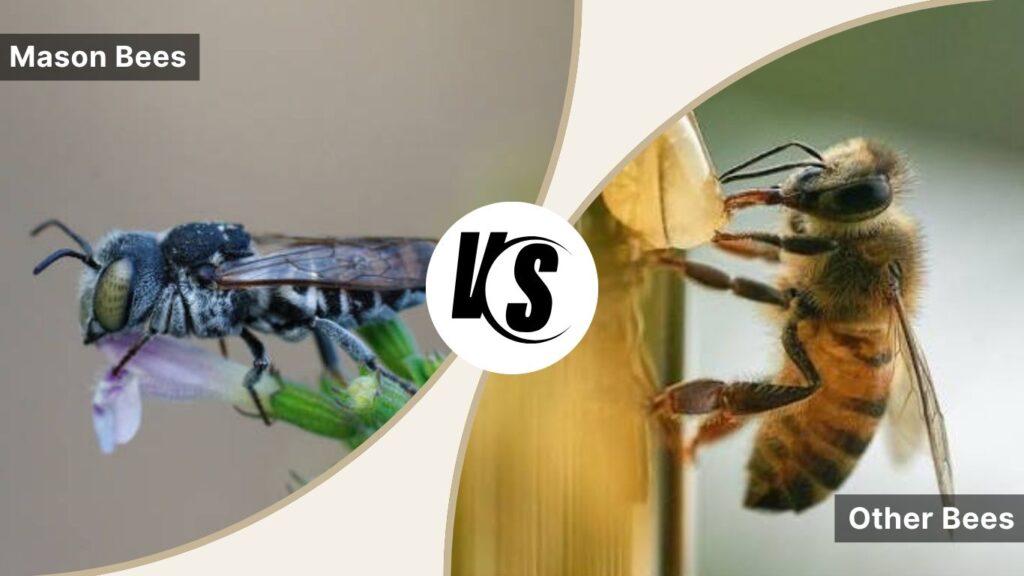
Mason bees are sometimes mistaken for honey bees or carpenter bees because all three may visit many of the same flowers. Their nesting behavior, social organization, appearance, and ecological roles differ considerably. Recognizing these differences can prevent harmless mason bees from being unnecessarily treated as pests.
Mason Bee vs. Honey Bee
Honey bees live in large colonies containing a queen, workers, and drones. They build wax combs and store substantial amounts of honey.
Mason bees are solitary. Each female builds and provisions her own nest without a worker caste. They do not maintain large honey reserves.
Mason bees are particularly valuable as spring pollinators, while honey bees operate as large social colonies through much of the growing season.
Mason Bee vs. Carpenter Bee
Carpenter bees often excavate their own tunnels in wood, especially untreated or weathered lumber.
Mason bees generally use existing cavities rather than drilling significant tunnels themselves. They seal brood cells with mud, which explains their name.
A bee repeatedly entering a pre-existing narrow hole and carrying mud may therefore be a mason bee rather than a wood-damaging carpenter bee.
Mason Bee Pollination
Mason bees are highly effective flower visitors because pollen is carried loosely on hairs beneath their bodies, where it can readily contact flower structures.
They are particularly valuable for spring-blooming fruit trees such as apples, pears, cherries, and plums.
Encouraging mason bees with nesting sites and diverse pesticide-free flowers can support pollination in home gardens and orchards.
Common Mason Bee House Problems
Installing a bee house is only the beginning. Nesting material can eventually accumulate pollen mites, parasitic wasps, mold, and other organisms if it is left unmanaged for many seasons. Location can also cause problems when a house remains shaded, becomes soaked by rain, or is too far from mud and flowers.
How to Keep a Mason Bee House Healthy
Check nesting materials annually and follow a responsible maintenance routine suitable for the type of tubes or blocks being used.
Provide fresh nesting cavities, keep the structure dry, and avoid placing it where sprinklers or heavy rain constantly soak the tubes.
Maintaining flowering plants and a nearby mud source also makes the nesting location more useful to returning females.
FAQs
Mason bees are among the easiest solitary bees to encourage in gardens because they readily use artificial nesting tubes when flowers, mud, and appropriate shelter are available. Their calm behavior and valuable pollination make them especially useful around fruit trees and spring gardens.
Are mason bees aggressive?
No. Mason bees are generally gentle and do not aggressively defend their nesting sites. Females can sting but rarely do so unless physically handled or trapped.
Do mason bees make honey?
Mason bees collect nectar and pollen for their offspring but do not produce large stores of honey like honey bees. Their nests contain individual food provisions for developing larvae rather than harvestable honeycomb.
What is the best place for a mason bee house?
A protected location receiving morning sun and facing roughly east or southeast can work well. The house should be securely mounted near flowers and a source of workable mud.
When do mason bees emerge?
Many species emerge during spring when temperatures become suitable and early flowers begin blooming. Males usually emerge before females.
Are mason bees good for gardens?
Yes. Mason bees are excellent pollinators of many spring flowers and fruit trees. Providing nesting cavities and diverse flowering plants can help support both garden pollination and native bee populations.